
Selecting the right seating configuration for a large family is a balancing act between spatial limits, daily comfort, and long-term durability. The ideal setup depends heavily on your room’s physical geometry, how your family interacts daily, and how much flexibility you require over time. While a standard three-seater offers a classic, formal look that fits narrow spaces, an L-shaped configuration excels at corner lounging and maximizing corner space. Meanwhile, modular leather sofas provide unmatched adaptability for changing layouts and growing households.
Assessing Your Living Room and Family Dynamics
Before browsing online marketplaces or visiting local showrooms, establish a clear baseline of your physical space and household habits. Start by measuring the exact footprint of your living room, noting the location of fixed architectural elements such as low-hanging windows, electrical outlets, light switches, and air conditioning units. In tropical climates like the Philippines, maintaining proper air circulation is essential; plan to leave a gap of at least 10 to 15 centimeters between the back of the sofa and the wall to prevent moisture buildup and mold growth on the leather.
Next, analyze how your family actually uses the living area. If your household gathers primarily to watch television or play video games, a configuration that faces a central screen is paramount. If you frequently host extended family gatherings or require separate zones for reading and socializing, you will need a layout that facilitates face-to-face conversation. Do not forget to measure your home’s entry points. Large leather sofas are notoriously difficult to maneuver through tight condominium corridors, narrow stairwells, and standard doorframes, so knowing your maximum clearance dimensions is a non-negotiable first step.
Products mentioned in this guide
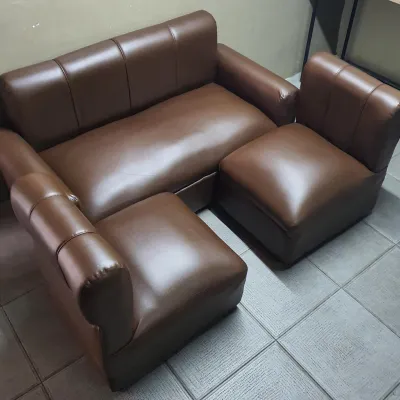
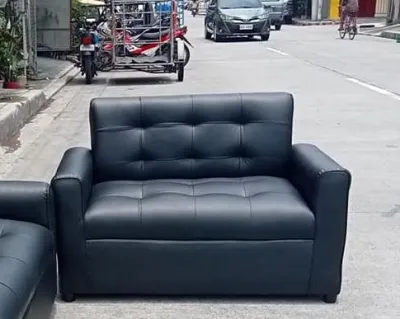
Prices are valid at publication and may change. Please refer to the product page for the latest price.
Standard 3-Seater Leather Sofas
The standard three-seater leather sofa is a timeless choice that offers exceptional space efficiency, particularly in narrow, rectangular, or open-plan living rooms. Because of its straight, linear footprint, it can easily sit flush against a wall or act as a clean divider between the living and dining areas without obstructing walkways. This configuration is highly beneficial for formal living spaces where maintaining a tidy, structured appearance is a priority.

However, for a large family, a single three-seater sofa presents clear limitations. It typically accommodates only three adults comfortably, leaving other family members to seek alternative seating. Furthermore, the linear arrangement forces occupants to sit side-by-side, which restricts natural eye contact and makes group conversations awkward. To make a three-seater work for a larger household, you will generally need to pair it with matching armchairs, accent chairs, or even a second three-seater, which requires careful spatial planning to avoid a cluttered look.
L-Shaped Leather Sofas
L-shaped leather sofas, often referred to as sectionals, are highly popular among large families due to their cozy, communal feel. By utilizing corner spaces that might otherwise go unused, an L-shaped sofa maximizes the seating area without encroaching too far into the center of the room. The extended chaise portion is particularly coveted, offering a dedicated space for multiple family members to stretch out their legs during movie nights or lazy weekend afternoons.
This configuration naturally establishes a clear focal point in the room, making it ideal for spaces centered around a television or entertainment console. However, L-shaped sofas do have structural limitations. Their fixed orientation—either left-facing or right-facing—means they cannot be easily rearranged if you decide to redecorate or move to a new home. Additionally, in smaller or highly rectangular rooms, the protruding chaise can easily block traffic flow, creating a physical barrier that makes the space feel cramped and difficult to navigate.
Modular Leather Sofas
For families seeking ultimate versatility, modular leather sofas represent the pinnacle of adaptable design. Composed of individual, freestanding sections—such as corner units, armless chairs, and ottomans—modular systems allow you to configure and reconfigure your seating to match any occasion. You can easily push the pieces together to form a massive U-shaped pit for family movie nights, or separate them into individual seating clusters when hosting guests who prefer more personal space.
This scalability makes modular sofas exceptionally well-suited for unusually large, open-concept, or irregularly shaped living rooms. If your family grows or you move to a larger home, you can simply purchase additional modules to expand your setup. The primary trade-offs with modular configurations involve structural stability and overall footprint. Because the pieces are separate, they can shift or slide apart over time, especially on polished tile or hardwood floors common in tropical homes. They also tend to have a larger physical footprint and a chunkier aesthetic, which can overwhelm moderately sized rooms.
Configuration Comparison Matrix
| Configuration | Space Efficiency | Seating Capacity | Flexibility | Ideal Room Shape | Best For |
|---|---|---|---|---|---|
| Standard 3-Seater | High | Low to Medium | Low | Narrow or Rectangular | Formal spaces and multi-sofa layouts |
| L-Shaped | Medium | Medium to High | Low | Square or Corner spaces | Casual family lounging and TV viewing |
| Modular | Low to Medium | High | High | Large or Irregular | Dynamic households and frequent hosting |
Decision Framework: Which Configuration Should You Choose?
To determine the best configuration for your household, apply a systematic decision framework based on your room’s layout and your family’s lifestyle.
Choose a standard three-seater leather sofa if your living room is narrow, formal, or serves multiple purposes where space is at a premium. This option is also ideal if you prefer a modular look achieved by mixing different furniture styles, such as pairing a classic leather sofa with lightweight rattan or fabric accent chairs to suit a tropical aesthetic.
Opt for an L-shaped leather sofa if your primary goal is to create a dedicated, comfortable family hub for casual lounging and television viewing. This configuration works best in square rooms or open-plan spaces where the sofa can define the living zone without blocking major pathways. Ensure you select the correct chaise orientation (left or right) by mapping out your room’s traffic patterns beforehand.
Select a modular leather sofa if your family values adaptability, hosts frequent social gatherings, or anticipates moving to different homes in the future. The ability to split, rearrange, and expand the sofa ensures your investment remains useful for years to come. However, before finalizing this choice, verify that your room can accommodate the wider footprint and deeper seat profiles typical of modular designs.
Regardless of the configuration you choose, always verify the delivery path first. Measure the height and width of all doorways, elevator cabins, and stairwell turns to ensure the delivery team can safely transport the sofa into your living room without damaging the leather or your home’s walls.
Essential Pre-Purchase Checks for Large Leather Sofas
Purchasing a large leather sofa is a significant investment, making thorough pre-purchase checks essential. First, consult the manufacturer’s product manual to verify the internal frame construction. Look for frames made from kiln-dried hardwood with reinforced joints, as these materials resist warping in high-humidity environments and provide the necessary weight capacity for a large family. Avoid lightweight frames that may sag or creak under heavy, daily use.
Second, pay close attention to the leather specifications and care instructions. In warm, tropical climates, genuine top-grain leather is highly recommended because of its natural breathability, which prevents the sticky, uncomfortable feeling associated with synthetic alternatives. However, leather requires consistent maintenance to prevent drying and cracking. Review the manufacturer’s guidelines regarding cleaning agents; avoid harsh chemicals and instead use recommended leather conditioners to keep the material supple.
Finally, double-check the assembly and installation requirements. Some large configurations, particularly modular and L-shaped sofas, require specialized brackets or interlocking hardware to keep the sections securely aligned. Ensure these connectors are included in your purchase and check if the delivery service includes professional assembly, as improper installation can lead to premature wear and structural instability.
Frequently Asked Questions (FAQ)
Can I combine a 3-seater with an L-shaped sofa in the same room?
Yes, you can combine a three-seater with an L-shaped sofa, provided your living room has sufficient square footage. When mixing these large configurations, maintain visual balance by choosing pieces with similar seat heights and arm profiles. To ensure comfortable movement throughout the room, leave a minimum of 75 to 90 centimeters of walkway clearance between the two pieces and any surrounding walls or coffee tables.
Do modular leather sofas shift or separate over time?
Modular leather sofas can shift or separate over time, particularly when placed on smooth flooring surfaces like polished tile, marble, or hardwood. To prevent this, check the product specifications for heavy-duty interlocking connectors, such as alligator clips or slide-in metal brackets, which lock the modules together. Additionally, placing a large area rug underneath the sofa or using non-slip rubber pads on the feet of each module can significantly reduce unwanted movement.
Community discussion
Share your experience or ask a question. Comments are reviewed before publication.