
Finding the right loft bed for a small room as an adult requires balancing space-saving efficiency with structural safety. Unlike children’s furniture, an adult-sized setup must accommodate significantly more weight, offer comfortable headroom for sitting up, and fit within tight floor plans. A standard adult loft bed needs a weight capacity of at least 250 to 300 pounds for a single sleeper, though a limit of 400 pounds or more is highly recommended to safely support the mattress, bedding, and active movement.
To ensure the structure is both functional and safe, you must carefully calculate your room’s physical limits. In compact urban spaces, such as typical studio apartments or condominiums, every inch of vertical and horizontal space counts. Choosing the wrong frame dimensions can leave you with a bed that blocks your windows, limits your ability to sit up, or fails to fit through your doorway during delivery. By measuring your space systematically, you can maximize your floor area without compromising on comfort.
How to Calculate the Safe Weight Capacity for Adult Loft Beds
Determining the necessary weight capacity for an adult loft bed requires looking beyond the sleeper’s body weight. You must use a comprehensive weight calculation framework that accounts for every element resting on the elevated platform. Start with your own weight, then add the weight of your mattress, pillows, heavy blankets, and any personal items you keep in bed, such as a laptop or books.
Products mentioned in this guide
![[Manila 24-hour Boat]Black Loft Bed Elevated Bed 180*200*90/120/150CM Modern Simple and Thickened Iron Art Elevated Bed Apartment Bed Loft Bed For Small Room Student Dormitory Bed Single Size Iron Art Bed Adjustable Staircase Alternating Left And Right](https://img.lazcdn.com/g/p/61a97ae76a0c00cd13c04edac78cc9a4.jpg_400x400q80.jpg_.webp)
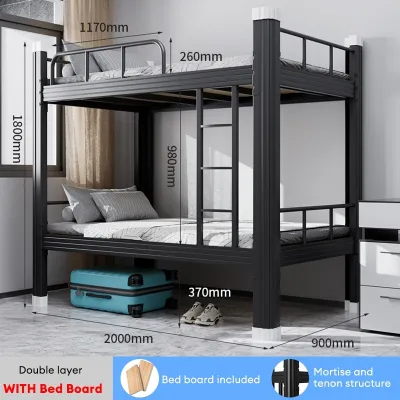
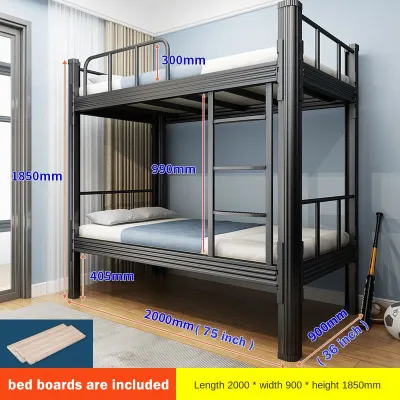

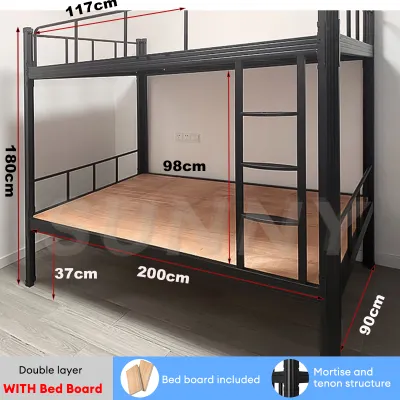

Prices are valid at publication and may change. Please refer to the product page for the latest price.
Mattress weight is a frequently overlooked factor that can heavily impact your calculations. While a simple foam mattress might only weigh 20 to 30 pounds, a high-density memory foam, latex, or hybrid mattress can easily weigh 70 to 100 pounds. Combining a heavy mattress with standard bedding can quickly consume a significant portion of a lower-end frame’s weight limit before you even climb into bed.
To ensure long-term structural integrity, you must understand the difference between static and dynamic loads. A manufacturer’s specified static load refers to the weight the bed can support when the load is completely stationary. The dynamic load accounts for the force exerted by movement, such as climbing the ladder, tossing and turning, or sitting down heavily on the edge of the mattress. Always look for frames that explicitly state their dynamic weight limit or overall weight capacity on the product label, manual, or official specifications.
Never assume that all metal or wood frames are engineered equally. Many mass-market loft beds are strictly rated and engineered for children or teenagers, with weight limits capped at 150 to 200 pounds. An adult sleeping on a frame designed for children risks joint fatigue, bending, or catastrophic structural failure over time. Always verify that the manufacturer explicitly certifies the frame for adult use.
Matching Bed Frame Dimensions to Your Small Room Footprint
When planning your layout, remember that a loft bed’s external frame dimensions are always larger than the standard mattress size it holds. A standard mattress—whether it is a Single (36 by 75 inches), a Double (54 by 75 inches), or a Queen (60 by 75 inches)—only represents the sleeping surface. The actual bed frame will typically extend 2 to 5 inches wider and longer due to the thickness of the support posts, side rails, and assembly hardware.

Beyond the frame itself, you must detail the floor footprint required for your chosen access point. Straight ladders hug the side of the frame vertically, consuming virtually no extra floor space, but they require vertical climbing agility. Angled ladders are easier to climb but extend outward by 12 to 20 inches, creating a diagonal footprint that cannot be blocked by other furniture. Built-in staircases offer the easiest access and often include integrated storage drawers, but they can add up to 30 inches to the overall length of the bed, which can easily overwhelm a small room.
To avoid layout conflicts, measure your room’s usable floor area rather than relying on general room dimensions. Account for the thickness of baseboards, which can prevent a frame from flushing perfectly against the wall. Map out the exact swing paths of your bedroom door, closet doors, and any cabinet drawers to ensure the bed frame or ladder does not obstruct daily movement. If you have existing furniture that cannot be moved, such as a wardrobe, ensure there is at least a 24-inch pathway around the bed frame for comfortable walking clearance.
Navigating Ceiling Height and Headroom Requirements
Vertical space planning is the most critical step in establishing a comfortable loft bed setup. Standard residential condominiums and apartments often feature lower ceilings, sometimes ranging between 7.8 to 8.8 feet (2.4 to 2.7 meters). In these spaces, a standard-tall loft bed can leave you feeling cramped or unable to use the space below effectively.
To calculate your upper headroom, measure the distance from the top of your mattress to the ceiling. To sit up comfortably in bed to read or work without hitting your head, you need a minimum of 30 to 36 inches of clearance. If your ceiling is 8 feet (96 inches) high and you use a 55-inch-tall loft frame with an 8-inch mattress, you will have roughly 33 inches of upper headroom, which is generally sufficient for most adults.
Lower headroom determines the usability of the space underneath the sleeping platform. If you plan to set up a home office desk, you need a lower clearance of at least 50 to 60 inches from the floor to the bottom of the upper bed rail to prevent hitting your head when sitting down or standing up. If you only plan to use the lower area for low-profile storage bins or a TV console, a lower clearance of 40 to 45 inches may suffice.
Always inspect your ceiling for permanent fixtures before finalizing your bed placement. Take note of ceiling fans, light fixtures, smoke detectors, exposed structural beams, and wall-mounted split-type air conditioning units. Placing a loft bed too close to a ceiling fan poses a severe safety hazard, while positioning it directly in front of an air conditioner can block essential airflow and expose you to uncomfortable drafts or condensation moisture.
Critical Sizing and Placement Mistakes to Avoid
One of the most common placement errors is ignoring window locations, wall-mounted AC units, and window treatments. Placing a loft bed directly in front of a window can block natural light, make it difficult to open or clean the glass, and interfere with curtains or blinds. More importantly, it can restrict access to emergency exit routes, which is a vital safety consideration in any residential building.
Another frequent mistake is forgetting to measure the entire delivery pathway leading to your bedroom. A heavy-duty adult loft bed often ships in large, flat-packed boxes that can be incredibly heavy and awkward to maneuver. Measure the height and width of your apartment building’s elevator cabin, narrow stairwells, hallway corners, and your front door to guarantee the packages can physically reach your unit.
Additionally, you must account for the actual physical space required to assemble the frame. Loft beds are typically constructed by laying the side panels flat on the floor and bolting them together before raising the entire structure upright. If your bedroom is barely larger than the bed itself, you will not have enough floor space to assemble the pieces or safely stand the completed frame up without hitting the walls or ceiling. Ensure you have at least a few feet of open working space adjacent to the assembly site.
Finally, never assume that a bed labeled for a “small room” will automatically fit standard doorways or elevator cabins during delivery or relocation. Always check the package dimensions provided by the manufacturer against your actual entryways. If you live in a high-rise building with strict service elevator rules, verifying these dimensions beforehand can save you from costly return shipping fees.
Verifying Structural Stability and Safety Features
When purchasing an adult loft bed, prioritizing structural stability is essential for both your safety and peace of mind. Start by verifying the guardrail height. Safety guidelines dictate that guardrails must extend at least 5 inches above the top surface of your mattress. If you plan to use a plush 10-inch mattress, your frame must have exceptionally tall guardrails of at least 15 inches to prevent you from rolling over the edge.
Examine the frame’s structural design indicators in the product specifications to ensure it can handle daily adult use. For metal frames, look for thick-gauge steel tubing rather than thin, lightweight aluminum. For wooden frames, prioritize solid hardwoods or high-density engineered wood rather than light particle board. A high-quality adult frame should feature robust cross-bracing (such as X-braces on the back and sides) and heavy-duty, multi-bolt joint connections to eliminate swaying and squeaking.
Once your loft bed is delivered, follow the manufacturer’s assembly instructions precisely, without skipping any support slats or wall-anchoring brackets. Because the high humidity in tropical climates can cause wood to expand or contract, and because dynamic adult movement exerts continuous stress on joints, make it a habit to inspect the frame regularly. Check and tighten all bolts, screws, and brackets every three to six months to maintain absolute structural stability.
Frequently Asked Questions (FAQ)
Can I use a standard queen mattress on a loft bed in a small room?
While queen-sized loft beds exist, they are generally impractical for small rooms because they require a massive physical and visual footprint of 60 by 75 inches. A queen frame demands a significantly higher weight capacity and a much more robust structural design, which often translates to thicker, bulkier posts. For small bedrooms or studio apartments, a Single or Double loft bed is highly recommended to preserve valuable floor space and maintain a balanced room layout.
How much clearance do I need above and below the loft bed?
As a general ergonomic guideline, you need at least 30 to 36 inches of clearance between the top of your mattress and the ceiling so you can sit up comfortably without bending over. Below the bed, you need a minimum of 50 to 60 inches of vertical clearance if you plan to place a desk or seating area underneath. Because these requirements depend entirely on your personal height, mattress thickness, and ceiling height, you must measure your specific space rather than relying on generic averages.
Community discussion
Share your experience or ask a question. Comments are reviewed before publication.