
Quick Guide: Drafting Tables for Small Home Offices
Finding the right drafting table for a compact home office requires balancing two competing priorities: securing an expansive, stable surface for detailed design work and preserving precious floor space. Traditional drafting tables are notoriously bulky, often designed for spacious commercial studios. However, working from a compact urban apartment or a shared spare room demands a more strategic approach. The primary challenge is to maximize your active workspace without turning your room into an overcrowded, non-functional storage area.
Modern furniture design addresses this challenge through highly specialized, space-saving configurations. Foldable frames, wall-mounted drop-leaf units, and compact mobile tables on casters offer practical alternatives to massive, stationary oak or steel desks. These designs allow you to reclaim your floor area when you are not actively drawing, sketching, or drafting.
Before browsing online marketplaces or visiting local showrooms, you must treat spatial planning as a non-negotiable first step. Success depends entirely on precise measurements. You must evaluate your available floor area, vertical clearance, and the narrow pathways leading into your home. A beautiful table is useless if it cannot clear your doorway or if it prevents you from opening your office door.
Products mentioned in this guide
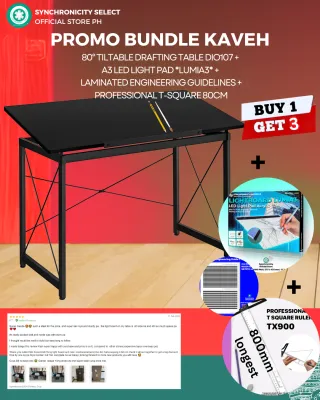
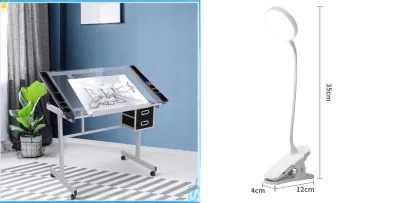
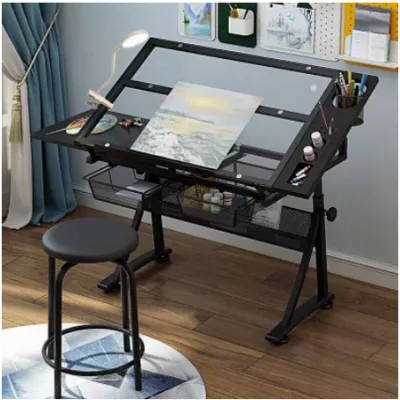
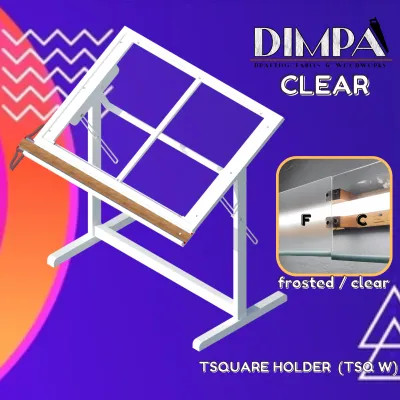
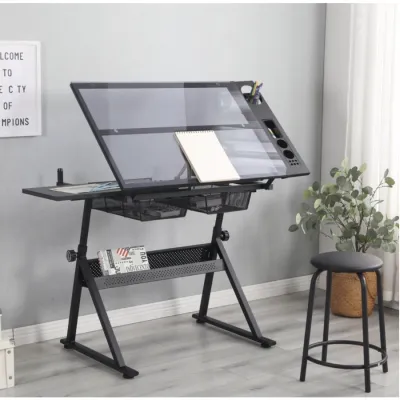
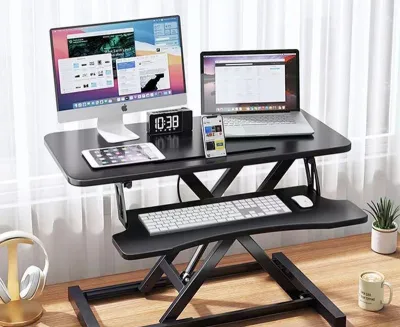
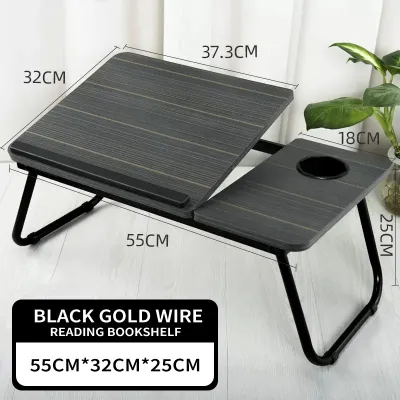
Prices are valid at publication and may change. Please refer to the product page for the latest price.
How to Measure Your Home Office for a Drafting Table
To avoid costly return shipping fees and spatial frustration, follow a systematic measurement framework before committing to any drafting table purchase. Because these tables feature tilting tops and wide structural bases, their physical impact on a room changes dramatically depending on how they are configured.

Floor and Pathway Measurement
Begin by measuring the exact length and width of the floor area where the table will sit. Do not rely on visual estimation. Use a steel tape measure to map out the footprint, and mark it on your floor using painter’s tape to visualize the physical presence of the furniture.
Equally important is the transit route. In high-density residential areas, such as condominiums in Metro Manila, elevator doors, narrow hallways, and tight stairwell turns present major obstacles. Measure the width and height of every doorway, hallway turn, and elevator entrance the packaged or semi-assembled table must pass through. If the table’s shortest box dimension exceeds your narrowest corridor clearance, you will face an incredibly difficult delivery process.
Clearance for Movement
A drafting table requires significantly more clearance than a standard writing desk. You must account for the footprint of your seating—which is often a taller drafting stool with a wider base—and the physical space needed to push the stool back, stand up, and sit down comfortably.
As a general rule, maintain a minimum clearance of 76 to 91 centimeters (30 to 36 inches) of open space behind the desk for your chair. If your workspace is in a high-traffic area or double-duty room, check the manufacturer’s specifications for the table’s fully assembled depth and compare it against your chair’s turning radius to ensure your daily movements remain unobstructed.
Vertical and Tilt Clearance
Drafting tables are dynamic; their height and angle adjust constantly. When you tilt a drafting board from a flat position to a steep angle, the back edge rises significantly, and the front lip drops.
Before purchasing, measure the vertical clearance from your floor to the ceiling, paying close attention to potential overhead obstructions. Low-hanging light fixtures, ceiling fans, wall-mounted split-type air conditioners, and floating wall shelves can easily block a tilted drafting board. Ensure that when the board is adjusted to its maximum tilt angle, it clears these fixtures with at least 15 centimeters of safety margin to prevent accidental damage to both your equipment and your home.
Utility Access
Drafting and detailed illustration require high-quality, focused illumination. You must plan your table’s placement relative to your room’s electrical outlets. Task lamps, electric pencil sharpeners, and digital drawing tablets all require reliable power.
In a small room, placing a table far from an outlet results in extension cords running across the floor, creating a severe tripping hazard and cluttering the visual space. Position your table within 1.2 meters of an outlet, or use secure, low-profile cord covers along the baseboards to maintain a clean, safe, and professional workspace.
Space-Saving Drafting Table Types for Small Offices
Selecting the right style of drafting table depends heavily on how you use your space throughout the day. If your home office must transition into a guest bedroom, living room, or dining area after work hours, specific space-saving designs can help you maintain that flexibility.
Foldable and Collapsible Drafting Tables
Foldable drafting tables are the ultimate solution for multi-purpose rooms where a permanent creative setup is not feasible. These tables feature scissor-style frames or collapsible X-legs that allow the entire unit to fold down to a depth of just 10 to 15 centimeters. When your workday ends, you can easily slide the collapsed table under a bed, behind a wardrobe, or inside a utility closet.
When shopping for a foldable model, prioritize structural integrity over low cost. Check the construction of the folding hinges and the locking pins. Because foldable furniture has multiple moving parts, cheap plastic joints or thin metal frames will degrade quickly under the weight of heavy reference books or the downward pressure applied while drawing. Look for steel frames with heavy-duty locking mechanisms that click securely into place, ensuring the tabletop remains perfectly rigid and level during use.
Wall-Mounted Drafting Tables
If you have absolutely zero floor space to spare but possess an empty, sturdy wall, a wall-mounted drop-leaf drafting table is an exceptional alternative. These units bolt directly to the wall and feature a hinged top that folds flat against the wall when not in use. This completely frees up your floor space, making the room feel significantly larger and allowing for effortless floor cleaning.
However, wall-mounted installations demand strict adherence to safety protocols. You must verify your wall construction before purchasing mounting hardware. In the Philippines, residential walls are commonly constructed from concrete hollow blocks (CHB) or drywall.
- Concrete/Masonry Walls: Require heavy-duty expansion sleeves or masonry anchors.
- Drywall/Stud Walls: Must be anchored directly into the wooden or metal studs using robust wood screws.
Never mount a drafting table solely to drywall using plastic anchors; the downward pressure you apply while leaning on the table to draw can easily tear the unit from the wall, causing severe damage and potential injury. Always check that the brackets and wall anchors are rated to support both the weight of the table and your active working load.
Compact Mobile Drafting Tables
Compact mobile drafting tables offer unparalleled flexibility for dynamic home offices. Built on heavy-duty casters, these tables can be rolled effortlessly from a dark corner to a position directly in front of a window to take advantage of natural morning light. They typically feature a smaller footprint, with bases designed to slide under other furniture when parked.
To ensure a mobile table is safe and practical, inspect the base design and caster quality. The base must be wide and heavy enough to act as a counterweight; a top-heavy mobile table can easily tip over when the drafting board is fully tilted or loaded with heavy equipment. Additionally, verify that all casters are made of non-marring materials (such as polyurethane) to protect your floor tiles or wood laminates, and ensure that at least two of the wheels feature robust, independent locking brakes to keep the table stationary while you work.
Maximizing Working Surface Without Crowding the Room
You do not need a massive, room-swallowing table to work on detailed creative projects. By choosing smart design features and understanding your actual spatial requirements, you can maximize your usable working area while keeping the physical footprint of the desk remarkably small.
Right-Sizing the Board
Many creators automatically assume they need the largest drafting board available. However, buying a table designed for giant architectural blueprints is counterproductive if you primarily work on smaller formats.
Analyze the maximum paper, canvas, or digital tablet size you actually use on a daily basis. If you primarily work on A3 (297 x 420 mm) or A2 (420 x 594 mm) sheets, a compact board measuring roughly 60 x 90 centimeters is more than adequate. Choosing a board tailored to your actual media size, rather than defaulting to an oversized professional standard, can save you up to 30% of your room’s floor space without compromising your creative process.
Integrated Storage Solutions
In a small office, keeping your active workspace clear of clutter is essential. When tools, pens, rulers, and reference books pile up on your drafting board, your usable workspace shrinks rapidly. Look for compact drafting tables that incorporate clever, built-in storage features.
- Under-Board Pencil Ledges: A secure, adjustable ledge at the bottom of the tilting board keeps your active pencils and brushes from sliding off when the table is angled.
- Slide-Out Side Trays: Many modern compact tables feature pull-out side shelves or plastic supply cups that extend your workspace horizontally only when you need them, sliding back under the main top when your work is finished.
- Under-Desk Wire Shelves: A low-profile wire basket or shelf suspended between the table legs utilizes otherwise wasted space to store paper rolls, portfolios, and reference manuals, keeping them off your floor and off your main work surface.
Adjustable Height and Tilt
A highly adjustable drafting table can easily serve as a multi-functional workstation, eliminating the need for separate writing and drawing desks. By selecting a model with a wide range of height and tilt adjustments, you can transition the table seamlessly throughout the day.
Set the tabletop completely flat and lower the height to use it as a standard writing desk for your laptop, administrative tasks, or video calls. When it is time to draw, raise the height and tilt the board to your preferred angle. This dual-purpose utility allows a single piece of furniture to handle all your daily WFH tasks, saving you the expense and spatial clutter of buying multiple desks.
Common Sizing and Placement Mistakes to Avoid
Setting up a drafting table in a tight space requires careful attention to detail. Avoid these common pitfalls to ensure your creative workspace remains comfortable, ergonomic, and safe.
Ignoring Chair Compatibility
One of the most frequent errors is assuming a standard office desk chair will work perfectly with a drafting table. Drafting tables are inherently taller than standard writing desks to accommodate the tilting mechanics and allow for comfortable standing-height work.
Using a standard chair with a high drafting table forces you to reach upward, causing severe shoulder and neck strain. Conversely, if you raise the table to its maximum height, a standard chair will leave your legs dangling uncomfortably. Plan to pair your table with a specialized drafting stool or an adjustable ergonomic chair equipped with a built-in foot ring. Always check the height ranges of both the table and the chair before purchasing to ensure they align perfectly for proper ergonomics.
Overlooking the Base Footprint
It is easy to fall into the trap of looking only at the dimensions of the tabletop. However, the stability of a tilting table relies heavily on its base. Some compact tables feature a modest 60 x 90-centimeter board but utilize a wide, sprawling H-frame or tripod base that extends far beyond the edges of the top to prevent tipping.
Always check the manufacturer’s detailed technical drawings for the floor-level footprint dimensions. A base that juts out into your room’s walkways creates a constant tripping hazard, especially in tight home offices. Look for designs where the base footprint is flush with or slightly recessed from the tabletop edges, ensuring maximum stability without encroaching on your walking paths.
Blocking Natural Light or Airflow
In a small room, furniture placement options are limited. However, shoving your drafting table into the only available corner without considering environmental factors can make your workspace highly uncomfortable.
Avoid placing your table directly in front of a window where intense afternoon tropical sunlight can cause blinding glare on your white drawing paper or digital screen. Similarly, do not position the table directly beneath or in front of your air conditioning unit or wall fan. Direct, high-velocity airflow can blow lightweight tracing paper away and cause uneven cooling that makes long drawing sessions uncomfortable. Position your table perpendicular to your main light source to enjoy soft, diffused natural light without the heat and glare.
Additionally, pay close attention to material care in humid tropical climates. Many budget-friendly drafting tables use medium-density fiberboard (MDF) or particleboard cores. High humidity can cause untreated or poorly sealed manufactured wood to swell, warp, or peel at the edges over time. When selecting a table, check that the tabletop features a high-quality, moisture-resistant laminate finish and robust PVC or ABS edge banding to protect the inner core from moisture absorption.
Frequently Asked Questions (FAQ)
Can I use a regular desk as a drafting table in a small space?
Yes, you can easily convert a standard flat desk into a temporary drafting station by placing a portable, adjustable drafting board or a tabletop drafting easel on top of it. This is an excellent space-saving option if you cannot accommodate a dedicated drafting table. To ensure safety and stability, place a high-grip, non-slip silicone mat beneath the portable board to prevent it from sliding, and verify that your existing desk is deep enough to support the board securely without any overhang.
What is the standard height for a drafting table?
Traditional, fixed-height drafting tables typically stand between 90 and 105 centimeters (35 to 41 inches) tall, which is significantly higher than a standard 75-centimeter writing desk. This height is designed to allow creators to work comfortably while standing or while sitting on high drafting stools. For a small home office, look for a height-adjustable model that can transition from 72 centimeters up to 100 centimeters, allowing you to use it for both standard computer work and specialized drafting.
Are glass-top drafting tables practical for small apartments?
Glass-top drafting tables are highly practical for small spaces because their transparent surfaces allow light to pass through, making a cramped room feel visually open and airy. They are also incredibly easy to clean if you work with wet media like inks, watercolors, or markers. However, keep in mind that glass surfaces show fingerprints, dust, and smudges very easily, requiring frequent wiping. If your apartment is extremely tight, a glass edge is also less forgiving than wood or rounded MDF if you accidentally bump into it while moving around the room.
Community discussion
Share your experience or ask a question. Comments are reviewed before publication.