
Selecting a large black leather sofa for a Filipino household requires balancing generous seating capacity with the realities of tropical living. A black leather sofa is a classic centerpiece that resists visible staining, making it highly attractive for busy households. However, finding the right 3-5 seater, L-shaped sectional, or modular configuration involves evaluating how the piece fits your living room, how the material responds to high humidity, and whether the internal frame can withstand daily family use. By focusing on verifiable specifications, precise spatial measurements, and proper material care, you can secure a durable investment that serves as the social hub of your home for years to come.
Assessing Space and Choosing the Right Configuration
Before committing to a specific sofa style, you must accurately measure your living room to ensure the furniture fits comfortably without obstructing daily traffic. Begin by mapping out the exact footprint of the proposed sofa using masking tape on your floor. This physical outline helps you visualize how much space remains for walking paths, which should ideally be at least 75 to 90 centimeters wide to allow comfortable movement. Additionally, you must measure every doorway, hallway, stairwell, and elevator cabin through which the sofa must pass during delivery. Many homeowners in high-rise condominiums or traditional multi-story houses face the frustration of purchasing a beautiful sofa only to find it cannot clear tight corner turns or low ceiling beams during transit.
When deciding between configurations, consider how your family uses the living space. A fixed 3-5 seater sofa offers a clean, traditional look and works well in long, narrow rooms where furniture must sit flat against a wall. However, these linear setups can limit face-to-face interaction during family gatherings. In contrast, an L-shaped sectional maximizes corner space, providing a natural lounging area that encourages conversation. The trade-off is that L-shaped sofas have a fixed orientation—either left-facing or right-facing—which limits your ability to rearrange the room layout in the future. You must verify the orientation carefully before ordering to avoid blocking balcony doors or natural light sources.
Products mentioned in this guide
![[AVAILABLE ONHAND] Classic Black Leather Folding Sofa Bed Foldable up to 180 Degree](https://img.lazcdn.com/g/p/56577d29f132e6501a5ea4451c45d397.jpg_400x400q80.jpg_.webp)
Prices are valid at publication and may change. Please refer to the product page for the latest price.
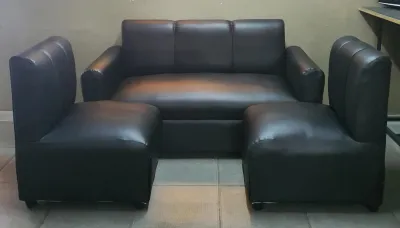
For maximum adaptability, modular configurations offer individual seating units that can be rearranged to suit different occasions. These systems allow you to expand your seating over time by adding middle chairs, corner pieces, or ottomans as your family grows. When evaluating modular options, pay close attention to how the individual sections connect. High-quality modular sofas use heavy-duty metal interlocking brackets or alligator clips underneath the frame to prevent the pieces from sliding apart when someone sits down. If a modular sofa lacks secure connectors, the individual sections will constantly shift on tiled or polished wooden floors, creating uncomfortable gaps.
Understanding Leather Grades and Family Durability
The term “leather” covers a wide range of materials with vastly different performance characteristics, especially under the demands of a large family. To make an informed purchase, you must look past marketing buzzwords and inspect the manufacturer’s technical specifications. Full-grain leather is the most durable option because it retains the entire natural grain of the hide, allowing it to develop a unique patina over time. Top-grain leather is slightly more pliable and consistent in texture, as the outermost layer is lightly sanded to remove imperfections. Both full-grain and top-grain options offer excellent breathability and longevity, but they require a higher initial investment and consistent maintenance to prevent drying out.

If your budget or lifestyle leads you toward alternative materials, you will often encounter genuine leather, bonded leather, or polyurethane (PU) synthetic options. In the furniture industry, “genuine leather” typically refers to lower-grade split leather that has been embossed and finished to look like top-grain; while it is real leather, it lacks the structural strength of higher grades. Bonded leather consists of shredded leather scraps glued onto a fiber backing, which is highly prone to peeling and cracking within a few years of heavy use. PU leather is entirely synthetic; while it resists initial spills and is easy to wipe clean, it does not breathe well in warm climates and can degrade rapidly if exposed to high humidity and friction.
Regardless of the leather grade, you must verify the surface treatments and protective coatings applied during manufacturing. Many family-friendly black leather sofas feature a pigmented protective topcoat that shields the material from liquid penetration and minor scratches. While this coating makes daily cleanup easier, no leather is entirely scratch-proof. Sharp pet claws, toy edges, and metal rivets on clothing can still puncture the surface. To maintain the deep black finish and prevent the material from cracking in the humid Philippine climate, you must establish a regular conditioning schedule. Check the manufacturer’s guidelines to identify approved water-based cleaners and pH-balanced leather conditioners, avoiding any products containing harsh solvents or silicones.
Verifying Frame Strength and Cushion Support
A large sofa designed for three to five active users requires a robust internal structure to prevent sagging and frame failure. When browsing options, ask the retailer for detailed specifications regarding the frame construction. Prioritize sofas built with kiln-dried hardwood, such as mahogany or acacia, or those featuring reinforced steel frames. Kiln-drying removes moisture from the wood, preventing it from warping, shrinking, or cracking when exposed to seasonal humidity shifts. Avoid sofas constructed primarily from unreinforced engineered woods like particleboard or thin plywood, as these materials can bend or break under the concentrated weight of multiple family members.
The longevity of the sofa also depends heavily on how the frame joints are secured. High-quality frames are joined using double-dowels, corner blocks glued and screwed into place, or heavy-duty metal brackets. If a sofa frame is held together solely by staples, nails, or cheap glue, the joints will gradually loosen under daily stress, leading to squeaking and structural instability. When testing a sofa in a showroom, gently lift one front corner of the frame off the ground; if the opposite corner remains on the floor or the frame twists noticeably, the joint construction is insufficient for a large household.
Cushion support is the final element of structural integrity. Look for high-density polyurethane foam cores (ideally with a density rating of 30 kg/m³ or higher) wrapped in polyester fiber or down feathers for surface softness. Alternatively, pocket spring systems—similar to those used in high-quality mattresses—provide excellent individual support and retain their shape much longer than low-density foam. Always verify the manufacturer’s stated weight capacity per seat, which should ideally be at least 100 to 120 kilograms. Insufficient cushion support not only causes uncomfortable sagging but also places extra tension on the leather seams, leading to premature tearing.
Practical Features for Busy Households
Modern black leather sofas often come equipped with functional features designed to enhance comfort during family movie nights or weekend gatherings. If you are considering a model with built-in recliners, you must measure the clearance required behind the sofa. “Wall-hugger” reclining mechanisms require only a few centimeters of clearance to extend fully, making them ideal for tighter spaces, whereas traditional recliners may require up to 30 centimeters of space between the sofa back and the wall. Additionally, verify whether the reclining mechanism is manual or electric, keeping in mind that electric models require proximity to a wall outlet and involve cords that must be safely routed to avoid tripping hazards.
Other integrated features, such as cup holders, drop-down consoles, hidden storage compartments, and adjustable headrests, can significantly improve convenience. However, these additions also introduce more moving parts and crevices where dust, crumbs, and small items can accumulate. When choosing a highly featured sofa, inspect how easily you can access these hidden areas for cleaning. Removable cup holder inserts and accessible storage linings make it much easier to wipe away spills and vacuum out debris.
Deep-seated modular and L-shaped configurations require extra attention when it comes to routine maintenance. Because these layouts have more seams and joining points than standard three-seaters, they naturally collect more household dust and debris. Ensure that the seat and back cushions are either securely attached to prevent shifting, or fully removable so you can easily vacuum the underlying deck. If the cushions are removable, check if the leather covers feature ventilation holes or mesh panels on the underside to allow air to escape when you sit down, which prevents ballooning and reduces strain on the zippers.
Pre-Purchase Checklist for Furniture Delivery
To avoid delivery-day surprises and ensure your investment is fully protected, complete this final verification checklist before finalizing your purchase:
- Confirm Pathway Clearances: Double-check that the packaged dimensions of the sofa—including the box height, width, and depth—can clear your building's service elevator, stairwell turns, front door frame, and any narrow interior hallways.
- Review the Warranty Details: Read the fine print of the manufacturer's warranty. Verify the coverage duration for the internal frame (which should ideally be at least 5 to 10 years), the leather upholstery against peeling or splitting (typically 1 to 3 years), and any mechanical or electrical components. Note any actions, such as using unapproved chemical cleaners or placing the sofa in direct sunlight, that could void your coverage.
- Clarify Delivery and Assembly Fees: Confirm whether the listed ₱ price includes professional delivery, white-glove assembly, and the removal of packaging materials. Some retailers charge extra for carrying heavy items up stairs if there is no working elevator.
- Understand the Return and Exchange Policy: Verify the store's policy regarding returns or exchanges for large furniture items. Ensure you know who covers the return shipping costs if the sofa does not fit or if you discover a manufacturing defect upon delivery.
Frequently Asked Questions (FAQ)
Is black leather too hot for the Philippine climate?
Genuine leather is a natural, porous material that breathes and adapts to body temperature, making it surprisingly comfortable even in warm weather. However, synthetic alternatives like PU or bonded leather do not breathe, which can cause them to feel sticky and hot in humid conditions. To maximize comfort, keep your black leather sofa out of direct sunlight, which can rapidly heat the dark surface and cause the leather to dry out. Maintaining good indoor air circulation with ceiling fans or air conditioning, and placing a breathable cotton or linen throw over the seating area during the hottest hours of the day, will also help keep the surface cool.
How do I clean spills on a black leather sofa?
When a spill occurs, immediately blot the liquid with a clean, dry microfiber cloth to prevent it from soaking into the pores or seams. Avoid rubbing or wiping aggressively, as this can push the liquid deeper into the leather or damage the protective surface coating. For sticky residues, use a slightly damp cloth with distilled water, then immediately dry the area with a separate towel. Always consult the manufacturer’s care label before applying any commercial leather cleaners, soaps, or conditioners, and test any new product on an inconspicuous spot first to ensure it does not discolor the black finish.
Can modular sofas be rearranged after assembly?
Yes, modular sofas are specifically designed to be rearranged, but the ease of doing so depends on the connection hardware used. Some models feature simple drop-in brackets that allow you to lift and separate the modules easily, while others use heavy-duty under-mount clips that require a bit more effort to disengage. Always refer to the product manual for the correct method of detaching and reattaching the sections. Dragging connected modules across the floor without unlinking them first can bend the metal brackets, tear the underlying fabric, or scratch your flooring.
Community discussion
Share your experience or ask a question. Comments are reviewed before publication.