
To fit a small Philippine bedroom—such as a typical 20 to 25-square-meter studio or one-bedroom condo—without overcrowding, a makeup dresser table should ideally have a narrow depth of 30 to 40 centimeters and a width of 60 to 80 centimeters. This compact footprint preserves essential walking paths while providing enough surface area for daily grooming. Selecting the right size requires balancing these physical dimensions with the clearance needed for seating, door swings, and natural light.
Assessing Your Available Space and Clearance Needs
Before browsing online marketplaces or local furniture showrooms, you must accurately map out the physical limits of your bedroom. Use a metal tape measure rather than relying on visual estimation or step-counting. Compact bedrooms in Philippine apartments often feature structural columns, low window sills, or awkwardly placed electrical outlets that can instantly disrupt your placement plans. Mark the proposed footprint of the makeup dresser table on the floor using masking tape to help visualize how much floor area it will occupy.
Pay close attention to the swing radius of nearby doors, including wardrobe doors, the main bedroom entryway, and even en-suite bathroom doors. A vanity table that sits too close to these zones will cause daily frustration, forcing you to close one door just to open another. Ensure there is a clear path of travel around the bed, keeping in mind that a standard walkway should remain unobstructed for safety and ease of movement.
Products mentioned in this guide
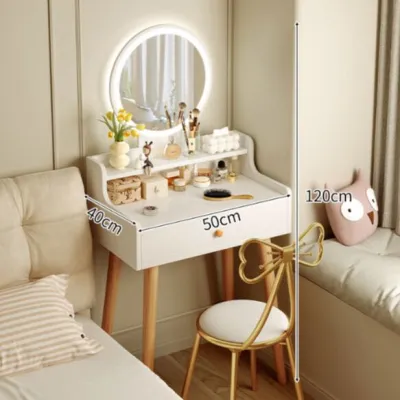
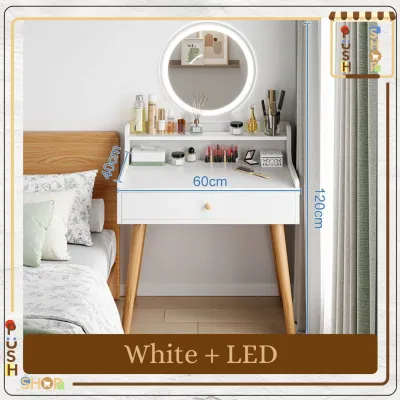
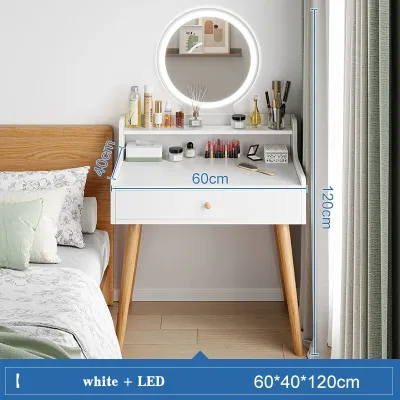
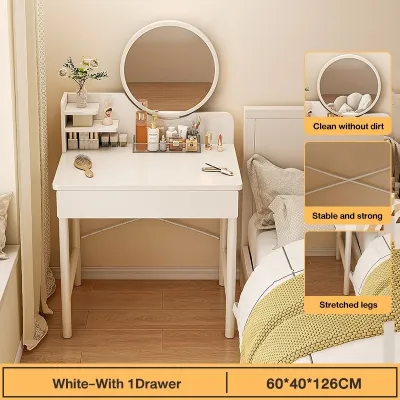

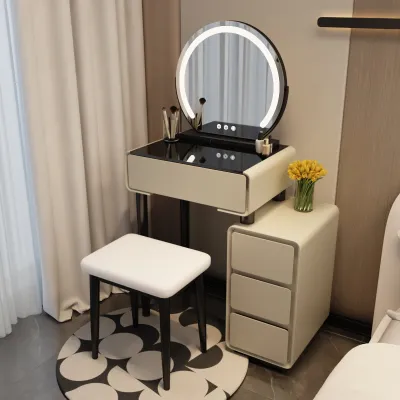
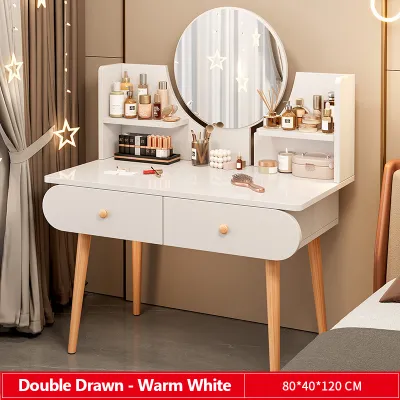
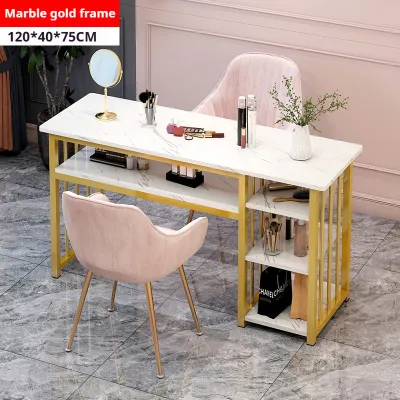
Prices are valid at publication and may change. Please refer to the product page for the latest price.
Vertical clearance is another critical factor that is easily overlooked. Measure the height of the wall where you plan to place the vanity, noting the positions of wall-mounted air conditioning units, light switches, and power outlets. If your makeup dresser table features a tall vertical mirror or integrated LED lighting, it must not block these fixtures or obstruct the airflow from your cooling system.
Finally, calculate the space required for your seating. A vanity is only functional if you can comfortably sit at it, which means you must factor in the depth of a stool or chair when pulled out. Ensure there is enough clearance behind the seating area so that you do not bump into the bed frame or wardrobe when sitting down or standing up.
Matching Table Dimensions to Your Room Layout
When evaluating different makeup dresser table options, prioritize units with a narrow depth. Standard office desks typically measure 60 centimeters deep, which can easily choke a narrow bedroom walkway. For tight spaces, look for dedicated vanity tables or console tables with a depth of 35 to 40 centimeters. This slim profile keeps the furniture flush against the wall, leaving more open floor space in the center of the room.

The width of the table should correspond directly to your measured wall segment. A width of 60 centimeters is generally the minimum required to sit comfortably and align a standard mirror. If you have a bit more wall space, an 80-centimeter width offers a more practical tabletop surface for organizing cosmetics without dominating the room. Avoid wider tables unless you are certain they will not crowd adjacent bedside tables or wardrobe doors.
Always check the manufacturer’s detailed specifications for exact assembly dimensions rather than relying on product photos. Pay close attention to the leg clearance height, which is the distance from the floor to the underside of the drawer frame. If this clearance is too low, you may find your knees knocking against the drawers, making the vanity uncomfortable to use for extended periods.
Additionally, consider the space required for drawer extension. Drawers that slide outward require extra clearance in front of the table. If your bed is positioned close to the vanity, ensure that opening a drawer to reach your makeup does not require you to squeeze uncomfortably against the mattress or stand at an awkward angle.
Space-Saving Configurations for Tight Layouts
If a traditional four-legged table takes up too much floor space, consider alternative configurations designed specifically for compact living. Wall-mounted or floating vanities are excellent solutions for small bedrooms. By eliminating the table legs entirely, these units open up the floor below, making the room feel more spacious and significantly easier to clean. This open space also allows you to tuck a small stool completely underneath the unit when it is not in use.
Corner-mounted vanity units are another highly efficient option for tight layouts. The corners of a bedroom are frequently underutilized, often becoming dead space. A corner makeup dresser table fits snugly into these angles, maximizing your usable floor area while providing a surprisingly generous tabletop surface and keeping the center of the room clear.
For multi-functional spaces, look for fold-down or hidden vanity desks. These innovative designs feature a hinged tabletop with a mirror attached to the underside. When you need to get ready, you simply lift the lid to reveal your cosmetics and mirror; when closed, the unit transforms into a flat writing desk or a neat console table. This dual-purpose design is ideal for studio apartments where a single piece of furniture must serve multiple roles.
Common Sizing and Placement Mistakes to Avoid
One of the most common mistakes when choosing a makeup dresser table is ignoring the physical depth of the seating. Many homeowners select a slim table that fits perfectly against the wall, only to realize that their chosen chair or bulky stool sticks out into the main walkway. To avoid this, opt for low-profile stools or ottomans that can slide entirely underneath the vanity frame when not in use.
Another frequent error is blocking natural light sources or ventilation. Placing a tall vanity mirror directly in front of a window not only blocks natural light—which is essential for accurate makeup application—but can also restrict airflow in rooms that rely on window ventilation. Position your vanity adjacent to windows rather than directly in front of them, ensuring you benefit from natural light without blocking the view or the breeze.
Do not overlook the practical challenges of tropical climates when selecting materials. High humidity levels can cause low-quality composite woods to warp or swell over time. When choosing a vanity, check the manufacturer’s care instructions and verify that the finish, joints, and drawer glides are designed to withstand humid conditions. Look for easy-to-clean surfaces that resist cosmetic stains and moisture damage.
Lastly, avoid placing the vanity too close to electrical outlets without checking cord paths. If your vanity requires power for integrated lights or hair styling tools, ensure the cords do not stretch across walkways, creating a tripping hazard. Plan your placement so that the table sits close to an outlet while keeping all cables neatly tucked away behind the furniture frame.
Frequently Asked Questions (FAQ)
Can I use a regular desk as a makeup dresser table?
Yes, you can use a regular desk, but standard desks are typically deeper and taller than dedicated makeup tables, which can easily overwhelm a compact bedroom. If you choose a regular desk, verify that its depth does not block your room’s walkways and check that the surface material is resistant to cosmetic stains, water, and heat from styling tools.
How much space do I need between the bed and the vanity?
You should aim for a minimum clearance of 60 to 70 centimeters between the edge of your bed and the vanity table. This distance provides enough physical space to pull out a stool, sit down comfortably, and still allow another person to walk past without having to squeeze through a tight gap.
Community discussion
Share your experience or ask a question. Comments are reviewed before publication.