
Transparent shoe cases offer a practical way to protect footwear while maintaining visual inventory in a closet system. Because there is no single universally ideal product, the most suitable choice depends on matching the internal dimensions of the case to your specific shoe profiles, verifying the structural rigidity for safe stacking, and ensuring the design integrates smoothly with your existing closet shelves. In humid tropical climates like the Philippines, dust and moisture are constant challenges for footwear preservation. Transparent cases offer a dual benefit: they shield shoes from airborne dust and pests while allowing you to see your collection instantly. This guide outlines the evaluation criteria and spatial planning needed to select the appropriate transparent storage solutions for sneakers, heels, and boots.
Assessing Your Footwear Dimensions and Closet Space
Before browsing online marketplaces for storage solutions, it is essential to establish your baseline size requirements by measuring both your footwear and your physical closet space. Do not rely solely on your shoe size numbers, such as US 10 or EU 42, because sole designs, heel heights, and decorative elements vary significantly between brands. Use a physical tape measure to find the exact length, width, and height of your largest pairs.
Pay close attention to the most extreme profiles in your collection, such as chunky platform sneakers, pointed-toe dress shoes, or high-top athletic footwear. Pointed toes add extra length that might prevent a case door from closing, while chunky soles add width and height that can cramp the interior. Measuring these specific dimensions ensures you establish the minimum internal clearance your cases must provide to prevent crushing or deforming the shoes.
Products mentioned in this guide
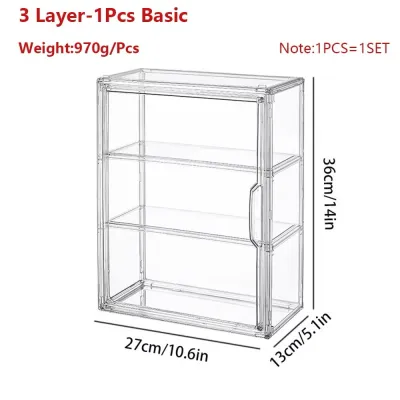
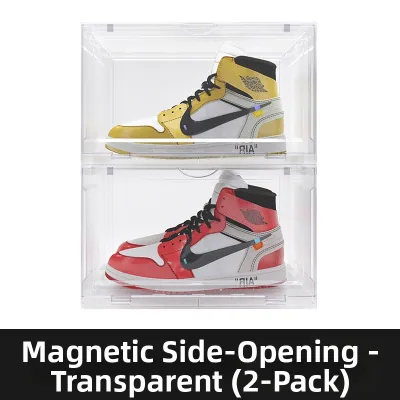
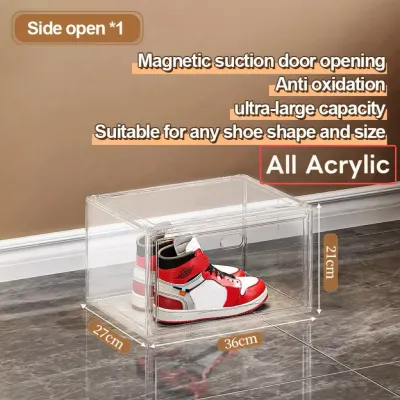
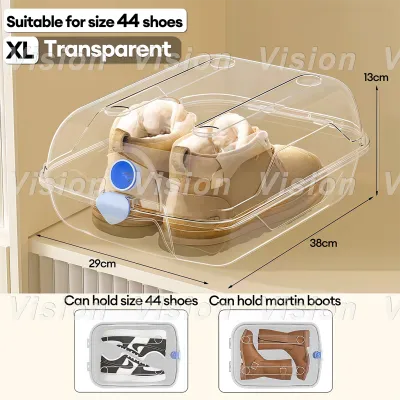
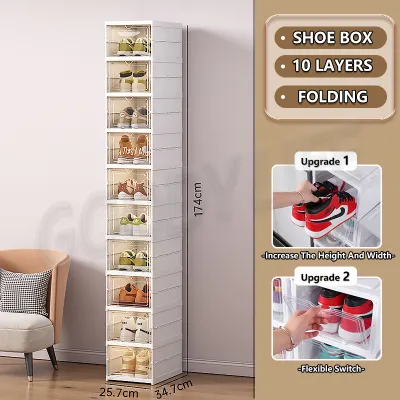
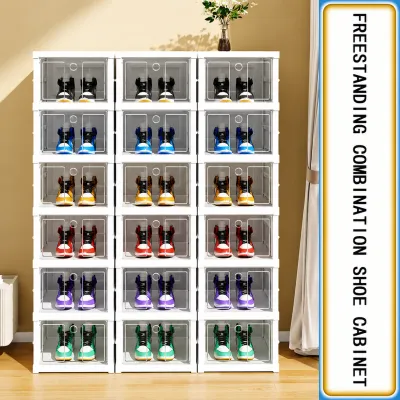
Prices are valid at publication and may change. Please refer to the product page for the latest price.
Next, measure the depth, width, and vertical clearance of your existing closet shelves. Ensure the external dimensions of the cases you select will fit within these boundaries without hanging over the edge of the shelf. Overhanging cases are unstable and prone to falling, especially when you open or close the case doors.
Calculate how many cases can safely stack within a shelf opening by dividing the shelf height by the external height of a single case. Always leave a small gap of at least a few centimeters at the top of the stack. This clearance allows you to easily slide the top case out if needed and ensures the stack does not press against the upper shelf.
Finally, account for door swing clearance and walkway space in your closet area. If your closet has sliding or hinged doors, ensure the shoe cases do not obstruct their movement. For cases placed on the floor or lower shelves, verify that opening the case door does not block the walkway or collide with adjacent furniture.
Matching Shoe Case Designs to Specific Footwear Types
Different shoe styles demand distinct storage environments to maintain their shape and condition. A uniform set of cases might look neat, but a mix of specialized sizes often provides better protection and space efficiency. Let’s look at how to match case designs to specific footwear categories.

Sneakers and Everyday Flats
Standard rectangular drop-front or side-opening cases are highly suitable for sneakers and everyday flats. These designs allow you to slide shoes in and out without unstacking the boxes, which is essential for daily-use footwear. Look for cases with clear front doors so you can quickly identify the pair you want to wear.
Pay close attention to the internal height for bulky sneakers. High-top collars and thick, cushioned soles require extra vertical space. Check that the shoe can stand upright without the collar being crushed or deformed by the top panel, which can ruin the structure of the shoe over time.
For low-profile flats, sandals, and slippers, you can sometimes find dual-compartment cases or use internal dividers. This maximizes vertical space within a single case, allowing you to store two pairs in the footprint of one. Ensure any internal dividers are smooth to avoid scratching the materials.
Heels and Dress Shoes
Delicate dress shoes, heels, and stilettos require careful handling to prevent damage to fine leather, suede, or patent finishes. Look for cases with smooth, burr-free interior bases. Any rough plastic edges or molding seams can easily scuff or tear delicate materials when you slide the shoes in and out.
Verify the internal height against your highest stiletto or block heel. When storing heels, they are often placed in alternating directions—one toe forward, one heel forward—to save horizontal space. Ensure the case is wide enough to accommodate this arrangement comfortably without the shoes pressing against each other.
Consider the angle of the drop-front door. A door that opens fully to 180 degrees or slides underneath the case provides the safest access. This design reduces the risk of catching a delicate heel, strap, or buckle on the door frame during retrieval.
Boots and Tall Footwear
Boots present a unique storage challenge due to their height and weight. Standard shoe cases are rarely tall enough for ankle boots, let alone mid-calf or knee-high styles. For these, look for specialized extra-tall or modular stackable cases designed specifically for boots.
Note that larger boot cases have a significantly larger footprint and weigh more when filled. Ensure your closet shelves can support this concentrated weight, and place these heavier units on the lowest shelves or the closet floor to maintain stability and prevent shelf bowing.
If specialized tall cases are unavailable or do not fit your closet layout, you can use flexible boot shapers or folding inserts to store boots horizontally in wider, flatter cases. While this protects them from dust, it does require more horizontal shelf space and limits your ability to stack other items on top.
Evaluating Material, Structure, and Accessibility
The durability of a transparent shoe case depends heavily on its material composition and structural design. Check product specifications for the thickness and rigidity of the transparent panels. Flimsy, thin plastic sheets tend to bow, crack, or collapse under the weight of stacked units over time, especially in warmer environments.
Look for high-grade plastics like acrylic, polystyrene, or polypropylene. Acrylic offers high clarity but can be brittle, while polypropylene is more flexible and impact-resistant. Verify the manufacturer’s care instructions to ensure the material can withstand regular cleaning without clouding or scratching.
Stacking stability is critical for safety. Verify the presence of interlocking grooves, alignment pegs, or secure locking mechanisms between units. These structural features prevent the cases from sliding or tipping over when you open a door or bump the stack during daily use.
Examine the door mechanism closely. Assess the quality of the door hinges, magnetic closures, or sliding tracks. A strong magnetic closure keeps the door securely shut against dust and pests, while smooth hinges ensure you can access your shoes daily without putting stress on the plastic joints.
Avoid cases that require complex assembly if the joints appear fragile. Look for user feedback regarding how easily the pieces snap together and whether the tabs are prone to breaking during setup. A sturdy, pre-assembled or easily snapped frame is generally more reliable.
Integrating Shoe Cases into Your Closet System
Integrating shoe cases into your closet requires strategic planning to ensure safety and convenience. Start by placing your heaviest and most frequently worn shoes in the lowest cases. This keeps the center of gravity low, reducing the risk of the stack tipping over, and makes daily retrieval much easier.
Ventilation is a critical consideration, especially in warm, humid environments. Sealed plastic boxes can trap moisture, leading to mold growth and unpleasant odors. Ensure adequate ventilation by leaving slight gaps between the cases and the closet walls, or select designs with built-in air vents.
Avoid stacking cases higher than the manufacturer’s recommended limit or beyond your safe reach zone. A stack that is too high is inherently unstable and increases the risk of accidental toppling when you try to open a top case. If you must stack high, consider anchoring the stack to the wall or shelf frame.
Consider the lighting in your closet. While transparent cases make it easy to see your shoes, direct exposure to harsh closet lights or nearby windows can affect certain materials. Position your cases where they are shaded from direct light to preserve both the plastic clarity and the shoe colors.
Building Your Conditional Shortlist
When searching for transparent shoe cases on online marketplaces, avoid relying on vague size labels like “large,” “extra-large,” or “universal.” These terms are not standardized across different brands. Instead, filter your search results by checking the exact internal dimensions listed in the product specifications.
Compare material specifications across different listings and read user reviews carefully. Look specifically for feedback regarding long-term stack stability, door durability, and whether the plastic retains its clarity or becomes cloudy over time. Pay attention to reviews that mention how well the interlocking mechanisms actually hold up in daily use.
Calculate the total cost per unit, keeping shipping fees in mind. Because empty plastic shoe cases are bulky, they often incur high volumetric weight charges on ecommerce platforms. A low product price can sometimes be offset by high shipping costs, so compare the total delivered price in ₱ to find the true value.
Consider purchasing a single sample unit before committing to a large set. This allows you to physically test the fit of your largest shoes, verify the structural rigidity, and ensure the case fits perfectly within your closet system before making a larger financial investment.
Frequently Asked Questions (FAQ)
How do I prevent transparent shoe cases from turning yellow over time?
Yellowing is primarily caused by prolonged exposure to ultraviolet (UV) light, which degrades the polymers in certain plastics. To prevent this, position your closet system and shoe cases away from direct, unfiltered sunlight. If your closet is near a window, use curtains or UV-blocking window films to protect your storage setup.
When shopping, check the product specifications for UV-resistant materials. High-grade acrylic or polycarbonate options often resist yellowing better than standard utility plastics, though they may carry a higher price point. Regular cleaning with a soft, damp microfiber cloth also helps maintain clarity by removing dust that can dull the surface.
Can I store wet or muddy shoes directly inside these cases?
Storing damp, wet, or soiled shoes directly inside sealed transparent cases is highly discouraged. The enclosed environment traps moisture, creating an ideal breeding ground for mold, mildew, and bacteria. This not only causes persistent, unpleasant odors but can also permanently rot leather, degrade adhesives, and ruin the case interior.
Always allow your shoes to air-dry completely and clean off any mud or debris before placing them in the cases. In humid tropical climates, placing a small silica gel packet or a reusable moisture absorber inside each case can provide effective additional humidity control, keeping your footwear dry and well-preserved.
Community discussion
Share your experience or ask a question. Comments are reviewed before publication.