
A true heavy-duty designation is much more than a marketing label; it represents an organizer engineered to support substantial weight over years of daily use without bowing, warping, or collapsing. When searching for a reliable shoe rack organizer heavy duty model, you must look for specific structural indicators rather than relying on bold packaging claims. These indicators include thicker material gauges, reinforced joints, and robust connecting hardware that can withstand constant physical loading.
Standard shoe organizers often rely on thin plastic connectors and hollow, lightweight aluminum tubes that quickly sag under the weight of multiple pairs of heavy footwear. In contrast, a heavy-duty unit is engineered to maintain its structural rigidity under a full load. This means the shelves will not bow in the center, and the entire frame will remain stable when you place or remove your shoes, ensuring your investment lasts for years.
Weight Capacity Specs: Per-Shelf vs. Total Load
Understanding manufacturer weight ratings requires looking closely at how those limits are distributed across the unit. A common mistake is looking at a total weight capacity of, say, 50 kilograms and assuming a five-shelf unit can safely support 10 kilograms on any single shelf. Structural limits are rarely distributed in such a perfectly linear fashion.
Products mentioned in this guide

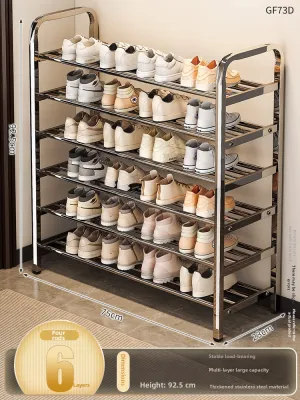
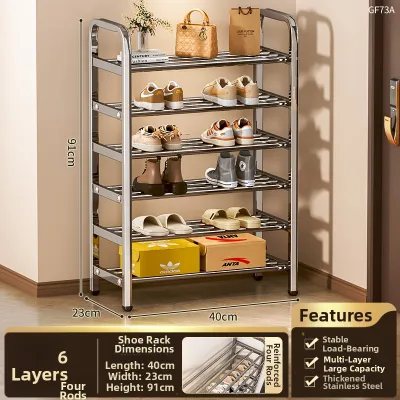
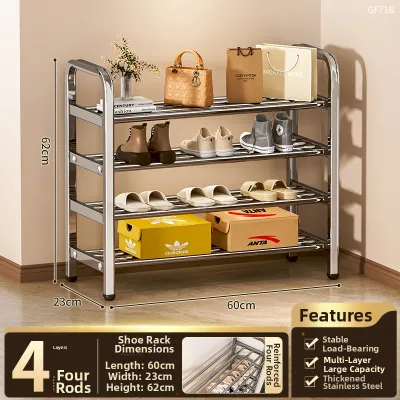
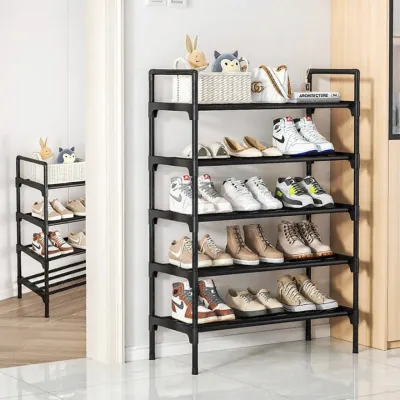
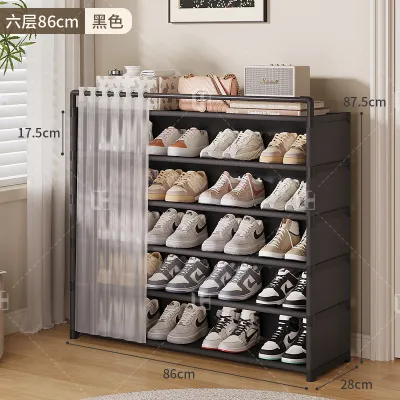
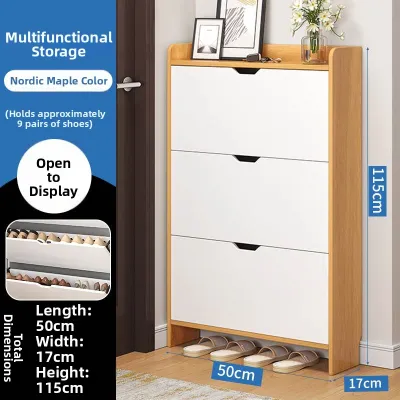

Prices are valid at publication and may change. Please refer to the product page for the latest price.
The overall stability of the rack depends heavily on the lowest shelves anchoring the unit. If you place all your heaviest items on the top shelf, you compromise the center of gravity, risking a tip-over even if the total weight remains well below the maximum limit. Always prioritize checking the specific per-shelf weight limit, which is the actual measure of how much stress an individual tier can handle without bending.
Calculating Your Real-World Load
To choose the right organizer, you must estimate the actual weight of your household’s footwear. While a pair of lightweight slippers or canvas sneakers might only weigh around 0.3 to 0.5 kilograms, other footwear types are significantly denser.
For example, heavy leather work boots, steel-toe boots, or thick-soled platform heels can easily weigh 1.5 to 2.5 kilograms per pair. If a single shelf holds four pairs of these heavy shoes, that shelf must safely support up to 10 kilograms. Calculating your load based on your heaviest shoes—rather than an unrealistic average of lightweight sandals—prevents unexpected structural failures.
Static vs. Dynamic Weight Limits
Weight limits are typically rated as static loads, meaning the weight is applied gently and remains completely undisturbed. However, daily life involves dynamic forces that place much higher, sudden stresses on the frame.
When you drop a heavy pair of boots onto a shelf, lean against the frame while putting on your shoes, or pull a tightly wedged box from a lower tier, you subject the organizer to dynamic load. This temporary force can easily double the physical stress on the joints. To account for these everyday movements, it is wise to select a rack with a rated capacity that is at least 20% to 30% higher than your calculated static shoe weight.
Material Breakdown: Choosing a Shoe Rack Organizer Heavy Duty Frame
The materials used in a shoe rack’s construction dictate its ultimate strength, longevity, and resistance to environmental wear. However, simply seeing the word “metal” or “wood” on a product listing does not guarantee heavy-duty performance.

To evaluate a rack’s true capability, you must look at the specific material specifications, such as tube wall thickness, wood density, and protective surface treatments. In humid environments like the Philippines, these material details also determine whether your organizer will succumb to rust, mold, or structural softening over time.
Metal Frames (Steel and Iron)
Metal is the most common choice for high-capacity storage because of its high tensile strength. When evaluating metal frames, check the tube wall thickness (often measured in gauge, where a lower number indicates thicker metal) and the overall pipe diameter. Thin-walled steel tubes can easily bend or buckle under pressure, whereas thick-gauge carbon steel or iron pipes provide a rigid, unyielding skeleton.
Because tropical humidity can quickly degrade unprotected metal, a high-quality finish is non-negotiable. Look for frames with a thick powder-coated or electroplated finish rather than simple spray paint. This protective layer seals the steel away from moisture, preventing rust from forming at the joints and eating away at the rack’s structural integrity.
Solid Wood vs. Engineered Wood
Solid wood offers exceptional natural strength, excellent screw-holding capability, and classic aesthetic appeal. Hardwoods and dense softwoods can support heavy loads without sagging, provided the shelves are thick enough (typically at least 15 to 20 millimeters).
In contrast, engineered wood like medium-density fiberboard (MDF) or particleboard is more susceptible to sagging under heavy, concentrated loads. If you choose an engineered wood organizer, verify that the shelves are reinforced with under-shelf support bars and that all edges are sealed with high-quality edge banding. Unsealed engineered wood can absorb ambient moisture from the air, causing the fibers to swell, weaken, and lose their load-bearing capacity.
Heavy-Duty Plastics and Resins
High-density plastics and polymer resins are completely immune to rust and water damage, making them appealing for entryway or outdoor use. Some reinforced resin models can handle moderate loads quite well, especially if they feature ribbed structural designs on the underside of the shelves.
However, plastics generally have much lower maximum weight ceilings compared to steel or solid wood. They are also prone to creeping—gradually bending under a constant load over several months. Additionally, prolonged exposure to direct sunlight or high temperatures can cause plastic components to become brittle, leading to sudden cracks under weight.
Structural Features That Support Heavy Loads
A heavy-duty rating is as much about structural engineering as it is about raw materials. Even the strongest steel will fail if the joints are weak or the design lacks lateral support. Look for structural reinforcements such as rear crossbars (X-bracing), center support beams under each shelf, and heavy-duty corner gussets that prevent the frame from swaying side to side.
Leveling is another critical factor for long-term stability. If a shoe rack sits on an uneven floor, the weight of the shoes will be distributed unevenly, placing intense twisting stress on the frame’s joints. Choosing a unit with adjustable leveling feet allows you to compensate for uneven tiles or concrete floors, keeping the frame perfectly plumb and stable.
Finally, physical dimensions and safety must guide your installation. Before purchasing, verify the finished dimensions of the rack to ensure it fits comfortably in your space without blocking doorways, hallways, or lift access. For tall, high-capacity organizers, anchoring the unit to the wall is essential. A top-heavy shoe rack loaded with heavy footwear poses a severe tip-over risk, making anti-tip kits or wall anchors a mandatory safety feature, particularly in homes with active children or pets.
How to Evaluate a Heavy Duty Shoe Rack Before Buying
To ensure you are buying a genuinely durable organizer rather than a basic storage unit with a “heavy duty” label, use this practical verification checklist before making your purchase:
- Verify the Per-Shelf Limit: Check the product manual or official specifications for the exact weight limit of each individual shelf, rather than relying solely on the total weight capacity.
- Inspect the Material Details: Look for specific measurements of material thickness, such as steel tube gauge or wood panel thickness, instead of accepting generic material names.
- Examine the Joint Construction: Check product photos or assembly instructions for reinforced metal brackets, thick bolts, or heavy-duty plastic connectors rather than thin, press-fit joints.
- Assess the Finish and Coating: For metal racks, confirm the presence of a rust-resistant powder coating; for wood, check for a sealed, moisture-resistant finish.
- Measure Your Space and Access: Ensure the finished dimensions match your available floor space and that the packaged box can easily pass through your doorways or elevator during delivery.
- Compare Price Bands: High-quality construction comes at a cost. While temporary plastic-and-fabric racks might cost under ₱500, robust, heavy-duty steel or solid wood organizers typically range from ₱1,500 to over ₱4,000 depending on the size and tier count.
Frequently Asked Questions (FAQ)
Can I use a heavy-duty shoe rack for items other than shoes?
Yes, heavy-duty shoe racks are highly versatile and can hold storage bins, tools, or pantry items, but you must ensure the items fit the shelf depth and do not exceed the per-shelf weight limit. Avoid placing extremely dense, concentrated weights, such as a single heavy toolbox, in the center of a shelf designed for distributed shoe weight. If you plan to store non-shoe items, place the heaviest objects on the bottom shelf to maintain a low center of gravity and prevent the rack from becoming top-heavy.
Does a heavier shoe rack mean it is more durable?
A heavier rack often indicates the use of thicker materials, such as solid wood or thick-gauge steel, which usually correlates with higher durability and load capacity. However, weight alone is not a guarantee of quality. Structural design, joint integrity, and proper weight distribution are equally important; a heavy but poorly designed rack with weak connections can still fail under pressure. Always prioritize reinforced joints and balanced engineering over physical weight alone.
Community discussion
Share your experience or ask a question. Comments are reviewed before publication.