
For large Filipino families of 6 to 10 people, finding a dining table set plastic that balances everyday space efficiency with the capacity for large gatherings is a common challenge. The best extendable plastic dining table sets are those that combine high-density polyethylene (HDPE) or engineered polypropylene surfaces with robust, powder-coated steel underframes and reliable extension mechanisms. These sets provide the ultimate flexibility, allowing a household to maintain a compact footprint for daily family meals while easily expanding to accommodate relatives during Sunday lunches, birthday parties, and holiday feasts.
When searching for the ideal set, the decision comes down to verifying structural integrity, understanding the specific extension mechanism that fits your home’s layout, and ensuring the chairs and table can withstand frequent use. Rather than relying on generic plastic furniture, choosing a set with certified weight capacities, proper locking safety features, and weather-resistant coatings ensures long-term durability. By focusing on precise dimensions and hardware specifications, you can secure a versatile, budget-friendly dining solution that serves your family comfortably for years.
In the Philippines, where homes often host spontaneous gatherings of extended family, neighbors, and friends, having a dining set that can adapt to changing guest counts is invaluable. A high-quality plastic set offers a modern, clean aesthetic that fits well into contemporary homes while avoiding the high cost and delicate maintenance associated with solid wood or glass. By choosing an extendable model, you can optimize your available floor space without sacrificing the ability to host memorable meals.
Products mentioned in this guide
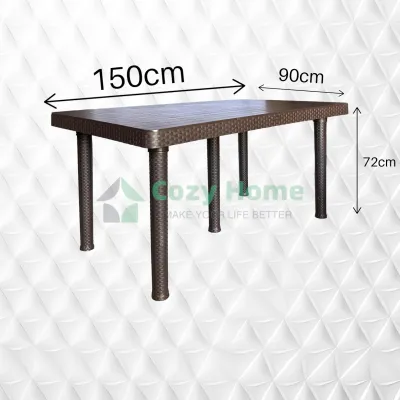
Prices are valid at publication and may change. Please refer to the product page for the latest price.
Practical Benefits of Extendable Plastic Dining Sets
In many Philippine households, the dining room is the undisputed heart of the home, serving not just as an eating area but also as a homework station, a home office, and a food preparation zone. Space is often at a premium, especially in urban townhouses, subdivisions, and condominiums where the dining area directly abuts walkways, living spaces, or staircases. An extendable plastic dining table set addresses this constraint by offering a variable footprint. During the week, the table can remain in its collapsed state, preserving vital floor space for daily foot traffic and household activities. When weekend gatherings, family reunions, or holiday celebrations arise, the table easily expands to accommodate 8 or 10 seated guests, transforming the space into a banquet hall.
The lightweight characteristic of plastic furniture is another significant advantage for large families. Unlike heavy solid wood, marble, or glass tables, which require multiple people to lift and risk damaging tiled or laminated floors, a plastic dining table can be easily repositioned. This mobility is particularly useful when rearranging the layout to accommodate buffet-style serving or when moving the entire setup to an outdoor patio, garden, or carport for an open-air celebration. The ease of handling ensures that a single person can often set up, extend, or adjust the dining arrangement without strenuous physical effort or the risk of injury.
Furthermore, high-quality plastic dining sets offer exceptional cost-effectiveness and low maintenance compared to traditional materials. Large families naturally generate more wear and tear, from spilled hot soups and condensation rings to accidental impact from children’s toys and heavy kitchenware. Plastic surfaces are inherently non-porous, meaning they resist deep staining from common local ingredients like soy sauce, vinegar, fish sauce, or colored juices. They do not require periodic polishing, varnishing, or specialized wood treatments, allowing busy households to maintain a clean, hygienic dining environment with minimal effort and expense.
Additionally, the durability of modern engineered plastics means they are highly resistant to pests like termites, which can be a common concern for wooden furniture in tropical climates. They are also unaffected by water spills, high humidity, and damp environments, ensuring that the table will not warp, rot, or harbor mold. This resilience makes them an exceptionally practical investment for families looking for long-lasting utility without the stress of constant upkeep.
Key Specifications to Verify Before Purchase
To ensure your extendable plastic dining table set can safely support a full feast for up to 10 people, you must look closely at the manufacturer’s technical specifications rather than assuming all plastic furniture performs the same.

Weight Capacity and Stability
Always verify the maximum weight capacity specified by the manufacturer for both the collapsed and fully extended configurations. A table hosting 10 people must support not only the weight of heavy serving platters, rice cookers, and soup tureens but also the occasional downward pressure of guests leaning on the edges. Look for tables that feature thick, powder-coated steel legs (ideally with a diameter of 28mm or greater) and integrated cross-bracing beneath the tabletop. This underframe reinforcement distributes weight evenly and prevents the center of the table from sagging or bowing when the extension leaves are fully deployed. Check if the legs have non-slip rubber feet, which prevent the table from sliding on smooth tiled floors and protect the floor surface from scratches.
Material Grade and Labels
Do not assume that all plastic tables are automatically weatherproof or heat-resistant. Read the product labels carefully to identify the specific type of polymer used. High-Density Polyethylene (HDPE) is highly recommended for its impact resistance, structural strength, and ability to withstand heavy loads without cracking. Additionally, check for explicit “UV-resistant” or “UV-stabilized” ratings if you plan to use the set near large windows, on a veranda, or in a semi-outdoor dirty kitchen, as unprotected plastics can become brittle, yellow, and discolor under intense tropical sunlight. Ensure the manufacturer specifies the material’s heat tolerance level to understand if it can handle warm serving dishes directly, as some lower-grade plastics can soften or warp under high temperatures.
Dimensional Accuracy
Before committing to a purchase, obtain the precise measurements of the table in both its minimum and maximum states. For a comfortable 10-person setup, the fully extended table length should typically measure at least 240 centimeters (approximately 8 feet), allowing roughly 60 centimeters of width per person. Pay close attention to the table’s width as well; a width of 90 to 100 centimeters is ideal, as anything narrower will leave insufficient space for central serving dishes once individual plates, drinking glasses, and cutlery are set down. Ensure that the table’s height is standard (around 75 centimeters) to match standard dining chairs, allowing adequate clearance for guests’ knees.
Safety Features
An extendable table relies on moving parts, which can present safety hazards if poorly designed. Inspect the extension tracks and hinges to ensure they operate smoothly without catching or requiring excessive force. Look for models equipped with built-in locking pins, safety latches, or sliding rings that secure the table frame firmly in place once extended. These safety mechanisms prevent the table from accidentally collapsing or sliding shut if someone bumps into the legs during a lively family gathering. Additionally, check that all hinges and metal joints are covered, rounded, or recessed to eliminate pinch points that could injure children or guests during setup and disassembly.
Types of Extension Mechanisms for Large Seating
Understanding the different types of extension mechanisms allows you to choose a table design that aligns with your physical space and how often you expect to adjust the seating capacity.
Drop-Leaf and Fold-Down Sides
Drop-leaf tables feature hinged side panels that hang vertically when not in use and lift up to be supported by pull-out brackets or rotating legs when extra seating is required. This design is highly efficient for narrow dining rooms or open-plan apartments, as it allows the table to function as a slim console or a small 4-seater against a wall during the week. When evaluating a drop-leaf plastic table, it is crucial to inspect the strength of the support brackets beneath the leaves. Because the extended sections rely entirely on these brackets rather than direct vertical legs, they generally have lower weight limits and require careful distribution of heavy items. You must also check that the hinges are heavy-duty and rust-resistant, especially in humid environments where metal parts are prone to oxidation.
Center-Pull or Slide-Out Extensions
Center-pull tables feature a split tabletop that slides apart along metal tracks to reveal one or more expansion leaves stored in a hidden compartment underneath, or slide-out panels that extend from the ends. This mechanism keeps the table’s structural legs at the outer corners, maximizing legroom for guests and maintaining excellent stability. However, operating a center-pull mechanism requires sufficient floor space on both ends of the table to pull the frame apart. You must ensure your dining room has enough clearance to accommodate this physical expansion process without hitting walls, sideboards, or adjacent furniture. It is also important to verify that the tracks are made of sturdy, rust-resistant metal that won’t warp under the weight of the extended leaves.
Fully Foldable Banquet-Style Tables
For families who only require large-scale seating during major holidays, fiestas, or occasional community events, heavy-duty folding banquet tables are a highly practical alternative. These tables do not extend in the traditional sense; instead, they feature legs that fold flat into the underside of the tabletop, and many models fold in half like a suitcase with a carrying handle. While they offer superb weight capacities and can be easily stored in a closet, garage, or utility room when not in use, they present the trade-off of requiring separate storage space for 10 dining chairs and lack the refined, permanent aesthetic of a dedicated indoor dining set. They are, however, incredibly versatile for families who host outdoor gatherings frequently.
Evaluation Criteria
When comparing these mechanisms, consider the physical effort and number of people required to set them up. A center-pull table with smooth roller tracks can often be operated by a single adult, whereas a large folding banquet table may require two people to lift, unfold, and lock safely. Assess the long-term durability of the joints; mechanisms with fewer moving parts and heavy-duty metal hardware tend to experience less wear and tear over years of repeated folding and extending. Think about your family’s lifestyle: if you host guests weekly, a permanent center-pull table is more convenient, whereas a monthly or seasonal host may prefer the storage flexibility of a fully foldable banquet table.
Measuring Your Space for a 10-Person Setup
To avoid creating a cramped and uncomfortable dining environment, you must carefully measure your room to ensure a fully extended 10-person table fits alongside the necessary chairs and allows for normal household movement.
Calculating the Total Footprint
To determine if your dining room can accommodate a 10-person setup, use a standard spatial footprint formula. Take the fully extended length and width of the table and add a minimum of 24 inches (61 centimeters)—ideally 30 inches (76 centimeters)—of clearance on all sides. This extra space is necessary to allow guests to pull their chairs out comfortably to sit down and stand up without their backs hitting the walls or other furniture. For example, if your extended table measures 240 centimeters by 90 centimeters, your room’s clear dining zone should measure at least 362 centimeters by 212 centimeters to maintain basic physical comfort. If space is tight, consider using bench seating on one or both sides, as benches can be tucked completely under the table when not in use, saving valuable floor space.
Navigating Room Layouts
Beyond the basic footprint, analyze how the extended table interacts with the rest of the room. Ensure the fully extended table does not block the swing path of nearby doors, pantry cabinets, or refrigerator doors. In the Philippines, where ceiling fans and wall-mounted air conditioners are commonly used for cooling, verify that the placement of the extended table does not position guests directly under a low-hanging fan or block the airflow from wall-mounted units. Additionally, maintain a clear pathway of at least 36 inches (91 centimeters) along major thoroughfares, such as the route between the kitchen entrance and the dining table, to prevent collisions when carrying hot food, heavy platters, or trays of drinks.
Delivery and Setup Logistics
Before placing an order, map out the delivery route from the street to your dining room. Measure the width and height of all entry gates, front doors, hallways, stairwells, and elevator cabins. Even if an extendable table is designed to be compact when collapsed, it is often shipped in a large, single box containing the main tabletop structure, which cannot be folded during transport. Ensuring the packaged product can navigate tight corners, narrow hallways, and low ceilings prevents the frustration of delivery day complications. If you live in a high-rise condominium, check the building’s service elevator dimensions and weight limits, as well as any association rules regarding delivery hours and furniture assembly.
Routine Care and Surface Maintenance
While plastic is highly durable, implementing proper care and maintenance routines based on manufacturer guidelines will prevent premature wear and keep your dining set looking pristine.
Cleaning Protocols
For daily cleaning, wipe down the plastic surface using a soft microfiber cloth dampened with warm water and a mild dishwashing liquid. Avoid using abrasive scouring pads, steel wool, or harsh chemical cleaners containing bleach, ammonia, or acetone. These harsh materials can create microscopic scratches on the plastic surface, which not only dull the finish over time but also act as traps for dirt, food particles, and bacteria, making the table increasingly difficult to clean. For stubborn food residues, allow a damp cloth to sit on the spot for a few minutes to soften the residue before gently wiping it away.
Heat and Stain Management
Although modern high-quality plastics are engineered to resist moderate warmth, they can warp, melt, or discolor if subjected to extreme heat. Always place protective trivets, silicone mats, or heat-resistant hot pads under serving dishes, rice cookers, and pots taken directly from the stove. Refer to the manufacturer’s user manual to identify the specific heat threshold of your table. Additionally, wipe up spills from highly pigmented foods—such as tomato sauces, curries, and dark soy sauces—immediately to prevent the pigments from bonding with the plastic surface. Using a table runner or individual placemats can also provide an extra layer of protection against spills and heat.
Hardware and Joint Care
The moving parts of an extendable table require periodic attention to remain functional, especially in the high humidity of the Philippines. Every few months, perform a visual inspection of the underside of the table. Dust the extension tracks, hinges, and locking pins with a dry brush or clean cloth to remove accumulated debris. If the manufacturer’s care instructions permit, apply a light coat of a plastic-safe dry silicone lubricant to the tracks to ensure smooth operation; avoid using heavy WD-40 or organic oils, which can attract household dust and gum up the mechanism. Check all screws and bolts periodically and tighten them gently if they have become loose from repeated use.
Frequently Asked Questions (FAQ)
Can a plastic extendable table support heavy holiday dishes?
A plastic extendable table’s ability to support heavy holiday dishes depends entirely on the manufacturer’s structural design, frame material, and leg bracing, rather than the plastic surface itself. To prevent damage, always verify the product’s stated maximum load limit and distribute heavy items like lechon platters, cast-iron pots, and beverage dispensers evenly across the table, avoiding excessive weight concentration directly over the extension joints or outer leaves.
How do I prevent the extension hinges from sticking in humid weather?
To prevent extension hinges and tracks from sticking in humid tropical climates, keep the moving parts clean and completely dry. Periodically wipe away dust and moisture with a dry microfiber cloth, and if the manufacturer’s care instructions allow, apply a small amount of a plastic-safe dry lubricant to the tracks; avoid heavy oils or grease, which can attract dust, clog the tracks, and degrade certain plastic polymers over time.
Community discussion
Share your experience or ask a question. Comments are reviewed before publication.