
Selecting a makeup cabinet with mirror for a small Philippine bedroom requires balancing personal grooming needs with strict spatial limits. In typical urban condominiums or townhouse bedrooms, floor space is at a premium, often ranging from 9 to 12 square meters. Introducing a bulky piece of furniture can easily disrupt the flow of the room, blocking pathways and making the space feel cramped. To maintain a comfortable, functional layout, the ideal makeup cabinet should have a compact width of 60 to 80 centimeters and a shallow depth of 35 to 45 centimeters. This size provides sufficient tabletop space for your daily routine while keeping your bedroom easy to navigate. By choosing the right proportions and style, you can establish a dedicated beauty station that enhances your room’s design without compromising on physical comfort.
Measuring Your Space and Clearance Requirements
Before purchasing any furniture, you must accurately measure your bedroom’s physical layout to establish a safe maximum footprint. Start by using a steel tape measure to find the exact width of the wall segment where you plan to place the cabinet. Next, measure the floor depth extending outward from that wall. It is vital to measure the physical space rather than relying on visual estimation, as baseboards, wall trim, and uneven floor surfaces can reduce the actual space available by several centimeters.
Beyond the physical footprint of the cabinet itself, you must calculate the clearance required for sitting and moving. A standard stool or vanity chair requires at least 60 to 70 centimeters of clear floor space behind the desk. This clearance allows you to pull the seat out, sit down comfortably, and push the seat back in without bumping into your bed, wardrobe, or adjacent walls. If the vanity sits along a primary pathway in the bedroom, ensure there is at least an additional 60 centimeters of walking clearance behind the seated position so other household members can pass by unimpeded.
Products mentioned in this guide
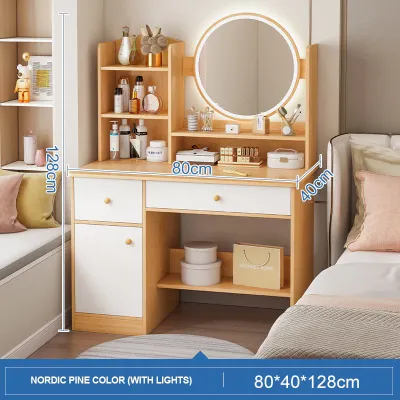
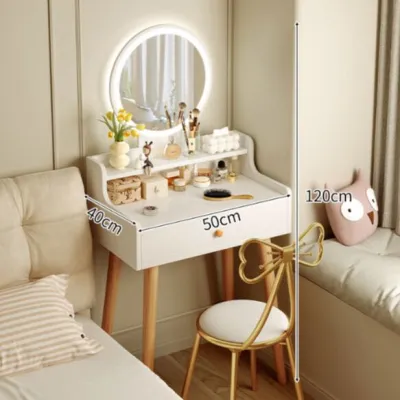
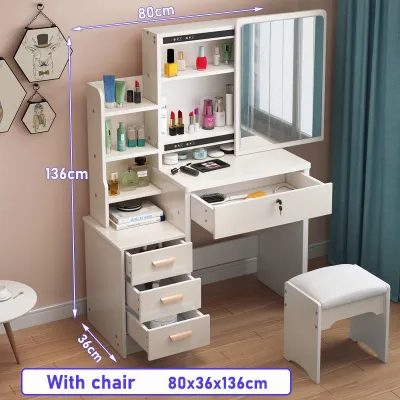
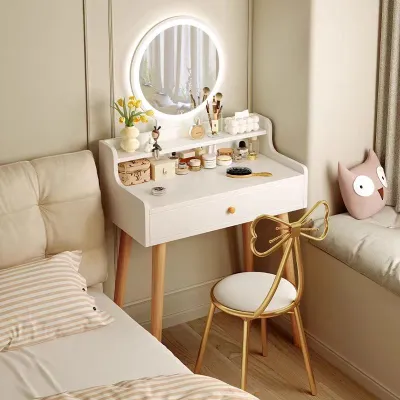
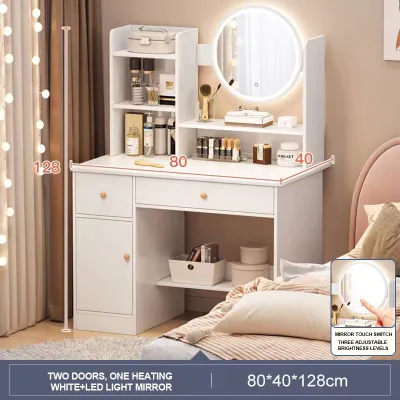
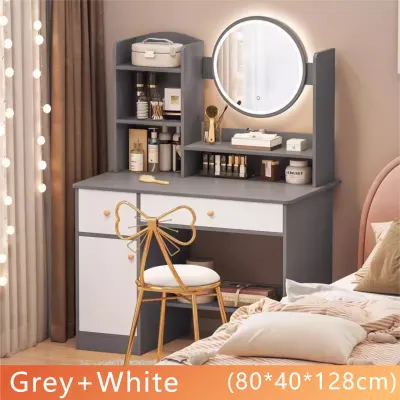
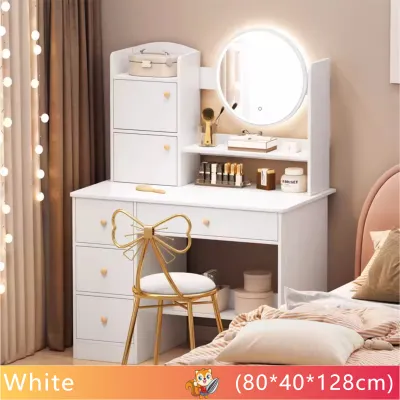
Prices are valid at publication and may change. Please refer to the product page for the latest price.
You must also account for the swing radius of nearby doors, wardrobes, and windows. If your bedroom features traditional swing-door wardrobes or a standard entry door, map out their full opening arcs. A collision between a heavy wooden door and a glass mirror or the corner of a makeup cabinet can cause severe damage. If space is exceptionally tight, consider positioning the cabinet next to sliding-door wardrobes to eliminate swing-path conflicts entirely.
Finally, locate your existing electrical outlets before deciding on a final position. Modern makeup cabinets often feature integrated LED mirrors, and you will likely need power for hair dryers, straighteners, or phone chargers. Placing the cabinet too far from an outlet creates a hazard, as cords stretched across walking paths can lead to trips or damage to your appliances. Verify that the outlet is easily accessible and that cords can be routed neatly behind the cabinet body.
Choosing the Right Dimensions for Compact Layouts
Once you have mapped out your room’s physical limits, you can select the specific dimensions of your makeup cabinet with mirror. The key is to find a balance where the furniture provides adequate storage and surface area without dominating the room’s visual or physical landscape.

Narrow Profiles (Typically Under 60 cm Wide)
For extremely tight spaces, such as narrow alcoves or the small gap between your bed and the wall, a narrow profile under 60 centimeters is the most practical choice. While these ultra-compact units save valuable floor space, they require a trade-off in tabletop surface area. To compensate for the limited horizontal space, look for designs that utilize vertical storage, such as tall drawers, open shelving units rising beside the mirror, or hidden compartments behind a sliding mirror face. Before committing to a unit under 60 centimeters, sit down and measure your own shoulder width. The average adult shoulder width ranges from 40 to 50 centimeters; a vanity narrower than 60 centimeters leaves very little elbow room, which can make styling your hair or applying makeup feel physically restrictive.
Standard Compact Widths (60 cm to 80 cm)
A width of 60 to 80 centimeters is the standard compact range and represents the sweet spot for most small Philippine bedrooms. This dimension is wide enough to accommodate a generously sized, functional mirror that captures your entire face and shoulders, while still leaving room for built-in drawers. It provides enough tabletop surface for your daily cosmetics, a brush holder, and a small organizer without feeling cluttered. When placing a 60 to 80-centimeter cabinet, verify how it impacts the surrounding walking paths. In a typical layout where the vanity sits parallel to the bed, ensure the remaining gap between the edge of the vanity and the bed frame is wide enough for you to walk through comfortably or carry laundry baskets.
Depth and Height Proportions
The depth of your makeup cabinet directly dictates how far it projects into your bedroom’s walking paths. For small rooms, prioritize a shallow depth of 35 to 40 centimeters. A shallow profile keeps the pathway clear while keeping the mirror at a comfortable, focused distance for detailed makeup application. For the height, the tabletop should ideally align with standard desk heights of 75 to 78 centimeters. This height ensures that when you sit on a standard stool (usually 43 to 45 centimeters high), your legs fit comfortably underneath the drawer frame. Additionally, check that the vertical center of the mirror aligns naturally with your seated eye level, preventing you from having to slouch or stretch to see your reflection.
Space-Saving Styles for Small Bedrooms
The physical style of your makeup cabinet plays a significant role in how spacious your bedroom feels. Certain configurations are specifically engineered to maximize storage while keeping the floor and visual field clear.
Wall-Mounted and Floating Units
Floating makeup cabinets are anchored directly to the wall, leaving the floor space beneath completely open. This design offers a distinct visual benefit: seeing more floor area makes a small room feel significantly larger and less congested. It also makes daily cleaning much easier, preventing dust and hair from accumulating in hard-to-reach corners—a common issue in tropical environments. However, before purchasing a wall-mounted unit, you must verify the structural integrity of your wall. In the Philippines, interior walls are sometimes constructed from lightweight fiber cement boards or gypsum boards over thin metal studs. These partition walls cannot support a heavy wooden cabinet and mirror without proper reinforcement. Ensure the unit is anchored securely into solid concrete walls or directly into the wooden or metal studs of a partition wall using heavy-duty toggle bolts or masonry anchors.
Fold-Down and Multi-Functional Designs
If your bedroom must serve multiple purposes, such as a sleeping space and a home office, a multi-functional vanity is an excellent solution. These cabinets feature a hinged tabletop with a mirror mounted on the underside. When the lid is lifted, it reveals a fully organized makeup compartment with slots for cosmetics and jewelry. When closed, the surface becomes completely flat, transforming the unit into a neat study desk or console table. When choosing this style, inspect the quality of the hardware. Look for durable pneumatic struts or heavy-duty brass hinges that can withstand daily opening and closing. Additionally, verify the weight capacity of the lid when closed to ensure it can safely support a laptop or books.
Corner Configurations
Corner spaces are frequently wasted in small bedroom layouts. An L-shaped or triangular corner makeup cabinet fits neatly into these dead zones, turning an unused corner into a highly functional grooming station. Because corner units utilize two walls, they often provide a surprisingly large tabletop surface and deep drawer storage without protruding into the main walking paths of the room. When opting for a corner setup, pay close attention to lighting. Corners are naturally darker than flat wall spaces, so you will need to rely on a cabinet with an integrated LED mirror or install dedicated warm-white lighting nearby. Furthermore, verify that the mirror angles do not distort your reflection or force you into an awkward seating posture to see yourself clearly.
Common Sizing and Placement Mistakes
Avoiding common layout and environmental mistakes will protect your investment and ensure your vanity setup remains comfortable over time.
One frequent error is failing to account for the fully extended depth of drawers and cabinet doors. A vanity might look perfect on paper, but if its drawers require 30 centimeters of clearance to open fully, they may hit your bed frame or bedside table, preventing you from accessing your cosmetics. Always measure the total depth of the cabinet with all drawers pulled out to their maximum extension.
Environmental placement is another critical factor, especially in the tropical climate of the Philippines. Avoid placing your makeup cabinet in direct sunlight or directly beneath an air conditioning vent. High humidity combined with direct sunlight can cause wood veneer to peel, solid wood to warp, and paint finishes to fade. Furthermore, extreme temperature fluctuations from an air conditioner blowing directly onto a mirror can lead to desilvering—a chemical reaction where the reflective silver backing lifts or develops dark, unsightly spots.
Additionally, do not ignore your own height during the selection process. A mirror mounted too low or too high relative to the tabletop will force you to strain your neck. Always test or calculate the seated viewing height before finalizing your purchase.
Finally, ensure there is adequate ventilation around the cabinet. Pushing a wooden cabinet completely flush against a concrete wall in a humid environment traps moisture, creating a breeding ground for mold and mildew. Leave a small gap of 2 to 5 centimeters between the back of the cabinet and the wall to allow air to circulate freely.
Installation and Safety Checks
Ensuring physical safety and stability is the final step in setting up your makeup cabinet. Tall, freestanding cabinets with heavy, top-mounted mirrors are inherently top-heavy. To prevent accidental tipping—especially if you have children or pets in the home—always secure the cabinet to the wall using an anti-tip anchoring kit. Most quality furniture manufacturers include these brackets; if not, they are readily available at local hardware stores.
For units with integrated lighting, perform a thorough electrical safety check. Ensure all power cords are routed safely through designated cutouts in the back of the cabinet. Cords must never be pinched or compressed by sliding drawers, cabinet doors, or the weight of the vanity legs, as damaged insulation can lead to electrical shorts or fire hazards.
Lastly, establish a safe maintenance routine. Before using any cleaning products on your new cabinet, check the manufacturer’s care instructions. Avoid harsh chemical cleaners, alcohol-based sprays, or abrasive scrubbing pads, which can strip protective polyurethane lacquers, scratch laminate finishes, or damage the delicate silver backing of the mirror. Instead, use a slightly damp microfiber cloth to wipe down surfaces, and dry them immediately to prevent moisture from seeping into the joints.
Frequently Asked Questions (FAQ)
Can a standard study desk work as a makeup vanity?
Yes, a standard study desk can be repurposed as a makeup vanity, but you must consider the ergonomic differences. Study desks are typically deeper (60 centimeters or more) than compact vanities, which can place the mirror too far away for detailed makeup application. To make it work, you will need to add a separate, securely anchored tabletop mirror or wall-mounted mirror. You must also manage tabletop clutter carefully, as study desks lack the specialized, shallow drawers and compartments designed to keep cosmetics organized.
How do I determine the correct mirror height?
To find the correct mirror height, sit comfortably on your vanity stool and measure the vertical distance from the tabletop to your seated eye level. The center of the mirror should align directly with this eye-level measurement to ensure your entire face and upper body are clearly visible without slouching. When mounting a separate mirror, leave a practical gap of 5 to 10 centimeters between the tabletop and the bottom of the mirror frame. This gap prevents water or cosmetic spills on the tabletop from splashing onto the glass and makes daily cleaning much easier.
Community discussion
Share your experience or ask a question. Comments are reviewed before publication.