
Installing heavy-duty drawer guides requires a level of measuring precision that goes far beyond standard cabinet hardware projects. Because heavy-duty slides support substantial weight—often carrying heavy cookware, tools, or pantry items—even a millimeter of misalignment can cause the entire mechanism to bind, grind, or fail prematurely. To ensure a smooth, reliable glide, you must carefully measure the cabinet opening, verify the drawer box dimensions, and calculate the exact side clearance required by your specific hardware model.
Achieving a proper fit is not about guessing or relying on standard industry assumptions. Standard drawer slides typically require a half-inch of clearance on each side, but heavy-duty alternatives frequently demand larger or highly specific tolerances to accommodate their thicker steel profiles and ball-bearing assemblies. By taking systematic measurements at multiple points and checking for squareness, you can prevent costly installation errors and ensure your cabinetry remains structurally sound under heavy loads.
Understanding Heavy Duty Drawer Guide Clearance Requirements
Heavy-duty drawer guides are engineered with thicker steel members, larger ball bearings, and more robust mounting brackets than standard slides. These structural enhancements mean the physical profile of the guide is significantly wider. While a standard residential slide might consistently measure 12.7 millimeters (half an inch) in thickness, heavy-duty guides often range from 19 millimeters (three-quarters of an inch) to over 25 millimeters. Attempting to install these high-capacity guides in a cabinet built for standard hardware without adjusting the drawer width will inevitably result in a drawer that cannot fit or slide.
Products mentioned in this guide

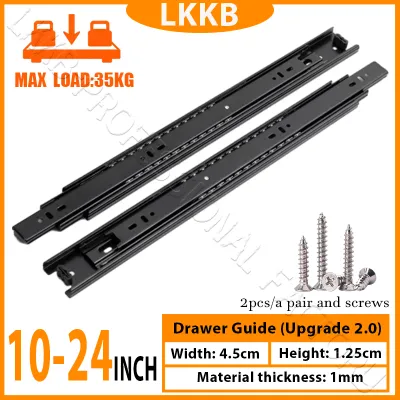
565 Lazada user ratings
Versatile for table installation, Excellent value for money, Smooth and silent operation,
Effortless drawer sliding experience, High-quality ball bearing mechanism,
Smooth and silent operation, Convenient soft closure feature
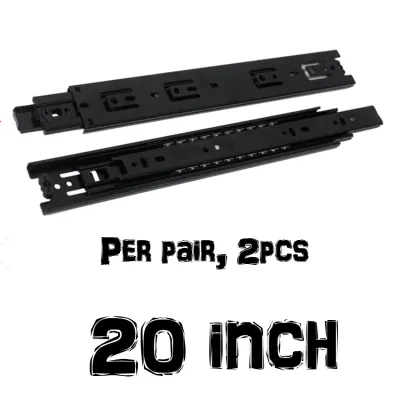
763 Lazada user ratings
for 60cm drawers, my carpenter asks me to buy a little less shorter drawer guides so it its 24 inches, 18-20incheals lenght is just right
🔧Ease of Installation:Sleek and modern design, Provides a clean and tidy appearance, Ensures safety with its soft close feature,
Great value for the price, Enhances the functionality of your furniture, much cheaper than those from Handyman, Ace, etc.

2,351 Lazada user ratings
Ingenious hole design for easy assembly, High-quality materials ensure durability, Versatile sizes available for different table installatio…Read full reviewShow less
Ingenious hole design for easy assembly, High-quality materials ensure durability, Versatile sizes available for different table installations, Excellent craftsmanship, every detail is perfect, Sturdy ball bearing for smooth sliding motion, Sleek and modern design enhances any furniture,
🏅Material Quality:very good 🔧Ease of Installation:madali lang 🛠️Durability:100 High-quality materials ensure durability, Easy installation, p…Read full reviewShow less
🏅Material Quality:very good 🔧Ease of Installation:madali lang 🛠️Durability:100 High-quality materials ensure durability, Easy installation, perfect for DIY projects, Hydraulic mechanism ensures effortless operation, ....
Excellent craftsmanship, every detail is perfect, Easy installation, perfect for DIY projects, Smooth and quiet drawer slides, High-quality …Read full reviewShow less
Excellent craftsmanship, every detail is perfect, Easy installation, perfect for DIY projects, Smooth and quiet drawer slides, High-quality materials ensure durability, Hydraulic mechanism ensures effortless operation,
Hydraulic mechanism ensures effortless operation, Easy installation, perfect for DIY projects, Sleek and modern design enhances any furnitur…Read full reviewShow less
Hydraulic mechanism ensures effortless operation, Easy installation, perfect for DIY projects, Sleek and modern design enhances any furniture, Smooth and quiet drawer slides,
Versatile sizes available for different table installations, Excellent craftsmanship, every detail is perfect,
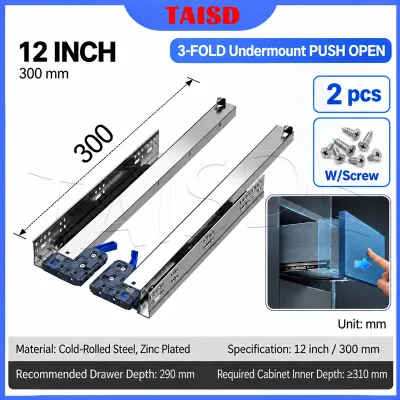
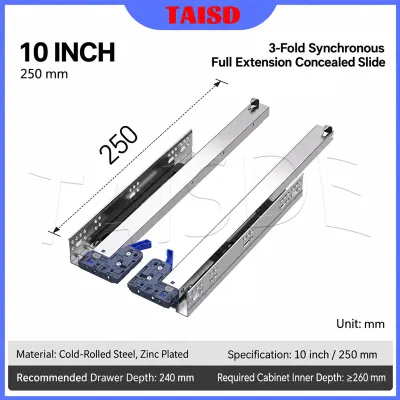
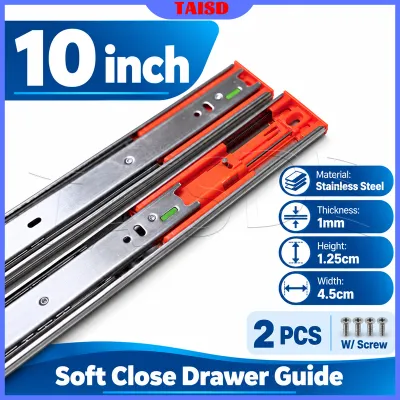
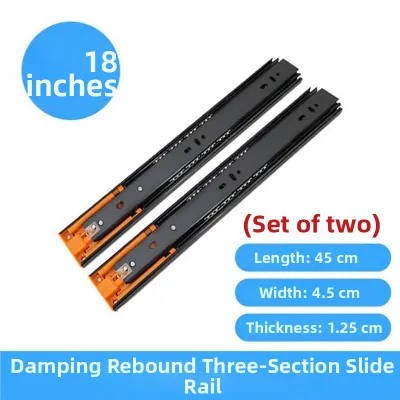
3 Lazada user ratings
ok na to sukat na sukat. salamat st meron cya kasama na tornilyo hindi kagaya ni Mogee Hardware wala kasama na tornilyo pero intayin ipadala…Read full reviewShow less
ok na to sukat na sukat. salamat st meron cya kasama na tornilyo hindi kagaya ni Mogee Hardware wala kasama na tornilyo pero intayin ipadala.
Prices are valid at publication and may change. Please refer to the product page for the latest price.
Because there is no single universal standard for heavy-duty hardware dimensions, you must verify the exact manufacturer-specified side clearance on the product label, packaging, or technical manual. Never assume that a slide labeled as heavy-duty will match the dimensions of a model you have used in the past. Even a minor variation of one millimeter can prevent the slide from engaging properly or cause it to lock up entirely once weight is applied.
The mechanical consequences of improper clearance are severe and immediate. If the clearance is too narrow, the slide components will be compressed, leading to extreme friction, noisy operation, and rapid wear of the ball bearings. Conversely, if the clearance is too wide, the drawer box will have excessive lateral play, which forces the slides to flare outward. This misalignment reduces the load capacity of the guides, risks stripping the mounting screws, and can cause the drawer to unexpectedly drop off its tracks when fully extended.
Essential Tools for Measuring Cabinet and Drawer Dimensions
To achieve the level of accuracy required for heavy-duty hardware installation, you must use the right measuring instruments. While a standard flexible tape measure is excellent for determining general cabinet depth and height, it can introduce slight errors when measuring tight internal widths due to the play in the end hook. For the most precise side-clearance calculations, supplement your tape measure with a rigid steel ruler or a digital caliper, which allows you to measure small gaps and material thicknesses down to a fraction of a millimeter.

A carpenter’s square or a combination square is equally indispensable for this project. Cabinet carcasses and drawer boxes are rarely perfectly square, even in high-quality furniture. A square allows you to check the internal corners of the cabinet opening and the external corners of the drawer box to identify any racking or twisting. If the opening is out of square, a simple width measurement at the front face will not represent the actual space available deeper inside the cabinet.
Before you begin pulling measurements, prepare a dedicated notepad or digital sheet to record your findings systematically. Label each measurement clearly—such as ‘Cabinet Internal Width – Front, Middle, Back’—and write down the exact numbers immediately. Avoid relying on memory or performing mental math on the fly, as transposing even two digits can lead to incorrect cuts or purchasing the wrong size of heavy-duty guides.
How to Measure the Cabinet Opening Accurately
Measuring the internal cabinet carcass requires a methodical approach that accounts for structural inconsistencies. Begin by measuring the internal width of the cabinet opening at three distinct points: the very front, the middle, and the rear. Within each of these zones, take measurements at both the top and the bottom of the opening. Record all six dimensions and identify the smallest measurement; this narrowest point represents the absolute maximum width limit for your drawer and slide assembly.
Next, measure the internal depth of the cabinet carcass from the inside of the front face (or the front edge of the cabinet side panel) to the back panel. When taking this measurement, look closely for any internal obstructions that could interfere with the slide or the drawer box. Common obstacles include protruding hinge plates, back braces, pocket-hole screws, or face-frame overhangs. Your usable depth is determined by the distance from the front edge to the forward-most face of any rear obstruction.
Finally, measure the internal height of the cabinet opening from the floor of the cabinet to the top rail or underside of the countertop. You must ensure there is adequate vertical clearance not only for the drawer box itself but also for any vertical space the heavy-duty slide requires during installation and operation. Some heavy-duty guides feature tall profiles that require significant vertical clearance above and below the drawer box to allow for easy mounting and removal.
How to Measure the Drawer Box for Heavy Duty Slides
If you are retrofitting an existing drawer box or building a new one to fit heavy-duty slides, you must measure its external dimensions with extreme care. Measure the exact outside width of the drawer box at the front, middle, and back. Just as with the cabinet opening, wood can warp or bow, meaning the drawer might be wider in the center than at the ends. Use the widest measurement of the drawer box as your baseline for all clearance calculations.
Verify the overall depth of the drawer box from the front face to the back panel, excluding any decorative drawer fronts. Compare this depth against the internal cabinet depth you recorded earlier and the nominal length of the heavy-duty slides you plan to install. The slide length should generally match the drawer box depth, but you must ensure the cabinet has enough rear clearance to accommodate the full length of the slide housing without bottoming out against the back wall.
In addition to physical dimensions, inspect the drawer box for squareness and structural integrity. Heavy-duty slides are designed to carry substantial loads, which places immense stress on the drawer joints. Check the corners with your carpenter’s square to ensure they form precise 90-degree angles. If the drawer box is weak, racked, or constructed from thin material, the weight of the contents can cause the box to twist during use, misaligning the slides and causing them to bind.
Calculating Side Clearance and Verifying the Fit
Once you have gathered all your measurements, you can perform the calculations to verify if your drawer and cabinet are compatible with your chosen heavy-duty guides. Start by taking the minimum internal cabinet width you recorded and subtracting the maximum external drawer box width. The resulting number represents the total available lateral space inside the cabinet carcass.
To find the available clearance for each side, divide this total remaining space by two. For example, if your minimum cabinet width is 500 millimeters and your maximum drawer width is 462 millimeters, the total remaining space is 38 millimeters. Dividing this by two gives you exactly 19 millimeters of clearance per side. You must then compare this calculated value directly against the clearance specification provided by the slide manufacturer.
If your calculated clearance does not match the manufacturer’s required tolerance, you must take corrective action before proceeding with the installation. If the gap is too narrow, you may need to trim down the sides of the drawer box or construct a new, narrower drawer. If the gap is too wide, you can install precise wooden shims or mounting spacers along the cabinet walls to reduce the opening width, ensuring the spacers are perfectly flat, parallel, and securely fastened to the cabinet carcass.
Pre-Installation Checks Before Mounting the Guides
Before driving any screws into your cabinet or drawer, perform a final physical inspection to ensure a successful installation. Verify that the cabinet walls are plumb and parallel to one another. If the cabinet sides taper inward or outward toward the back, the slide tracks will not run parallel, causing the drawer to bind as it is pushed in. You can use a level and a spacer block cut to the exact width of the opening to check for parallel alignment from front to back.
Examine the internal mounting surfaces of the cabinet for any imperfections. Sand down any uneven joints, glue squeeze-outs, or rough wood grain that could prevent the slide from sitting perfectly flat against the cabinet wall. A heavy-duty slide must make full, continuous contact with its mounting surface to distribute the weight of the loaded drawer evenly and prevent the metal tracks from flexing under load.
Consider the structural capacity of the cabinet carcass itself. Heavy-duty drawers can hold significant weight, which exerts strong downward and pulling forces on the cabinet walls and joints. Ensure the cabinet material—whether solid wood, plywood, or medium-density fiberboard—is thick enough to hold the mounting screws securely without stripping. If the cabinet walls are thin or made of low-density particleboard, you may need to reinforce the mounting areas with solid wood backing strips.
If you discover that the cabinet carcass is severely warped, structurally weak, or out of square beyond what simple shims can correct, pause the project. Attempting to force heavy-duty slides into a compromised cabinet will only lead to damaged hardware and ruined cabinetry. In these situations, consulting a qualified carpenter or furniture professional is the best way to ensure your storage system is safe, functional, and built to last.

Community discussion
Share your experience or ask a question. Comments are reviewed before publication.