
Finding the perfect balance between storage and personal styling in a compact bedroom requires a strategic approach. A dresser with drawers that doubles as a vanity must satisfy two distinct needs: it must offer ample, organized drawer space for your wardrobe and provide a comfortable, durable tabletop surface for your daily grooming routine. The ideal solution for a tight space is a multi-functional unit—such as a low-profile wide dresser, a tall chest with an integrated pull-out desk, or a corner-fitting L-shaped unit—built with moisture-resistant materials that can handle both cosmetics and tropical humidity.
Optimizing a small room is about choosing furniture that performs double duty without sacrificing floor space. By selecting a dresser with drawers that features a suitable height, depth, and finish, you can consolidate your morning routine and clothing storage into a single piece of furniture. This layout keeps your bedroom organized, functional, and visually open.
Measuring Your Small Bedroom for a Dresser and Vanity Setup
Before shopping for any new furniture, you must accurately assess your available floor space to define the minimum functional requirements for your dual-purpose setup. Start by measuring the intended wall or corner with a standard tape measure. Be sure to account for protruding baseboards, door swings, and window sills, as even a few centimeters of miscalculation can prevent a dresser from fitting flush against the wall.
Products mentioned in this guide
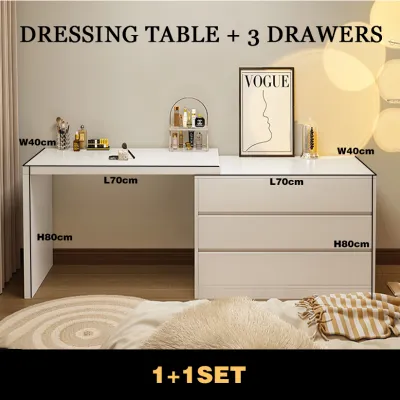
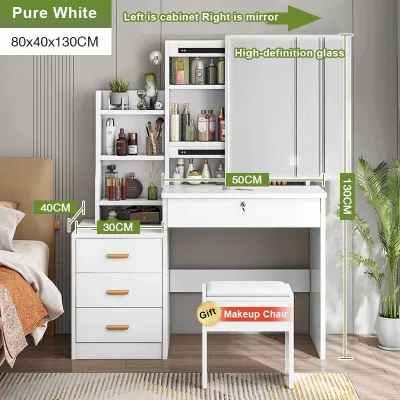
Prices are valid at publication and may change. Please refer to the product page for the latest price.
Your bedroom entry door and closet doors require clear swing paths to operate properly. If a door swings inward toward the dresser, it will limit your usable depth and potentially cause collisions. Window sills are another critical factor; if your dresser is too tall, it might block natural light or prevent the window from opening, which can disrupt the room’s ventilation and brightness.
A functional vanity surface requires a minimum width of 80 centimeters and a depth of at least 40 to 45 centimeters. This footprint ensures you have enough room to set down a freestanding tabletop mirror, organize a small makeup tray, and move your elbows freely without knocking items over. Anything smaller will feel cramped and restrict your daily grooming routine.
Maintaining clear walking paths is essential to keep a small bedroom from feeling claustrophobic. Aim to keep a clear walkway of at least 60 centimeters between the edge of the dresser and any adjacent furniture, such as your bed or wardrobe. This ensures you can move around the room comfortably without having to squeeze past your vanity chair.
To calculate the exact remaining footprint for your dresser with drawers, measure your existing bed frame, wardrobe, and bedside tables first. Subtract their combined footprint from your total room area. Additionally, verify that the packaged dresser can fit through your home’s doorways, hallways, and condominium service lifts to avoid delivery-day complications.
Top Dresser with Drawers Configurations for Small Spaces
Selecting the right furniture configuration depends on whether you have more horizontal wall space or vertical clearance. Choosing a dual-purpose setup allows you to consolidate your morning routine and clothing storage into a single piece of furniture, saving valuable floor space.

Wide and Low-Profile Dressers
- Surface Area: These units typically stand around 75 to 80 centimeters high, which aligns perfectly with standard desk heights. The broad, uninterrupted top surface provides ample space to spread out cosmetics, hair tools, and jewelry trays during use.
- Visual Weight: Because they sit low to the ground, they keep your visual line of sight open. This prevents a small bedroom from feeling cramped or dark. You can easily mount a large decorative mirror on the wall directly above the dresser to enhance the illusion of space.
- Drawer Capacity: Before purchasing, verify the internal drawer depth. Low-profile dressers sometimes feature shallower drawers, which are excellent for cosmetics and undergarments but may limit your ability to store bulky clothing or thick linens.
Tall Chests with Pull-Out or Fold-Down Desks
- Vertical Footprint: When floor space is exceptionally tight, vertical storage is the most practical path forward. A tall chest of drawers utilizes height rather than width, leaving more open floor space for walking and daily movement.
- Hinge and Weight Limits: Some modern tall chests feature a middle drawer front that folds down or slides out to reveal a hidden vanity desk. When using this setup, always check the manufacturer's specified weight limits and the durability of the hinges or drawer runners to ensure they can support the weight of your arms and vanity accessories.
- Ergonomic Height: Ensure the height of the folded-down desk is comfortable for sitting. A surface that sits too high or too low can cause neck and shoulder strain during longer grooming sessions.
Corner or L-Shaped Dresser Units
- Corner Optimization: Corner-optimized and L-shaped dresser units are designed to transform underutilized bedroom corners into highly functional hubs. By wrapping around the corner, these units maximize both drawer storage and tabletop surface area without extending deep into the center of the room.
- Zoned Functionality: In an L-shaped configuration, one side of the unit can be dedicated to your vanity setup, complete with a mirror and lighting, while the perpendicular side serves as standard drawer storage for folded clothes.
- Wall Clearance: Be sure to measure the corner angles and wall lengths precisely. Standard L-shaped units require specific clearances on both adjoining walls, and even a minor misalignment in your wall's angle can prevent a pre-assembled unit from sitting flush.
Essential Clearances and Dimensions for a Comfortable Vanity
Ergonomics are crucial when a dresser serves a dual purpose. Standard vanity desk surfaces sit between 75 and 76 centimeters high. To maintain a comfortable posture, pair this setup with a stool or chair that has a seat height of 43 to 45 centimeters, leaving about 30 centimeters of clearance for your legs.
Rear clearance is another essential factor. You need at least 60 to 75 centimeters of open space behind the vanity chair to slide it back, sit down, and stand up comfortably. If the chair collides with your bed frame or wardrobe doors every time you move, the setup will quickly become frustrating.
Front clearance for the drawers is equally important. Standard dresser drawers require 30 to 45 centimeters of space to slide fully open. If you plan to access your makeup, hair tools, or clothing while seated at the vanity, ensure the drawers can extend fully without hitting your knees or the vanity stool.
Always cross-reference these clearance calculations with the detailed product dimensions provided by the manufacturer. Additionally, check the furniture’s load capacity and stability ratings. For safety, especially with tall or heavy drawer units, plan to anchor the dresser securely to the wall to prevent tipping when multiple drawers are pulled open.
Choosing the Right Surface Finish for Cosmetics and Humidity
The climate in the Philippines, characterized by high relative humidity and warm temperatures, demands careful material selection for any bedroom furniture. When a dresser is used as a vanity, the top surface must also withstand exposure to liquid foundations, alcohol-based perfumes, oils, and harsh nail polish removers.
Look for non-porous, sealed surfaces that resist staining and moisture penetration. High-pressure laminates, tempered glass toppers, and fully sealed engineered wood with polyurethane finishes are excellent choices because they can be easily wiped clean with a damp cloth.
Moisture-resistant edge banding, such as thick ABS or PVC banding, is critical. In humid environments, unsealed edges on particleboard or MDF can absorb airborne moisture, causing the material to swell, warp, or peel over time.
Avoid raw, untreated, or highly textured wood surfaces for the vanity top. These surfaces easily trap cosmetic dust, powder, and spills, making them difficult to sanitize and highly prone to permanent staining. Always review the manufacturer’s care instructions and material specifications to confirm the finish is rated for daily cosmetic use and easy cleaning.
If you are budgeting for a high-quality unit, expect prices to range from entry-level options to premium solid wood or custom designs starting around ₱5,000 to ₱15,000 or more, depending on the materials and built-in features.
Common Sizing and Placement Mistakes to Avoid
One of the most common mistakes is ignoring the “drawer open” footprint. Homeowners often measure the dresser only when the drawers are closed, only to find that opening a drawer completely blocks the main walkway or strikes the bed frame.
Choosing a dresser with excessive depth is another frequent error. While deep drawers offer more storage, a unit that protrudes too far into a small bedroom restricts central circulation, making the entire room feel claustrophobic and restricted.
Be mindful of placement relative to natural light and climate control. Avoid positioning your vanity area directly in front of a window where it blocks natural light, or in a spot that obstructs the airflow from your wall-mounted air conditioning unit. Blocking AC airflow can lead to uneven cooling and increased energy consumption.
Finally, plan for power access. Before finalizing your dresser’s position, identify the location of electrical outlets. You will need convenient access to outlets for plug-in vanity mirrors, hair dryers, straighteners, and phone chargers without running hazardous extension cords across the floor.
Community discussion
Share your experience or ask a question. Comments are reviewed before publication.