
Fitting a black vanity table into a small bedroom requires a careful balance of physical clearance and visual weight. While dark furniture is highly sought after for its sleek, modern, and dramatic look, its light-absorbing properties can easily overwhelm a compact space if the layout is not planned correctly. To achieve a harmonious setup, you must select a configuration that maximizes floor space, prioritize smart storage, and use strategic lighting to offset the heavy visual footprint of a dark finish. By taking precise measurements and choosing a design tailored to your specific room layout, you can enjoy the elegance of a black vanity without making your bedroom feel cramped or cluttered.
Assessing Your Bedroom Space and Clearance Needs
Before browsing online catalogs or visiting furniture showrooms, you must accurately map out your bedroom’s physical limits. Start by measuring the exact wall space where you plan to position the vanity. Use a metal measuring tape to record the width, depth, and height of the available area. Do not rely on visual estimates; even a discrepancy of two or three centimeters can prevent a drawer from opening or block a nearby closet door. When measuring, take note of architectural details that could interfere with your setup, such as low window sills, wall outlets, light switches, air conditioning units, and baseboards.
Once you have the raw dimensions of the wall, define your clearance zones. A common mistake is only measuring the footprint of the vanity table itself while ignoring the space required for active use. To sit comfortably and pull out a vanity stool or chair, you need a minimum clearance of 60 to 75 centimeters behind the table. Furthermore, you must account for the depth of fully extended drawers or cabinet doors, which typically require an additional 30 to 45 centimeters of front clearance. If these zones overlap with your bed frame, wardrobe, or bedroom entry door, you risk creating a constant physical bottleneck.
Products mentioned in this guide


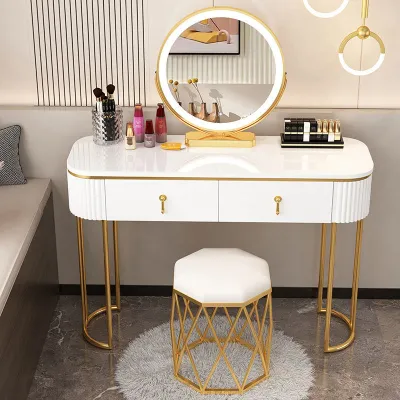

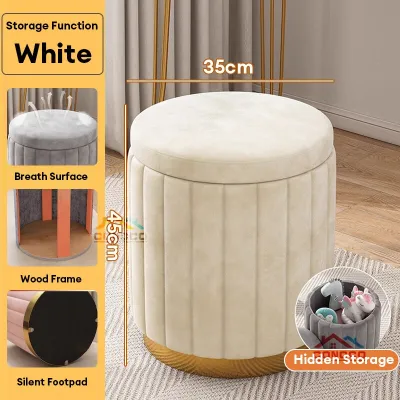
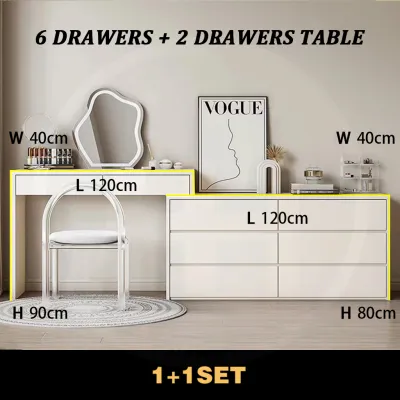
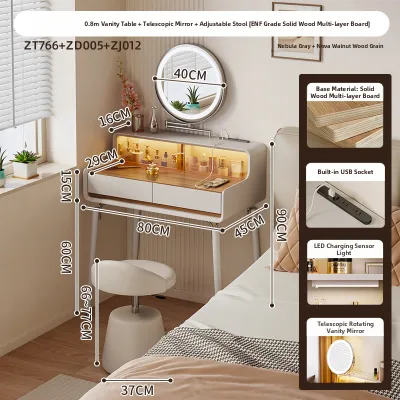
Prices are valid at publication and may change. Please refer to the product page for the latest price.
Next, analyze the primary traffic paths of your bedroom. Draw a simple floor plan on paper or use a mobile layout app to trace how you move from the doorway to the bed, and from the bed to the closet or bathroom. Your vanity should sit entirely outside these high-traffic lanes. If you must place the vanity along a main walkway, opt for a model with rounded corners to prevent painful bumps in tight spaces.
Finally, plan for the delivery and assembly process. A vanity table might fit perfectly in its designated corner, but it first has to get there. Measure the width and height of your bedroom door, narrow hallways, tight staircase turns, and condominium service lifts. If you live in a high-rise building, check the property management’s elevator dimensions and delivery guidelines. Choosing a flat-packed vanity that you assemble inside the bedroom can often bypass these tight transit obstacles, provided you have enough floor space to safely lay out the parts during assembly.
Ideal Dimensions and Configurations for Compact Rooms
Selecting the right silhouette is key to integrating dark furniture into a tight space. Standard vanity tables often feature deep drawers and wide tabletops that are designed for spacious dressing rooms. For a compact bedroom, you must look for specialized configurations that minimize floor obstruction while maintaining practical utility.

Narrow and Corner Vanity Designs
When floor space is at a premium, a narrow-depth black vanity table is one of the most efficient options. Standard dressers and desks typically have a depth of 50 to 60 centimeters, but space-saving vanities often reduce this depth to a slim 30 to 40 centimeters. This shallow profile allows the table to sit flush against short wall segments, behind doors, or at the foot of your bed without protruding into major walkways.
Another highly effective layout strategy is utilizing corner or L-shaped vanity designs. Corners are frequently left as dead space in small bedrooms, making them the perfect home for a triangular vanity. A corner black vanity table naturally tucks away, keeping the center of the room open and airy. However, before purchasing a narrow or corner model, you must carefully verify the internal drawer dimensions. Shallow depths and angled corners often mean that drawer space is limited. If you use tall skincare bottles, large eyeshadow palettes, or bulky acrylic makeup organizers, measure them beforehand to ensure they can actually fit inside the vanity’s compact drawers.
Wall-Mounted and Floating Options
If you want to maximize the feeling of openness in a small bedroom, a wall-mounted or floating black vanity is an excellent alternative to traditional floor-standing models. By eliminating table legs entirely, a floating vanity exposes the floor beneath it. This visual trick makes the room feel significantly larger and less congested. It also simplifies your cleaning routine, allowing you to easily sweep or vacuum underneath the unit.
However, installing a wall-mounted vanity requires strict attention to structural safety. You must verify your bedroom wall’s composition and weight-bearing capacity before mounting any furniture. In many Philippine homes, walls are constructed from hollow concrete blocks, solid concrete, or drywall over metal studs. Lightweight drywall anchors are not sufficient for a floating vanity, which must support not only its own weight but also the pressure of you leaning on it during use. Always secure the mounting brackets directly into wall studs or use heavy-duty masonry anchors for concrete walls.
Additionally, floating designs require careful planning for cable management. If your black vanity features built-in LED mirrors, USB charging ports, or outlets for hair styling tools, the power cords will hang down visibly unless managed. Plan to install the vanity directly over an existing wall outlet, or use paintable cable raceways that match your wall color to keep the cords hidden and tidy.
Space-Saving Features and Visual Balance for Dark Furniture
To make a black vanity table work in a small room, you must look for smart design features that serve multiple purposes while managing the visual weight of dark furniture. Black is a bold, dominant color that absorbs light, which can make a small room feel visually heavy if it is not balanced by clever design choices and contrasting elements.
First, prioritize multi-functional furniture pieces. A vanity table that doubles as a writing desk or a laptop station is an excellent way to save space. Look for designs featuring a flip-top mirror. When you need to apply makeup, you lift the lid to reveal a mirror and hidden storage compartments. When you are finished, you close the lid to create a flat, clean surface for working or studying. This hidden storage system is incredibly useful for keeping clutter out of sight, which is essential because visual clutter makes small rooms feel even smaller.
In addition to flip-top compartments, look for integrated vertical storage. Vanities with built-in drawer dividers, side shelves, or pegboards allow you to store your beauty products vertically rather than spreading them across the tabletop. This keeps the surface of your black vanity clean and minimalist.
To balance the dark color of the vanity, you must use contrast and lighting strategically. Pair your black vanity table with a light-colored wall backdrop, such as off-white, cream, beige, or soft pastel tones. This high contrast prevents the dark furniture from blending into a dark corner and creating a gloomy shadow. You can also place a large, frameless mirror above the vanity. The reflective surface of the mirror will bounce natural light around the room, instantly brightening the space and making it feel more expansive.
The finish of your black vanity also plays a significant role in how it interacts with light. Matte black finishes offer a modern, sophisticated look and reduce glare from ring lights or overhead bulbs. However, in the humid tropical climate of the Philippines, matte surfaces can easily show fingerprint oils, sweat, and dust. Glossy black finishes, on the other hand, reflect light and help make the room feel brighter, but they require frequent cleaning to keep them free of dust and smudges. Consider your room’s natural lighting and your willingness to perform daily maintenance when choosing between matte and glossy finishes.
Common Sizing and Placement Mistakes to Avoid
When setting up a black vanity in a tight space, small planning errors can lead to daily frustration. Recognizing these common pitfalls beforehand will help you create a functional and comfortable grooming station.
One of the most frequent mistakes is ignoring the “chair footprint.” Many people measure the vanity table perfectly but forget to account for the stool or chair when it is not in use. If your vanity chair cannot slide completely underneath the table, it will permanently protrude into your walking space. When shopping, always compare the distance between the vanity legs with the width of your chosen stool to ensure a seamless fit. If space is exceptionally tight, consider a backless stool that can be tucked entirely out of sight under the vanity frame.
Another critical error is placing the vanity in a position that blocks natural light. While it might seem convenient to place your vanity next to a window, doing so can block precious daylight from entering your small room. Furthermore, applying makeup with natural light coming from only one side creates uneven shadows on your face. For the best results, place your vanity adjacent to a window so light washes across your face evenly, or rely on high-quality artificial lighting.
You must also watch out for door and drawer collisions. Before finalizing the vanity’s position, check that its drawers can open fully without hitting your bed frame, nightstand, or wardrobe doors. If your bedroom has sliding closet doors, ensure the vanity does not block the sliding path. If space is extremely tight, look for vanities with open shelving or sliding cabinet doors instead of outward-swinging ones.
Finally, do not rely solely on your bedroom’s overhead ceiling light. Overhead lighting casts harsh shadows downward, emphasizing under-eye circles and making precise grooming difficult—a problem made worse by a dark table surface that absorbs light rather than reflecting it. To prevent this, always install dedicated, front-facing vanity lighting. Position LED strip lights or vanity bulbs at eye level on both sides of the mirror to provide even, shadow-free illumination. If you are renting or cannot install permanent wall lights, look for a black vanity table with a built-in LED mirror or use a plug-in lighted makeup mirror.
Frequently Asked Questions (FAQ)
Can a black vanity table make a small room look smaller?
A black vanity table does not inherently make a small room look smaller, but its placement and styling determine its visual impact. Because black absorbs light, a bulky dark vanity placed in a poorly lit corner can create a heavy, shadowed area that visually shrinks the room. However, you can easily counter this effect by creating high contrast and maximizing light reflection. Position the vanity against a light-colored wall (such as soft cream or light gray) to make its silhouette pop cleanly. Additionally, pair the table with a large frameless mirror and bright, front-facing LED vanity lights. These reflective and luminous elements bounce light back into the bedroom, maintaining an open, airy feel while showcasing the sophisticated, modern aesthetic of your black vanity.
How do I ensure a wall-mounted vanity is safe to install?
Ensuring the safety of a wall-mounted floating vanity requires verifying your wall’s structural integrity and using the correct mounting hardware. First, identify your wall type. If your bedroom wall is made of drywall, you must locate the wood or metal studs using a stud finder and secure the vanity’s mounting brackets directly into them; drywall alone cannot support the weight. If your wall is made of concrete or hollow blocks, which is common in Philippine homes, you must use heavy-duty masonry wall plugs and screws. Always check the manufacturer’s specified weight limit for both the vanity and the mounting hardware, and remember to factor in the weight of your stored cosmetics and the physical pressure you apply when leaning on the table. If you are unsure of your wall’s construction or need to route electrical wiring for integrated lighting, it is highly recommended to hire a qualified local carpenter or handyman to complete the installation safely.
Community discussion
Share your experience or ask a question. Comments are reviewed before publication.