
Determining the right foldable shoe box organizer requires matching your specific closet dimensions with the physical footprint of your footwear collection. By accurately measuring your available space, assessing the types of shoes you own, and verifying the structural limits of the organizers, you can select a configuration that maximizes storage efficiency without compromising accessibility or stability.
Measure Your Closet Space and Physical Boundaries
Before purchasing any organizers, you must establish the exact physical boundaries of your closet. Start by measuring the depth, width, and vertical height clearance of each shelf where you plan to place the boxes. Use a metal measuring tape for accuracy, as fabric tapes can stretch and lead to incorrect calculations. Write down these dimensions and keep them handy when browsing different organizer options.
Do not rely solely on open shelf space; you must also account for physical obstructions within the closet. Check the door swing radius of your closet doors to ensure that the boxes will not block them from closing or opening fully. If you have sliding doors, measure the overlap area where the doors meet, as this can restrict access to the sides of your shelves.
Products mentioned in this guide
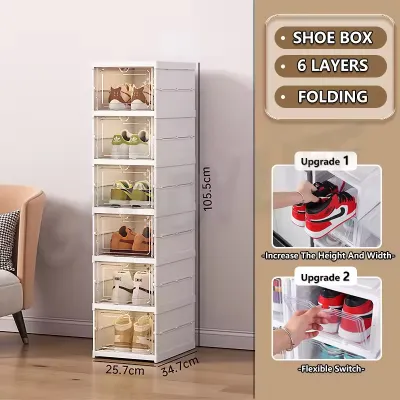
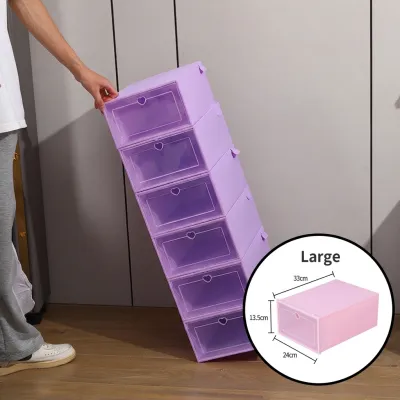
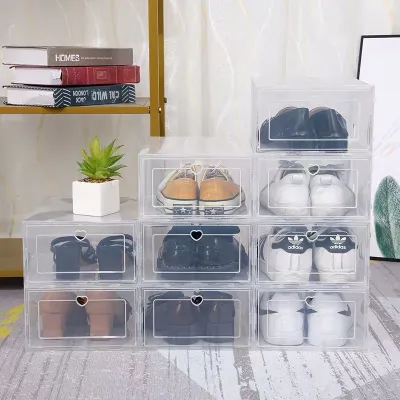
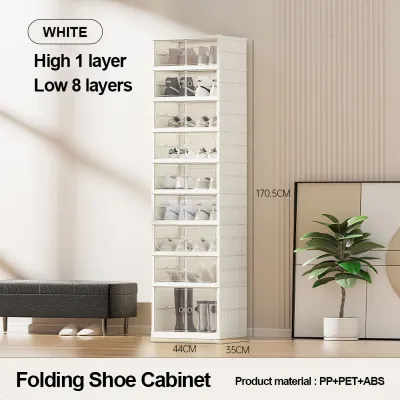
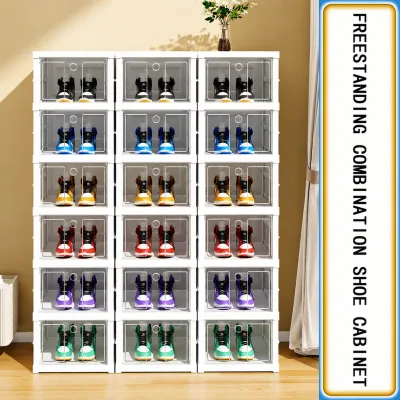
Prices are valid at publication and may change. Please refer to the product page for the latest price.
Take note of hanging clothes clearance if your shelves sit directly beneath a hanging rod. Long dresses, trousers, and jackets can drape over the shelves, reducing the usable height and potentially blocking the front doors of your shoe boxes. Ensure there is enough clearance between the bottom of your hanging garments and the top of your planned shoe box stack.
Additionally, inspect the closet for internal obstructions such as hinges, baseboards, or support brackets. These features can reduce the usable width or depth by a few centimeters, which might prevent a row of boxes from fitting flush against the wall. If you plan to stack the organizers directly on the closet floor, check for any slope, as an uneven floor will compromise the stability of a tall stack.
Assess Your Footwear Collection for Capacity Needs
Once you have mapped out your closet space, turn your attention to your footwear collection. Group your shoes by their physical profile rather than their color or style. For example, separate low-profile footwear like sandals, flats, and slippers from bulkier items like high-top sneakers, platform heels, and ankle boots.

Count the exact number of pairs in each category to determine your total capacity needs. This step prevents you from buying too few boxes or over-purchasing units that will sit empty and take up valuable space. Knowing the volume of each shoe type also helps you decide whether you need standard-sized boxes or larger, specialized containers.
At this stage, you must decide between a uniform sizing strategy or a mixed-size configuration. Using identical boxes throughout your closet creates a clean, streamlined aesthetic that looks highly organized. However, if your collection includes a wide variety of shoe heights, uniform boxes might result in wasted vertical space above low-profile shoes, or force you to store taller shoes on their sides.
A mixed-size approach optimizes spatial efficiency by matching the box height to the shoe profile. You can use shorter boxes for flats and sandals, and taller boxes for boots and heels. If you choose this route, verify that the different box sizes from the same manufacturer are designed to interlock or stack securely together, as mismatched brands rarely align properly.
Match Box Dimensions to Your Closet Layout
With your closet measurements and shoe counts ready, you can begin matching box dimensions to your layout. Compare the exterior dimensions of the organizers against your shelf width to calculate how many units can fit side-by-side. For instance, if your shelf is 90 centimeters wide and a single box is 22 centimeters wide, you can comfortably fit four boxes across, leaving a small gap for easy removal.
Do the same calculation for shelf depth to see if you can place boxes front-to-back. Double-row stacking works well for seasonal footwear that you do not need to access daily, but it requires you to move the front boxes to reach the back ones. If you choose a double-row layout, ensure the shelf depth can accommodate two full box lengths without protruding past the shelf edge.
Plan your vertical stacking arrangements by checking the height of your shelves against the stacked height of the boxes. Remember to account for the interlocking ridges or tabs on the top and bottom of each box, which can add a few millimeters to the overall height of the stack. Always verify the load capacity of your closet shelves before building a tall stack, as heavy footwear can cause shelves to sag over time.
The choice between front-opening and top-opening designs depends heavily on your shelf clearance. Top-opening boxes are generally unsuitable for stacked configurations because you must unstack the boxes every time you want to retrieve a pair. Front-opening designs, featuring drop-down doors or pull-out drawers, allow you to access your shoes easily while keeping the stack intact, making them the preferred choice for tight closet spaces.
Evaluate Stability, Materials, and Access Designs
The durability and safety of your storage system depend on the quality of the materials and the structural design of the organizers. Examine the thickness of the plastic or cardboard panels used in the construction. Thin, flimsy plastics tend to bow under the weight of heavy shoes, which can cause the entire stack to lean or collapse.
Look for organizers that feature reinforced plastic frames, sturdy corner joints, and secure interlocking mechanisms. These structural elements distribute the weight evenly across the stack, ensuring that the bottom boxes do not buckle under the load of the units above them. A secure locking system between stacked boxes is essential to prevent them from sliding or tipping over when you open the doors.
Pay close attention to the folding mechanism of the boxes. High-quality foldable organizers should expand easily and lock firmly into place with a secure snap. If the folding joints feel loose or fail to snap securely, the box may lose its shape over time, making it difficult to open and close the front door smoothly.
In tropical climates like the Philippines, managing humidity inside a closed closet is a constant challenge. Excess moisture can trap odors and encourage mold growth on leather, canvas, and suede shoes. To protect your collection, choose organizers equipped with built-in ventilation panels, rear air vents, or breathable mesh sections that promote continuous airflow while keeping dust out.
Common Sizing and Layout Mistakes to Avoid
One of the most common mistakes when choosing a foldable shoe box organizer is confusing the interior capacity with the exterior dimensions. Manufacturers often list the outer measurements to help you fit the boxes on your shelves, but the internal space is always slightly smaller due to the thickness of the walls and the folding frame. Always check the internal dimensions to ensure your shoes will actually fit inside without being bent or compressed.
Another frequent oversight is failing to account for the clearance required to open the box doors. Drop-down front doors need space to swing downward, while pull-out drawers require a clear path directly in front of the stack. If your closet has tight clearances or sliding doors, a drawer design might get blocked, making a drop-down door or a side-opening door a more practical choice.
Finally, do not overlook the physical bulk added by interlocking ridges, side clips, and external frames. While these features are necessary for stability, they can add several millimeters to the width and height of a stacked row. If your closet measurements are extremely tight, this extra bulk can prevent the final box in a row from fitting onto the shelf, forcing you to alter your entire layout.
Frequently Asked Questions (FAQ)
Will standard foldable shoe boxes fit high heels or ankle boots?
Standard foldable shoe boxes are typically designed for low-profile footwear like sneakers, flats, and loafers. High heels and ankle boots usually require extra vertical clearance to stand upright without bending the shafts or crushing the heels. Before purchasing, measure the height of your tallest heels and boots, then compare these measurements to the internal height specifications of the boxes. If your shoes exceed the standard height, look for specialized high-top or boot-sized organizers, or consider storing taller shoes on their sides if the box width allows.
How high can I safely stack foldable shoe boxes?
The safe stacking height of foldable shoe boxes depends on the material thickness, frame reinforcement, and the weight of the shoes inside. While some heavy-duty plastic organizers can be stacked up to ten units high, lighter or unreinforced models may begin to lean or buckle after four or five layers. To maintain stability, always place your heaviest shoes, such as boots and leather dress shoes, in the bottom boxes of the stack. Check the manufacturer’s guidelines for specific stacking limits, and ensure the stack is placed on a completely level surface to prevent tipping.
Community discussion
Share your experience or ask a question. Comments are reviewed before publication.