
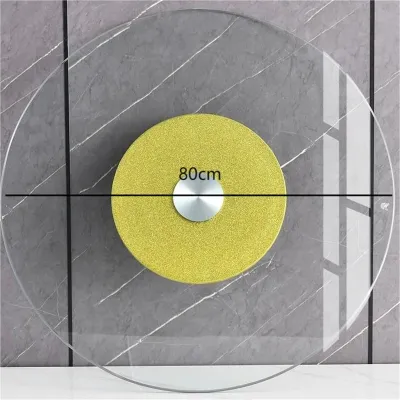
Finding the right lazy susan size for a 6-10 person dining table requires balancing the turntable’s diameter with the space needed for individual place settings. For a standard family gathering in the Philippines, where shared dishes like large platters of rice, main courses, and soup bowls are central to the meal, the turntable must be large enough to hold multiple serving dishes but small enough to prevent crowding. Generally, a table seating 6 to 10 people requires a lazy susan diameter ranging from 50 to 80 centimeters, depending on whether the table is round, oval, or rectangular. The key is maintaining a clear border of at least 30 to 40 centimeters around the entire perimeter of the table to accommodate plates, utensils, drinking glasses, and comfortable elbow room.
Assessing Your Table Shape and Usable Center Space
Before purchasing a turntable, you must measure the total width or diameter of your dining table to establish its maximum physical boundary. A round table naturally offers a single, symmetrical central zone that is ideal for a circular lazy susan. For instance, a round table with a diameter of 150 centimeters provides a generous center that can easily accommodate a large rotating tray while keeping all dishes equidistant from the guests.
Rectangular and oval tables present a different spatial dynamic. Because these shapes are elongated, a single round turntable placed in the exact center will only serve the guests seated in the middle. Those sitting at the far ends of a long rectangular table will still have to stretch or stand up to reach the rotating items. For rectangular setups seating 8 to 10 people, you may need to restrict a single turntable to the absolute center or consider using two smaller, strategically spaced turntables to ensure everyone has equal access.
Products mentioned in this guide
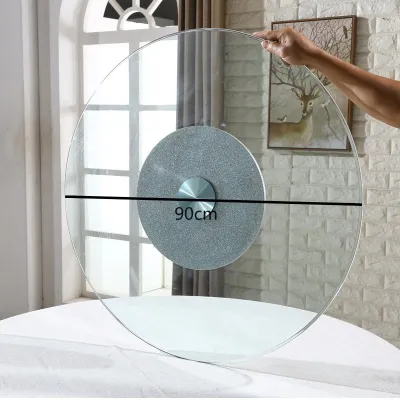
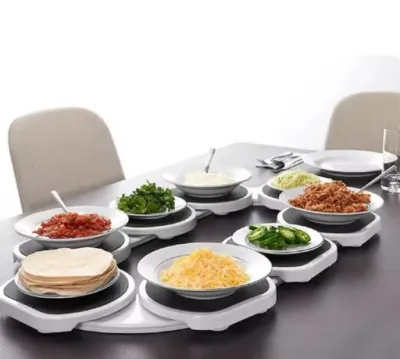
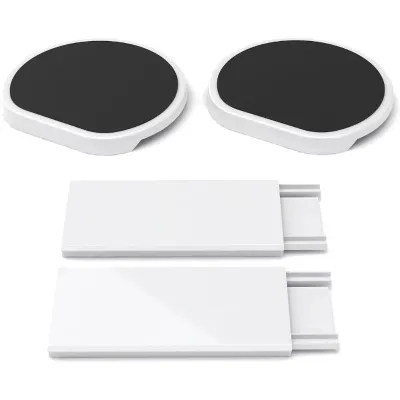
Prices are valid at publication and may change. Please refer to the product page for the latest price.
Additionally, inspect your table surface for physical obstacles before deciding on a turntable size. Built-in centerpieces, decorative tile inlays, or raised table seams can obstruct the rotation mechanism or cause the lazy susan to sit unevenly. If your table features a central umbrella hole or a decorative recess, ensure the turntable base is either wide enough to bridge the gap or small enough to sit entirely within a flat, unobstructed zone.
Calculating the Maximum Diameter for Place Settings
To find the absolute maximum diameter for your lazy susan, you must calculate the space required for individual place settings and guest comfort. Start by measuring the depth of a standard place setting from the edge of the table inward. A typical dinner plate, along with cutlery and glassware, requires approximately 30 centimeters of depth. In many households, guests also use individual dipping saucers or side bowls, which can push the active dining zone further toward the center.

Next, add a clearance buffer to this measurement. This buffer provides essential breathing room for arm movements, prevents guests from accidentally bumping glasses when the turntable rotates, and leaves space for serving utensils. A buffer of 5 to 10 centimeters is generally recommended to maintain a relaxed dining environment.
To determine the maximum safe turntable diameter, use the following calculation formula:
Maximum Turntable Diameter = Table Width (or Diameter) – [2 × (Place Setting Depth + Clearance Buffer)]
For example, if you have a round dining table with a diameter of 150 centimeters, and you allocate 35 centimeters for the place setting and clearance buffer on each side, your calculation would be:
150 cm – [2 × 35 cm] = 80 cm
In this scenario, an 80-centimeter lazy susan is the absolute largest size you should consider. Choosing a larger size would compromise the place settings, forcing guests to dine in a cramped space or risk having their glassware clipped by the rotating edge of the turntable.
Managing Expandable Tables and Leaf Inserts
Extendable dining tables offer excellent flexibility for hosting larger groups of 8 to 10 people, but they introduce unique challenges for central turntables. First, check if the table leaf inserts create a raised seam, gap, or slight misalignment when installed. Even a minor height difference across the table seam can cause a lazy susan base to wobble, slide, or experience resistance during rotation.
When dealing with an expandable table, you must decide whether you intend to use the lazy susan only when the table is fully extended or also when it is unextended. If you size the turntable for the fully expanded table, it will likely be far too large and overcrowd the surface when the leaves are removed. Conversely, a turntable sized for the unextended table may look disproportionately small and be difficult to reach when the table is fully open.
For long rectangular tables that use central leaf inserts, a highly practical alternative is to use two smaller, independent turntables placed on either side of the central seam. This configuration avoids placing a heavy rotating base directly over the table joint, ensures smooth rotation on flat surfaces, and distributes the serving dishes more evenly across the extended length of the table.
Verifying Weight Capacity and Rotation Stability
A lazy susan designed for a 6-10 person table must be capable of supporting a substantial amount of weight. Large ceramic serving bowls, heavy glass platters, and filled pitchers can quickly add up to several kilograms. Before purchasing, check the manufacturer’s stated weight capacity to ensure the turntable can handle your typical serving dishes without binding or jamming.
Stability is equally critical to prevent tipping when the turntable is loaded unevenly. If a guest places a heavy bowl of soup on the outer edge of the lazy susan while the opposite side is empty, a turntable with an inadequate base can tip forward. To prevent this, verify that the rotating base underneath the platter has a wide, stable footprint. Ideally, the base diameter should be at least half to two-thirds the diameter of the top rotating platter.
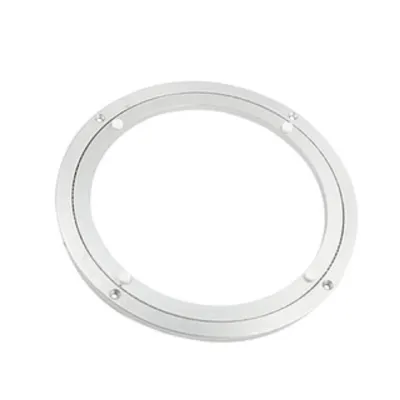
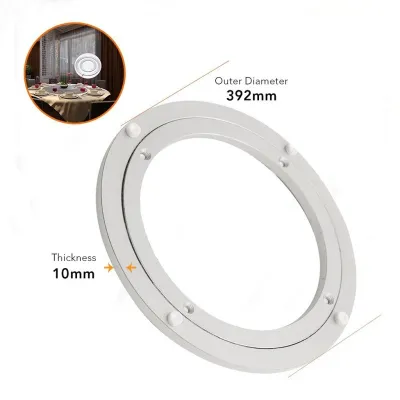
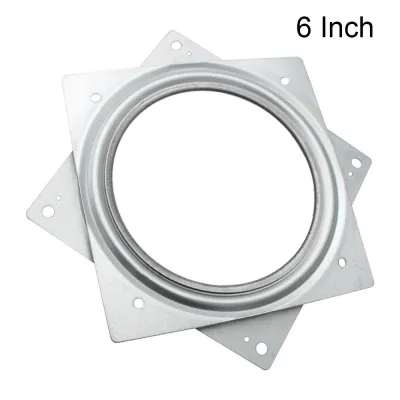
Finally, confirm that the rotation mechanism is rated for the intended load. High-quality steel ball-bearing rings generally offer smoother rotation under heavy loads compared to simple plastic ring glides. Inspect the mechanism to ensure it rotates quietly and evenly, as a grinding or sticking turntable can lead to spilled liquids and frustrated guests.
Common Sizing and Placement Mistakes
One of the most frequent mistakes is forgetting to account for the overhang of large serving platters. If you select a lazy susan that perfectly matches your calculated maximum diameter, but then place platters on it that extend 5 centimeters beyond its edge, those platters will encroach on the place settings. Always choose a turntable size that leaves a small margin of error for oversized serving ware.
Another common error is choosing a diameter that is too small for the table. While a small 30-centimeter turntable might seem safe to avoid crowding, it will look lost on a large 10-person table. More importantly, a tiny turntable forces guests to constantly rotate the center just to access a single dish, and it will not hold enough platters to serve a large family-style meal effectively.
Lastly, avoid placing a large turntable too close to the table edge on narrow rectangular tables. If the clearance zone is squeezed, guests sitting along the sides may find their plates directly adjacent to the rotating edge. This proximity increases the risk of sleeves catching on serving dishes or elbows bumping the turntable during lively conversation.
Frequently Asked Questions (FAQ)
Can I use a rectangular lazy susan on a rectangular dining table?
While rectangular or oval rotating trays exist, they do not rotate in a fixed, predictable footprint like circular ones. As a rectangular turntable spins, its corners swing out much further than its flat sides, requiring a massive clearance zone to avoid hitting plates and glasses. For long rectangular tables, using one or two round turntables is generally much safer and more space-efficient, as they rotate smoothly within a consistent, unchanging circular boundary.
What is the best material for a large lazy susan?
Rather than looking for a single best material, evaluate options based on your specific dining environment, care preferences, and weight requirements. When considering wood, check the quality of the protective sealant to ensure it can resist moisture from humid climates and food spills. For glass turntables, verify that the manufacturer uses certified tempered glass for safety, and keep in mind that large glass models can be heavy to lift and clean. If you prefer metal, inspect the finish to ensure it is rust-resistant and easy to wipe down after meals.
How do I keep a large lazy susan from sliding on the table?
To prevent the turntable from shifting during use, check if the base comes equipped with built-in non-slip rubber or silicone feet. If the base is smooth wood, glass, or plastic, you can place a thin, surface-safe silicone mat or a piece of non-slip shelf liner directly underneath the base. Ensure the liner is cut slightly smaller than the turntable base so it remains completely hidden from view and does not interfere with the outer rotating mechanism.
Community discussion
Share your experience or ask a question. Comments are reviewed before publication.