
Selecting the right rattan shoe cabinet requires balancing your household’s daily footwear habits with the physical constraints of your entryway. In the Philippines, where tropical humidity is a constant factor and footwear ranges from light rubber slippers to bulky leather shoes, choosing the correct size is essential for preserving your shoes and maintaining a clutter-free home. A well-proportioned cabinet keeps your entryway organized, ensures proper air circulation to prevent mold, and fits seamlessly into your living space without blocking foot traffic. To find the ideal dimensions, you must evaluate your current shoe collection, understand how rattan framing affects internal storage space, and measure your home’s layout with precision.
Assessing Your Shoe Collection and Household Needs
Before browsing online marketplaces or visiting local furniture showrooms, you need a clear count of the shoes your household actually owns. Start by gathering every pair of shoes currently in use and sorting them into distinct categories. Separate your daily rotation—such as school shoes, office heels, and everyday slippers—from occasional footwear like hiking boots, formal shoes, or seasonal rain boots. Counting your shoes systematically prevents the common mistake of buying a cabinet that is either too small to be functional or unnecessarily large for your space.
The size of your household and the lifestyles of its members directly dictate your storage capacity needs. A household of four active individuals will have vastly different storage requirements than a single professional or a couple. For a reliable baseline, plan for a capacity that accommodates at least three to four pairs of daily-use shoes per person, plus a small buffer for guest footwear near the entrance. This ensures that the shoes worn most frequently remain easily accessible, while less common pairs can be stored in bedroom closets or secondary storage areas.
Products mentioned in this guide
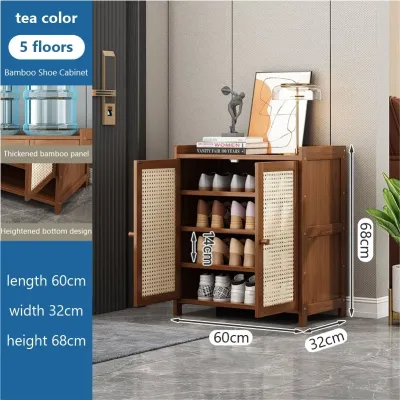
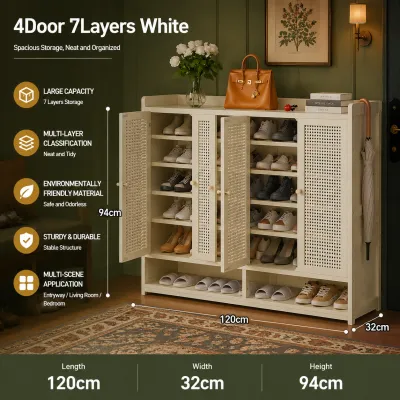
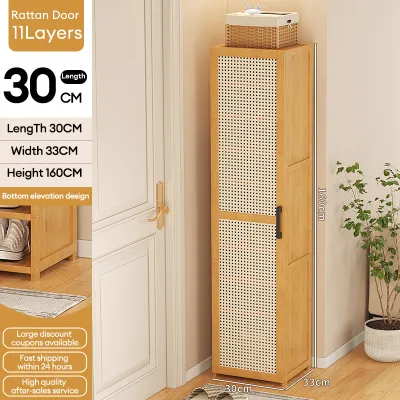
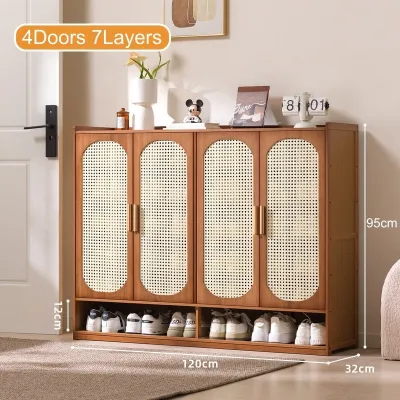
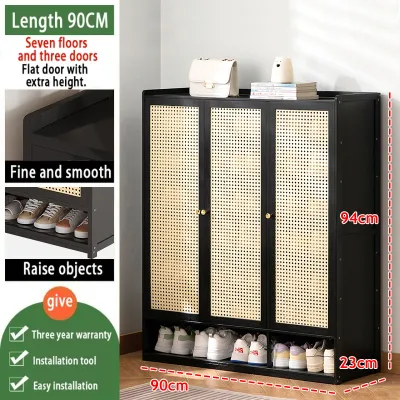
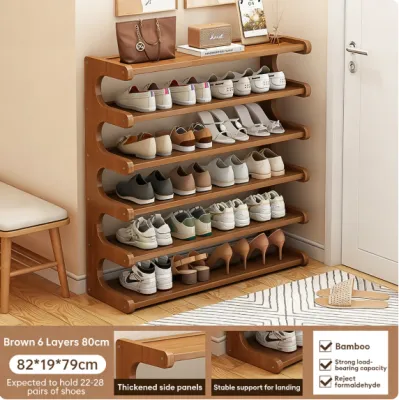
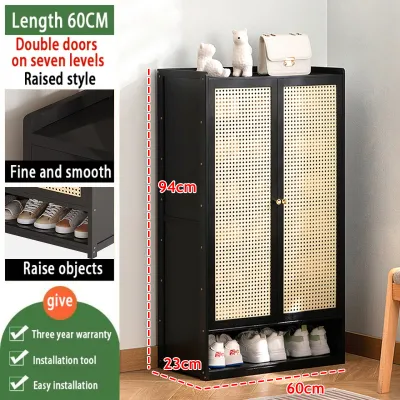
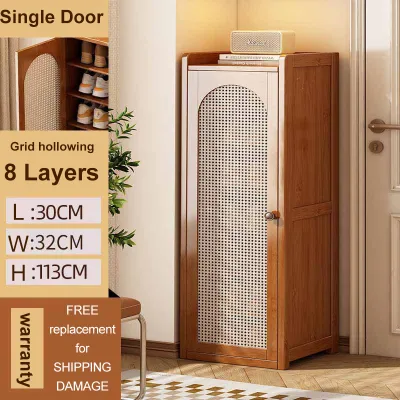
Prices are valid at publication and may change. Please refer to the product page for the latest price.
The specific types of shoes your family wears also influence the physical volume your cabinet must accommodate. Bulky items like thick-soled running shoes, basketball sneakers, or work boots take up significantly more physical space than flat sandals, slip-ons, or traditional step-ins. If your household collection consists primarily of flat, low-profile footwear, you can comfortably opt for a cabinet with closely spaced shelves. However, if your family members regularly wear high-top sneakers or structured platform shoes, you will need a unit that offers greater vertical height and deeper shelves to prevent squishing and damaging the materials.
Understanding Rattan Shoe Cabinet Dimensions and Capacity
Rattan shoe cabinets come in a wide variety of configurations, but they generally fall within standard dimensional ranges. Freestanding shoe cabinets typically range from 60 to 120 centimeters in width, 30 to 40 centimeters in depth, and 80 to 140 centimeters in height. Understanding these standard ranges helps you visualize how a cabinet will sit in your space and how many pairs of shoes it can realistically hold. However, when shopping for a rattan shoe cabinet, you must look beyond the external dimensions listed in the product description.

The unique construction of rattan furniture means that the outer frame significantly impacts the internal storage capacity. Unlike thin metal or all-plastic cabinets, a rattan shoe cabinet relies on a sturdy wooden or metal frame to support the woven rattan panels. This structural frame adds several centimeters to the external width, depth, and height of the unit, which directly reduces the actual usable space inside the shelves. When evaluating a cabinet, always check the manufacturer’s internal dimensions rather than relying solely on the overall footprint.
Despite these structural space trade-offs, the natural breathability of rattan makes it an exceptional material choice for shoe storage, particularly in tropical climates. The open weave of the rattan panels allows constant airflow, which helps dissipate moisture, reduce odors, and prevent the growth of mold and mildew on leather or canvas shoes. While the supporting frame dictates the physical boundaries of your storage, the woven panels ensure that your footwear remains in a healthy, ventilated environment.
Tall and Narrow Designs
If you are furnishing a compact condominium, a narrow hallway, or a small entryway, a tall and narrow rattan shoe cabinet is often the most efficient choice. These units typically measure between 50 and 70 centimeters in width but extend vertically up to 120 or 150 centimeters, maximizing your storage capacity without taking up valuable floor space. They allow you to stack your shoe collection vertically, keeping the entryway clear and unobstructed.
However, vertical storage designs carry inherent physical trade-offs regarding stability and safety. Because tall, narrow cabinets have a high center of gravity and a relatively small footprint, they are more prone to wobbling or tipping over when fully loaded or bumped. This risk is especially critical in households with active children or curious pets. When selecting a tall unit, always inspect the back panel for pre-installed wall anchors and consult the manufacturer’s assembly instructions to secure the cabinet firmly to your wall.
Wide and Low Consoles
For homes with spacious foyers, wide corridors, or expansive blank walls, a wide and low rattan shoe cabinet console offers a highly functional alternative. These units generally stand between 70 and 90 centimeters tall but stretch horizontally from 100 to 150 centimeters or more. This layout distributes the weight of your shoes evenly across a wider base, making the cabinet incredibly stable and eliminating the tipping risks associated with taller models.
A major benefit of a low console is that the top surface provides an excellent, easily accessible platform for daily convenience. You can use this sturdy top surface to place decorative items, house plants, mail organizers, or a tray for your car keys. Some low consoles are even structurally rated to serve as an entryway bench where you can sit while putting on your shoes. If you plan to use the top surface for seating or heavy items, always verify the manufacturer’s maximum load capacity to avoid bowing the frame or damaging the delicate rattan panels underneath.
Measuring Your Entryway and Available Space
To ensure your new rattan shoe cabinet fits perfectly, you must measure your intended installation spot with absolute precision. Start by measuring the maximum available width, height, and depth of the wall space where the cabinet will stand. Do not rely on visual estimation; use a metal measuring tape and record the numbers carefully. When measuring, pay close attention to structural details like baseboards, wall moldings, light switches, electrical outlets, or uneven floor tiles, as these elements can prevent a cabinet from sitting flush against the wall.
Next, you must evaluate the dynamic clearances of the space, particularly the swing radius of your front door and any adjacent interior doors. A shoe cabinet should never block the natural flow of foot traffic or prevent doors from opening fully. Open your front door completely and measure the distance between the door edge and the wall to ensure the cabinet’s depth will not cause a collision. You should also map out the path of travel through the entryway to confirm that family members can walk past the cabinet comfortably, even when carrying bags or groceries.
Before finalizing your purchase, also verify that the packaged cabinet dimensions can easily pass through your building’s doorways, stairwells, or elevator lifts. Many apartment buildings and condominiums have strict size limits on deliveries, and a cabinet that is too large to fit through the front door or lift will result in a frustrating return process. If the cabinet requires assembly, check the manufacturer’s specifications to ensure you have enough physical space in your home to lay out the parts and assemble the unit safely.
In humid and tropical environments like the Philippines, proper ventilation is essential for both your furniture and your footwear. When planning your layout, avoid pushing the cabinet completely flush against a damp wall or squeezing it tightly into a sealed corner. Leaving a ventilation gap of at least 2 to 5 centimeters behind and around the unit allows air to circulate freely. This simple gap maximizes the natural breathability of the rattan weave, helping to carry away ambient moisture and preventing damp air from becoming trapped inside the cabinet.
Matching Cabinet Size to Shoe Types and Storage Habits
The internal configuration of your rattan shoe cabinet must align with the physical dimensions of your footwear to prevent wasted space or cramped storage. Standard cabinet shelves are typically spaced about 15 to 20 centimeters apart, which is ideal for storing flat sandals, slippers, low-top sneakers, and standard dress shoes. If your collection consists primarily of these low-profile styles, standard fixed shelving will allow you to maximize the number of pairs you can store per shelf.
However, storing taller footwear like high-top basketball shoes, platform heels, or ankle boots presents a unique challenge in cabinets with fixed shelves. Forcing tall shoes into tight spaces can bend the uppers, crease leather, and damage the structural integrity of your footwear. To accommodate these items, carefully check the product specifications before purchasing to verify if the cabinet features adjustable or removable shelves. Adjustable shelves allow you to customize the internal height of individual compartments, giving you the flexibility to store taller items on one level while keeping flats on another.
Shelf depth is another critical dimension that directly affects your daily storage habits. Most standard shoe cabinets have an internal shelf depth of 30 to 35 centimeters, which easily accommodates average shoe sizes. However, if household members wear larger shoe sizes, you must verify that the internal shelf depth can accommodate the full length of the sole. Shelves that are too shallow will cause the heels of larger shoes to hang over the edge, preventing the cabinet doors from closing completely or forcing you to store the shoes at an angle, which reduces overall capacity. Conversely, excessively deep shelves may require you to reach deep inside, making it harder to see and retrieve your shoes.
Common Sizing Mistakes to Avoid
One of the most frequent mistakes homeowners make when purchasing a rattan shoe cabinet is failing to account for the door swing depth. Unlike sliding doors, traditional cabinet doors swing outward into the room, requiring clear floor space in front of the unit to open fully. This is especially important for rattan cabinets, which often feature thick, framed woven panels that require extra clearance. Before finalizing your purchase, measure the width of the cabinet doors and ensure that your entryway has enough open space to accommodate the doors when they are swung open at a full 90-degree angle.
Another common oversight is ignoring how the thickness of the cabinet’s wooden or metal frame reduces the actual internal shelf depth. Product descriptions online almost always highlight the external dimensions of the piece. If a cabinet is listed as having an external depth of 32 centimeters, the actual usable shelf depth might only be 28 or 29 centimeters once you subtract the thickness of the back panel, the front doors, and the supporting frame. Always look for the specified usable internal depth or contact the seller to verify this measurement before buying, especially if you have larger shoes.
Finally, avoid the trap of overestimating a cabinet’s capacity by assuming every shelf can hold the maximum number of shoes. Manufacturers often calculate capacity based on small, flat sandals or children’s shoes lined up perfectly side-by-side. In reality, bulky sneakers, wide-soled running shoes, and structured leather shoes take up more horizontal space than flat slippers. To prevent buying a cabinet that is too small, always round down the manufacturer’s estimated shoe capacity by 20 to 30 percent if your collection consists of diverse, adult-sized footwear.
Frequently Asked Questions (FAQ)
How does humidity affect the dimensions of a rattan shoe cabinet?
Natural rattan and solid wood frames are organic materials that naturally respond to environmental conditions. In high-humidity environments, such as during the rainy season in the Philippines, these natural materials absorb moisture from the air, which can cause them to expand slightly. To accommodate this natural movement and prevent structural stress, always leave a small clearance gap of at least 2 centimeters around the unit. Additionally, avoid placing your rattan cabinet directly against damp concrete walls or in unventilated corners, as this can lead to wood swelling, door misalignment, or mold growth.
Can I add extra shelves to a rattan shoe cabinet to increase capacity?
Whether you can add extra shelves to your cabinet depends entirely on the unit’s frame design and pre-drilled support holes. If your cabinet features an adjustable shelving system with pre-drilled peg holes, you can easily purchase or cut matching wooden inserts to add another level. However, if the cabinet has a fixed frame, you should avoid drilling new holes directly into the rattan panels or the main supporting frame. Modifying a fixed frame can weaken the structural integrity of the weave, cause the frame to sag, and potentially void the manufacturer’s warranty. Always consult the manufacturer’s care and modification guidelines before attempting any structural changes.
Community discussion
Share your experience or ask a question. Comments are reviewed before publication.