
Finding the perfect dining table for a large family requires balancing personal space, room layout, and material durability. When choosing a high-quality stainless table to seat 6 to 10 people, getting the dimensions right is the difference between a cramped, chaotic meal and a comfortable, relaxed gathering. In the Philippines, where family salo-salo feasts are central to daily life and tropical humidity demands highly resilient furniture, stainless steel has become an increasingly popular, modern choice for both indoor and semi-outdoor dining areas.
To accommodate a group of this size comfortably, you must look beyond the simple seating capacity label. A truly comfortable dining experience requires a table length of at least 72 inches (6 feet) for 6 people, 96 inches (8 feet) for 8 people, and 108 to 120 inches (9 to 10 feet) for 10 people. Additionally, the table must have a standard width of 36 to 42 inches to allow enough room for both individual place settings and shared serving platters. Understanding how these measurements interact with your room’s layout, your choice of chairs, and the table’s structural design will ensure you make a smart, long-term investment for your home.
Standard Dimensions for a 6 to 10 Seater Stainless Table
To determine the ideal table size, you must first understand the personal space requirements of an individual diner. As a general rule, each person requires approximately 24 to 30 inches (60 to 75 cm) of table width to eat comfortably without bumping elbows with their neighbor. In addition to width, each diner needs about 14 to 16 inches (35 to 40 cm) of depth for their plate, utensils, and glassware. This leaves a crucial 10- to 12-inch zone down the center of the table for shared serving dishes, water pitchers, and decorative centerpieces, which is why a total table width of 36 to 42 inches is the industry standard for large groups.
Products mentioned in this guide
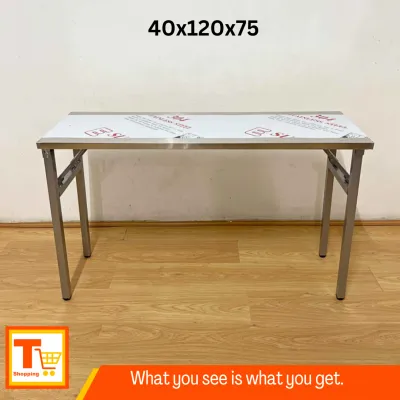
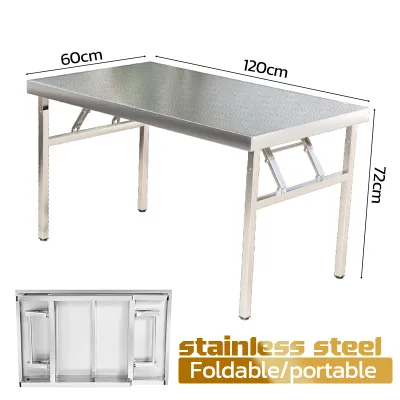
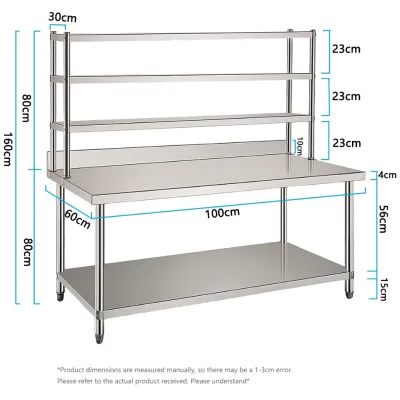
Prices are valid at publication and may change. Please refer to the product page for the latest price.
When shopping for rectangular stainless steel tables, the length of the table scales directly with the number of seats you need to provide. A standard 6-seater rectangular table should measure between 72 and 84 inches long. If you frequently host 8 people, you will need a table that is at least 96 inches long to avoid a cramped arrangement. For a full capacity of 10 people, the table must stretch to 108 or 120 inches in length. These longer dimensions ensure that guests seated at the heads of the table have sufficient elbow room and do not clash with those seated along the sides.
Round tables offer a more conversational dining experience but require significantly more central floor space to accommodate large groups. To seat 8 to 10 people comfortably around a round table, you will need a diameter of 72 to 84 inches. While round tables eliminate sharp corners and make it easier to share dishes, their large footprint can easily overwhelm a standard-sized dining room. Furthermore, reaching for food in the very center of an 84-inch round table can be difficult without the addition of a rotating Lazy Susan.
When evaluating a stainless steel table, it is essential to inspect the design of the legs and support frame, as these elements directly impact legroom and seating capacity. Many industrial or modern stainless steel tables feature thick corner legs, heavy trestle bases, or central pedestals. While a central pedestal base maximizes legroom and allows you to slide chairs in easily, you must verify its stability; a poorly engineered pedestal can cause a large table to tip if a guest leans heavily on the outer edge. Conversely, thick corner legs provide excellent stability but can restrict the placement of chairs near the ends of the table, effectively reducing your usable seating space.
Matching Table Size to Your Dining Room Layout
Choosing a table that fits your guests is only half the battle; the table must also fit harmoniously within your physical dining room. To ensure comfortable movement, you must apply the “clearance rule” of interior design. This rule dictates that you should leave at least 36 to 48 inches (90 to 120 cm) of open space between the edge of the dining table and the surrounding walls, sideboards, or doorways. This clearance allows diners to pull their chairs out and stand up easily, and it provides enough pathway space for someone to walk behind seated guests without causing disruption.

To measure your dining area accurately, start by clearing the room of temporary items and measuring the wall-to-wall distance of the space. Be sure to account for permanent architectural features such as swinging doors, low-hanging windows, air conditioning units, and built-in cabinets or buffet tables. If your dining room serves as a thoroughfare to the kitchen, living room, or outdoor patio—a common layout in modern Philippine open-plan homes—you should lean toward the higher end of the clearance spectrum (48 inches) along those specific walkways to prevent traffic bottlenecks.
Before finalizing your purchase of a large 8- or 10-seater stainless steel table, it is highly recommended to test the physical footprint in your room. You can do this easily by mapping out the exact dimensions of the prospective table on your floor using painter’s tape or flattened cardboard boxes. Leave this template on the floor for a day or two, walking around it during your normal daily routines. This simple exercise provides a realistic, three-dimensional sense of how the table will impact the flow of the room and whether it will make the space feel cramped.
Finally, do not overlook the logistics of delivery and installation. A fixed 96-inch or 120-inch dining table is an exceptionally large piece of furniture that may not easily navigate tight spaces. Measure the width and height of all entryways, front gates, front doors, narrow hallways, and stairwells leading to your dining room. If you live in a high-rise condominium in Manila, check the interior dimensions of the service elevator and consult the building administration regarding maximum furniture delivery sizes. To mitigate these delivery risks, look for stainless steel tables that feature detachable legs or a knock-down assembly design, allowing the frame to be transported in pieces and assembled directly in your dining room.
Fixed vs. Extendable Stainless Steel Tables for Large Families
For large families, deciding between a permanently large fixed table and an extendable model is a major crossroad. A fixed table is ideal if your household consistently sits 8 to 10 people for daily meals. These tables offer unmatched structural stability, a completely seamless tabletop surface, and no moving mechanical parts that could wear out over time. However, a fixed 10-seater table requires a permanently spacious dining room, and it can feel unnecessarily cold and empty if only three or four people are dining together on a regular weekday.
If your daily household consists of 4 to 6 people but you frequently host extended family for weekend gatherings, an extendable stainless steel table is often the most practical solution. These tables typically utilize drop-leaf designs or butterfly leaf systems that hide inside the table frame when not in use. When choosing an extendable model, pay close attention to the extension mechanism. Because of the humid tropical climate in the Philippines, ensure that the gliding tracks and internal hinges are made of high-grade, rust-resistant metals like Grade 304 stainless steel or brass. Smooth, ball-bearing tracks are essential to prevent the mechanism from jamming or warping over time.
While extendable tables offer fantastic space-saving versatility, they do come with trade-offs in terms of stability and maintenance. When fully extended, the outer leaves of the table must be strong enough to support the weight of heavy serving bowls and guests leaning on the edges without sagging or wobbling. Inspect the locking mechanisms that hold the leaves in place to ensure they form a tight, secure joint. Additionally, keep in mind that the seams on an extendable tabletop can collect food crumbs and liquids, requiring more diligent cleaning than a single, solid sheet of stainless steel.
Weight and mobility are also critical factors to consider when choosing a large metal table. Stainless steel is a dense, heavy material, especially when paired with a thick solid wood, natural stone, or tempered glass tabletop. A fixed 10-seater table can easily weigh over 100 kilograms, making it incredibly difficult to move once placed. Ensure that your flooring—whether ceramic tile, polished concrete, or hardwood—is perfectly level and robust enough to support this concentrated weight without cracking or scratching. If you anticipate needing to rearrange your dining space occasionally, look for tables with heavy-duty caster wheels that lock securely, or ensure the table legs are fitted with thick, non-marking rubber floor protectors.
Seating Configurations and Chair Sizing
Your choice of seating plays a massive role in how many people you can comfortably fit around your dining table. Standard dining chairs generally range from 18 to 22 inches in width. To maximize the seating capacity of a rectangular stainless steel table, opt for armless dining chairs. Armless designs allow guests to sit slightly closer together without their chairs clashing, and they can be slid completely under the table when the meal is over, clearing up valuable floor space in the room. Reserve chairs with armrests solely for the heads of the table, where there is naturally more space.
Using a dining bench on one or both of the long sides of a rectangular table is an excellent space-saving strategy, particularly for families with children. A single 72-inch bench can easily seat three or four children, whereas individual chairs would limit that same space to two or three people. Benches also offer a clean, minimalist visual profile because they can be tucked entirely underneath the table frame when not in use, keeping walkways completely clear. When selecting a bench, ensure its length is slightly shorter than the distance between the table legs so it can slide inward without obstruction.
Before purchasing chairs, you must verify their height compatibility with the specific design of your stainless steel table. Standard dining tables have a height of 28 to 30 inches, which pairs best with chairs that have a seat height of approximately 18 inches. This leaves a comfortable 10- to 12-inch gap for legroom. However, many stainless steel tables feature thick metal aprons, diagonal structural braces, or support crossbars underneath the tabletop to prevent the metal from flexing. Measure the distance from the floor to the lowest point of these under-table supports to ensure your chairs—and your guests’ knees—can slide underneath comfortably without hitting the metal frame.
Common Sizing Mistakes to Avoid
One of the most common mistakes buyers make when choosing a large dining table is focusing entirely on the tabletop dimensions while ignoring the design of the base. A table might have a beautiful, spacious 96-inch top, but if it features wide, angled trestle legs that sit right where a guest’s feet should go, those end seats become highly uncomfortable. Always check the physical placement of the table legs or pedestal to ensure they do not interfere with the natural seating positions of your family members.
Another frequent error is overlooking the visual weight of the furniture. Stainless steel has a bold, industrial, and highly reflective aesthetic. A massive, solid stainless steel table in a small or poorly lit dining room can make the space feel cold, clinical, and visually overcrowded. If you want the durability of a stainless steel frame but worry about the room feeling too heavy, consider a table that pairs a brushed stainless steel base with a clear tempered glass top. This combination allows light to flow through the room, creating an illusion of spaciousness while maintaining a sturdy, modern foundation.
Finally, avoid the temptation to buy a smaller table with the assumption that you can easily squeeze extra people around it on a regular basis. Trying to force 10 people onto a standard 72-inch (6-seater) table results in an unpleasant dining experience where guests are constantly bumping elbows, plates are crowded, and there is no room for serving dishes. If you are regularly hosting large groups, invest in the proper 96-inch or 108-inch dimensions, or opt for a high-quality extendable model that can adapt to your needs without sacrificing the comfort of your guests.
Frequently Asked Questions (FAQ)
Can a standard 6-seater stainless steel table comfortably fit 10 people in a pinch?
No, a standard 6-seater table (typically 72 inches long) cannot comfortably accommodate 10 people for a full meal. Squeezing 10 people around a table of this size violates the personal space rule, reducing the available width to just over 14 inches per person instead of the recommended 24 to 30 inches. While you might manage to fit 10 people for a casual standing cocktail party or quick drinks, a sit-down dinner with multiple plates and serving dishes will feel incredibly cramped and uncomfortable. For temporary hosting in a pinch, a 72-inch table should be capped at a maximum of 8 people by utilizing the two head ends of the table.
What is the best table shape for a narrow dining room?
A rectangular or oval table is the best choice for a narrow dining room. These elongated shapes mirror the natural proportions of a narrow space, allowing you to maximize the length of the table while leaving sufficient walkway clearance on the long sides. Avoid round tables in narrow rooms, as their equal diameter in all directions will consume too much width, blocking essential pathways and making the entire room feel restricted.
How do I prevent scratches on a large stainless steel dining table?
While stainless steel is highly durable and resistant to moisture and heat, its surface can develop fine hairline scratches over time from daily use. To preserve the finish, always use felt-bottomed placemats, coasters, and table runners to cushion plates and serving bowls. You can also opt for a custom-cut tempered glass top overlay, which protects the metal completely while showcasing the modern steel frame underneath. For daily cleaning, wipe spills immediately with a soft microfiber cloth, always wiping in the direction of the metal’s brushed grain rather than in circular motions, and avoid using abrasive scrubbing pads or harsh chemical cleaners.
Community discussion
Share your experience or ask a question. Comments are reviewed before publication.