
Selecting the right wooden sala set requires balancing your household size, daily lounging habits, and the physical constraints of your living room. Whether you are considering a standard 3-seater, a spacious 5-seater, an L-shaped sectional, or a flexible modular design, the decision hinges on accurate space planning and understanding how different configurations impact room flow. To find the right fit, you must measure your floor area, account for walkways, evaluate how your family uses the space, and verify that the wooden frames can clear your doors and hallways during delivery. Taking the time to plan these details prevents the frustration of buying a beautiful set that either crowds your home or fails to clear the front door.
Assess Your Living Room Dimensions and Layout
Before browsing online marketplaces or visiting local furniture showrooms, you must establish the physical boundaries of your living room. Start by measuring the total length and width of the designated seating area using a metal measuring tape. If your living room features an open-plan layout that merges with the dining area, define the specific zone you want the sala set to occupy. Note any irregular angles, alcoves, or structural pillars, as these architectural elements directly limit where long or wide wooden frames can sit.
Once you have the raw room dimensions, map out the essential walkways to maintain a comfortable flow of foot traffic. A good rule of thumb is to leave at least 75 to 90 centimeters of clear walking space along major pathways. This ensures that family members can move freely through the room without bumping into the corners of the wooden furniture. In high-traffic areas, squeezing a large sofa too close to a wall or doorway creates a bottleneck that makes the entire living room feel cramped.
Products mentioned in this guide




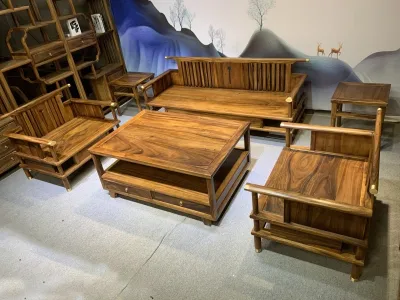
Prices are valid at publication and may change. Please refer to the product page for the latest price.
Architectural features require careful consideration when planning your layout. Identify the locations of all doors, windows, built-in cabinets, and electrical outlets. Wooden furniture should never block natural light sources or obstruct the opening of doors. Additionally, in tropical climates, positioning a solid wood sofa directly against a wall can trap moisture and restrict airflow, potentially leading to mold growth on both the wall and the wood finish. Leaving a gap of 10 to 15 centimeters between the back of the sofa and the wall promotes healthy air circulation and protects your investment.
Match Configuration to Family Size and Daily Usage
The right configuration of your wooden sala set depends heavily on how many people live in your home and how you use the space daily. Traditional linear layouts, such as a standard 3-seater sofa or a 5-seater set, are excellent for formal hosting and structured seating. A classic 3-seater works beautifully in smaller living rooms or when paired with two matching single wooden armchairs. This setup allows face-to-face conversation during family gatherings while keeping the center of the room open and airy.

For larger households or those who love to lounge, an L-shaped wooden sectional offers several distinct advantages. L-shaped configurations maximize corner spaces that might otherwise go unused, providing ample seating without taking up the center of the room. This layout is particularly effective for zoning open-plan spaces, acting as a natural divider between the living area and the dining room. It also provides a comfortable setup for casual family lounging, allowing multiple people to stretch out comfortably during movie nights.
If your household dynamics change frequently or you anticipate moving in the future, a modular wooden sala set offers unmatched flexibility. Modular sets consist of individual seating units—such as single-seat bases, corner pieces, and ottomans—that you can rearrange as needed. You can configure them into a long sofa, an L-shape, or separate individual chairs depending on the occasion. This adaptability makes modular designs highly practical for growing families who need to adjust their living space over time.
Verify Product Dimensions and Delivery Clearances
A common mistake when purchasing a wooden sala set is relying solely on general size descriptions like “medium” or “large.” You must verify the manufacturer’s exact assembled dimensions, including the total width, depth, and height of each piece. Wooden furniture often features wide, flared armrests, decorative wooden trim, or angled backrests that extend beyond the actual seating area. These design details add to the physical footprint of the furniture, so you must account for them when checking if the set will fit your planned layout.
Beyond the living room itself, you must ensure that the furniture can physically enter your home. Measure the width and height of every entryway, hallway, stairwell, and elevator door that the delivery team must navigate. Solid wood frames are rigid and cannot be bent or squeezed through tight spaces like upholstered sofas sometimes can. If your building has narrow corridors or sharp turns in the stairwell, a long, single-piece 3-seater wooden sofa may get stuck, resulting in delivery damage or a costly return.
Protecting your floors is another crucial step when installing heavy wooden furniture. Solid wood legs can scratch or dent delicate floor tiles, polished concrete, or wooden planks over time, especially when the furniture shifts during daily use. Plan to install high-quality felt pads or rubber floor protectors on the bottom of each wooden leg. In humid tropical environments, these protectors also serve as a barrier, preventing moisture from migrating from the floor into the raw wood of the furniture legs, which helps prevent warping and rot.
Common Space Planning Mistakes to Avoid
One of the most frequent errors in living room design is overlooking the visual weight of wooden furniture. Solid wood frames, especially those with dark finishes or thick, chunky designs, appear much heavier and larger than sleek metal or upholstered alternatives. In a compact room or a space with low ceilings, a massive wooden sala set can make the entire area feel dark and claustrophobic, even if it technically fits within the measured floor dimensions. To avoid this, opt for lighter wood tones, slender legs, and open spindle-back designs in smaller rooms to keep the space feeling light and open.
Another common pitfall is failing to leave adequate clearance between the edge of the wooden sofa and other key furniture pieces. For comfortable movement and legroom, maintain a gap of at least 35 to 45 centimeters between the front of the sofa cushions and your coffee table. This distance allows you to sit down and stand up easily without knocking your knees against the table. Similarly, ensure there is a distance of at least 1.5 to 2.5 meters between the seating area and your television screen, depending on the size of your TV, to prevent eye strain.
Finally, do not ignore the functional clearance required for moving parts and nearby fixtures. If your wooden sala set includes reclining features, adjustable backrests, or storage drawers built into the base, you must account for the extra space needed to operate these features. Additionally, check the swing radius of nearby doors, window panels, and cabinet doors to ensure they can open fully without striking the wooden frame. Taking these functional clearances into account during the planning stage prevents daily annoyances and protects your furniture from accidental impacts.
Frequently Asked Questions (FAQ)
How much clearance is typically needed between a wooden sofa and a coffee table?
For optimal comfort and easy movement, you should maintain a clearance of 35 to 45 centimeters between the edge of your wooden sofa seat and the coffee table. This gap provides sufficient legroom for most adults while keeping the table within easy reach for drinks, books, or remote controls. To finalize this distance, sit on the sofa and measure the space from your knees to the table edge, adjusting the table position slightly to match your personal comfort preferences.
Is a modular wooden sala set a good investment for renters or frequent movers?
Yes, a modular wooden sala set is a highly practical investment for renters and frequent movers due to its high adaptability. Because the set is made of individual, lightweight modules, it is much easier to pack, transport, and maneuver through narrow hallways and stairwells than a traditional, single-piece wooden sofa. When you move into a new home with a different layout, you can easily rearrange the modules to fit the new room’s shape, ensuring your furniture remains functional regardless of where you live.
Community discussion
Share your experience or ask a question. Comments are reviewed before publication.