
Finding the right stainless steel table for kitchen or dining spaces to seat 6 to 10 people requires balancing individual dining comfort with the physical limits of your room. In the Philippines, where homes often host large family gatherings, Sunday lunches, and festive celebrations, a dining table must be both highly durable and spacious. Stainless steel is an excellent material choice due to its resistance to tropical humidity, spills, and heavy daily use, but selecting the wrong dimensions can lead to cramped seating or blocked walkways. To ensure everyone sits comfortably, you must calculate the exact surface area needed per diner, choose a shape that complements your room’s layout, and maintain adequate clearance for movement.
Calculating the Ideal Dimensions for 6 to 10 Seats
To determine the correct table size, start with standard ergonomic spacing. Each seated individual requires a minimum of 60 centimeters of width to eat comfortably without bumping elbows. For a more relaxed dining experience, especially during long family meals, extending this width to 70 or 75 centimeters per person is highly recommended. Additionally, each diner needs about 35 to 40 centimeters of depth for their plate, utensils, and glassware, leaving a shared central zone of 20 to 30 centimeters for serving platters, rice cookers, and local dishes.
When scaling a table from 6 to 10 seats, the dimensions change significantly depending on the shape. For a rectangular table, seating 6 people typically requires a length of 150 to 180 centimeters. To accommodate 8 people, the length should increase to 200 to 220 centimeters. For a full gathering of 10 people, you will need a table measuring at least 240 to 270 centimeters in length. If you choose a round table, a diameter of 120 to 140 centimeters works well for 6 people, but seating 10 people comfortably will require a massive diameter of 180 centimeters or more, which can quickly overwhelm standard dining rooms.
Products mentioned in this guide
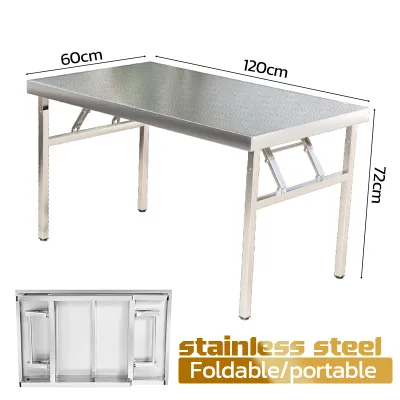
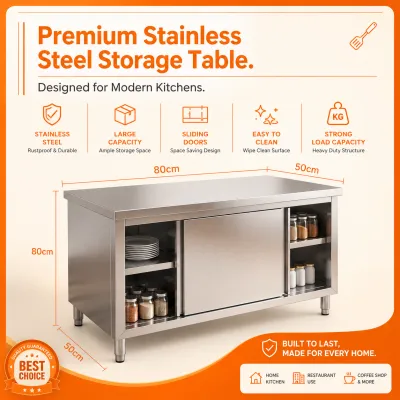
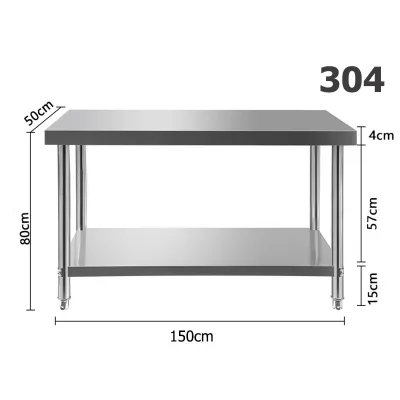
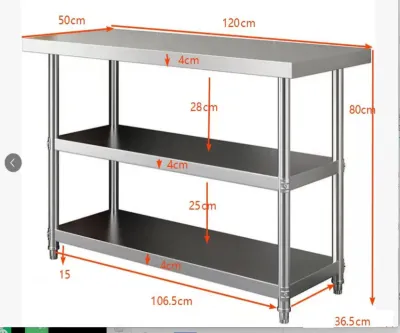
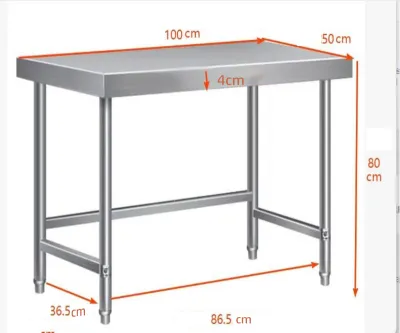
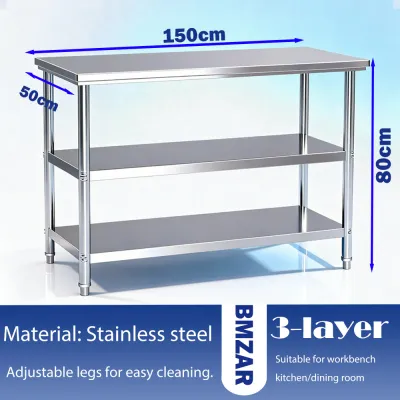
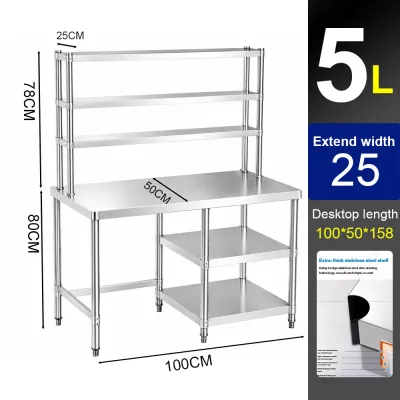
Prices are valid at publication and may change. Please refer to the product page for the latest price.
Choosing between a fixed-size table and an extendable model depends on how often you host large groups. A fixed-size stainless steel table offers unmatched structural rigidity and a seamless, easy-to-clean surface, making it ideal if your household regularly seats 8 to 10 people. However, if you only host large gatherings occasionally, an extendable or drop-leaf stainless steel table provides excellent flexibility. When opting for an extendable model, it is crucial to inspect the sliding tracks and locking joints to ensure they can withstand the local humid climate without rusting or jamming over time.
Matching Table Shapes to Your Kitchen or Dining Layout
The shape of your stainless steel table should harmonize with the proportions of your room to maximize both seating capacity and daily traffic flow. Rectangular tables are the traditional choice for long, narrow dining areas or open-concept kitchen layouts. They align naturally with walls and kitchen islands, creating a clean, streamlined look. While rectangular tables are highly efficient for seating large numbers of people, conversation can become segmented at longer lengths, as diners at one end may find it difficult to converse with those at the opposite end.

For square dining rooms or spacious, open-plan kitchens, round and oval stainless steel tables are highly effective alternatives. Round tables foster a more intimate and democratic dining experience, as everyone faces the center, making conversation flow naturally among all guests. Oval tables offer a middle ground, providing the elongated surface of a rectangle but with rounded ends that soften the room’s visual lines. A major advantage of round and oval shapes in busy household environments is the elimination of sharp corners, which improves traffic flow and reduces the risk of painful bumps in tight spaces.
If your kitchen layout is highly irregular or multi-functional, a single massive table might not be the most practical solution. In such cases, a modular approach using two smaller, matching rectangular stainless steel tables can offer superior versatility. You can push the two tables together to form a grand banquet setup for 10 people during special occasions, or separate them for daily use—utilizing one as a kitchen prep island and the other as a dedicated family dining table. This flexibility is particularly useful in modern homes where space must adapt quickly to different daily activities.
Measuring Your Space for Clearance and Traffic Flow
Before purchasing a large stainless steel table, you must measure your dining area to ensure there is sufficient clearance for movement when everyone is seated. As a general rule, you need a minimum of 90 centimeters of clear space between the edge of the table and the nearest wall, cabinet, or piece of furniture. This distance allows diners to pull out their chairs and sit down or stand up comfortably without feeling restricted. If the space behind the chairs serves as a primary walkway, increase this clearance to 110 to 120 centimeters so others can walk past without forcing seated guests to tuck in.
In a kitchen setting, you must also account for the clearance required by various appliances and architectural features. Ensure that the placement of your table does not obstruct the swing doors of your refrigerator, oven, or nearby pantry cabinets. If your dining table is positioned near a kitchen island or a doorway leading to an outdoor dirty kitchen, map out the traffic paths to prevent bottlenecks during busy meal preparation times. Using painter’s tape to outline the proposed table dimensions on your kitchen floor is a highly effective way to visualize the physical footprint and test the flow of daily traffic before making a final decision.
Additionally, consider the physical path the table must take to reach your dining room. Large, fixed-size stainless steel tables measuring over 240 centimeters can be incredibly difficult to maneuver through standard doorways, narrow hallways, tight stairwells, or condominium elevators. Always measure the entry points of your home, including the height and width of your front door and any elevator cabins, to confirm that the delivery team can safely transport the table into your living space. If access is restricted, look for models with detachable legs or modular designs that can be assembled directly inside the room.
Evaluating Stainless Steel Table Features for Large Gatherings
A large dining table must be structurally sound to handle the weight of heavy serving dishes and the occasional lean of a diner. When evaluating stainless steel tables, pay close attention to the base design. A traditional four-legged frame offers exceptional stability and keeps the center space beneath the table entirely open, but the corner legs can sometimes restrict where chairs can be tucked in, potentially limiting seating flexibility. Conversely, a central pedestal base maximizes legroom and allows you to squeeze in extra chairs around the perimeter, but you must verify that the pedestal is heavy and wide enough to prevent the table from tipping when weight is applied to the edges.
For extendable stainless steel tables, the quality of the extension mechanism is paramount. Because stainless steel is a dense, heavy material, the internal tracks, gears, and support bars must be robustly engineered. Check that the extension leaves align perfectly with the main tabletop without leaving wide gaps where food crumbs or liquids can accumulate. It is also wise to verify the load capacity of the extended sections; they should not sag or flex when loaded with heavy platters or when guests rest their elbows on the table ends.
Finally, inspect the edge treatments and surface finishes of the table to ensure safety and longevity. In a busy household, sharp metal edges can pose a safety hazard, so look for tables with eased, rounded, or bullnose edges that are smooth to the touch. The surface finish also plays a major role in how the table wears over time. While a highly polished, mirror-like finish looks striking, it easily highlights fingerprints, water spots, and fine scratches. A brushed or hairline finish is far more practical for daily kitchen use, as its textured pattern naturally diffuses light, helping to conceal minor wear and tear while maintaining a clean, modern aesthetic.
Frequently Asked Questions (FAQ)
Can a round stainless steel table comfortably seat 10 people?
While a round table is excellent for conversation, seating 10 people comfortably requires a diameter of at least 180 centimeters. A table of this size occupies a massive footprint and requires a very large, square room to maintain proper clearance around the perimeter. Furthermore, a 180-centimeter diameter places the center of the table nearly 90 centimeters away from every diner, making it difficult to reach shared serving dishes without standing up. If you choose a round table for 10, incorporating a central lazy Susan is highly recommended to facilitate the passing of food, though a rectangular or oval shape is generally more space-efficient for this many guests.
How do I protect my kitchen floor from a heavy stainless steel table?
Stainless steel tables are inherently heavy, and when fully loaded with food and surrounded by 10 diners, they can exert significant pressure on your flooring. To prevent scratches, dents, or scuff marks, check the bottom of the table legs for pre-installed protective caps. Most high-quality tables come with adjustable plastic or rubber feet, which also help level the table on uneven kitchen tiles. For added protection on delicate surfaces like hardwood, laminate, or polished natural stone, apply heavy-duty adhesive felt pads or silicone floor protectors to the bottom of the feet, and consider placing a durable area rug beneath the dining set to buffer the movement of chairs.
Community discussion
Share your experience or ask a question. Comments are reviewed before publication.