
A loft bed metal frame can be a safe and highly efficient space-saving solution for a child’s bedroom, but this safety is strictly conditional. It is not an absolute “yes.” Safety depends on the bed meeting recognized manufacturing standards, being assembled with absolute precision, and being used by a child who has reached the appropriate developmental stage.
The primary risk associated with any elevated sleeping platform is falls, which most frequently occur during climbing or sleeping. Head, neck, or limb entrapment is another serious hazard if the spacing between the frame components is poorly designed. For metal frames specifically, the material’s rigidity means that the kinetic energy from a child climbing or moving is transferred directly to the joints. Over time, this physical stress can cause bolts to loosen, introducing a structural wobble that compromises safety if left unaddressed.
Pediatricians and consumer safety organizations maintain a strict consensus: loft beds are not recommended for children under 6 years old. Before this age, children lack the necessary physical coordination, balance, and spatial awareness to safely navigate a ladder, particularly in the dark or when waking up disoriented.
Products mentioned in this guide
![[Manila 24-hour Boat]Black Loft Bed Elevated Bed 180*200*90/120/150CM Modern Simple and Thickened Iron Art Elevated Bed Apartment Bed Loft Bed For Small Room Student Dormitory Bed Single Size Iron Art Bed Adjustable Staircase Alternating Left And Right](https://img.lazcdn.com/g/p/61a97ae76a0c00cd13c04edac78cc9a4.jpg_400x400q80.jpg_.webp)
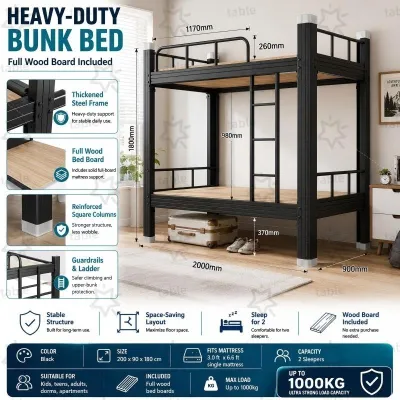
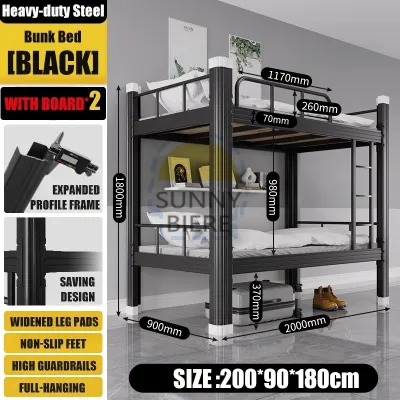
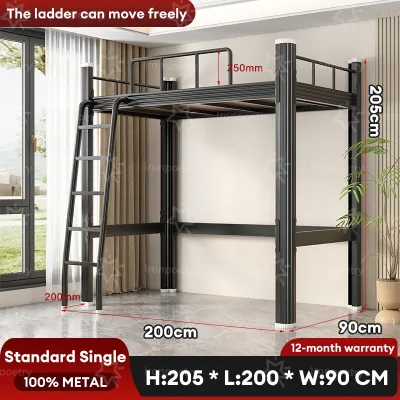
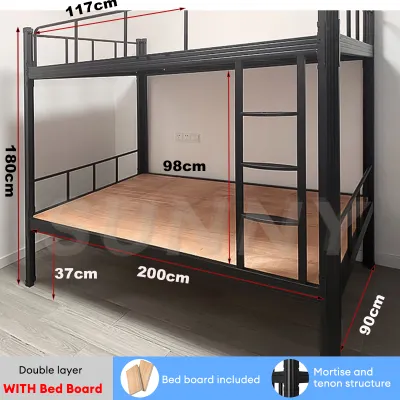
Prices are valid at publication and may change. Please refer to the product page for the latest price.
When comparing metal to wood, there is no single “safer” material. Solid wood is heavier and naturally dampens vibrations, but it can warp, split, or crack over time, especially in highly humid climates. On the other hand, metal is highly durable, resistant to pests, and unaffected by moisture, making it an excellent choice for tropical environments. However, because metal does not absorb impact in the same way wood does, it demands much more rigorous and frequent hardware inspections to ensure the joints remain tight and secure.
Critical Safety Features to Inspect Before Buying a Loft Bed Metal Frame
Buying a loft bed metal frame in the Philippines requires balancing budget with structural integrity. Prices can range from entry-level models around ₱5,000 to premium, heavy-duty industrial frames costing upwards of ₱20,000. While the lower price point of budget metal frames is appealing, safety must never be compromised. When evaluating options at a local showroom or through an online furniture retailer, look past the color and styling to inspect the core safety features.
Guardrails and Fall Protection
A secure guardrail system is your child’s primary defense against nighttime falls. Verify that guardrails are installed on all four sides of the bed. A common mistake is leaving the wall-facing side open, assuming the wall itself will act as a barrier. However, metal frames can flex or shift slightly, creating a dangerous gap between the mattress and the concrete or drywall where a child can slip and become trapped.
The guardrail must extend at least 5 inches (approximately 12.7 cm) above the top of the mattress. This means you must measure the guardrail height from the mattress surface, not from the bed slats. If you plan to use a thick mattress, ensure the guardrail is tall enough to maintain this 5-inch safety margin. Additionally, inspect the distance between the individual guardrail slats or balusters. These gaps must not exceed 3.5 inches (9 cm) to prevent a child’s head or limbs from sliding through.
Weight Capacity and Structural Limits
Every loft bed metal frame has a maximum weight capacity specified by the manufacturer, which you can find on the product label or in the user manual. It is vital to understand the difference between static weight (the weight of a stationary object) and dynamic weight (the force applied by movement, such as a child climbing, jumping, or rolling).
When calculating the required weight capacity, do not just look at your child’s current weight. You must factor in the weight of the mattress (which can be substantial for high-density foam or hybrid models), the pillows, heavy bedding, and the child’s projected growth over the next few years. Furthermore, consider practical scenarios: if you plan to sit on the edge of the bed to read a bedtime story or comfort your child, the frame must comfortably support the combined weight of both an adult and a child. Look for frames rated for at least 110 to 150 kg to ensure a safe structural margin.
Frame Stability and Joint Construction
The overall stability of a metal frame is determined by the thickness of the steel tubing and the engineering of the joints. High-quality frames are constructed from thick-gauge steel (typically 14-gauge or thicker). Thin, lightweight metal tubes bend easily under pressure and are highly prone to wobbling.
Examine the joints closely. Prioritize frames that utilize heavy-duty bolted connections with locking nuts or spring washers. Avoid frames that rely solely on snap-together pieces or simple friction-fit joints; while these are easier to assemble, the connection points will inevitably wear down and expand under daily use, leading to a loud, unstable bed. Additionally, look for structural cross-bracing—diagonal steel bars connecting the vertical posts on the back and sides. This bracing prevents “racking,” which is the lateral swaying motion that can cause a frame to collapse sideways under sudden lateral force.
Ladder Design and Accessibility
The ladder is the most active safety component of any loft bed. You will generally choose between an angled ladder and a straight vertical ladder. Angled ladders are significantly safer because they allow children to maintain their center of gravity over their feet while climbing. The trade-off is that they take up more floor space. If space constraints in a compact room or condominium require a vertical ladder, ensure it is bolted directly and securely to the main frame rather than hanging from simple hooks.
Inspect the rungs of the ladder. They should be flat, wide, and slip-resistant. Round, narrow metal bars are painful to climb on bare feet and offer very little traction, especially if a child’s feet are damp from a shower. Look for ladders with textured steps, rubberized grips, or integrated plastic treads. The spacing between the rungs must be uniform, typically between 10 and 14 inches, to prevent trips and missteps.
Proper Installation, Anchoring, and Mattress Fit
Even the most robust loft bed metal frame can become a safety hazard if it is assembled incorrectly or paired with the wrong mattress. Proper installation is a critical step that requires patience and precision.

When assembling the bed, follow the manufacturer’s manual exactly. Do not skip any steps, and never substitute missing hardware with random screws from a toolbox. Ensure every bolt is tightened securely, but avoid using high-torque power drills unless the manual explicitly recommends them. Over-tightening can easily strip the threads inside the metal tubes, rendering the joint permanently weak and impossible to tighten in the future.
In the Philippines, anchoring a loft bed to the wall is not an optional step—it is a safety necessity. The country is located in a seismically active zone where minor earth tremors are common. Additionally, active children may attempt to climb the outside of the frame. Secure the metal frame directly to the wall using heavy-duty L-brackets. For concrete or hollow-block walls (which are standard in most Filipino homes), use high-quality masonry anchors and expansion bolts. If securing to a drywall or wood-framed wall, ensure the brackets are screwed directly into the wooden studs, never into the drywall alone.
The mattress must fit perfectly within the dimensions of the bed frame. If the mattress is too small, it will slide around, creating dangerous gaps along the edges. These gaps are a major hazard, as a child’s limb or head can become wedged between the mattress and the metal frame. The gap between the mattress and the guardrails should never exceed 1 inch (2.5 cm) on any side.
Pay close attention to the thickness of the mattress. Many parents purchase thick, plush mattresses for comfort, but on a loft bed, an overly thick mattress reduces the effective height of the guardrails. Check the manufacturer’s guidelines; most loft beds require a mattress thickness of no more than 6 inches (15 cm) to ensure the guardrails remain high enough to prevent falls.
Daily Safety Rules and Risk Reduction at Home
Once the loft bed is fully assembled and anchored, maintaining a safe sleeping environment requires establishing clear household rules and performing routine maintenance.
Teach your child that a loft bed is strictly for sleeping and quiet activities like reading. Establish a firm “no jumping” rule. Jumping on an elevated bed not only risks a fall over the guardrail but also places immense dynamic stress on the metal joints, which can cause them to fail. Additionally, strictly prohibit hanging any items from the bed frame or guardrails. Belts, bags, jump ropes, or clothes hangers can easily catch around a child’s neck, presenting a severe strangulation hazard.
Carefully arrange the room layout around the loft bed. Keep the area directly underneath and surrounding the bed free of hard, sharp, or fragile objects. Avoid placing wooden desks, glass tables, or toy chests directly below the sleeping platform unless they are specifically designed to fit under that model and have padded corners. If a child does accidentally fall, landing on a clear floor or a soft play mat is far less likely to cause severe injury.
Climbing up or down a ladder in complete darkness is a major hazard. Install a soft, low-wattage LED nightlight near the ladder. This ensures that if your child needs to use the bathroom in the middle of the night, they can clearly see each rung and maintain a secure grip.
Metal frames are subject to physical vibrations from daily climbing, as well as expansion and contraction caused by temperature and humidity changes—factors that are highly pronounced in the tropical Philippine climate. These forces naturally cause bolts to loosen over time. Create a recurring schedule every three to six months to inspect the frame. Use the wrench or hex key provided by the manufacturer to check and tighten every joint, ensuring the bed remains completely rigid and squeak-free.
Warning Signs: When to Stop Using or Repair the Bed
Over years of use, even a premium loft bed metal frame can experience wear and tear. As a parent, you must be able to recognize the warning signs that indicate the bed is no longer safe to use.
Inspect the frame regularly for physical signs of metal fatigue. Look for bending or bowing in the main support posts or the horizontal slats supporting the mattress. Check the welded joints closely for any hairline cracks. In humid tropical environments, pay close attention to rust. While minor surface rust on a powder-coated frame is usually harmless, deep, flaking rust can eat through the thin steel walls, severely compromising the structural integrity of the frame.
Listen to the bed. A high-quality, properly maintained metal frame should be quiet. If the bed squeaks loudly every time your child moves, or if you notice any lateral shifting or swaying when they climb the ladder, the joints may be compromised. If tightening the bolts does not resolve the wobble, the metal holes may have stretched or the frame may have warped.
Never allow your child to sleep on a loft bed that has missing, stripped, or bent bolts. If a bolt becomes damaged, do not attempt to replace it with a random screw from a hardware store, as it may not have the correct thread pitch or tensile strength.
If you detect any of these warning signs, stop using the bed immediately. Have your child sleep on a temporary mattress on the floor. Contact the manufacturer to order official, compatible replacement parts. Never attempt makeshift repairs on load-bearing components, such as using duct tape, wire, or amateur welding, as these temporary fixes can fail catastrophically under weight.
Frequently Asked Questions (FAQ)
Can a metal loft bed collapse?
A sudden collapse of a metal loft bed is highly unlikely if the bed is assembled correctly, maintained regularly, and used within its specified weight limits. Catastrophic failures almost always occur due to severe overloading, missing structural components (like support slats or cross-braces), or ignoring clear warning signs like cracked welds or extreme wobbling.
Are metal loft beds safer than wood?
Neither material is inherently safer; safety is a product of engineering quality, proper assembly, and regular maintenance. Metal frames are highly durable, resistant to warping in humid tropical climates, and immune to wood-boring pests, but they transfer vibrations easily and require more frequent bolt tightening. Wood frames absorb vibrations better and feel heavier, but they can warp or split if exposed to high humidity.
What is the safest age for a child to use a loft bed?
The standard safety recommendation is that children must be at least 6 years old before using any elevated bed, including a loft bed. Younger children lack the physical coordination, balance, and judgment required to climb ladders safely, especially when they are half-awake during the night.
Community discussion
Share your experience or ask a question. Comments are reviewed before publication.