
Finding the perfect dining table for a large family requires balancing daily comfort, room traffic, and structural safety. If you are hosting a household of 6 to 10 people, investing in a large marble kitchen table can transform your dining area into an elegant, functional hub. However, natural stone is heavy, inflexible, and requires careful spatial planning to ensure that every family member can sit, dine, and move without feeling cramped.
To accommodate 6 to 10 people comfortably, a rectangular table must measure between 72 and 120 inches in length, while a round table requires a diameter of 60 to 84 inches. Because solid marble slabs of this scale carry immense physical weight, selecting the correct dimensions, shape, and structural support is critical to avoiding spatial errors and safety hazards in your home.
Standard Dimensions for 6 to 10 Seater Marble Tables
To design a comfortable dining experience, you must first understand tabletop ergonomics. Every seated individual requires a minimum of 24 inches of horizontal width to eat comfortably without bumping elbows, though 30 inches is highly recommended for larger armchairs. Additionally, a table must offer at least 12 to 15 inches of depth per setting to accommodate dinner plates and glassware, leaving a central zone of 10 to 18 inches for shared serving platters.
Products mentioned in this guide
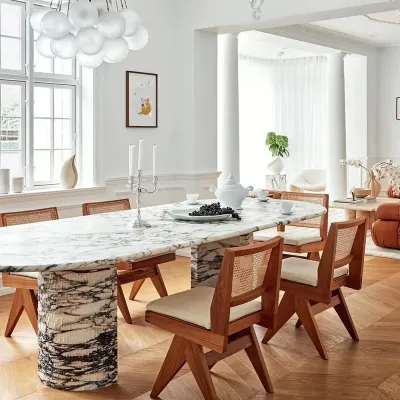
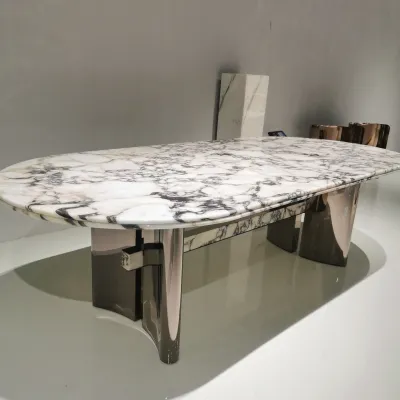

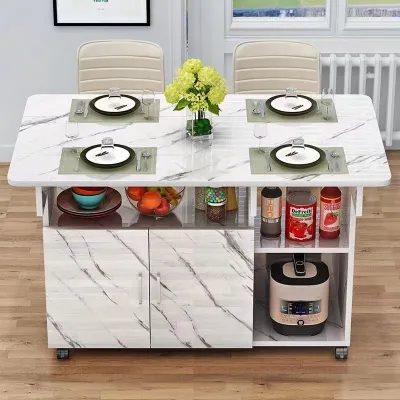

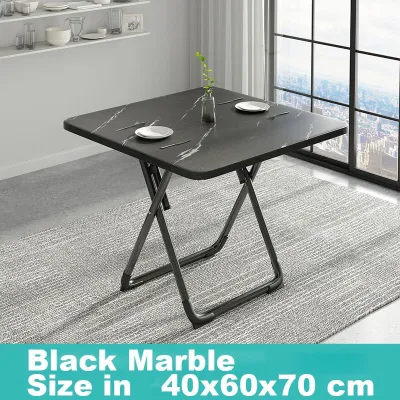
Prices are valid at publication and may change. Please refer to the product page for the latest price.
Rectangular and Oval Dimensions
- 6-Seater Tables: A rectangular table should measure 72 inches (183 cm) in length and 36 to 40 inches (91 to 102 cm) in width. This layout typically places two diners on each long side and one at each end.
- 8-Seater Tables: To seat eight people, the table length must increase to 96 inches (244 cm) with a width of 40 to 44 inches (102 to 112 cm). This allows for three diners on each long side and one at each head of the table.
- 10-Seater Tables: For ten people, you will need a table measuring 108 to 120 inches (274 to 305 cm) in length and 44 to 48 inches (112 to 122 cm) in width, accommodating four diners along each long side and one at each end.
Round Table Dimensions
- 6-Seater Round: A diameter of 54 to 60 inches (137 to 152 cm) is ideal, allowing everyone to face each other naturally.
- 8-Seater Round: Requires a diameter of 60 to 72 inches (152 to 183 cm). At 72 inches, the center of the table becomes difficult to reach without a Lazy Susan.
- 10-Seater Round: Requires a massive diameter of 72 to 84 inches (183 to 213 cm). Solid marble tops at this size are exceptionally rare and structurally challenging to support on a single pedestal.
Height and Legroom Clearances
Standard dining tables stand between 28 and 30 inches (71 to 76 cm) tall. When paired with standard dining chairs that have a seat height of 18 to 20 inches, this leaves 10 to 12 inches of vertical legroom. When purchasing a marble table, always check the thickness of the sub-top or supporting apron. A thick wooden or metal support frame glued beneath the marble can reduce this vertical legroom, making it uncomfortable for taller family members.
Choosing the Best Marble Kitchen Table Shape for Large Families
The shape of your large-capacity table dictates how people move around your dining room and how easily conversation flows during family meals.

Rectangular Tables
A rectangular marble kitchen table is the most practical and efficient shape for maximizing seating capacity, especially in long or narrow dining rooms. It aligns perfectly with walls and fits neatly into open-concept layouts common in modern Philippine townhomes. The linear structure allows you to push the table against a wall when not fully occupied, freeing up valuable floor space for daily foot traffic.
Oval Tables
Oval tables offer the same seating capacity and linear footprint as rectangular ones but feature rounded, graceful corners. This design is highly beneficial for high-traffic dining areas, as it eliminates sharp corners that present safety hazards for young children and older adults. The curved ends also make it easier to squeeze in an extra chair or stool when unexpected guests arrive for dinner.
Round Tables
Round tables excel at fostering intimate, democratic conversation because every diner faces the center. However, as the seating capacity increases to 8 or 10 people, the required diameter expands drastically. A 72-inch round marble slab is not only difficult to fit into standard rooms, but its center becomes a “dead zone” that is hard to reach during meals. Furthermore, supporting a massive, circular stone top requires an exceptionally wide, heavy-duty central pedestal to prevent the table from tipping when a guest leans on the edge.
Extendable and Leaf Tables
While extendable wooden tables are common, extendable marble tables present unique engineering challenges. Natural marble is heavy, brittle, and difficult to cut into seamless, matching leaves. Most extendable stone tables utilize high-end mechanical tracks where the marble top is split into sections that glide outward, revealing a central extension leaf made of matching marble or a contrasting material like tempered glass or wood. While highly flexible, these mechanisms are complex, expensive, and require regular maintenance to ensure the heavy stone slabs slide smoothly without misalignment.
Measuring Your Dining Space and Clearance Requirements
Before committing to a large marble table, you must meticulously measure your dining area to ensure the space remains functional and comfortable.
Calculating Minimum Room Dimensions
To determine if a table will fit, you must add the required clearance space to all sides of the table’s physical footprint. A table that is 96 inches long and 40 inches wide requires a much larger room than its physical dimensions suggest once you account for chairs and walking space.
Standard Clearance Rules
- The 36-Inch Rule: You must maintain a minimum of 36 inches (91 cm) of clear space from the edge of the table to the nearest wall, sideboard, or door frame. This distance allows diners to pull out their chairs, sit down, and rise comfortably without bumping into obstacles.
- The 48-Inch Rule: If a major walkway or entry path runs behind the dining chairs, increase the clearance to 48 inches (122 cm). This ensures that family members can walk past the table without forcing seated guests to tuck themselves in.
Accounting for Obstacles and Furniture
Do not measure wall-to-wall without accounting for existing furniture. Dining buffets, display cabinets, structural pillars, and even wall-mounted split-type air conditioning units or low-hanging pendant lights can restrict placement. Ensure that cabinet doors and drawers can open fully even when chairs are occupied.
The Visualization Test
To avoid costly mistakes, map out the proposed table dimensions on your dining room floor using blue painter’s tape or large sheets of cardboard taped together. Place your existing chairs around this template and physically walk through the space. This exercise helps you visualize the table’s true physical footprint and assess whether it will disrupt the natural flow of your home.
Structural and Practical Considerations for Heavy Marble Tables
Owning a large marble table involves unique structural and logistical challenges that do not apply to lighter wooden or glass furniture.
Weight and Base Support
A 10-seater marble slab can easily weigh between 150 and 250 kilograms. This massive weight requires an exceptionally strong, well-engineered base to prevent sagging, structural failure, or tipping. Look for bases constructed from solid hardwood, cast iron, or reinforced heavy-duty steel. The stone top must be securely bonded to a sub-top—typically marine plywood or a metal plate—which is then bolted to the base, distributing the weight evenly and preventing localized stress points.
Floor Load Capacity
Before installing a massive stone table, verify the load-bearing capacity of your floors, especially in older homes, wooden loft structures, or upper-story dining rooms. While ground-floor concrete slabs easily support the concentrated weight, older wooden floor joists may require reinforcement to prevent bowing or structural damage over time.
Delivery and Access Logistics
One of the most common delivery failures involves large, single-piece marble tops that cannot navigate the delivery route. Measure the width and height of all entry doors, tight hallway corners, and stairwells. If you live in a high-rise condominium, check the interior dimensions and weight capacity of the service elevator. A 108-inch marble slab often cannot fit in standard elevators, requiring professional movers to carry the heavy stone up multiple flights of stairs or employ specialized exterior crane rigging, which can incur significant additional costs.
Maintenance in Tropical Climates
The warm, humid climate of the Philippines does not degrade natural marble, but it can impact the table’s overall longevity. Metal bases must feature high-quality rust-resistant coatings to prevent corrosion from humidity. Additionally, marble is a porous, calcium-based stone that is highly sensitive to acids. Local culinary staples like calamansi juice, vinegar, and mangoes can cause immediate chemical etching (dull spots) and staining if spilled. To protect your investment, the marble must be sealed with a high-quality penetrating sealer upon installation and resealed every six to twelve months, depending on usage.
Common Mistakes When Sizing a Large Dining Table
Avoiding these frequent pitfalls will save you from logistical headaches and ensure a successful purchase.
Ignoring Chair Armrests and Depth
Many homeowners purchase a table based solely on the seat count, forgetting to measure their dining chairs. Chairs with wide armrests require significantly more horizontal space (up to 30 inches per seat) and may not slide fully under the table if the apron or support frame is too low, leaving them protruding into walkways.
Neglecting the Delivery Path
Failing to measure the entire journey from the delivery truck to the dining room is a recipe for disaster. Always confirm that a single-piece marble slab can clear low ceilings, tight stairwell turns, and narrow doorways before finalizing your order.
Underestimating Round Table Scale
Choosing a round table for 10 people without understanding the sheer physical presence of an 84-inch circle often results in a table that completely dominates the room, leaving no space for comfortable movement.
Overlooking Visual Weight
A thick, dark marble slab (such as Nero Marquina or dark grey varieties) carries immense visual weight. In a medium-sized or poorly lit dining room, a massive dark table can make the entire space feel cramped and gloomy. If your space is compact, opt for lighter stones like Carrara, Calacatta, or Arabescato with a slim, chamfered edge profile to maintain an airy, open aesthetic.
Frequently Asked Questions (FAQ)
How thick should the marble top be for a large 8 to 10 seater table?
For a large dining table spanning 8 to 10 seats, the standard thickness of the marble slab typically ranges from 3/4 inch (20mm) to 1 1/4 inches (30mm). To prevent cracking over long spans without adding excessive weight, fabricators usually laminate a 3/4-inch marble slab to a robust sub-top made of marine plywood or aluminum honeycomb. This sub-top provides essential structural reinforcement, absorbs vibrations, and allows the stone to be securely bolted to the table base. Always consult your furniture manufacturer or stone fabricator regarding the specific marble variety, as softer or highly veined stones may require thicker cuts or more extensive sub-frame support.
Is it safe to use a glass top protector on a marble dining table?
While placing a custom-cut tempered glass top over your marble table protects the stone from scratches, heat, and acidic spills, it introduces other risks. In humid tropical climates, moisture can easily become trapped in the microscopic gap between the glass and the porous marble. This trapped condensation can cause dark moisture spots, cloudiness, or chemical etching over time, permanently damaging the stone’s appearance. If you choose to use a glass protector, you must place small, breathable felt or silicone spacers between the glass and the marble to ensure continuous air circulation. A more natural and visually appealing alternative is to apply a high-quality penetrating sealer regularly and use coasters, placemats, and trivets for daily protection.
Community discussion
Share your experience or ask a question. Comments are reviewed before publication.