
Integrating a dedicated shoe box storage system into your closet is one of the most effective ways to maximize vertical space, protect your footwear investment, and maintain a clutter-free wardrobe. When coordinated thoughtfully with your existing hangers, shelving, and hanging rods, individual shoe boxes transform underutilized zones—such as the floor beneath short-hanging shirts or the deep recesses of overhead shelves—into highly functional storage hubs. The key to a successful integration lies in selecting modular, stackable containers that match both the physical dimensions of your closet and the specific access requirements of your daily routine. By choosing the right combination of materials, opening mechanisms, and spatial layouts, you can create a cohesive closet ecosystem where every pair of shoes is visible, protected, and easily reachable without disrupting the rest of your wardrobe.
Assessing Closet Clearances and Shoe Dimensions
Before purchasing any storage containers, you must conduct a thorough spatial audit of your closet interior to ensure a seamless fit. Begin by using a reliable metal measuring tape to record the exact width of your closet floor, the depth of your existing shelves, and the vertical clearance between your hanging rods and the floor or lower shelves. It is crucial to measure the actual usable space rather than the nominal dimensions of the closet frame, taking into account any baseboards, door hinges, or sliding track mechanisms that might obstruct placement. Knowing these precise dimensions prevents the common frustration of buying boxes that are slightly too deep for your shelves or too wide to allow your closet doors to close completely.
Next, categorize your footwear collection by height, width, and overall bulk, as a standard shoe box will not accommodate every style. High-top sneakers, platform heels, and ankle boots require significantly more vertical clearance than flat sandals, loafers, or running shoes, while tall riding boots may need to be stored horizontally or in specialized extra-large containers. Measure the tallest and widest pairs in your collection to establish a baseline for the box dimensions you will need to purchase. Grouping your shoes by size allows you to determine how many standard, large, and extra-large boxes your system will require, ensuring that no space is wasted on oversized boxes for flat shoes, and no footwear is cramped or bent out of shape.
Products mentioned in this guide
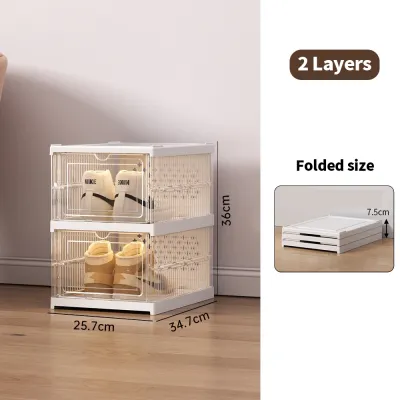
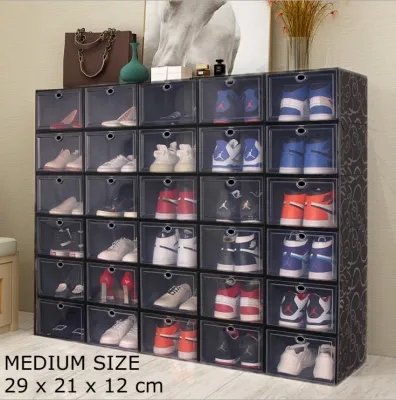
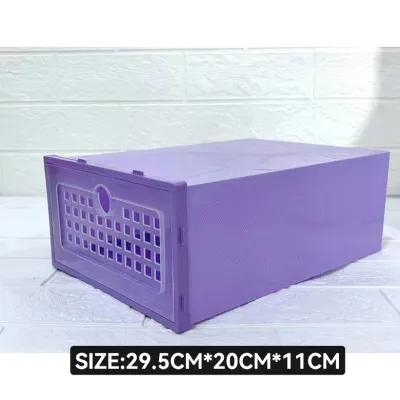
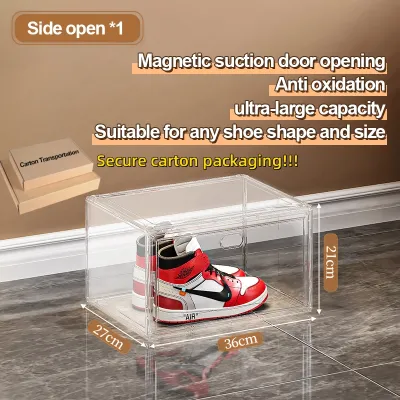
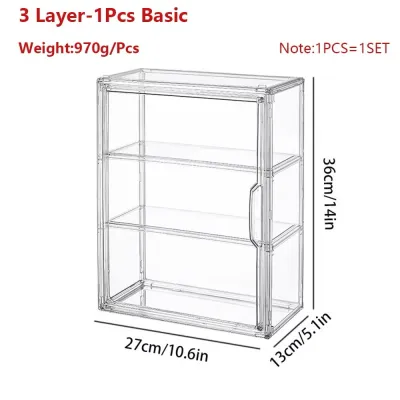
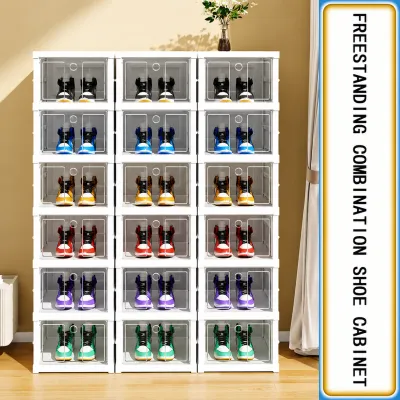
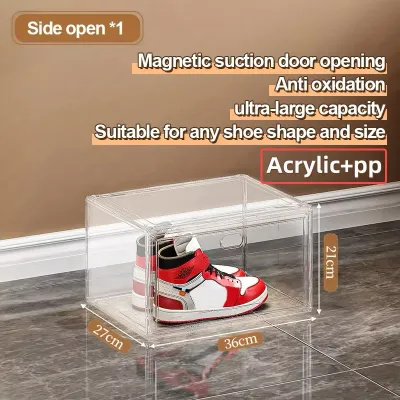
Prices are valid at publication and may change. Please refer to the product page for the latest price.
Finally, you must account for the dynamic spatial relationship between your hanging garments and your shoe storage. Measure the drop length of your longest hanging items, such as dresses, trousers hung by the cuff, and long coats, to identify where the floor must remain completely clear of storage boxes. Additionally, consider the swing space required for your clothes hangers; garments do not hang completely flat, and bulky jackets or thick wooden hangers can extend several inches forward, potentially colliding with shoe boxes stacked on shallow shelves. Ensuring there is a buffer zone of at least two to three inches between the front of your stacked boxes and the outer edge of your hanging clothes will preserve the clean lines of your closet and prevent friction damage to delicate fabrics.
Comparing Shoe Box Materials and Access Designs
Selecting the right material and access design for your shoe boxes is essential for balancing visual clarity, structural stability, and long-term durability. Clear acrylic or rigid plastic drop-front bins are highly favored for modern closet systems because they offer maximum visibility, allowing you to identify your footwear instantly without opening multiple containers. These rigid boxes typically feature interlocking tabs or molded grooves on the top and bottom panels, which secure them in place when stacked vertically and prevent the entire column from shifting or tipping. The drop-front door design is particularly advantageous because it allows you to retrieve a pair of shoes from the bottom of a tall stack without having to unstack the boxes above it, saving time and effort during busy mornings.

For a softer, more integrated aesthetic, fabric or canvas shoe boxes with magnetic flaps or zippered closures offer an excellent alternative, especially in traditional or walk-in closets. These boxes are lightweight, often collapsible when not in use, and provide a breathable, dust-proof environment that is highly gentle on delicate materials like suede and soft leather. While they do not offer the crystal-clear visibility of acrylic bins, many fabric options feature small clear plastic windows on the front panel or dedicated label holders so you can still identify the contents easily. However, because fabric boxes lack a rigid internal skeleton, they cannot be stacked as high as plastic bins; placing too much weight on top of a fabric box can cause the sides to bow, potentially crushing the shoes inside.
Modular stacking cubes represent a third category, offering a highly customizable and semi-permanent structural solution for larger closets. These systems often consist of individual plastic or wire mesh panels that lock together using multi-angle connectors, allowing you to build a custom grid pattern that fits perfectly around your hanging rods or sloped ceilings. This flexibility makes them ideal for awkward closet layouts where standard rectangular boxes might leave wasted gaps. When choosing between these options, it is helpful to evaluate how each material performs across key functional categories to determine the best placement within your closet layout.
| Storage Type | Visibility | Ventilation | Structural Rigidity | Ideal Placement Zone |
|---|---|---|---|---|
| Clear Acrylic Drop-Front | Excellent (Full view of footwear) | Moderate (Rear or front vents) | High (Supports tall vertical stacks) | Floor level, mid-level shelves, high-traffic zones |
| Fabric / Canvas with Window | Moderate (Small window or label) | High (Breathable woven fibers) | Low to Moderate (Limited stacking) | Upper shelves, seasonal storage, delicate footwear |
| Modular Stacking Cubes | High to Moderate (Open or clear doors) | High (Open-front or mesh panels) | Moderate (Requires secure connectors) | Under short-hanging rods, awkward corners |
Key Features for Seamless Closet Integration
When integrating shoe boxes into a shared closet space, the specific design features of the containers will dictate how safely and efficiently the system functions over time. One of the most critical decisions is choosing between front-opening and top-opening access designs. Top-opening boxes, which require you to remove the lid from the top, are only practical if the boxes are placed individually on separate shelves or if they are reserved for long-term, seasonal storage where frequent access is not required. For daily-use footwear integrated into a stacked configuration, front-opening doors—whether they swing downward, slide outward, or secure with magnets—are essential, as they allow you to access any pair instantly without disturbing the structural integrity of the stack.
In tropical climates or enclosed, unventilated closets, adequate airflow is paramount to prevent the buildup of stale odors, mustiness, and moisture damage. When evaluating plastic or acrylic shoe boxes, look for models that feature built-in ventilation holes, rear mesh panels, or small gaps around the door frame to facilitate continuous air circulation. Fabric boxes naturally offer superior breathability due to the porous nature of woven materials, but they should still be kept away from damp closet walls. Without proper ventilation, residual moisture from sweat or humid air can become trapped inside a sealed plastic box, creating an environment that can degrade shoe adhesives, ruin leather finishes, and cause unpleasant odors to permeate your entire wardrobe.
Structural stability is another vital safety consideration, particularly when stacking boxes multiple units high on the closet floor or on wide overhead shelves. Always verify that the boxes you choose feature robust interlocking mechanisms, such as deep nesting grooves, tongue-and-groove edges, or physical clips that lock adjacent units together. A stack of individual boxes that simply sit on top of one another without any interlocking features is highly susceptible to tipping over if bumped or if the closet floor is slightly uneven. Additionally, always review the manufacturer’s weight limits and structural guidelines; the bottom box in a stack must bear the cumulative weight of all the boxes and shoes above it, so placing heavy boots at the bottom and lightweight flats at the top is a necessary practice to prevent bowing and structural failure.
Space Planning: Coordinating Shoe Boxes and Hangers
A truly organized closet requires careful space planning to ensure that your shoe storage system coexists harmoniously with your hanging garments and accessories. One of the most efficient layouts is to position your stacked shoe boxes directly beneath short-hanging items, such as folded trousers on hangers, button-down shirts, and short skirts. This zone often becomes a cluttered graveyard for loose shoes, but by stacking modular boxes up to the hemline of your hanging clothes, you utilize every inch of vertical space. Be sure to leave a clearance of at least three to four inches between the bottom of the hanging garments and the top of the shoe boxes to allow clothes to slide freely along the rod without dragging across the storage units.
If your closet features adjustable shelving tracks, you can customize the vertical gaps to create dedicated zones for different types of storage. For instance, you can install a shelf directly above your shoe box stack to act as a physical barrier, protecting the boxes from any downward pressure and providing a flat surface for storing folded sweaters, handbags, or accessory organizers. This prevents the weight of other closet items from resting on your shoe boxes, preserving their shape and alignment. For closets with fixed wooden shelves, you can use under-shelf wire baskets or hanging fabric organizers alongside your shoe boxes to maximize the remaining overhead space without needing to drill new holes.
For long-hanging garments like full-length dresses, trench coats, and jumpsuits, the floor space directly beneath them must remain completely clear of shoe boxes to allow the fabrics to drape naturally without wrinkling or gathering dust. Instead, group these long items together on one side of the closet rod, and concentrate your shoe box stacks on the opposite side under your shorter garments. To optimize daily accessibility, place your most frequently worn shoes at eye or waist level, where they can be reached effortlessly. Reserve the highest, less accessible shelves of your closet for seasonal footwear, formal shoes, or pairs that are only worn on special occasions, storing them in clearly labeled or transparent boxes so they remain easy to locate when needed.
Maintaining Your Closet Shoe Storage System
To keep your closet shoe storage system looking pristine and functioning effectively, establishing a simple maintenance routine is essential. Periodically wipe down the exterior and interior surfaces of clear plastic or acrylic boxes with a soft microfiber cloth and a mild, non-abrasive cleaning solution to remove dust, fingerprints, and static buildup. For fabric or canvas boxes, use a soft-bristled brush or a vacuum cleaner with a brush attachment to gently remove dust from the woven fibers. Keeping the viewing panels clean ensures that your closet maintains its bright, organized appearance and allows you to identify your footwear at a glance without having to open the doors.
Before placing any footwear back into its designated box, ensure that the shoes are completely clean and dry. Walking on damp streets or wearing shoes on a hot, humid day introduces moisture and dirt that, if sealed inside a confined box, can lead to mold growth and material degradation. Allow your shoes to air out in a well-ventilated room for several hours after wearing them, and use a shoe brush or damp cloth to wipe away any soil from the outsoles before storing them. Additionally, it is highly beneficial to place a small silica gel packet or a reusable moisture-absorbing sachet inside each box—especially for leather and suede footwear stored in humid environments—to actively control moisture levels. Finally, conduct a quick structural check of your stacks every few months, ensuring that the boxes remain perfectly aligned, interlocking joints are secure, and the bottom units show no signs of bowing or stress under the weight.
Frequently Asked Questions (FAQ)
Can I stack shoe boxes directly on top of a closet hanging rod?
No, you should never stack shoe boxes directly on top of a closet hanging rod, as rods are designed solely to support the downward, distributed weight of hanging garments on hangers. Placing heavy, rigid boxes directly on a rod—or on a flimsy wire shelf that relies on the rod for support—can cause the rod to bow, bend, or completely pull away from the wall anchors, leading to a catastrophic closet collapse. Instead, always store your shoe boxes on dedicated wooden or heavy-duty wire shelves that are securely mounted to the wall studs with robust support brackets. If your closet lacks overhead shelving, consider using a freestanding shoe rack or stacking your modular boxes on the closet floor where the weight is safely supported by the ground.
How do I prevent mold in fabric shoe boxes inside a closed closet?
Preventing mold in fabric shoe boxes within an enclosed closet requires active moisture management and consistent airflow. Start by placing silica gel packets, activated charcoal bags, or small hanging dehumidifiers inside the closet to absorb excess humidity from the air. Never store shoes that are damp from rain, sweat, or cleaning; always allow them to dry completely in an open, well-ventilated space before placing them inside the fabric boxes. Additionally, avoid pushing your fabric boxes flush against exterior closet walls, which can experience temperature fluctuations and condensation. Periodically open your closet doors to let fresh air circulate, and consider leaving a small gap between individual boxes to promote passive ventilation throughout your storage system.
Community discussion
Share your experience or ask a question. Comments are reviewed before publication.