
To maximize a small Philippine bedroom closet, a slim shoe rack cabinet with an external depth of 15 cm to 25 cm is the ideal choice. In compact urban spaces, such as condominiums and townhouses in Metro Manila, closet space is at a premium. Standard bedroom closets typically have an interior depth of 50 cm to 60 cm, which is mostly consumed by hanging clothes. Introducing a standard shoe organizer into this space can easily crush garments or block access. Choosing a slim shoe cabinet with a tilt-out mechanism allows you to store footwear vertically within a minimal footprint, keeping your closet organized and your clothes wrinkle-free.
Standard Closet Depths vs. Slim Shoe Rack Clearances
Understanding the spatial relationship between your closet’s structure and your storage furniture is the first step to a functional bedroom. In the Philippines, most built-in or freestanding bedroom wardrobes feature an interior depth ranging from 50 cm to 60 cm. While this depth is standard for accommodating clothes hangers—which typically measure 40 cm to 45 cm wide—the actual space occupied by hanging garments is larger. Once you account for bulky jackets, folded sleeves, and fabrics that flare outward, hanging clothes easily consume 50 cm to 55 cm of depth.
This leaves very little clearance for additional floor-standing furniture. Standard shoe racks or traditional cabinets usually have a depth of 30 cm to 40 cm. If you attempt to place a standard cabinet inside a 60 cm deep closet, it will inevitably press against your hanging garments. This constant friction results in deeply wrinkled clothes, restricted airflow, and difficulty sliding hangers along the rod.
Products mentioned in this guide
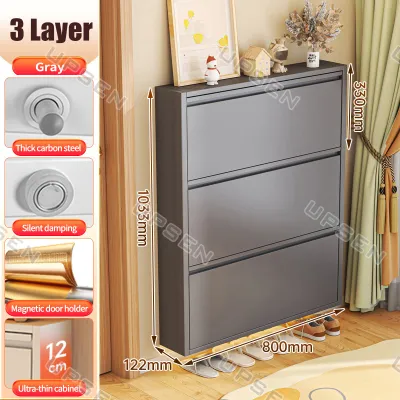
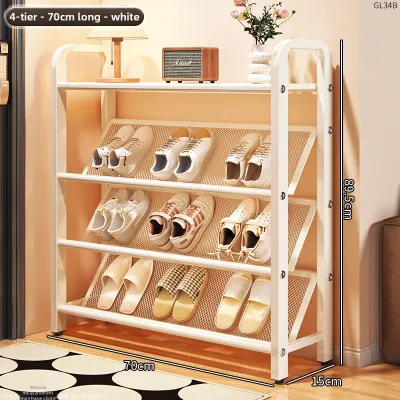
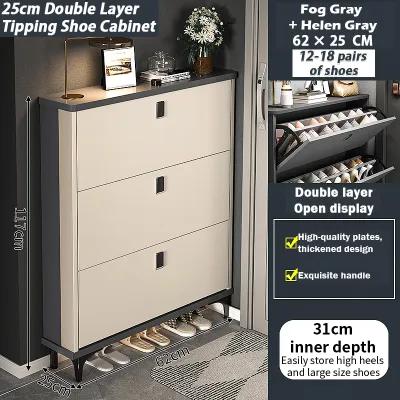
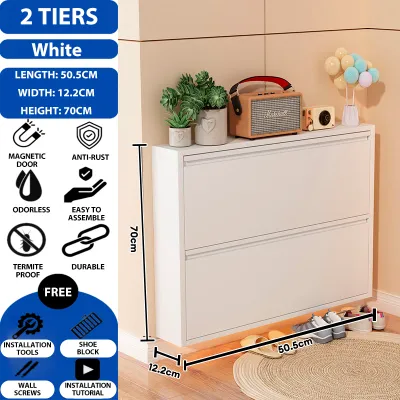
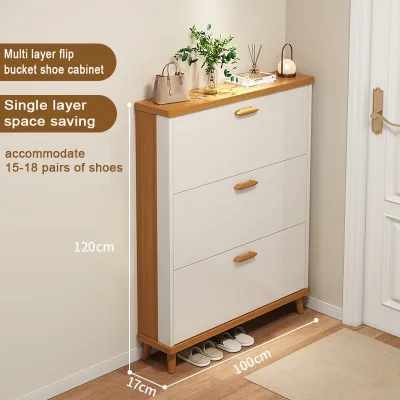
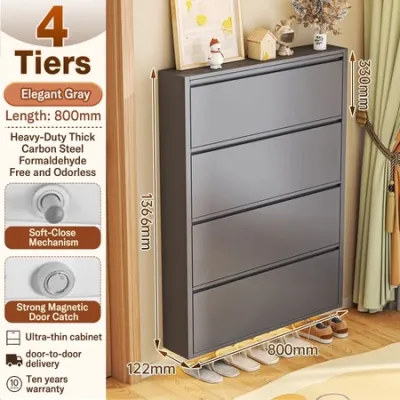
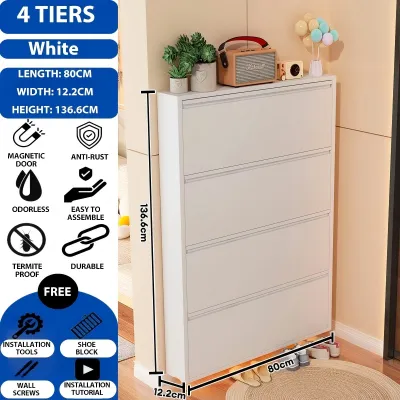
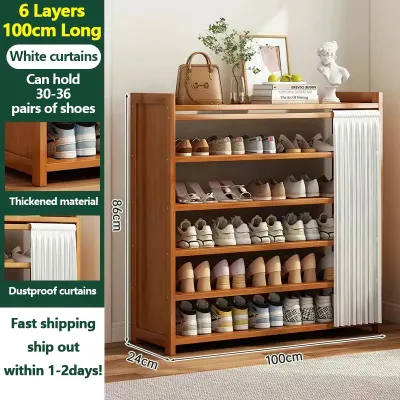
Prices are valid at publication and may change. Please refer to the product page for the latest price.
To resolve this conflict, slim shoe rack cabinets are designed with a significantly reduced profile, typically ranging from 15 cm to 30 cm in depth. An ultra-slim cabinet measuring 15 cm to 20 cm deep can sit comfortably at the bottom of a wardrobe without interfering with the natural hang of your clothes. By selecting a cabinet depth that respects the clearance zone of your hanging garments, you preserve a functional walkway or reaching area inside the closet, making it easy to access both your wardrobe and your footwear.
Essential Measurements to Take Before You Buy
A successful closet organization project relies on precise, real-world measurements rather than guesswork. Before purchasing a slim shoe rack cabinet, you must evaluate the physical boundaries of your closet and bedroom to ensure the unit fits through your home and operates smoothly in its designated spot.

Internal Closet Dimensions Begin by measuring the exact internal width, height, and depth of the usable closet space. Do not assume the closet is perfectly square; measure the depth at both the top and bottom, as well as the width at the front and back. Be sure to subtract the space occupied by internal obstructions. These include protruding shelf brackets, sliding door tracks, low-hanging rods, built-in drawer units, or internal light fixtures. The remaining clear space is your maximum allowable envelope for the cabinet.
Door and Entryway Clearances A common oversight is purchasing a cabinet that fits the closet but cannot physically enter the room. If you are buying a pre-assembled unit, measure the width and height of your bedroom door frame, hallway corners, and any stairwells or elevator doors. If you are purchasing a flat-pack unit, ensure there is sufficient floor space in your bedroom to lay out the panels and safely assemble the cabinet according to the manufacturer’s instructions.
Baseboards and Casings Most Philippine homes feature baseboards along the bottom of the walls or decorative casings around closet doors. These architectural details can project 1 cm to 2.5 cm from the wall. Because slim shoe cabinets are tall and top-heavy, they must sit completely flush against the wall or closet back panel to remain stable. Measure the height and thickness of your baseboards. Some slim cabinets feature a pre-cut baseboard notch at the back; if yours does not, you will need to account for this gap when calculating the total depth the cabinet will occupy.
Operational Clearance A cabinet is only useful if you can open it. If you choose a model with traditional hinged doors, you must measure the door swing radius to ensure it does not strike the closet doors or your bed frame. For tilt-out drawers, calculate the projection of the drawer when fully opened. Additionally, remember to leave at least 40 cm to 50 cm of physical clearance in front of the open cabinet so you can comfortably bend down, select your shoes, and stand back up without hitting surrounding walls.
Space-Saving Layouts to Protect Your Hanging Clothes
Integrating a slim shoe cabinet into a small closet requires strategic placement. Depending on your closet’s layout and how you organize your garments, you can choose from three primary space-saving configurations.
Under-Hanging Clothes (Bottom Placement)
The area directly beneath hanging clothes is often underutilized. To place a slim shoe cabinet here, you must first calculate the “safe depth.” Measure the distance from the back wall of the closet to the front edge of your hangers, then subtract this from the total closet depth. The remaining space is your safe depth zone.
For this layout, ultra-slim tilt-out shoe cabinets with a depth of 15 cm to 20 cm are highly recommended. Because these cabinets use a vertical tilting mechanism rather than horizontal shelves, they keep the footprint exceptionally shallow. Additionally, you may need to adjust the height of your hanging rod. Ensure that shorter items like shirts and folded trousers hang above the cabinet, while long garments like dresses, long skirts, or coats are moved to a separate section so they do not drag on top of the cabinet and gather dust.
Side-by-Side in Narrow Closet Dead Zones
Many built-in closets feature “dead zones”—narrow vertical spaces on the left or right sides that are difficult to reach because they sit behind the door frame or adjacent to a corner. These areas are ideal for vertical storage.
In these narrow zones, you can install a tall, narrow slim shoe cabinet measuring 20 cm to 25 cm deep. This layout maximizes vertical space, allowing you to stack multiple pairs of shoes upward without encroaching on the main horizontal hanging rod. Before finalizing this placement, check the cabinet’s footprint against the closet’s internal corner angles. Older built-in closets in the Philippines may have slightly uneven plaster or wood joints in the corners, which can prevent a rigid cabinet from sitting level.
External Gaps Adjacent to the Closet
If your wardrobe is completely filled with clothes, forcing a shoe cabinet inside will only lead to frustration. Instead, look for external gaps in your bedroom that sit directly adjacent to the closet structure.
A narrow gap between the exterior side panel of the closet and the bedroom wall, or the space between the closet and a bed frame, can easily accommodate a freestanding slim cabinet. Selecting a unit that is 15 cm to 25 cm wide or deep allows you to extend your closet system outward seamlessly. When placing a cabinet externally, verify that it does not block the bedroom’s main walkway or interfere with the swing of the bedroom door, closet doors, or nearby drawers.
Common Sizing and Clearance Mistakes to Avoid
Avoiding common pitfalls during the planning phase will save you the hassle of returning heavy furniture or dealing with damaged belongings.
- Ignoring Door Swing Radius: Many homeowners focus solely on whether a cabinet fits when closed, forgetting how it behaves when open. Traditional hinged doors require significant clearance. In a tight closet, opening these doors can block the entire walkway or collide with sliding closet doors. If space is tight, prioritize tilt-out drawers or open-front slim racks that do not require wide swinging clearances.
- Overlooking Internal Hardware: Never assume that a closet's external dimensions match its internal usable space. Sliding door tracks, heavy-duty hinges, shelf support brackets, and back panels all subtract valuable centimeters from the interior depth. Always measure the clearance from the shallowest point—such as the edge of a sliding door track—rather than the bare wall.
- Neglecting Ventilation in Humid Climates: The Philippines' tropical climate features high relative humidity, especially during the rainy season. Placing a wooden or particle-board shoe cabinet flush against a concrete wall or tightly packing it against clothes inside an unventilated closet traps moisture. This creates an ideal breeding ground for mold and mildew, which can ruin both your leather shoes and your garments. To prevent this, leave a slight air gap of 2 cm to 3 cm between the cabinet and the wall, ensure the cabinet has ventilation holes or an open-back design, and consider placing moisture absorbers inside the closet.
- Assuming "Slim" Means Universal Fit: The label "slim" refers to the external dimensions, not the internal capacity. Many ultra-slim cabinets achieve their shallow depth by tilting the shoes vertically. This design works exceptionally well for flat shoes, sandals, and low-profile sneakers, but it may not accommodate high heels, ankle boots, or larger shoe sizes. Always check the manufacturer's internal shelf dimensions and weight limits before purchasing to ensure your specific footwear will fit.
Matching External Dimensions to Actual Shoe Capacity
To choose the right slim shoe rack cabinet, you must understand how its external dimensions translate into actual, usable internal storage.
First, distinguish between external cabinet depth and internal usable depth. A cabinet with an external depth of 17 cm may only have an internal usable depth of 14 cm once you subtract the thickness of the back panel, front door, and the plastic tilt-out brackets. This difference is critical because it dictates the maximum length of shoe that can sit flat or tilted inside the compartment.
Ultra-slim tilt-out cabinets (typically 15 cm to 20 cm deep) store shoes at an angle. While highly space-efficient, they have strict limitations. For instance, high-top sneakers, platform heels, or men’s shoes larger than US size 10 often prevent the tilt-out drawer from closing completely. If your household has larger shoe sizes, look for cabinets with slightly deeper profiles (22 cm to 30 cm) or units that feature adjustable internal shelves and removable dividers. These adjustable components allow you to customize the height of each compartment to accommodate taller footwear like ankle boots or heels.
Finally, when selecting a cabinet for an enclosed closet, check the manufacturer’s care instructions and material labels. In the humid Philippine environment, materials like engineered wood (MDF or particle board) should feature a moisture-resistant finish or laminate to prevent warping. Inspect the joints and edge banding to ensure they are tightly sealed against ambient moisture.
Frequently Asked Questions (FAQ)
Can a slim tilt-out shoe cabinet fit large men's shoes or boots?
Ultra-slim tilt-out cabinets with an external depth of under 20 cm are generally designed for standard low-profile footwear, such as flats, sandals, and standard running shoes. They often struggle to accommodate men’s shoes larger than US size 10, high-top sneakers, or boots, as these taller profiles prevent the tilting drawer from closing. Before purchasing, always check the manufacturer’s specifications for maximum shoe length and internal compartment height. If you need to store larger or bulkier footwear, look for a slim cabinet with a slightly deeper profile of 25 cm to 30 cm, or opt for a model with adjustable internal dividers.
Should I anchor a tall, slim shoe cabinet inside a closet?
Yes, you should strongly consider anchoring any tall, slim shoe cabinet to the wall. Because these cabinets have a very narrow footprint and a high center of gravity, they are highly prone to tipping forward when multiple tilt-out drawers are opened simultaneously, especially when fully loaded with heavy shoes. To prevent accidents and ensure stability, use the anti-tip anchoring hardware provided by the manufacturer. If you are renting a home in the Philippines and your lease agreement prohibits drilling into closet walls, look for heavy-duty, non-damaging adhesive anti-tip straps designed for furniture, or ensure the cabinet is securely wedged and balanced.
Community discussion
Share your experience or ask a question. Comments are reviewed before publication.