
The structural strength of a bed frame depends on more than just the baseline material; it is determined by the specific wood species or engineered wood type, the joint construction, and the underlying support system. While high-quality solid hardwood and structural-grade plywood generally offer superior load-bearing capacity and long-term durability, lower-density engineered woods like particleboard or MDF may struggle with joint integrity under heavy daily use. Ultimately, the “stronger” choice relies on verifying the manufacturer’s weight limits, inspecting the support slats and center legs, and matching the material’s structural traits to your specific household needs.
When selecting a bed frame, many buyers assume that any option labeled “wood” will provide the same level of stability. However, the internal composition of the frame dictates how well it handles daily physical stress, shifting weight, and environmental factors. In tropical climates with high relative humidity, such as the Philippines, these material differences become even more pronounced over time. Moisture in the air can penetrate unprotected wood fibers, causing certain materials to swell, warp, or lose their structural grip at critical connection points.
Understanding how solid wood and engineered wood compare structurally allows you to select a frame that remains silent, stable, and secure for years to come. A bed frame must support not only the weight of the sleepers but also the substantial weight of modern mattresses, which often feature dense foam layers or heavy pocket springs. By focusing on structural details rather than surface aesthetics, you can make a choice that stands up to daily wear.
Products mentioned in this guide
88 Lazada user ratings
🎨Design: ok 🔨Durability:rubbish 🛡️Safety:rubbish 🛋️Comfort:no good bed was poorly packaged missing parts quality of finish was poor had to pay…Read full reviewShow less
🎨Design: ok 🔨Durability:rubbish 🛡️Safety:rubbish 🛋️Comfort:no good bed was poorly packaged missing parts quality of finish was poor had to pay to have holes drilled and missing frame pieces made . shocking for the money was overcharged by courier over 6k instead of 4k +
naiship agad ni seller yung orddr ko, mabilis ko din na natanggap, maayos yung packaka seal at pack ng order, tama yung sukat tsaka descript…Read full reviewShow less
naiship agad ni seller yung orddr ko, mabilis ko din na natanggap, maayos yung packaka seal at pack ng order, tama yung sukat tsaka description
great value for money and great quality of items. will surely buy again from the seller very fast and smooth delivery of the products.
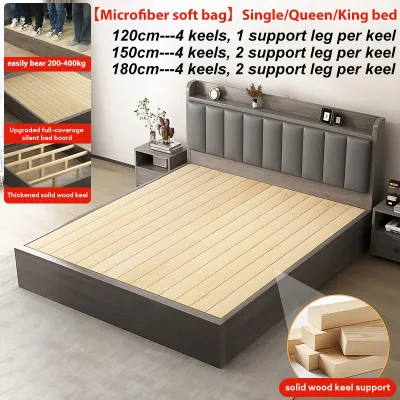
Solid wood construction, Laminate surface finish, Durable rubberwood frame, 6-month warranty included, Modern and practical design,
di ko pa na I aayus so far oky naman siya salamt seller
Prices are valid at publication and may change. Please refer to the product page for the latest price.
What Defines Structural Strength in a Bed Frame?
Evaluating a bed frame’s structural integrity requires looking at the entire assembly rather than just the raw material. A frame made of the densest hardwood can still fail if the joints are poorly designed or if the support system lacks central reinforcement. Structural strength is the collective ability of the headboard, footboard, side rails, slats, and hardware to distribute weight evenly to the floor without bending, cracking, or swaying.
The connection methods, or joinery, serve as the primary defense against structural failure. Traditional woodworking joints, such as mortise-and-tenon or doweled connections, distribute physical stress across a larger surface area of the wood itself. In contrast, many modern flat-pack frames rely on metal-to-metal brackets, threaded inserts, or cam lock systems. While metal-to-metal connections can be exceptionally secure, their stability depends heavily on how firmly the receiving hardware is anchored into the wood rail.
Another critical element is the foundation architecture, which includes the slats and center support legs. Slats that are too thin or spaced too far apart will sag under weight, placing concentrated stress on the side rails and causing the mattress to dip. A structurally sound frame typically features a dedicated center support rail equipped with adjustable legs that make direct contact with the floor. This configuration prevents the frame from bowing inward and balances the load across the entire footprint of the bed.
Solid Wood Bed Frames: Structural Traits and Limitations
Solid wood bed frames are constructed from natural timber cut directly from trees, offering inherent grain continuity that provides excellent natural load-bearing capacity. The structural performance of solid wood, however, is not uniform across all species. Hardwoods, such as mahogany, acacia, tanguile, and oak, feature dense cellular structures that resist bending and hold fasteners securely. Softwoods, such as pine or fir, are lighter and easier to harvest but are more susceptible to denting, scratching, and gradual warping under heavy loads.

Because solid wood is an organic material, it remains responsive to its environment even after being processed into furniture. In regions with distinct wet and dry seasons, solid wood naturally absorbs and releases moisture, leading to minor expansion and contraction. If a frame is not properly sealed with a high-quality lacquer, varnish, or polyurethane finish, this constant movement can cause the wood to warp or split. Over time, environmental shifting can also loosen the hardware connections, meaning you may need to perform periodic maintenance, such as tightening bolts, to prevent squeaking.
Despite these environmental sensitivities, solid wood offers a distinct structural advantage in terms of repairability and longevity. If a screw hole becomes stripped or a joint loosens after years of use, solid wood can be repaired using wood glue, dowels, or wood filler, and then re-drilled. The material also tolerates heavy-duty hardware modifications, allowing you to reinforce weak points with aftermarket steel brackets if your structural needs change over time.
Engineered Wood Bed Frames: Structural Traits and Limitations
Engineered wood is a broad category of manufactured products created by binding wood fibers, particles, or veneers together with adhesives under high pressure. The structural capabilities of these materials vary dramatically depending on their density and manufacturing process. High-grade plywood, which consists of cross-laminated wood veneers, offers exceptional dimensional stability and structural strength. Because the grain directions of each layer alternate, plywood resists warping, shrinking, and cracking, making it highly resilient in humid environments.
On the lower end of the density spectrum are medium-density fiberboard (MDF) and particleboard. These materials are made from compressed wood dust or wood chips mixed with resin. While they provide a perfectly flat surface free of natural knots, they lack the fibrous structural integrity of solid wood or plywood. Under heavy daily loads, MDF and particleboard side rails are more prone to sagging, especially if the span of the bed rail is not reinforced with a metal support bar.
The primary structural limitation of lower-density engineered wood lies in its hardware retention. Screws driven directly into particleboard or MDF rely on the adhesion of compressed particles to hold their grip. Under the dynamic stress of daily use—such as sitting on the edge of the bed or tossing and turning—these particles can break down, causing the screws to strip out of the material. Once a connection point in particleboard fails, it is incredibly difficult to repair structurally without using specialized through-bolts or extensive reinforcement.
To protect engineered wood from structural degradation, manufacturers apply surface treatments like wood veneers, paper foils, or plastic laminates. It is crucial to inspect the edge banding on these frames, as unsealed edges can absorb ambient humidity. If moisture penetrates the core of an MDF or particleboard frame, the material will swell, lose its structural density, and eventually crumble under load.
Comparing Structural Dimensions: What to Check
When comparing solid wood and engineered wood bed frames, you should evaluate specific structural dimensions rather than relying on broad material labels. A well-engineered plywood frame can easily outperform a poorly constructed softwood frame, just as a solid hardwood frame will outlast a basic particleboard model. To make an objective comparison, you must look at how each material handles load verification, joint durability, and environmental resilience.
Load-bearing capacity should always be verified through the manufacturer’s official specifications rather than assumed. A high-quality solid hardwood frame often supports substantial weight limits, but this is only true if the frame features robust joinery and a reinforced center rail. For engineered wood frames, look for specifications that explicitly state the use of multi-layered plywood or high-density fiberboard for the load-bearing side rails, rather than low-density particleboard.
Joint durability is another critical point of comparison. Solid wood frames excel at holding heavy-duty threaded bolts and barrel nuts, which can be tightened repeatedly without damaging the wood. Engineered wood frames, particularly those made of MDF, often rely on cam lock fasteners or wood screws. While cam locks allow for quick assembly, they do not distribute tension as effectively as through-bolts, making them more prone to loosening and wobbling over time.
The following table outlines the key structural checkpoints you should verify on the product specification sheet or manual before making a purchase:
| Structural Checkpoint | Solid Wood Bed Frames | Engineered Wood Bed Frames |
|---|---|---|
| Primary Material Density | High in hardwoods (acacia, mahogany); lower in softwoods (pine). | High in structural plywood; low to medium in MDF and particleboard. |
| Joint Connection Type | Mortise-and-tenon, dowels, or heavy-duty metal-to-metal bolts. | Often relies on cam locks, dowels, or wood screws; plywood may use metal inserts. |
| Moisture & Humidity Response | Expands and contracts; requires protective sealant (lacquer/varnish) to prevent warping. | Plywood remains highly stable; MDF/particleboard swells permanently if moisture penetrates edges. |
| Repairability of Stripped Joints | High; can be filled, glued, re-drilled, or reinforced with standard hardware. | Low to moderate; stripped particleboard holes require specialized anchors or through-bolts. |
| Slat Support Requirements | Requires solid wood or thick plywood slats; spacing should be checked against mattress guidelines. | Often uses laminated bentwood slats or plywood sheets; check for center support legs. |
How to Verify Bed Frame Strength Before You Buy
Before purchasing a bed frame from an online marketplace or a local furniture showroom, you should systematically verify its structural specifications. Start by checking the stated weight capacity on the product label, manual, or official store listing. This weight limit must accommodate the combined weight of all occupants plus the weight of your mattress. If a manufacturer does not publish a maximum weight capacity, treat this as a warning sign regarding the frame’s structural testing.
Next, inspect the details of the internal support system. A strong bed frame should feature a center support rail that runs from the headboard to the footboard, supported by at least three adjustable center legs. These legs must make firm contact with the floor to prevent the frame from sagging in the middle. Additionally, measure the spacing between the slats; for most modern pocket spring and memory foam mattresses, slats should be spaced no more than 3 inches (approximately 7.6 cm) apart to prevent mattress damage and ensure even weight distribution.
Examine the hardware kit and assembly instructions closely. Look for frames that utilize thick steel brackets, barrel nuts, and machine bolts rather than thin wood screws or plastic connectors. If you plan to assemble the frame yourself, verify that the package includes clear instructions and all necessary structural fasteners.
Finally, do not forget to verify the physical dimensions of both the assembled frame and its packaging. Ensure the finished dimensions fit comfortably within your bedroom layout, leaving adequate clearance around the walls and other furniture. You must also measure your home’s entryways, hallways, stairwells, and elevator doors to guarantee that the packaged boxes can be safely transported to your bedroom without getting stuck or requiring risky maneuvers.
Which Bed Frame Material Should You Choose?
Your choice between solid wood and engineered wood should align with your long-term durability expectations, budget, and environmental conditions. Solid wood is the appropriate choice if you prioritize maximum structural longevity, plan to keep the bed frame for decades, and want the ability to repair or refinish the furniture over time. While solid hardwood frames often require a higher initial investment, their resistance to bending and their ability to hold heavy-duty hardware make them highly reliable for heavy daily use.
Engineered wood is a suitable alternative if you are working within a specific budget or prefer modern, minimalist designs with perfectly uniform surfaces. If you choose engineered wood, prioritize frames constructed from high-grade plywood or high-density fiberboard (HDF) rather than cheap particleboard. Plywood frames offer excellent dimensional stability, meaning they will not warp or crack when exposed to seasonal humidity changes in tropical environments.
Regardless of the material, you should avoid any bed frame that lacks clear weight specifications, uses thin particleboard for the main load-bearing side rails, or lacks center support legs. By carefully checking the joinery, support architecture, and manufacturer guidelines, you can select a bed frame that provides a stable, squeak-free foundation for a restful night’s sleep.
Frequently Asked Questions (FAQ)
Does the type of mattress affect the bed frame's structural lifespan?
Yes, the weight and construction of your mattress directly impact the stress placed on your bed frame. Heavy mattresses, such as multi-layer memory foam, latex, or hybrid pocket spring models, exert a high static load on the support slats even when the bed is unoccupied. To prevent premature structural fatigue, warping, or sagging of the frame, you must add the weight of your mattress to the weight of the sleepers when verifying the frame’s maximum load capacity. A heavy mattress requires a frame with closely spaced slats and a robust center support rail with adjustable legs to distribute the weight evenly.
Can engineered wood bed frames be safely disassembled and reassembled?
The safety of disassembling and reassembling an engineered wood bed frame depends heavily on the material density and the type of hardware used. High-grade plywood frames utilizing metal-to-metal threaded inserts can typically withstand being disassembled and moved multiple times without losing structural integrity. However, frames made of lower-density particleboard or MDF are highly susceptible to damage during disassembly, as the wood fibers around screws and cam locks can easily crumble or strip. If you must move an MDF or particleboard frame, proceed with extreme care, avoid over-tightening the screws during reassembly, and consider reinforcing loose joints with specialized furniture brackets if necessary.

Community discussion
Share your experience or ask a question. Comments are reviewed before publication.