
Finding the perfect bedside table for bedroom layouts in the Philippines often feels like a puzzle, especially in compact studio apartments, modern condominiums, or cozy townhouses. To maximize limited floor area while keeping your devices powered, the best compact bedside table must balance a slim footprint with smart vertical storage and built-in, safe charging capabilities.
In tropical climates where humidity levels fluctuate, selecting a unit with moisture-resistant finishes is just as critical as finding one that physically fits. The ideal solution does not merely sit next to your mattress; it actively declutters your sleeping area, organizes your daily essentials, and provides a centralized power hub without creating a dangerous tangle of messy extension cords.
By focusing on precise physical clearances, tailored storage configurations, and verified electrical specifications, you can transform a cramped bedside into a highly functional, organized zone. Let’s look at how to evaluate these factors to choose the perfect space-saving companion for your bed.
Products mentioned in this guide
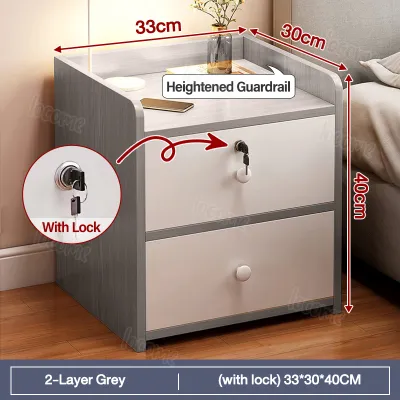
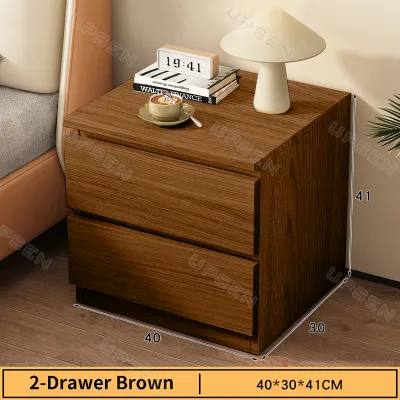
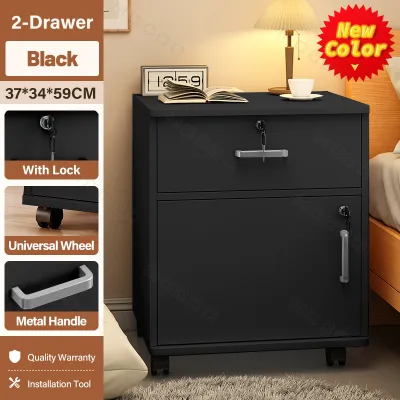
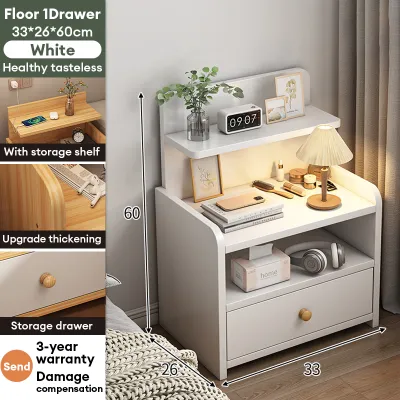
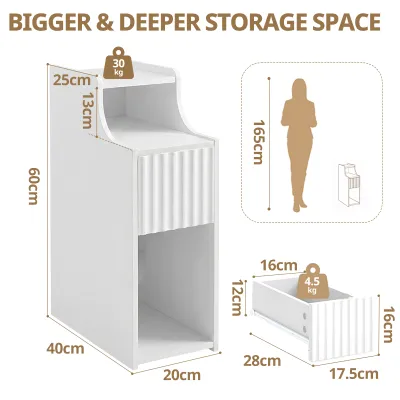
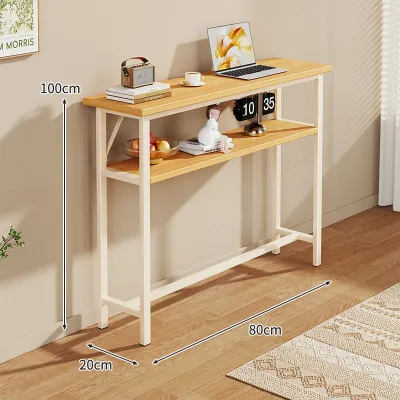
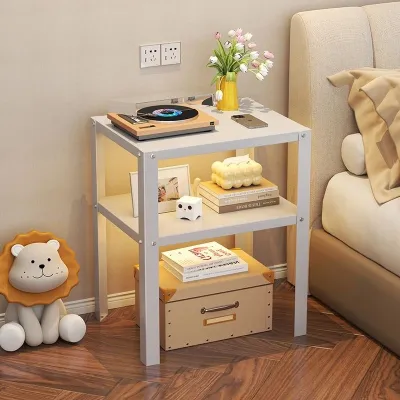
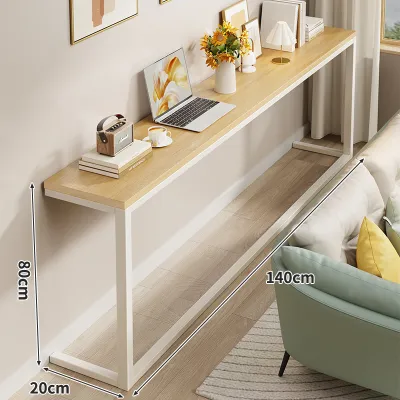
Prices are valid at publication and may change. Please refer to the product page for the latest price.
Measuring Your Space: Clearances and Layout Planning
Before browsing online marketplaces or visiting local furniture showrooms, you must establish your bedroom’s exact physical boundaries. A bedside table that is even a few centimeters too wide can block wardrobe doors, prevent drawers from opening, or force you to shimmy awkwardly around the foot of your bed.
Begin by measuring the absolute width of the available gap between your bed frame and the adjacent wall or nearest piece of furniture. Be sure to measure from the widest point of your bed frame, taking into account any protruding mattress edges, decorative headboards, or baseboards along the wall that might reduce the actual floor space.
Next, assess the depth clearance of the surrounding walkway to ensure your path remains entirely unobstructed. A standard walkway requires at least 50 to 60 centimeters of clear space for comfortable movement; if your bedside table extends too far forward, it becomes a constant tripping hazard in the dark.
Take note of how nearby doors swing, including bedroom entryways, closet doors, and lower dresser drawers. Open every door and drawer fully to verify that they will not collide with your prospective bedside table, adjusting your maximum allowable depth accordingly.
Height is the third crucial dimension to measure, as it directly impacts both your physical comfort and the accessibility of your charging ports. For optimal ergonomics, the top surface of your bedside table should sit roughly level with, or up to five centimeters higher than, the top of your mattress.
Locate your existing wall outlets before finalizing your table’s height and placement. If the outlets are low to the ground, a table with an open back or a specific cut-out will allow you to push the unit flush against the wall without pinching or damaging your power cords.
Finally, look at the visual weight of the space and identify potential clutter zones. In a small room, a solid, bulky cabinet can make the entire area feel cramped, whereas a compact footprint with elevated legs or a floating design immediately improves the perceived size of the room by exposing more floor space.
Essential Features: Choosing a Bedside Table for Bedroom Storage and Charging Specs
When square footage is limited, every square centimeter of furniture must work twice as hard. Evaluating storage configurations requires a careful balance between hidden compartments for personal items and open shelves that keep your daily essentials within arm’s reach.

Deep drawers are excellent for hiding visual clutter, such as medication, eye masks, and loose items, but they require physical space to pull open. If your bedside clearance is exceptionally tight, consider open cubbies, sliding doors, or fabric baskets that provide access without demanding extra clearance in front of the unit.
Integrated charging features elevate a basic table into a functional power hub, but you must choose the right configuration for your devices. Built-in USB-A and USB-C ports eliminate the need for bulky wall adapters, while integrated wireless charging pads built directly into the top surface offer a clean, cable-free look for compatible smartphones.
For those with multiple high-draw devices, such as laptops, tablets, and smartwatches, look for units featuring integrated power strips tucked into a recessed compartment. This keeps large power bricks hidden from view while preventing a dangerous tangle of cords running from the wall to your tabletop.
Safety is paramount when dealing with integrated electrical modules in the Philippines. Always verify that the built-in charging components are rated for the local electrical standard of 220 volts at 60 Hertz (220V/60Hz) to prevent overheating, short circuits, or damage to your sensitive electronics.
Look closely at the product label or manufacturer specifications for recognizable safety certification marks, such as the Philippine Standard (PS) mark or the Import Commodity Clearance (ICC) sticker. Avoid unbranded, generic electrical furniture that lacks clear certification, as substandard wiring poses a serious fire hazard in your sleeping area.
Material selection directly influences both the longevity and stability of narrow-footprint furniture, particularly in humid tropical environments. Solid wood, powder-coated steel, and high-quality moisture-treated engineered wood resist warping and swelling far better than cheap, untreated particleboard.
Because compact bedside tables are often tall and slim, you must carefully evaluate their center of gravity and overall base weight. A top-heavy table can easily tip over when you open a fully loaded drawer or reach for a charging cable, making a heavy base or built-in anti-tip anchoring hardware essential for safety.
Top Space-Saving Designs for Compact Bedrooms
Selecting the right structural form factor is far more critical than simply looking at overall dimensions when dealing with tight bedroom layouts. Different architectural designs solve unique spatial problems, allowing you to maximize storage and charging capabilities without sacrificing precious floor area.
Floating or Wall-Mounted Nightstands
Floating or wall-mounted nightstands are the ultimate solution for bedrooms with minimal floor space and high foot traffic. By anchoring directly to the wall, these units leave the floor completely clear, making it incredibly easy to sweep, vacuum, or mop away dust and allergens.
This open floor area creates an immediate visual illusion of a larger room, as the uninterrupted flooring trickles light and space deeper into the corner. However, this design does come with storage limitations, typically offering only a single shallow drawer or an open shelf best suited for holding a phone, a book, and a glass of water.
Before purchasing a floating unit, you must verify your wall material to ensure it can support the weight of the furniture and its contents. In the Philippines, bedroom walls are commonly constructed from solid concrete, hollow concrete blocks, or lightweight drywall and Hardiflex sheets.
Solid masonry or concrete walls provide excellent load-bearing capacity when paired with standard plastic or metal masonry anchors. If your wall is made of drywall or fiber cement board, you must locate and anchor directly into the wooden or metal studs; never hang a floating table solely on unsupported drywall, and stop and consult a professional contractor if the wall type is unknown.
To keep your charging setup clean, look for floating nightstands with built-in cable routing channels or hollow back panels. This allows you to run the main power cord discreetly down the wall, hiding it behind a decorative cord cover or routing it directly to an outlet positioned behind the unit.
Slim C-Tables and Slide-Under Bedsides
Slim C-shaped tables and slide-under bedsides offer an ingenious way to reclaim underutilized space around your bed frame. These units feature a cantilevered design where the flat base slides directly under the bed, allowing the tabletop to hover neatly over the edge of your mattress.
To ensure a proper fit, you must measure the vertical clearance between the floor and the bottom of your bed frame, as well as any mattress overhang. The lower support bars of the C-table must slide freely under the frame without catching on fabric, supports, or low-slung wooden slats.
While these designs provide a highly accessible surface right next to your pillow, they present a trade-off between a small surface area and overall stability. Look for models constructed with heavy steel frames and weighted bases to prevent the table from tipping forward when you place a heavy item on the cantilevered edge.
Storage on C-tables is typically minimal but highly optimized, often featuring side-mounted fabric pockets, lower-tier wire mesh baskets, or slim under-table shelves. Charging hubs on these models are usually mounted along the side frame or integrated into the rear edge of the tabletop to keep cords completely out of the way of your sleeping area.
Tiered Storage Carts with Integrated Power
For renters, students, or anyone requiring high-capacity, flexible storage, tiered storage carts with integrated power strips are an incredibly versatile option. These multi-level units utilize vertical space efficiently, offering multiple deep shelves or baskets stacked vertically over a compact footprint.
The primary advantage of a mobile cart is its ability to roll out of the way on lockable casters, allowing you to reposition the unit instantly when cleaning, rearranging furniture, or accessing a nearby closet. When stationary, locking the casters ensures the cart remains securely in place next to your bed.
To prevent tall, narrow carts from becoming unstable, look for designs with a wide, sturdy wheelbase and a low center of gravity. Distribute your stored items strategically by placing heavier items, like books or storage boxes, on the bottom tier, while keeping lightweight electronics on the top shelf.
Managing the main power cord on a mobile cart requires careful attention to prevent tripping hazards or cord damage when moving the unit. Secure the main power strip to the frame of the cart using heavy-duty cable ties, and always unplug the main cord from the wall outlet before rolling the cart across the room.
Organize the different tiers of your cart for specific functions to maximize daily efficiency. Keep the top tier dedicated to active charging, your alarm clock, and frequently used items, while utilizing the lower tiers for bulkier storage, extra bedding, or personal organizers.
Pre-Purchase Checklist for Online Furniture Shopping
Buying furniture online from ecommerce platforms can be highly convenient, but it requires diligent verification to avoid sizing errors and incompatible electronics. Always cross-reference the written dimensions in the product description with user-uploaded photos in the review section to spot any discrepancies in scale, color, or material quality.
Pay close attention to the exact specifications of the integrated charging module, verifying the voltage, amperage, and plug type on the product page. Ensure the unit is designed for 220V/60Hz and features a standard Type A or Type B plug compatible with Philippine wall outlets, saving you from using bulky, unsafe adapters.
Carefully review the retailer’s return policy, focusing specifically on their terms regarding assembled furniture and integrated electrical components. Many online shops will not accept returns once the furniture has been partially or fully assembled, making it critical to inspect all parts for damage before beginning assembly.
Finally, check the assembly requirements and confirm that all necessary hardware is included in the package. For floating designs, verify if specialized wall-mounting brackets and concrete anchors are provided, or if you will need to purchase high-quality mounting hardware separately from a local hardware store.
Frequently Asked Questions (FAQ)
Can I add charging to a standard bedside table if it lacks built-in ports?
Yes, you can easily retrofit any standard bedside table with integrated charging capabilities using low-profile accessories. Consider mounting an adhesive-backed power strip to the back of the unit or installing a clamp-on desk power hub directly onto the rear edge of the tabletop. To maintain a clean, organized look on a small surface, use adhesive silicone cable clips or neoprene sleeves to route the cords neatly down the legs of the table. Always ensure you avoid overloading standard extension cords by plugging in only low-draw devices like phones, tablets, and lamps, rather than high-wattage appliances.
What wall types support floating nightstands?
Floating nightstands require a strong, structurally sound wall to safely support both the weight of the shelf and any items placed on top. Solid concrete, brick, or masonry walls provide the most secure foundation and should be installed using heavy-duty plastic or metal masonry expansion anchors. If you are mounting the table to a drywall or Hardiflex wall, you must locate the internal wooden or metal studs using a stud finder and screw the mounting brackets directly into them. If you cannot verify your wall’s internal structure, or if the package lacks appropriate heavy-duty hardware, halt the installation immediately and consult a qualified local contractor.
How do I manage cables on a compact nightstand without built-in cable management?
Managing cords on a small bedside table is essential to prevent visual clutter and maximize your limited surface area. Use self-adhesive silicone cable organizers or magnetic cable ties along the back edge of the table to keep your charging ends from slipping behind the furniture when unplugged. When routing your cables, always leave enough slack in the wire to prevent physical strain on your device’s charging port when you pick up your phone in bed. Additionally, you can secure heavy power bricks to the underside or back of the table using heavy-duty mounting tape, freeing up valuable space in your drawers or shelves.
Community discussion
Share your experience or ask a question. Comments are reviewed before publication.