
Managing a growing shoe collection in a compact Filipino home presents a unique set of storage challenges. With urban living spaces, such as condominiums and studio apartments in metropolitan areas, featuring increasingly limited floor plans, maximizing every square inch of your closet is essential. High relative humidity throughout the year can also accelerate mold growth and cause unpleasant odors if footwear is crowded into unventilated spaces. To keep your shoes organized, accessible, and in pristine condition, you must look beyond basic floor racks and invest in dedicated space-saving organizers designed specifically for tight wardrobe interiors.
Selecting the right organizer begins with an accurate assessment of your closet’s net physical dimensions. Do not rely solely on the general exterior measurements of your wardrobe; instead, use a metal measuring tape to determine the exact internal width, depth, and height. Subtract the space occupied by baseboards, door hinges, sliding door tracks, and any existing hanging clothes. For instance, if your hanging clothes extend 100 centimeters down from the closet rod, you must measure the remaining vertical clearance below them to ensure a floor rack will fit without crushing your garments.
Next, categorize your footwear collection to understand your specific height and depth requirements. Group your shoes into categories such as flat sandals, sneakers, high heels, and ankle boots. Flat shoes and slippers generally require a vertical clearance of only 10 to 12 centimeters, whereas athletic sneakers and formal heels need 15 to 20 centimeters. Ankle boots may require 25 centimeters or more. Measure the physical depth of your longest pair of shoes—typically men’s formal shoes or athletic sneakers—to ensure the organizer’s shelves are deep enough. Standard shoe depths range from 30 to 35 centimeters, and choosing a rack that is too shallow will cause shoes to protrude, potentially blocking your closet doors.
Products mentioned in this guide
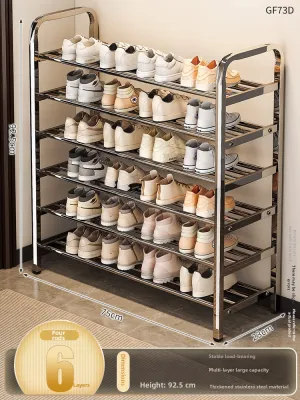
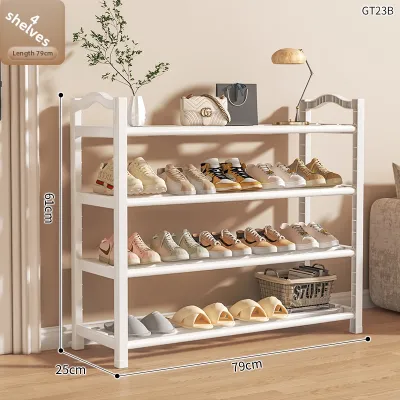
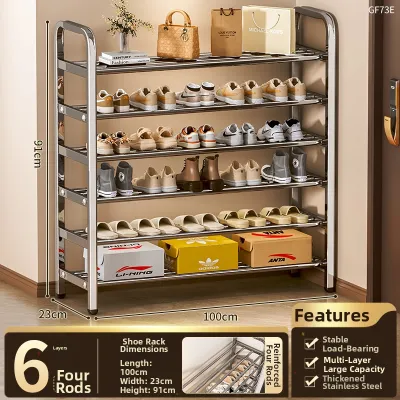
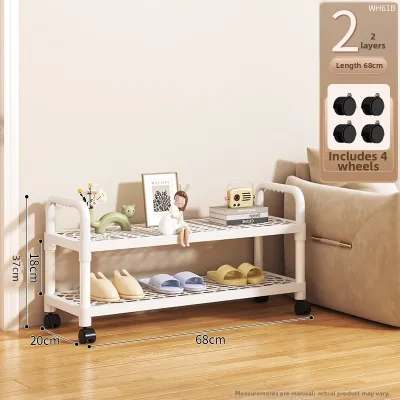
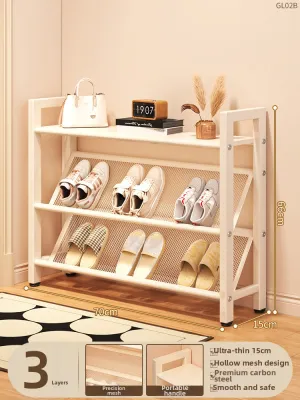
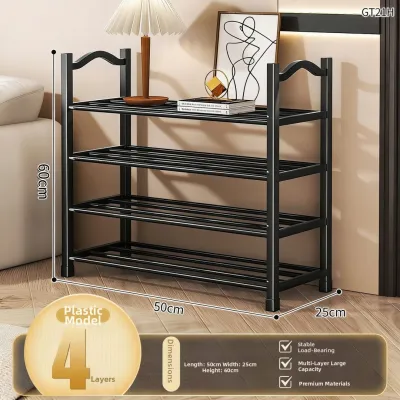
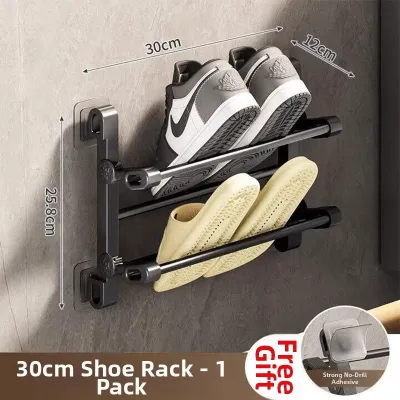
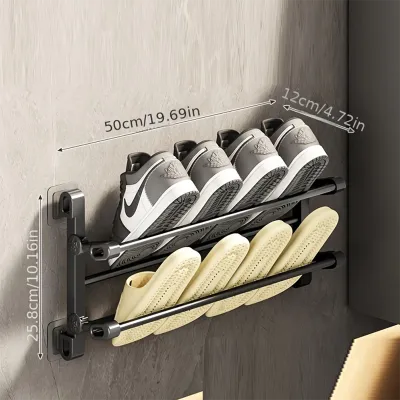
Prices are valid at publication and may change. Please refer to the product page for the latest price.
Finally, evaluate how your closet doors operate to prevent daily access issues. A swinging door requires clear floor space in front of the wardrobe, and any internal organizer must sit far enough back to avoid obstructing the door’s swing path or catching on the hinges. For sliding doors, the organizer must not protrude into the door tracks. Because sliding doors only expose one half of the closet at a time, ensure your shoe organizer is positioned so that you can easily reach every pair without having to awkwardly slide the doors back and forth repeatedly.
Key Space-Saving Designs for Compact Closets
To optimize a small closet, you must shift from horizontal storage to vertical or hidden configurations. There are three primary space-saving designs suited for compact wardrobes: stackable tiered racks, hanging organizers, and integrated pull-out inserts. Each design addresses a different spatial constraint, allowing you to utilize the closet floor, the hanging rod, or the back of the door. Before choosing a style, it is crucial to understand how these structures mount, how much weight they can safely support, and how they interact with your existing closet layout.
Stackable and Adjustable Tiered Racks
Freestanding stackable racks are highly versatile because they allow you to build upward as your shoe collection grows. When evaluating these units, prioritize models with adjustable shelf heights. Racks that feature removable panels or adjustable peg systems enable you to customize the distance between shelves, allowing you to store flat sandals on one level and high-top sneakers on another without wasting valuable vertical space.
Verify the base footprint of the rack to ensure it sits entirely flat on the closet floor. The feet must not rest on baseboards or slide into door tracks, which can cause the rack to tilt. If your closet floor is slightly uneven, look for racks equipped with adjustable leveling feet to maintain stability.
Confirm the center of gravity and safety features when stacking multiple modular units. As you stack racks higher, the assembly naturally becomes top-heavy and prone to wobbling. Check if the manufacturer includes secure interlocking clips, wall-anchoring brackets, or anti-tip straps. Avoid stacking units beyond the manufacturer’s recommended height limit, and always place your heaviest footwear on the lowest shelves to keep the center of gravity as low as possible.
Over-the-Door and Hanging Closet Organizers
Over-the-door and hanging organizers are excellent for utilizing underused vertical zones without taking up any floor space. For over-the-door models, the most critical check is the thickness of the mounting hooks. Standard closet door frames have very tight tolerances; if the metal hooks are too thick, the door will scrape against the frame or fail to close completely. Look for flat, heavy-duty steel hooks that match the exact thickness of your door panel.
For hanging fabric organizers that suspend from the closet rod, pay close attention to the compartment height and the load-bearing limits of the hanging strap. These organizers typically attach using wide hook-and-loop fasteners or metal hooks. Heavy shoes, such as leather boots or thick-soled sneakers, can cause fabric shelves to sag, which strains the seams and can pull the closet rod downward. Ensure the fabric is a heavy-duty weave, such as canvas or reinforced polyester, with rigid shelf inserts to prevent sagging.
Additionally, assess the utility of clear plastic or breathable mesh pockets. Clear pockets allow for instant visual identification in dimly lit closets, saving you time when searching for a specific pair. In the humid Philippine climate, mesh pockets are highly advantageous because they promote continuous air circulation around your shoes, helping to dissipate moisture and prevent the growth of mold and mildew.
Pull-Out and Drop-Down Closet Inserts
Integrated pull-out and drop-down inserts offer a premium, built-in storage solution that maximizes deep or hard-to-reach closet corners. Pull-out trays slide forward on metal runners, allowing you to view and access shoes stored at the very back of the wardrobe. Before purchasing, confirm that your closet has sufficient interior depth and that the side panels are thick and sturdy enough to support sliding rails.
Evaluate the quality of the sliding mechanism. Look for ball-bearing drawer slides with soft-close or damping mechanisms, which ensure smooth operation and prevent shoes from shifting or falling off the tray when pulled forward. Check the rated weight capacity of the slides when fully extended, as a tray loaded with multiple pairs of heavy shoes exerts significant leverage on the mounting screws.
Drop-down designs, which lower shoes from high, hard-to-reach shelves, rely on hydraulic or spring-assisted supports to manage the weight safely. Because these systems exert substantial force on the closet frame during operation, they require precise alignment. If your closet structure is made of thin particleboard, professional installation is highly recommended to reinforce the mounting points and prevent the hardware from tearing out of the wood.
Material and Stability Checks for Daily Use
Do not rely solely on generic material names like “metal,” “wood,” or “plastic” to judge the durability of a shoe organizer. Instead, inspect the specific finish, joint construction, and structural details. In tropical environments, high humidity can quickly rust untreated metal and cause mold on unsealed wood. Look for metal components with thick powder-coated, chrome-plated, or anodized finishes that resist moisture. For plastic components, check for reinforced edges and high-density polymers, such as ABS or polypropylene, which resist warping under constant load.

Verify the type of fasteners used to assemble the organizer. Avoid structures that rely entirely on simple friction fits or weak plastic snap-fits, as these can loosen over time due to the vibrations of daily use. Organizers assembled with metal screws, bolts, or secure interlocking metal joints offer superior long-term stability and are less likely to wobble.
Cross-reference the manufacturer’s stated maximum load limit with the actual weight of your footwear. A typical pair of adult sneakers weighs approximately 0.8 to 1.2 kilograms, while formal leather shoes or boots can easily exceed 1.5 kilograms. Calculate the total weight of the shoes you plan to store on a single shelf to ensure it remains well below the rated limit, preventing the shelves from bending or collapsing.
Finally, check the base of the organizer for stability features. Non-slip rubber pads or adjustable leveling feet are essential for keeping freestanding racks stable on tiled or uneven closet floors. These features prevent the rack from sliding or shaking when you retrieve or replace your shoes, protecting both your footwear and your closet floor from scratches.
Building Your Shortlist: What to Verify Before Buying
When browsing online marketplaces or visiting local furniture stores, use a systematic verification process to filter your options and avoid purchasing incompatible organizers. Always compare the product’s external dimensions with your closet’s net interior dimensions, leaving a clearance of at least 2 to 3 centimeters on all sides. This clearance makes installation much easier and ensures adequate ventilation, which is vital for controlling moisture and odors in enclosed spaces.
Read buyer reviews on e-commerce platforms critically. Focus on feedback regarding assembly difficulty, actual load-bearing performance under daily use, and the quality of the material finish. Look for uploaded photos from buyers to verify if the product’s color and texture match the seller’s description, and pay attention to any complaints regarding missing parts or flimsy joints.
Verify the seller’s return and exchange policy before finalizing your purchase. This is especially critical for custom inserts, pull-out tracks, or wall-mounted racks that require drilling. If the unit does not fit your closet or if your wardrobe panels cannot support the hardware, a flexible return policy protects you from financial loss. Be sure to check who covers the return shipping costs for bulky items.
Check the package contents to confirm if all necessary mounting hardware, such as screws, wall anchors, or brackets, is included. Determine if you will need specific tools, such as a power drill, level, or screwdriver, to complete the assembly safely. If a product requires complex assembly but does not include clear instructions or the necessary hardware, it may be best to look for an alternative.
Installation and Safety Considerations
Proper installation is vital to prevent structural damage to your closet and eliminate safety hazards. For organizers that mount directly to the side or back panels of your wardrobe, verify the board material. Solid wood and high-quality plywood have excellent screw-holding capacity. In contrast, medium-density fiberboard (MDF) or particleboard can crumble or strip easily if screws are over-tightened or subjected to heavy loads. If mounting to MDF, use specialized wood screws and avoid over-tightening.
Avoid mounting heavy shoe racks directly onto thin back panels, which are often only 3 to 5 millimeters thick and cannot support structural loads. Instead, locate the sturdier internal frame or vertical studs, or use through-bolts with backing washers to distribute the weight evenly across the panel. This prevents the panel from bowing or cracking under the weight of the organizer.
If the installation instructions are unclear, conflict with your closet’s structure, or if you suspect hidden electrical wiring or plumbing behind the closet walls, stop immediately and consult a qualified professional carpenter or installer. Making unauthorized modifications to your closet can void its warranty and compromise its structural integrity.
When using high shelving or hanging rod organizers, keep the center of gravity as low as possible. Place heavier footwear, such as boots and leather shoes, on the lowest shelves or near the bottom of the hanging organizer. This distribution prevents the closet rod from bending and reduces the risk of the entire organizer tipping forward when you reach for a pair of shoes.
Frequently Asked Questions (FAQ)
Can I store heavy boots in hanging shoe organizers?
Hanging fabric organizers are generally designed for lightweight footwear like sandals, flats, and light sneakers. Storing heavy boots in these compartments can cause the fabric seams to tear, the shelves to sag, or the hanging straps to fail. Additionally, the concentrated weight can warp or bend your closet’s main hanging rod. For heavy boots, it is safer to store them on the bottom tier of a freestanding floor rack or directly on the closet floor using dedicated boot shapers to maintain their structure.
How do I prevent shoe odors from transferring to my clothes in a small closet?
To prevent odors from transferring to your garments, never place damp or dirty shoes directly into a closed closet. Allow your shoes to air dry completely in a well-ventilated area outside the closet before storing them. For enclosed shoe boxes or cabinets, choose designs with built-in ventilation holes to promote airflow. You can also place charcoal desiccants, silica gel packets, or specialized odor absorbers on the shelves, establishing a regular schedule to check and replace them to control humidity and freshness.
Are tension rod shoe racks safe for all closet types?
Tension rod shoe racks rely on outward pressure and friction to stay in place between two parallel surfaces. They are not suitable for all closet types, particularly those with thin, hollow-core wooden panels, plasterboard, or highly smooth and slippery surfaces. Excessive tension can warp or crack thin closet side panels, while insufficient tension can cause the rack to collapse under the weight of your shoes. Always verify the manufacturer’s specified surface compatibility and avoid over-tightening the rods against fragile materials.
Community discussion
Share your experience or ask a question. Comments are reviewed before publication.