
When organizing a closet system, choosing the right shoe box is the difference between a seamless daily routine and a frustrating chore. The ideal storage solution depends on your closet’s shelf depth, the height of your shelves, and how often you wear each pair of shoes. There is no single “best” option; instead, the right choice aligns with your specific space constraints and daily habits.
For those who need daily access to stacked shoes, drop-front shoe boxes are highly recommended. They excel on deep closet shelves and eliminate the need to unstack multiple containers to retrieve a single pair of shoes.
Conversely, standard stackable shoe boxes—which typically require removing the top lid or detaching the front panel—are excellent for storing seasonal or rarely worn footwear. They are also highly budget-friendly and work exceptionally well on the very top or bottom shelves of a closet system, where front-facing access might be physically awkward or restricted.
Products mentioned in this guide
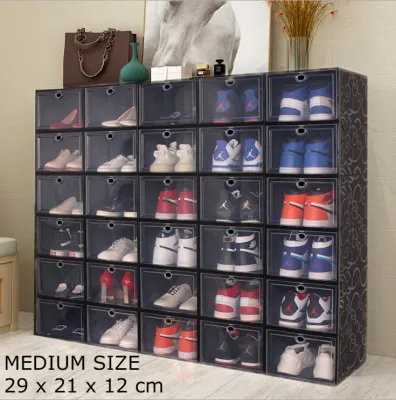
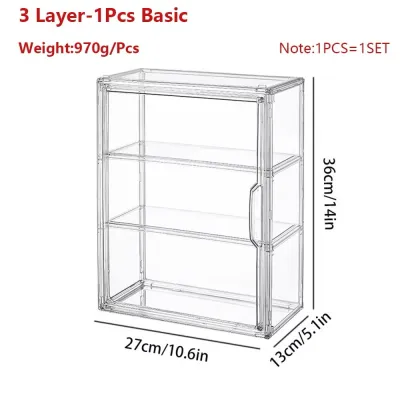
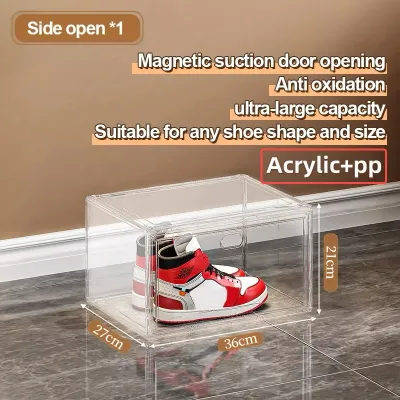
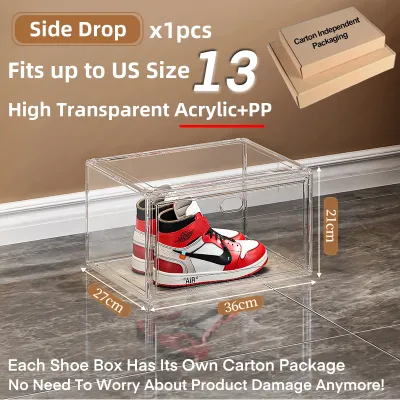
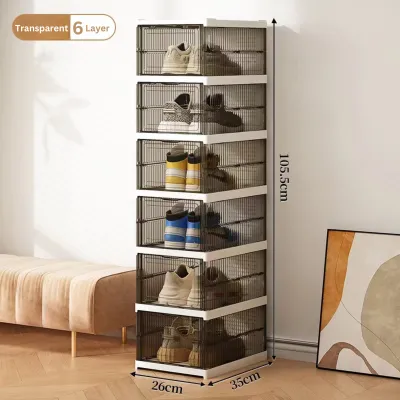
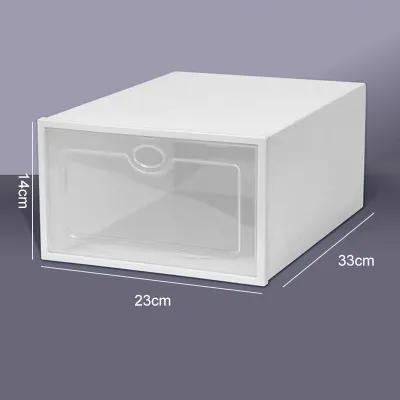
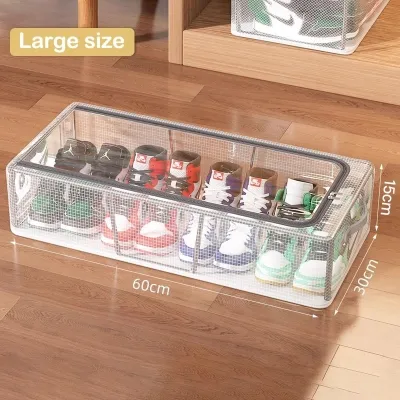
Prices are valid at publication and may change. Please refer to the product page for the latest price.
Regardless of the design you choose, verifying the external dimensions of the boxes against your closet’s physical shelf depth is a critical first step. Understanding the structural differences, performance characteristics, and spatial requirements of both options will help you build an efficient, long-lasting closet system.
Defining the Designs: Standard Stackable vs Drop-Front
To make an informed decision, it is essential to understand the structural mechanisms that define these two categories. While both options allow you to stack containers vertically, they differ fundamentally in how they open and how they distribute weight.
Standard Stackable Shoe Boxes
Standard stackable shoe boxes are traditional containers designed with interlocking lids and bases to ensure vertical stability. To access the footwear inside, you typically must remove the entire lid from the top or, in some designs, detach the front panel completely. This structural setup means that if you want to retrieve a pair of shoes from the middle or bottom of a tall stack, you must physically lift and dismantle the boxes resting above it. This design is highly robust because the solid walls and secure lids provide excellent load-bearing support, but it introduces physical friction if you need to access the shoes frequently.
Drop-Front Shoe Boxes
Drop-front shoe boxes feature an integrated front door that operates on a hinge, magnetic closure, or slide-down mechanism. The primary design advantage of this style is that it allows you to open the front panel and retrieve your shoes without disturbing or unstacking any of the boxes stacked on top. While they are inherently designed to stack on top of one another, their structural and aesthetic focus is centered on front-facing accessibility. This makes them highly popular for integrated closet systems where shoes are displayed and accessed on a daily basis.
Core Comparison: How Each Design Performs in a Closet System
Evaluating these two designs requires looking beyond their visual appeal. You must consider how they perform under daily usage, how they fit into standard closet layouts, how stable they remain when stacked, and how they protect your shoes in challenging environmental conditions.

Accessibility and Daily Convenience
The height at which you store your shoes dictates how convenient a box design will be. Drop-front boxes are exceptionally convenient for eye-level and mid-tier shelves. On these shelves, reaching straight forward, opening the magnetic door, and pulling the shoes out is a seamless, single-handed motion.
For floor-level or extremely high top-shelf placement, standard stackable boxes are often more ergonomic. Bending down to open a drop-front door at floor level can be awkward, and reaching up to open a hinge door on a high shelf can block your line of sight. In contrast, pulling a lightweight standard box down from a high shelf to remove its lid at waist level is often much safer and easier.
The “friction” of daily use heavily influences whether your closet remains organized over time. If a shoe box requires too many steps to open and close, you are more likely to leave your shoes on the floor. Drop-front boxes minimize this friction for daily wear, while standard stackable boxes are better suited for long-term storage where quick retrieval is not a priority.
Space Efficiency and Closet Layout Compatibility
A critical factor in closet planning is understanding the relationship between external box dimensions and internal storage capacity. Drop-front boxes require thicker front frames, hinges, and magnetic latching mechanisms, which can add bulk to the exterior while slightly reducing the usable internal volume.
Shelf depth is another vital consideration. Standard stackable boxes typically have a smaller, more streamlined footprint that fits easily onto shallow shelves. Drop-front boxes, however, require deeper shelves to accommodate not only the box itself but also the clearance needed for the door to swing open or slide down. If your closet has sliding doors or hanging clothes nearby, an opening drop-front door can easily collide with these obstacles, disrupting your layout.
Before purchasing, always check the clear path in front of the shelves. If space is tight, standard stackable boxes or drop-front doors that slide inward rather than swinging outward are necessary to prevent physical interference.
Stability and Weight Capacity
Stacking multiple pairs of shoes creates significant vertical load, making stability a primary safety concern. Standard stackable boxes often rely on deep, molded interlocking grooves between the lid and the base. This design distributes weight evenly across all four solid walls, providing high vertical stability and reducing the risk of the stack shifting or bowing.
Drop-front boxes, by contrast, have an open front face that is structurally weaker than a solid wall. While manufacturers reinforce these boxes with rigid plastic frames, stacking them too high can sometimes cause the front door frames to warp or sag, preventing the doors from closing properly.
To ensure safety, always check the manufacturer’s specifications for maximum stacking heights and weight limits. As a general rule of thumb, place your heaviest footwear, such as leather boots, heavy sneakers, or platform shoes, in the bottom-most boxes. This lowers the center of gravity of the entire stack, preventing tipping and protecting the structural integrity of the lighter boxes above.
Dust Protection and Climate Considerations
In tropical and highly humid climates like the Philippines, protecting footwear from environmental damage requires careful planning. Standard stackable boxes with tight-fitting lids generally offer excellent full-enclosure dust protection, keeping fine tropical dust away from delicate suede or leather. However, this tight seal can trap moisture inside if the shoes are stored damp, creating a breeding ground for mold and mildew.
Drop-front boxes often have small gaps around the hinges or magnetic doors. While this allows a tiny amount of dust to enter over time, it also provides passive air circulation. When selecting shoe boxes for a humid environment, do not rely on the plastic material itself to prevent mold; instead, look for boxes designed with built-in ventilation holes or mesh back panels to promote continuous airflow.
Regardless of the box design, always ensure your shoes are completely dry and clean before placing them inside. In highly humid regions, regular cleaning of the closet interior and the strategic placement of silica gel packets or reusable dehumidifiers inside the boxes are essential steps to preserve your footwear.
Stackable vs Drop-Front Shoe Boxes: Feature Breakdown
To help you visualize how these two storage solutions compare, the table below outlines their primary design characteristics and conditional advantages.
| Feature | Standard Stackable | Drop-Front |
|---|---|---|
| Access Method | Requires removing lid or unstacking | Direct front-opening door |
| Best Shelf Placement | Top shelves, floor level, deep storage | Mid-tier, eye-level shelves |
| Structural Rigidity | High (solid walls and deep grooves) | Moderate (reinforced front frame) |
| Space Efficiency | Compact footprint; high internal-to-external ratio | Bulkier exterior; requires front door clearance |
| Dust Sealing | Tight seal (excellent dust protection) | Moderate seal (slight gaps around door) |
| Typical Use Case | Seasonal storage, boots, budget organization | Daily-wear shoes, sneakers, display setups |
Pre-Purchase Checklist: Measuring Your Closet for Shoe Boxes
To avoid the hassle of returns and wasted closet space, you must take precise measurements of your existing closet system before purchasing any shoe boxes. Do not rely solely on the advertised “fits up to size US 12” labels, as external dimensions vary significantly between brands.
Measure the Shelf Depth Measure the distance from the back wall of your closet to the front edge of the shelf. If your closet has doors (hinged or sliding), measure to the inner track or door frame to ensure the shoe boxes will not block the closet doors from closing. For drop-front boxes, add at least 2 to 3 inches of clearance to accommodate the outward swing of the door. For standard stackable boxes, ensure there is enough room for your fingers to grip the sides or lid of the box during retrieval.
Calculate the Shelf Height and Vertical Clearance Measure the vertical distance between your shelves to determine how many boxes can safely stack. Divide this total height by the external height of a single shoe box. For standard stackable boxes, you must leave at least 1 to 2 inches of clearance at the very top of the stack; otherwise, you will not be able to lift the top box slightly to slide it out.
Determine the Shelf Width and Side-by-Side Capacity Measure the total horizontal width of each shelf. Divide this measurement by the external width of the shoe box to see how many columns of boxes will fit side-by-side. If the math leaves a gap of 2 or 3 inches, you can use this extra space to store slim items like shoe horns or cleaning cloths, but avoid forcing an extra box that might cause the stack to buckle or sit unevenly.
Identify Potential Obstructions Look closely at the interior architecture of your closet. Check for protruding door hinges, sliding door tracks, low-hanging garment bags, or internal LED lighting fixtures. These obstructions can easily block a drop-front door from opening fully or prevent a tall stack of standard boxes from sitting flush against the back wall, compromising stability.
Final Decision Framework: Which Shoe Box Fits Your Routine?
Choosing the right shoe box comes down to analyzing your daily habits, your budget, and your physical closet space. Use this final checklist to guide your purchase.
Choose Drop-Front Boxes If:
- You are organizing mid-level, eye-level, or easily reachable shelves in your daily closet.
- You wear a rotating selection of shoes daily and want to retrieve them in a single, quick motion.
- You want a clean, premium, display-like aesthetic where your footwear collection is highly visible.
- Your closet shelves are deep enough to accommodate the box depth plus the front door's opening clearance.
- Your budget allows for a slightly higher price point, typically ranging from ₱250 to ₱500+ per premium box in the local market.
Choose Standard Stackable Boxes If:
- You are storing off-season shoes, formal footwear, or pairs you only wear occasionally.
- You are utilizing the highest top shelves or the lowest floor space where front-door access is physically awkward.
- You need maximum structural stability to stack boxes high without worrying about warping.
- Your closet shelves are shallow, or you have limited clearance in front of the shelves due to sliding doors.
- You are looking for a highly cost-effective solution, with basic models starting around ₱100 to ₱180 per box.
Verify First If:
- You plan to mix both types within the same closet system. If you do, ensure their external footprints (length and width) are identical so they can stack safely.
- You are buying online; always verify the exact millimeter or centimeter measurements provided by the seller rather than relying on generic size estimates.
Ultimately, the most successful closet organization system is not the one that looks most impressive in photos, but the one that minimizes your daily friction. Select the design that matches how you actually live, dress, and maintain your home.
Frequently Asked Questions (FAQ)
Can I mix stackable and drop-front shoe boxes in the same closet?
Yes, you can mix both types, but it requires careful planning to maintain stability. The external footprint (length and width) of both box types must be identical to ensure they stack securely. It is highly recommended to keep them in separate vertical columns. Stacking a drop-front box directly on top of a standard stackable box can be unstable if the interlocking grooves do not align perfectly, which creates a serious tipping hazard.
Do clear shoe boxes cause yellowing in tropical climates?
Yellowing in clear plastics is primarily caused by prolonged UV exposure and material degradation, which can be accelerated by high tropical heat. To minimize this, check the product specifications for the type of plastic used (such as high-grade PET or PP) and look for manufacturers that specify UV resistance or anti-yellowing properties. For the best protection, place your clear shoe boxes deep inside your closet, away from direct sunlight coming through windows.
How do I prevent mold inside enclosed shoe boxes?
Enclosed plastic shoe boxes can trap moisture, especially during the humid rainy season in the Philippines. To prevent mold, never store shoes while they are damp or sweaty; let them air-dry completely in a well-ventilated space before placing them in a box. Choose shoe boxes that feature built-in ventilation holes or rear mesh panels to encourage airflow. For added protection, place a silica gel packet or a small moisture absorber inside each box, and replace them regularly according to the manufacturer’s instructions.
Community discussion
Share your experience or ask a question. Comments are reviewed before publication.