
The choice between stackable and regular transparent shoe boxes depends primarily on your closet’s vertical clearance, shelf depth, and how frequently you access your footwear. If you want to maximize vertical space on your closet floor or deep bottom shelves, stackable clear shoe boxes are the ideal choice because they feature front-access doors that let you grab shoes without unstacking. Conversely, regular non-stackable boxes are better suited for standard fixed shelving units with limited height, under-bed storage, or seasonal shoes that you only access occasionally.
While both designs satisfy the need for a shoe box transparent clear setup by offering excellent visibility, their structural differences dictate where and how they should be deployed in your home. Choosing the wrong type can lead to unstable towers, wasted shelf space, or daily frustration when trying to retrieve a favorite pair.
Structural Differences: What Makes a Shoe Box "Stackable"?
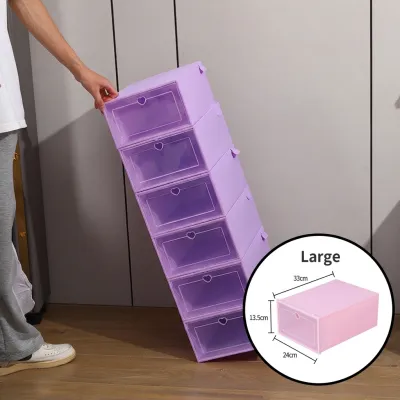
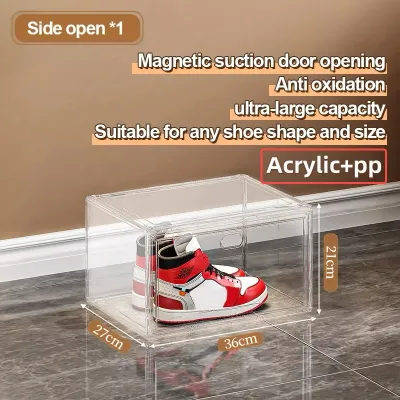
To understand why these two options perform so differently, it helps to examine their physical design. A stackable clear shoe box is engineered as a structural building block. These units typically feature interlocking mechanisms, such as molded tabs, grooves, or recessed channels on the top and bottom panels, which lock adjacent boxes together to prevent sliding. The frames are reinforced with thicker plastics, such as rigid acrylic or heavy-duty polypropylene, and often include structural columns at the corners to distribute weight evenly. Crucially, they incorporate front-opening doors—either drop-front hinges or magnetic closures—allowing the front panel to open while the box remains under load.
Products mentioned in this guide
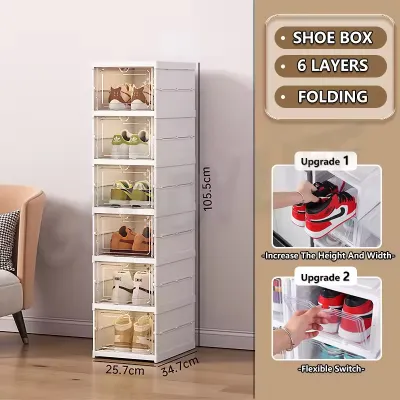
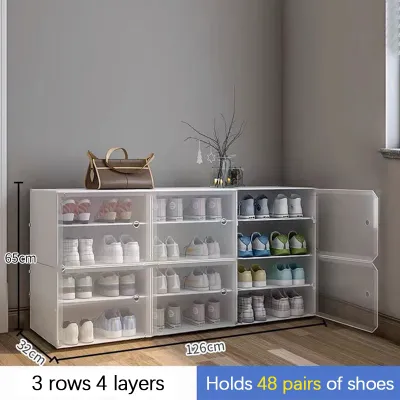
Prices are valid at publication and may change. Please refer to the product page for the latest price.
Regular transparent shoe boxes, on the other hand, are designed for simplicity and individual containment. They generally feature a standard five-sided container with a separate snap-on or lift-off lid on top. Made from lighter, more flexible plastics like thin polypropylene (PP) or polyethylene terephthalate (PET), these boxes rely on the shoe inside or the lid itself to maintain their shape. Because their lids are flat and lack interlocking grooves, stacking them simply means resting one flat plastic surface on another. They are not structurally rated to support significant vertical weight, and accessing the contents always requires removing the lid from the top.
Space Efficiency: Maximizing Your Closet Layout
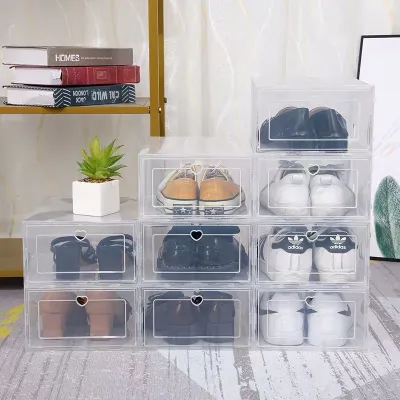
Maximizing your closet layout requires matching the physical limits of your storage system with the right box architecture. Vertical space utilization is where stackable designs truly shine. In many closets, the area beneath hanging clothes or the floor space itself goes underutilized. Stackable boxes allow you to build a self-supporting tower of footwear that rises from the floor to just below your hanging garments. Because they interlock, you can safely stack them multiple layers high, effectively turning empty air into a customized shoe cabinet.

However, this vertical advantage disappears when dealing with standard fixed closet shelving. If your closet features built-in wooden or wire shelves spaced 20 to 30 centimeters apart, stackable boxes are often inefficient. The height of a stackable box, combined with its interlocking frame, might leave just enough clearance for a single box, leaving a useless gap of empty space above it that is too small for a second box. In these tight, pre-defined vertical spaces, regular transparent shoe boxes are far more practical. Their thinner walls and lower profiles allow you to slide them side-by-side or stack them exactly two-high to fill the shelf height perfectly without wasting space.
Hanging zones present another spatial puzzle. Placing a tall tower of stackable boxes under active hanging space works well if your garments are short, such as shirts or folded trousers. For longer clothes like dresses or coats, you must keep the floor clear. In this scenario, regular boxes are better suited for high shelves above the hanging rod. Since you will likely need a step stool to reach these top shelves anyway, storing seasonal or formal shoes in lightweight, regular boxes makes it easy to pull down a single container at a time without managing a heavy, interlocking stack.
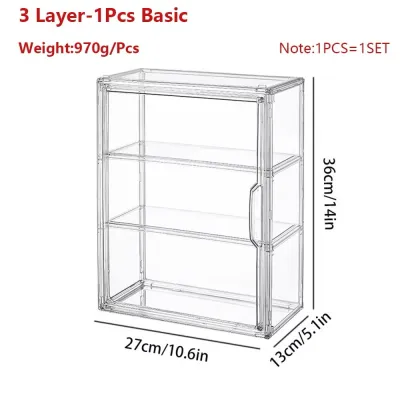
Before purchasing any storage system, grab a tape measure and document your closet’s exact dimensions. Measure the total floor width and depth, the height from the floor to the bottom of your hanging clothes, and the precise clearance between any fixed shelves. Compare these measurements against the external dimensions of the shoe boxes you are considering. Remember to account for the door swing clearance of front-opening stackable boxes; if your closet has sliding doors or tight walk-in pathways, a drop-front door must have enough physical clearance to swing open fully without hitting obstacles.
Stability and Safety: Weight Limits and Tipping Risks
When stacking multiple containers, physics and safety must be your primary considerations. The weight distribution of your footwear collection plays a major role in how your storage system behaves over time. A single pair of heavy leather boots, thick-soled basketball sneakers, or platform heels can weigh over a kilogram. When you stack five or six boxes on top of each other, the bottom box must bear the cumulative weight of all the boxes and shoes above it. Stackable boxes are designed with reinforced frames to handle this load, transferring the weight down through the corners rather than the center of the box.
If you attempt to stack regular, non-reinforced transparent boxes to similar heights, you risk structural failure. Under continuous vertical pressure, thin PP or PET plastic will begin to bow outward. This bowing deforms the lid, causing the stack to lean. Over time, the plastic can crack, or the entire column can collapse, potentially damaging your shoes or causing injury. This hazard is amplified in active households with curious pets or young children who might pull on the boxes, or in regions like the Philippines where minor seismic activity or tremors can easily destabilize unanchored, top-heavy structures.
To maintain a safe closet environment, always verify the structural limits of your chosen product. Check the manufacturer’s product label, instruction manual, or official specifications for the maximum recommended stack height and weight capacity. Do not guess or assume all plastic boxes are identical. If you plan to build a tall column of stackable boxes that exceeds five layers, or if the stack feels slightly unstable on carpeted or uneven closet floors, consider anchoring the column. Some premium stackable systems include wall-mounting brackets or safety straps. If yours does not, placing the heaviest shoes in the bottom-most boxes and the lightest footwear at the top will naturally lower the center of gravity and reduce tipping risks.
Daily Convenience: Accessing Your Shoes Easily
The ease with which you can retrieve and store your shoes determines whether your closet remains organized or descends back into chaos. The primary differentiator in daily convenience is the door mechanism. Stackable boxes almost always feature front-access panels. These can be drop-down doors, side-swinging doors, or magnetic latch systems. When you want to wear a specific pair of shoes, you simply open the front door of that specific box, slide the shoes out, and close the door. The rest of the stack remains completely undisturbed, saving you time and effort during busy mornings.
Regular transparent boxes present what professional organizers call the “bottom box problem.” Because these boxes only open from the top, accessing a pair of shoes stored at the bottom of a stack requires you to physically lift off every single box resting above it. You must set those upper boxes aside, remove the lid of the target box, retrieve your shoes, replace the lid, and then rebuild the stack. If you are in a rush, you are highly likely to bypass this tedious process, leading to shoes left scattered on the floor or certain pairs being ignored entirely because they are too difficult to reach.
To design an efficient system, align the box type with your personal wear habits. If you are organizing daily-wear shoes, such as school shoes, work heels, or your favorite everyday sneakers, investing in stackable, front-opening boxes is highly recommended. The time saved and the reduction in daily friction justify the investment. Conversely, regular top-opening boxes are perfectly adequate for shoes you rarely wear. Formal dress shoes, seasonal boots, or holiday footwear can be safely sealed in regular boxes and placed on high shelves or under the bed. Since you only retrieve them a few times a year, the minor inconvenience of unstacking them is negligible.
Aesthetics: Creating a Visually Organized Closet
A visually cohesive closet brings a sense of calm and order to your home. The aesthetic appeal of your shoe storage depends heavily on material clarity and design uniformity. High-clarity acrylic boxes offer a glass-like appearance that showcases your footwear collection beautifully, turning your shoes into a visual display. This is particularly popular among sneaker collectors who want to highlight their collection. Standard polypropylene or PET boxes, while still transparent, often have a slightly milky, textured, or bluish tint that diffuses light, offering visibility but lacking the premium, crystal-clear look of acrylic.
Frame designs and hardware colors also play a role in closet design. Many stackable boxes feature solid colored frames—such as matte black, clean white, or translucent grey—with clear front doors. These frames can be used to match your closet cabinetry, creating a built-in, custom furniture appearance. Regular boxes are typically fully translucent with matching translucent lids, offering a more utilitarian, modular look. While they look neat when lined up side-by-side on a shelf, they can look cluttered if they are different sizes or if the shoes inside are highly colorful and visible through thin, distorted plastic.
Living in a humid, tropical climate like the Philippines introduces specific environmental factors that affect both aesthetics and material lifespan. High humidity levels can trap moisture inside sealed plastic containers, leading to condensation, musty odors, or mold growth on leather and canvas shoes. When selecting any clear shoe box, look for models that incorporate ventilation holes or rear mesh panels to promote airflow. Additionally, if you choose stackable boxes with metal hinges, magnetic plates, or decorative metallic trim, verify that these components are rust-resistant. Over time, salty coastal air or persistent tropical humidity can cause cheap metal hardware to corrode, leaving unsightly orange stains and ruining the clean aesthetic of your closet.
Cost and Durability: Evaluating Long-Term Value
Evaluating the long-term value of your shoe storage requires balancing your immediate budget against the expected lifespan of the containers. The initial investment for these two styles differs significantly. Regular transparent shoe boxes are highly budget-friendly, typically sold in multi-packs that bring the cost per unit down to a very accessible range (often between ₱50 and ₱150 per box in the Philippine market). Stackable clear shoe boxes, due to their complex injection-molded frames, interlocking tracks, and magnetic door mechanisms, require a higher upfront investment, often ranging from ₱250 to over ₱600 per individual box.
However, durability and wear patterns paint a more complex picture. Stackable boxes are made of thicker materials, making them highly resistant to cracking or shattering under normal use. Yet, they have more moving parts. Over years of daily opening and closing, plastic hinges can wear down, magnetic latches can lose their alignment, or drop-front doors can become loose. If a hinge breaks on a stackable box, the front door may no longer seal properly, compromising its dust-free protection.
Regular boxes have zero moving parts, which theoretically makes them highly reliable. However, because the plastic is thin and flexible, they are far more vulnerable to physical damage. Stepping on an empty box, dropping a heavy object onto a shelf, or pulling a lid off too aggressively in cold or humid conditions can easily crack the plastic or split the corners. When evaluating long-term value, consider your lifestyle. If you move frequently or have a dynamic household, the rugged, self-supporting nature of stackable boxes may save you money over time by outlasting multiple sets of flimsy, cracked regular boxes. If your storage is static and protected inside a quiet guest closet, regular boxes will easily last for years at a fraction of the cost.
Decision Framework: How to Choose the Right Clear Shoe Box
To finalize your closet organization plan, use this structured framework to match your physical space and habits with the correct container type.
| Feature | Stackable Clear Shoe Boxes | Regular Transparent Shoe Boxes |
|---|---|---|
| Best Placement | Closet floors, deep lower shelves, open room displays | Fixed closet shelves, under-bed storage, top shelves |
| Access Type | Front-opening (drop-front or magnetic door) | Top-opening (lift-off or snap-on lid) |
| Stability | High (interlocking channels and reinforced frames) | Low to Moderate (best kept unstacked or in low stacks) |
| Ideal Use Case | Daily-wear shoes, sneakers, heavy footwear collections | Seasonal storage, formal wear, budget-conscious setups |
| Average Price Band | Mid to High (₱250 – ₱600+ per unit) | Low (₱50 – ₱150 per unit) |
Choose Stackable Clear Shoe Boxes if:
- You have ample vertical floor space or deep lower shelves and want to build a high, self-supporting storage tower.
- You need quick, daily front-access to your shoes without the hassle of unstacking heavy boxes.
- You want a premium, uniform, and built-in aesthetic that showcases your footwear collection clearly.
- You are storing heavier shoes, such as thick sneakers or boots, that require reinforced structural frames.
Choose Regular Clear Shoe Boxes if:
- Your closet consists of fixed shelves with low vertical clearance that cannot accommodate tall, interlocking stacks.
- You are working within a strict budget and need to organize a large volume of shoes economically.
- You are storing seasonal, formal, or rarely worn shoes that do not require frequent retrieval.
- You plan to utilize shallow, wide spaces like the void under your bed frame.
Verify First if:
- Your closet shelves or floor have strict weight limits that could be exceeded by heavy acrylic boxes loaded with shoes.
- The local climate or closet location is highly humid; ensure your chosen boxes have ventilation slots to prevent mold.
- You are storing exceptionally large or high-top shoes; check the internal dimensions of the boxes, as high-tops may require extra-tall or wide sizes.
Frequently Asked Questions (FAQ)
Can I mix stackable and regular shoe boxes in the same closet?
Yes, mixing both types of clear shoe boxes is an excellent way to optimize different zones within a single closet. You can place heavy-duty stackable boxes on the closet floor or deep bottom shelves to create an easy-access zone for your everyday shoes. Meanwhile, regular, lightweight boxes can be lined up on high, fixed shelves or placed under the bed to hold seasonal or formal footwear. However, avoid stacking regular boxes directly on top of stackable ones. Because their footprints, lids, and interlocking channels do not align, placing a regular box on top of a stackable column creates an unstable, slippery surface that significantly increases the risk of tipping.
How high can I safely stack clear shoe boxes?
The safe stacking height of clear shoe boxes depends entirely on the manufacturer’s specifications, the thickness of the box material, and the weight of the shoes stored inside. For premium, reinforced stackable boxes, manufacturers often support stacks of up to six to ten units high, provided they are placed on a level, solid surface. For regular, non-reinforced boxes, it is generally unsafe to stack them more than two or three units high, as the weight will cause the lower lids to bow and slide. Always consult the product packaging or manufacturer instructions for weight limits, and keep tall stacks at or below eye level to ensure safe, comfortable retrieval.
Community discussion
Share your experience or ask a question. Comments are reviewed before publication.