
Choosing the right storage system for your footwear can mean the difference between a cluttered, stressful wardrobe and a beautifully organized space. When organizing the interior of your closet, finding a system that maximizes every square inch of available floor and vertical space is essential. Two of the most popular configurations for this task are stackable and tiered shoe racks.
Determining which option works better inside your closet depends entirely on your closet’s physical dimensions, door clearance, and the specific habits of your shoe collection. Stackable shoe racks are the superior choice if you have irregular floor spaces, tight vertical gaps below hanging clothes, or a gradually growing collection that requires modular flexibility. Conversely, tiered shoe racks are the better fit if you have a wide, unobstructed closet floor, a large and stable collection, and a preference for immediate high capacity and structural stability.
By evaluating how each design interacts with your closet’s layout, your footwear styles, and practical factors like stability and airflow, you can select the perfect organizer to keep your shoes protected and accessible.
Products mentioned in this guide
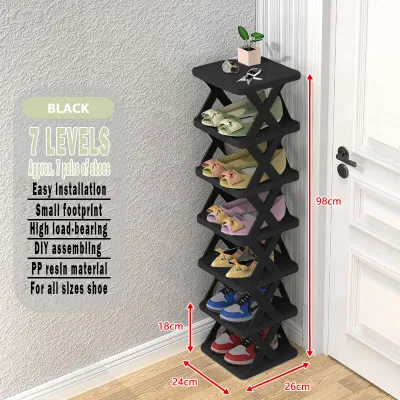
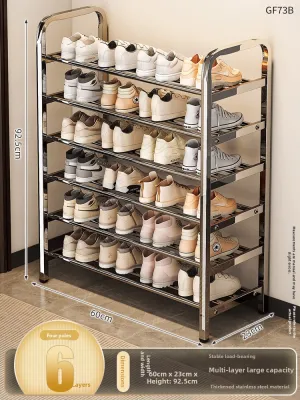
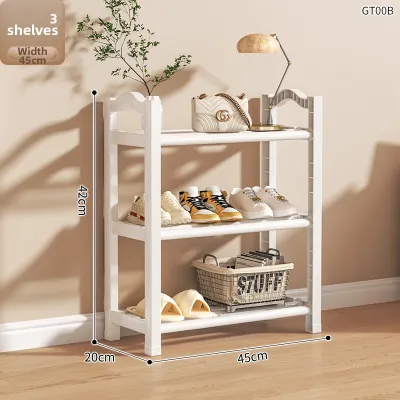
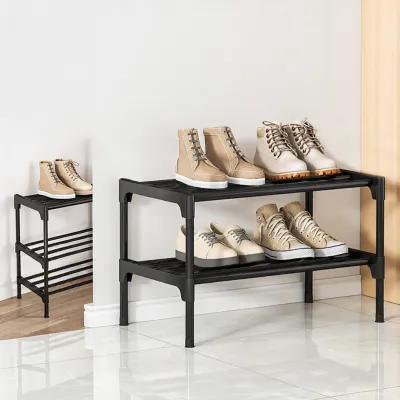
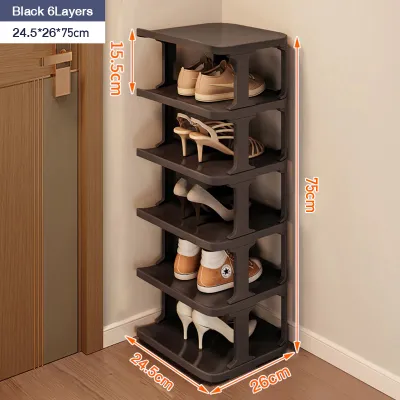
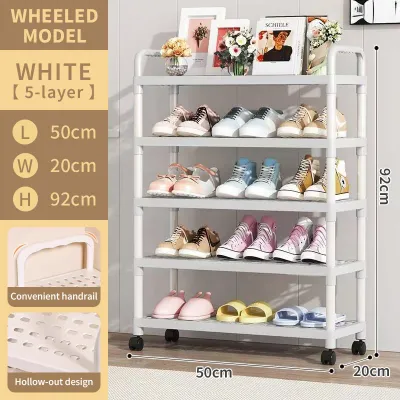
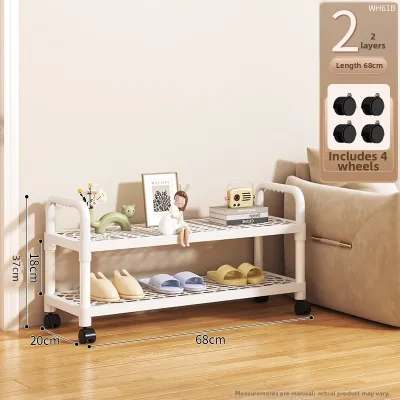
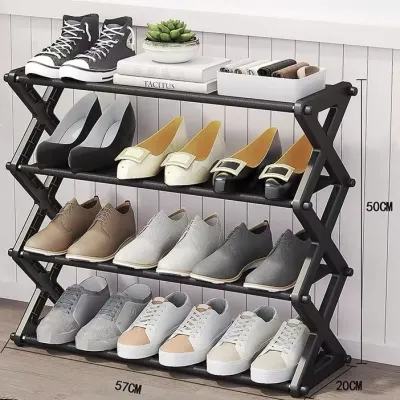
Prices are valid at publication and may change. Please refer to the product page for the latest price.
Defining the Designs: Stackable vs. Tiered Shoe Racks
To make an informed decision, it is important to first understand the structural and design differences between these two common shoe rack configurations. While both serve the same primary purpose, their physical construction dictates how they utilize space and how they must be handled inside an enclosed closet environment.
Stackable shoe racks feature a modular, interlocking design that is built for vertical expansion. Typically, a single individual unit consists of just one or two tiers. These units are engineered with specialized connectors, pins, or interlocking slots on the top and bottom corners, allowing you to stack multiple units securely on top of one another. Common materials for stackable models include molded plastic, lightweight metal wire, or engineered wood. This modularity means you can start with a low-profile setup and gradually increase the height of your storage as your collection or closet space allows.
Tiered shoe racks, on the other hand, utilize a fixed-frame design. These are single, unified structures that typically feature three to six shelves built into a continuous frame. Because they are manufactured as a single piece, they do not allow you to add or subtract levels easily. Tiered racks are available in a wide variety of styles, including slanted wire shelves, flat wooden shelves, or heavy-duty metal bench-style racks. The structural frame is designed to support a set number of shoes from the moment of assembly, providing a permanent and cohesive storage solution.
These fundamental design differences directly influence how much physical footprint each rack style occupies. A tiered rack requires you to commit to a specific height and width from day one, whereas stackable units allow you to customize the height, width, and overall shape of your storage system to match the changing landscape of your wardrobe.
Space and Layout: Fitting the Rack Inside Your Closet
Before purchasing any furniture organizer, measuring your closet’s interior dimensions is the most critical step. How a shoe rack fits within your width, depth, and vertical clearance limits will determine whether your closet doors can close properly and whether your hanging clothes have room to drape naturally.

Width and Floor Footprint
Tiered shoe racks generally require a continuous, wide span of unobstructed floor space. Because the frame is rigid and wide, you must ensure your closet floor has a straight run that can accommodate the rack’s full length without hitting baseboards or sliding door tracks.
Stackable units offer much greater footprint flexibility. Because they consist of independent modules, you can place them side-by-side, separate them into different corners, or stagger them to fit around closet baseboards and floor obstructions. If you have a narrow closet floor or an awkward corner, stackable modules can be configured to navigate these tight spaces easily.
Depth Constraints
Standard closet depths typically measure around 24 inches (approximately 60 centimeters) to accommodate hanging clothes on hangers. A standard shoe rack usually has a depth of 11 to 14 inches (28 to 35 centimeters).
When placing a shoe rack on the floor, you must verify that the rack’s depth, combined with the protrusion of your shoes, does not block sliding door tracks, folding doors, or swinging closet doors. Slanted tiered racks can sometimes save a few inches of depth by angling the shoes downward, which is highly beneficial in shallow wardrobes. Stackable units must be checked carefully to ensure their straight, flat profile does not interfere with the door’s path.
Vertical Clearance
Vertical space is often the most wasted resource in a closet. Below hanging shirts, jackets, or short dresses, you may have a clearance gap ranging from 15 to 30 inches.
Stackable racks excel in these variable vertical zones. You can build the stack to the exact height needed to sit perfectly below your hanging clothes. If you have long dresses on one side of the closet and short shirts on the other, you can stack the units higher under the shirts and keep them low under the dresses. Tiered racks, with their fixed heights, do not offer this adaptability. A tall tiered rack might force you to crowd your hanging clothes, causing hems to bunch up and wrinkle against the top shelf of the rack.
Closet Storage Comparison Matrix
To help visualize how these two configurations compare structurally, review the typical dimensional profiles and spatial requirements below:
| Feature / Dimension | Stackable Shoe Racks | Tiered Shoe Racks |
|---|---|---|
| Typical Height | Highly variable (modular, 1 to 6+ tiers) | Fixed (typically 3 to 6 tiers, 20 to 45 inches) |
| Width Flexibility | High (can be placed side-by-side or split) | Low (rigid, fixed-width frame) |
| Depth Profile | Flat shelves (typically 11 to 13 inches) | Flat or slanted shelves (11 to 14 inches) |
| Ideal Closet Zone | Below uneven hanging clothes, tight corners | Wide, open closet floors, walk-in closets |
| Ideal Closet Door Type | Sliding, folding, or walk-in entries | Swinging or deep walk-in wardrobes |
| Expansion Capability | Excellent (add units vertically or horizontally) | None (requires buying an entirely new rack) |
Capacity and Flexibility: Matching Your Shoe Collection
Your choice of organizer should also align with the size and variety of your footwear collection. Different shoe styles—from low-profile slippers to high-top sneakers and tall boots—require different spacing to prevent damage and maximize storage capacity.
Total Capacity and Setup
If you need to store a large volume of shoes immediately, tiered racks generally offer a higher capacity out of the box. A single 4-tier or 5-tier rack can easily accommodate 12 to 20 pairs of shoes depending on its width, and requires only a single assembly process.
To achieve this same capacity with stackable racks, you must purchase multiple individual modules and spend time locking them all together. This can sometimes result in a higher initial cost and more assembly steps to achieve the same storage volume as a single tiered unit.
Accommodating Different Shoe Types
Standard tiered racks often feature fixed shelf heights, typically providing about 6 to 8 inches of clearance between levels. While this is perfect for flat shoes, sandals, and standard sneakers, it can be highly problematic for tall boots, high heels, or chunky basketball shoes. Forcing taller footwear into tight spaces can bend the shafts of boots or scuff the delicate materials of high heels.
Stackable racks offer superior adaptability for diverse shoe collections. Many modular designs allow you to adjust the spacing between stacked units, remove a middle shelf during assembly, or leave a deliberate gap between modules to create a custom, tall opening. This flexibility ensures that every shoe type, from low-profile slippers to tall ankle boots, has a dedicated space that preserves its shape.
Scalability for Growing Collections
For those who regularly acquire new footwear, scalability is a major consideration. Stackable racks allow for incremental, cost-effective expansion. When your current rack is full, you can simply purchase one more individual module and snap it onto the top or side of your existing setup.
With a tiered rack, your storage capacity is capped. Once all the shelves are filled, expanding your storage requires buying a completely new, larger tiered unit or adding a second separate rack, which may not fit within your remaining closet floor space.
Climate and Airflow Considerations
In tropical, high-humidity environments like the Philippines, closet storage requires careful attention to moisture control. Closed wardrobes can easily trap humid air, creating a breeding ground for mold, mildew, and unpleasant odors that can ruin leather shoes, canvas sneakers, and fabric linings.
Regardless of whether you choose a stackable or tiered rack, prioritize designs that promote airflow. Open wire grids, slatted wood shelves, or mesh platforms allow air to circulate freely around and under your footwear. Avoid solid plastic or solid wood shelves that trap moisture underneath the soles of your shoes. Additionally, always ensure your shoes are completely dry before placing them back inside the closet.
Stability, Assembly, and Closet Floor Protection
Beyond dimensions and capacity, the practical aspects of daily use—such as how sturdy the rack feels, how easy it is to assemble, and how well it protects your closet flooring—are crucial for long-term satisfaction.
Structural Stability
Because tiered shoe racks are built with a single, continuous frame, they are generally highly stable and robust. When loaded with heavy work boots, thick leather shoes, or heavy sneakers, a quality tiered rack will resist wobbling and sagging.
Stackable racks rely on interlocking joints, pegs, or clips to stay together. If you stack these modular units too high—typically more than four or five levels—the structure can become top-heavy and prone to wobbling when you pull shoes out. If you plan to stack units high, check if the manufacturer provides wall-anchoring hardware. Keep in mind, however, that drilling anchors into a finished closet wall or partition can be difficult, especially if you are renting a condo or apartment where wall damage is restricted.
Assembly Effort
Assembling a tiered shoe rack is usually a straightforward, one-time task. Most models require securing a few shelves to two side frames using a handful of screws and an included hex key.
Stackable racks, while often featuring tool-free assembly, can require more repetitive effort. Snapping together multiple individual connectors, frames, and shelves for several separate modules can be tedious and time-consuming, especially if you are building a large storage wall.
Floor Protection
Closet floors are susceptible to damage from heavy storage units. Metal feet can scratch wooden parquet or laminate flooring, while heavy plastic edges can leave permanent indentations on carpeted closet floors.
When choosing a shoe rack, inspect the design of its feet. Look for racks that include rubber end caps, non-slip feet, or smooth plastic glides. If the rack does not come with these protective features, it is highly recommended to apply adhesive felt pads to the bottom of the feet or place a durable closet floor mat underneath the rack. This simple step prevents shifting, dampens noise, and protects your flooring from scratches and scuffs.
Decision Framework: Which Shoe Rack Should You Choose?
To make your final decision, evaluate your specific closet layout and storage needs against the following practical guidelines:
Choose Stackable Shoe Racks if:
- Your closet floor is irregular or tight: You need to navigate baseboards, floor vents, or awkward angles.
- You have varying vertical clearance: You want to maximize the exact space available below hanging clothes of different lengths.
- Your collection is diverse and changing: You need to store a mix of flat sandals and tall boots, and you plan to expand your collection gradually over time.
- You prefer modular customization: You want the freedom to split, stack, or rearrange your storage layout whenever you reorganize your closet.
Choose Tiered Shoe Racks if:
- You have a wide, open closet floor: Your wardrobe has ample, unobstructed floor space to accommodate a fixed-width frame.
- You want immediate, high-capacity storage: You have a large number of shoes to organize right away and want a single, cohesive unit.
- Your footwear is relatively uniform: Most of your shoes are flat shoes, sneakers, or loafers that fit standard shelf heights.
- You prioritize maximum stability: You want a heavy-duty, wobble-free frame that can support heavy footwear without needing wall anchors.
- You want a quick, simple assembly process: You prefer a straightforward setup with minimal parts.
- Your budget favors a single purchase: A single tiered rack often costs less than buying multiple individual stackable modules to achieve the same capacity.
Verify First if:
- Closet door clearance is tight: Measure the exact depth of the rack with your largest shoes on it to ensure sliding or folding doors can close freely.
- The closet floor is uneven: Ensure the rack's feet can sit level to prevent wobbling, especially for high-stacked modular units.
- The floor material is delicate: Check the feet of the rack and prepare felt pads or a protective mat to prevent scratches on wood or laminate surfaces.
Frequently Asked Questions (FAQ)
Can I mix stackable and tiered shoe racks in the same closet?
Yes, mixing both styles is an excellent way to zone your closet effectively. You can place a wide, stable tiered rack on the main open floor of your closet to handle your everyday sneakers, flats, and loafers. Then, you can use narrow, stackable units in tight corners, on upper closet shelves, or directly under shorter hanging garments to store seasonal footwear, heels, or boots. This hybrid approach maximizes both structural stability and spatial flexibility.
How do I prevent shoes from getting moldy inside a closed closet?
To prevent mold and mildew growth inside a closed closet, especially in humid climates, ensure your shoes are completely dry and clean before storing them. Avoid solid plastic or solid wood shelves; instead, choose open wire, mesh, or slatted wood designs that allow air to circulate freely. You can also place moisture-absorbing products, such as silica gel packets or calcium chloride dehumidifier boxes, inside the closet. Periodically leaving your closet doors open or running a fan nearby will also help refresh the air and keep humidity levels low.
Are over-the-door shoe racks better than floor racks for small closets?
Over-the-door shoe racks are highly effective at saving floor space in extremely small closets, but they come with distinct trade-offs. While they utilize vertical space on the back of a door, they can put significant strain on the door hinges over time, make noise when the door is opened or closed, and may prevent the door from opening fully against an adjacent wall. Additionally, over-the-door pockets are typically designed for flat, lightweight shoes and may not accommodate thick, heavy, or structured footwear like boots and chunky sneakers as easily as a sturdy floor rack.
Community discussion
Share your experience or ask a question. Comments are reviewed before publication.