
Finding the right furniture for a compact bedroom in the Philippines requires balancing style, storage, and physical space. A vanity dresser with mirror is a highly personal addition, but in a tight studio condo or a cozy suburban townhouse, choosing the wrong size can make your room feel cramped and difficult to navigate.
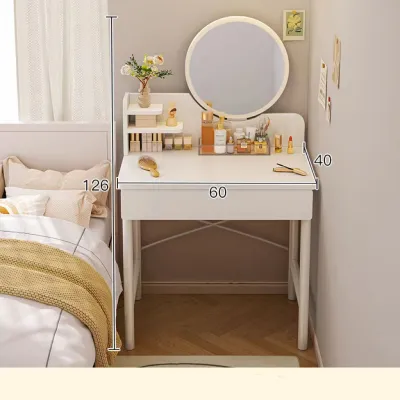
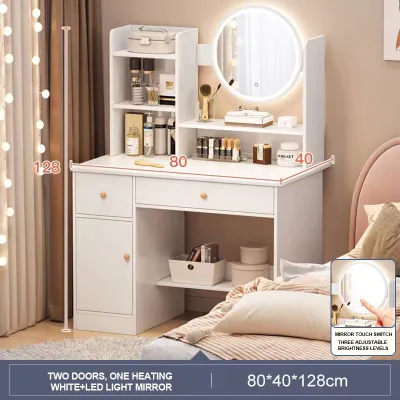
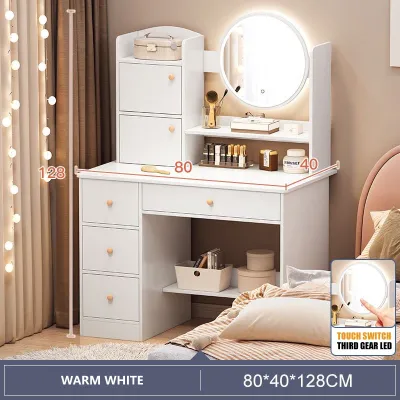
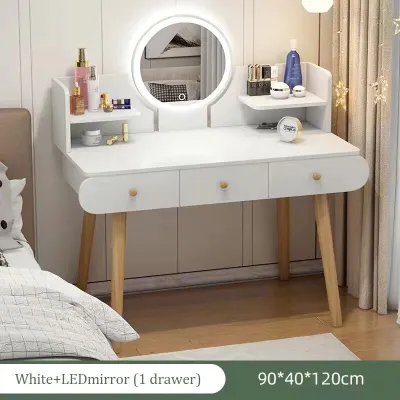
To keep your bedroom comfortable, a small-space vanity dresser should typically feature a width of 60 to 80 centimeters and a shallow depth of 35 to 40 centimeters. This specific size range allows you to set up a dedicated grooming station without sacrificing vital floor space or blocking essential walkways.
Choosing the right vanity involves more than just looking at the tabletop dimensions. You must also calculate the functional footprint, which includes seating clearance, drawer movement, and visual weight. By understanding how to measure your space and evaluate product specifications, you can select a vanity that fits your room perfectly while keeping your daily routine seamless.
Products mentioned in this guide
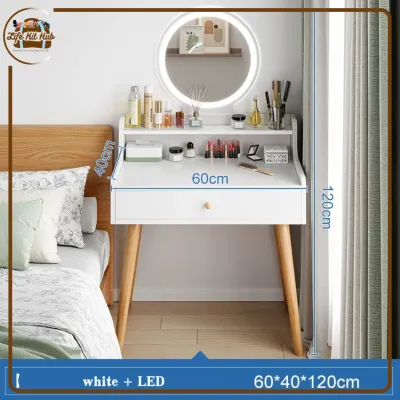
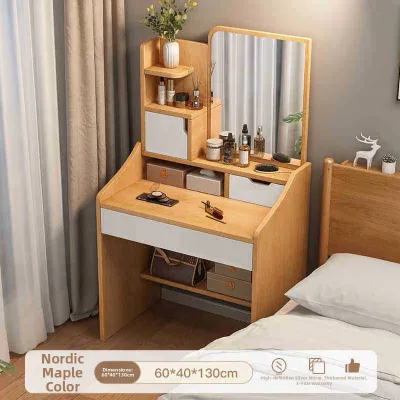
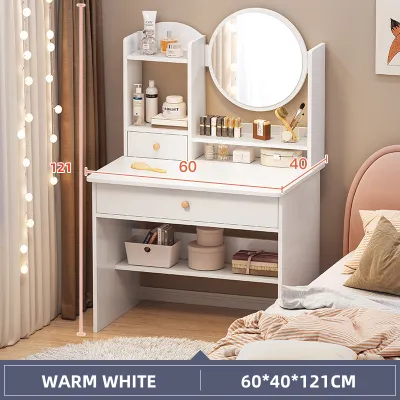
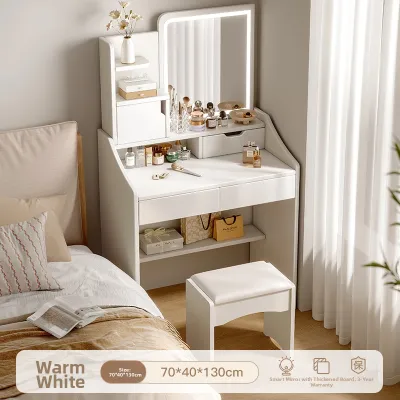
Prices are valid at publication and may change. Please refer to the product page for the latest price.
How to Measure Your Space and Calculate True Clearance
Before browsing online marketplaces or local showrooms, measure your designated wall space. Start with the width and height of the wall or corner where you plan to place the vanity. Do not rely solely on floor-to-floor measurements; check for baseboards, which can push the back of the dresser out by 1 to 2 centimeters, preventing it from sitting completely flush. Note the placement of electrical outlets, light switches, and window sills. If you need to plug in a hairdryer or LED mirror, the vanity must not block access to your outlets, nor should a tall mirror overlap with window sills or block natural light.
Calculating the true functional footprint requires looking beyond the tabletop dimensions. You must account for the “hidden” footprint, which includes the depth of the vanity chair and the space required to sit comfortably. A standard vanity table depth of 40 centimeters needs to be paired with a stool depth of 35 to 40 centimeters. Additionally, you must add 15 to 20 centimeters of clearance behind the chair when seated so you can pull the chair out and stand up without bumping into your bedframe or wardrobe.
Finally, analyze the swing radius of nearby doors. In small Philippine bedrooms, a swinging bedroom door, a hinged closet door, or a sliding wardrobe door can easily collide with your vanity chair or the corner of the dresser. Open all nearby doors fully and measure their paths to ensure your beauty station does not block entryways or daily storage access.
Vanity Dresser Dimensions to Look for in Compact Rooms
When shopping for a vanity dresser with mirror, avoid relying on generic marketing terms like “compact” or “space-saving” as they vary significantly between brands. Instead, refer to exact millimeter or centimeter measurements on the manufacturer’s specification sheet.

For small bedrooms, the ideal width for a freestanding vanity is between 60 and 80 centimeters. A 60-centimeter width provides just enough surface area for a mirror and daily essentials, while an 80-centimeter unit offers slightly more storage without overwhelming the layout. Units wider than 90 centimeters are generally too bulky, while anything under 50 centimeters may feel too cramped.
Verify the internal dimensions of the drawers. A vanity might look sleek on the outside, but if the drawers are too shallow, your skincare bottles and hair products will not fit upright. Look for units that feature at least one deeper drawer with an internal height of 12 to 15 centimeters to accommodate standing bottles, alongside shallower drawers for makeup palettes and jewelry.
Narrow and Slim-Profile Designs
In tight spaces, reducing the depth (front-to-back measurement) of your furniture is often far more effective than reducing the width. Standard desks and tables are typically 60 centimeters deep, which can severely restrict movement in a narrow bedroom. A slim-profile vanity dresser reduces this depth to 35 or 40 centimeters, saving valuable floor space while still providing a functional tabletop.
However, when opting for a slim-profile design, you must carefully check the knee clearance. If the table is shallow and features thick drawers directly beneath the tabletop, your knees may hit the bottom of the drawers when you slide your chair in. To ensure a comfortable seating position, look for a vanity that offers at least 60 to 65 centimeters of vertical clearance from the floor to the underside of the table.
Corner and Wall-Mounted Alternatives
If wall space along your main walkways is limited, a corner vanity dresser can be an excellent alternative. Corner units fit snugly into the 90-degree angle of two walls, utilizing dead space that would otherwise go unused. These designs often feature a triangular tabletop that provides a surprisingly generous surface area while keeping the center of your bedroom open and unobstructed.
Wall-mounted or floating vanities are another highly effective option for small rooms. By eliminating the legs entirely, a floating vanity opens up the floor space beneath the table, making the room feel larger. This design allows you to tuck your stool completely underneath the vanity when not in use, keeping it out of the walkway. It also makes sweeping, vacuuming, and mopping much easier.
Before committing to a wall-mounted vanity, verify your wall’s load-bearing capacity. Concrete or solid masonry walls, common in Philippine homes, are strong enough to support a floating vanity with proper masonry anchors. For drywall or light partition walls, you must locate the studs and secure the unit directly to them. Never mount a floating vanity solely to drywall, as the weight of the unit and downward pressure can cause the wall to fail.
Choosing the Right Mirror Size and Mounting Style
The mirror influences both physical clearance and the visual perception of your bedroom. When selecting a vanity dresser with mirror, you must choose between an attached mirror or a separate wall-mounted model.
Attached mirrors are convenient but add substantial height, which can make a small room feel visually crowded or block windows. A separate wall-mounted mirror offers more flexibility, allowing you to adjust the mounting height to your eye level while saving tabletop depth.
To keep a compact bedroom feeling open and airy, consider the visual weight of the mirror’s frame. Thick, dark, or heavily carved wooden frames can dominate a small space and make it feel cluttered. Instead, opt for frameless mirrors, thin metal frames, or round mirrors. Round mirrors are particularly effective in small rooms because their soft curves break up the straight lines of the walls and furniture, reflecting light beautifully and creating the illusion of a larger space.
Proportion is also vital for both safety and visual balance. The mirror should never be wider than the vanity table itself. A mirror that overhangs the sides of a narrow dresser creates a serious physical hazard in a tight room, as you could easily bump into the exposed glass edges while walking past. To maintain a balanced look, choose a mirror with a width that is roughly 70% to 90% of the table’s total width. This ensures the setup looks cohesive and structurally stable.
Delivery, Assembly, and Climate Considerations
Purchasing furniture for a small bedroom in the Philippines, particularly in high-rise condos or narrow townhouses, requires logistical planning. Before buying, measure every entryway the package must pass through, including the elevator door, stairwell turns, condo doors, and your bedroom door frame.
Flat-pack furniture is easy to transport through tight spaces, but assembly requires a surprising amount of floor space. If your bedroom is tight, consider assembling the vanity in a larger common area, like the living room, before moving the completed piece into place.
The local tropical climate is another critical factor when selecting materials and finishes. High relative humidity and seasonal monsoon moisture can cause unsealed engineered wood, such as low-grade particle board or medium-density fiberboard (MDF), to swell, warp, or develop mold over time. To ensure your vanity lasts, always check the manufacturer’s care labels and material specifications.
Look for vanities made from moisture-resistant materials, solid wood (such as mahogany, rubberwood, or treated bamboo), or high-quality engineered wood with fully sealed edges. If you choose a laminated or painted unit, inspect the edges to ensure there are no exposed areas where humidity can penetrate. Applying a thin coat of wax or using a dehumidifier in your bedroom can also help protect your furniture from moisture damage during the humid rainy season.
Common Sizing and Placement Mistakes to Avoid
One of the most frequent mistakes when placing a vanity in a small room is forgetting to account for the depth of open drawers and cabinet doors. A vanity table might fit perfectly when closed, but if the drawers extend another 30 centimeters when fully opened, they can block your bedroom’s main walkway or collide with your bedframe. Always measure the drawer extension depth before deciding on a final placement.
Another common error is placing the vanity too close to the bed. You should aim for at least 60 centimeters of clear space between the edge of the vanity setup and your mattress. If the gap is too narrow, simple daily tasks like making the bed, changing the sheets, or walking past in the dark become frustrating and physically uncomfortable.
Finally, do not ignore the height of the vanity and mirror in relation to existing wall features. In many Philippine homes, split-type air conditioning units, wall-mounted fans, and light switches are positioned at standard heights. Ensure your mirror does not block the airflow of your air conditioner, cover important light switches, or sit dangerously close to a rotating wall fan, which can create a safety hazard and disrupt your grooming routine.
Frequently Asked Questions (FAQ)
Can I use a regular desk as a vanity dresser in a small room?
Yes, you can use a regular writing desk, but there are distinct trade-offs to consider. Standard desks are typically designed for computer work or writing, meaning they are usually deeper (often 60 centimeters or more) and feature fewer, deeper drawers. This extra depth can quickly crowd a small bedroom. A dedicated vanity dresser is designed with a shallower profile (usually 35 to 45 centimeters) and features multiple shallow, compartmentalized drawers that are ideal for organizing small cosmetics, jewelry, and skincare items. If you use a regular desk, you will likely need to purchase additional desktop organizers and a separate mirror, which can clutter your limited workspace.
How much space do I need behind the vanity for a chair?
To sit comfortably and pull your chair out without restriction, you need a minimum of 60 to 75 centimeters of clear floor space behind the edge of the vanity table. This measurement accounts for the physical depth of a standard vanity stool or chair, which is typically 35 to 45 centimeters, plus the necessary legroom and elbow room required to sit down and stand up easily. If your space is extremely limited, consider using a backless stool that can slide completely underneath the vanity tabletop when not in use, keeping the walkway clear when you are not getting ready.
Community discussion
Share your experience or ask a question. Comments are reviewed before publication.