
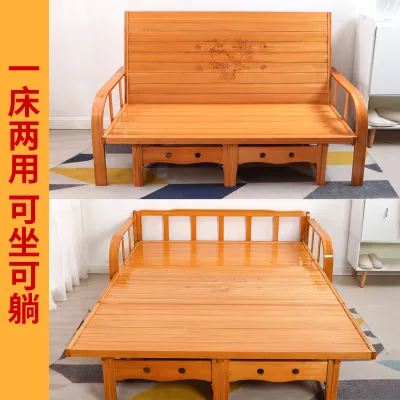
A folding chair bed wood frame offers an excellent dual-purpose solution for small-space living, providing both comfortable daytime seating and an extra sleeping surface for guests. In a compact 20 square meter condo living room, every centimeter of floor space is highly valuable. To prevent the room from feeling cramped or cluttered, a single-sized folding chair-bed with an unfolded footprint of approximately 75 cm to 90 cm in width and 180 cm to 190 cm in length is the most practical choice. This size allows you to preserve essential walkway clearances while keeping your primary sofa and coffee table in place. Selecting anything larger, such as a double-sized model, will likely overwhelm the limited layout and block daily traffic paths.
Calculating the True Usable Space in Your 20 Sqm Living Room
A 20 square meter condo living room is rarely a perfect, unobstructed rectangle. Real-world floor plans are heavily impacted by structural pillars, wall thicknesses, built-in kitchen counters, entryway corridors, and the swing radius of balcony doors. In typical Philippine high-rise developments, structural columns can protrude up to 30 centimeters into the living space, immediately reducing the actual rectilineal floor area available for furniture placement.
To determine how much space you actually have, you must map out the footprint of your existing furniture. A standard two-seater sofa occupies roughly 150 centimeters in width and 85 centimeters in depth, while a compact coffee table takes up about 90 centimeters by 50 centimeters. Together, these pieces cover nearly 1.7 square meters of physical space, but their functional footprint is much larger because they require dedicated clearance for legroom and daily use.
Products mentioned in this guide



Prices are valid at publication and may change. Please refer to the product page for the latest price.
Maintaining standard walkway clearances is critical to keeping the room functional and comfortable. Major pathways—such as the route from the entryway to the balcony or the kitchen—require a clear width of 75 to 90 centimeters to allow two people to pass each other easily. Secondary pathways, such as the gap between your sofa and the coffee table, require at least 45 to 60 centimeters of clearance to prevent awkward squeezing.
To find the maximum allowable footprint for your new chair-bed, subtract these fixed furniture dimensions and required walkways from your total floor area. You can do this by sketching your room layout on grid paper or by using masking tape on your floor to visualize the remaining open space. Any furniture piece you add must fit entirely within this leftover zone without overlapping your established pathways.
Target Dimensions to Look for in a Folding Chair Bed Wood Frame
When shopping for a wooden folding chair-bed, you must evaluate two distinct sets of dimensions: the folded footprint for daytime seating and the unfolded footprint for nighttime sleeping. Because wood frames feature structural elements like armrests, solid back panels, and thick legs, they generally have a larger physical presence than minimalist metal frames.

Comparing Folded Storage and Unfolded Sleeping Footprints
In its folded state, a single-sized wooden chair-bed functions as a deep armchair or a comfortable lounger. The typical folded dimensions of a quality wood frame range from 75 to 95 centimeters in width and 85 to 100 centimeters in depth. The wooden armrests and structural rear frame often add 10 to 15 centimeters of bulk to these measurements, which must be accounted for when placing the chair near other furniture or walls.
When converted into a bed, the internal mechanism extends forward, stretching the unfolded length to between 180 and 200 centimeters. This transition requires a completely clear projection path directly in front of the chair. You must ensure that unfolding the bed does not force you to slide your coffee table out of the room or push your primary sofa against the wall every time you host a guest.
Always plan for a clearance zone of at least 50 centimeters on at least one side of the unfolded bed. This ensures that a sleeping guest can get in and out of bed comfortably without having to crawl over the foot of the frame or squeeze tightly against a wall. Before purchasing, verify the manufacturer’s exact outer frame specifications for both states, as relying solely on the mattress size can lead to layout errors.
Evaluating Single vs. Double Size Clearances
A single-sized wooden chair-bed, which offers a sleeping surface of 75 to 90 centimeters in width, is the ideal choice for a 20 square meter room. Its compact width allows it to slip easily into empty corners or sit neatly perpendicular to your main sofa. It provides a highly functional sleeping space for one adult while leaving the rest of the room’s circulation paths completely undisturbed.
In contrast, a double or semi-double chair-bed (with a sleeping surface of 120 to 140 centimeters in width) presents severe spatial challenges in a small condo. When unfolded, a double frame will dominate the center of a 20 square meter room, leaving virtually no room for walkways. This layout choice often forces you to eliminate your primary sofa entirely, turning the living room into a dedicated bedroom space rather than a balanced multi-functional area.
To make an informed decision, avoid relying on generic marketing terms like ‘single,’ ‘twin,’ or ‘double,’ which vary significantly between manufacturers. Instead, check the precise centimeter measurements listed on the product’s official specification sheet. This ensures you are buying a piece of furniture that matches your physical space calculations rather than an idealized marketing label.
Layout Strategies to Place the Chair-Bed Without Crowding
Successful furniture placement in a 20 square meter condo relies on maintaining visual balance and clear physical pathways. The most effective layout is to place the wooden chair-bed perpendicular to your main sofa, forming an L-shaped seating arrangement. This configuration utilizes the corner space efficiently, keeps the center of the room open, and creates a natural zone for socializing during the day.
Another excellent option is to place the chair-bed in an underutilized corner near a window or balcony door. This position provides excellent natural light, making the chair an inviting spot for reading or working during daytime hours. However, ensure the chair is positioned so that it does not block the opening mechanism or the step-out path of your balcony door when fully unfolded.
Because solid wood furniture carries significant visual weight, a dark-stained frame can make a small room feel visually heavy and closed-in. To maintain an airy, spacious feel, opt for lighter wood finishes such as light oak, rubberwood, or natural pine. Additionally, try to avoid placing the chair-bed directly in the main line of sight from the front entrance, as this can make the entryway feel immediately congested.
A common layout error is squeezing the chair-bed into a tight corner between a wall and your television console. While the chair might fit perfectly when folded, unfolding it in this position becomes a frustrating chore. It often requires you to physically lift and slide the heavy wooden frame away from the wall to clear the TV console, which increases the risk of scratching your floors and straining your back.
Essential Access and Clearance Checks Before You Buy
Before finalizing your purchase, you must plan for the delivery and installation of the furniture. Unlike metal-framed furniture that often arrives completely disassembled in flat, easy-to-carry boxes, high-quality wooden chair-beds frequently feature large, pre-assembled solid wood side panels or heavy base frames that cannot be broken down further.
Measure the exact height and width of your condo unit’s entry door, the interior cabin dimensions of your building’s service elevator, and the clearance of any tight turns in the common corridors or stairwells. A wooden frame that cannot clear a standard 75-centimeter-wide doorway or fit inside the elevator cabin will result in a costly and frustrating delivery failure.
Solid wood frames are significantly heavier than hollow metal alternatives, which places concentrated pressure on your flooring. Check the manufacturer’s specified weight capacity for both the frame and the folding mechanism to ensure long-term durability. If your condo features soft flooring materials like laminate, engineered wood, or vinyl planks, you must plan to use protective pads or area rugs to prevent deep indentations and scratches.
Finally, account for architectural details such as protruding baseboards or skirting boards along your walls. These elements can prevent the wooden backrest of the chair from sitting completely flush against the wall, adding an unexpected 2 to 3 centimeters to your depth calculations. Also, make sure the folded chair does not block access to essential wall outlets, light switches, or high-speed internet ports that you use daily.
Managing Wood Weight and Humidity in Tropical Climates
Living in the tropical climate of the Philippines introduces unique environmental factors that affect wooden furniture. High humidity levels cause natural wood to absorb moisture, while dry air from air conditioning causes it to release moisture. This continuous cycle of expansion and contraction can cause solid wood joints to creak, warp, or loosen over time if the wood is not properly treated.
When selecting your chair-bed, check the manufacturer’s care instructions to ensure the wood has been properly seasoned, kiln-dried, and finished with a moisture-resistant sealant. Avoid placing the wooden frame directly beneath an air conditioning unit where condensation might drip onto the wood, or in direct sunlight near a window where intense heat can dry out and crack the finish.
Because solid wood is heavy, moving the chair-bed to clean behind it or to transition it into a guest bed requires physical effort. To make daily maintenance easier, look for models that feature heavy-duty, non-marking casters on the moving sections, or attach high-density felt pads to the bottom of the legs. This allows you to glide the frame smoothly across the floor without causing friction damage.
Upon delivery, conduct a thorough visual inspection of the wood finish, the tightness of the joints, and the alignment of the folding hinges. The moving parts of the mechanism should glide smoothly without rubbing against the wooden frame. Regularly checking and tightening the assembly hardware every six months will keep the structural frame stable and ensure the folding mechanism operates flawlessly for years to come.
Frequently Asked Questions (FAQ)
Can a wooden folding chair-bed damage laminate flooring?
Yes, heavy wooden frames and metal folding mechanisms can easily scratch or dent soft laminate flooring during daily use and conversion. To prevent this, place a low-pile area rug underneath the chair-bed or attach heavy-duty, non-scratch felt pads to all contact points on the legs.
How much space should I leave between the sofa and the chair-bed?
When the chair-bed is folded, maintain a minimum clearance of 60 centimeters between it and your sofa to allow for comfortable walking. When the bed is fully unfolded, ensure you have at least 45 centimeters of open space around the sides and foot of the bed to access it easily.

Community discussion
Share your experience or ask a question. Comments are reviewed before publication.