
Living in a compact condominium in the Philippines often requires clever spatial compromises. When dealing with a 20 square meter (sqm) footprint, every piece of furniture must justify its existence. A common question among condo dwellers is whether they can fit a substantial, comfortable sleeping option into their limited layout. Specifically, will a queen-size foldable sofa bed fit in a 20 sqm condo living room?
The short answer is yes, but with major caveats. A sofa bed foldable queen size model can successfully serve as both a primary lounge and a guest bed, provided you plan the layout down to the centimeter. In a 20 sqm unit, the living room is rarely a dedicated, isolated room; it usually shares space with the kitchen, dining area, and entryway. To make this setup work without turning your home into an obstacle course, you must calculate the exact spatial requirements of the folding mechanism, establish clear traffic lanes, and select a design that minimizes visual clutter.
Understanding the Dimensions of a Sofa Bed Foldable Queen Size in a 20 sqm Space
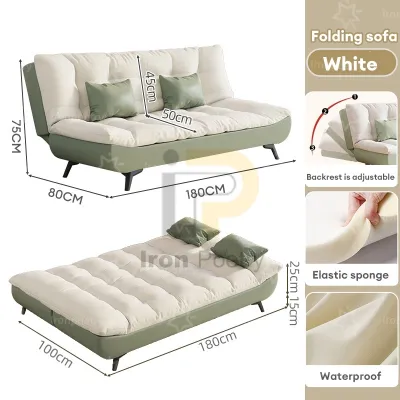
To determine if a large multi-functional piece of furniture is viable, you must first separate mattress dimensions from the actual outer frame dimensions. A standard queen-size mattress in the Philippines measures 60 inches wide by 75 inches long (approximately 152 cm by 190 cm). However, a sofa bed foldable queen size unit will always require more space than the mattress alone. The outer frame, armrests, backrest padding, and internal folding mechanism can easily push the total width of the sofa to 180 cm or even 210 cm, while the folded depth typically ranges from 90 cm to 105 cm.
Products mentioned in this guide
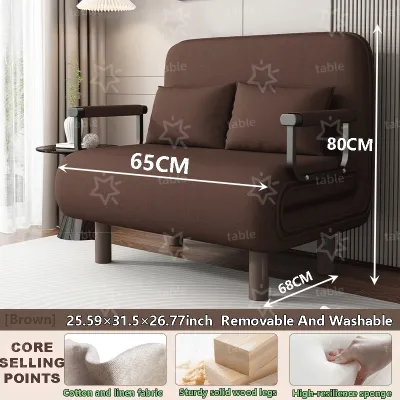

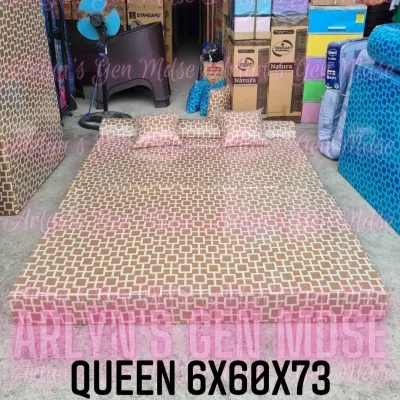
Prices are valid at publication and may change. Please refer to the product page for the latest price.
When applying these dimensions to a 20 sqm condo, you must look at the actual usable floor area rather than the total unit size. In a typical 20 sqm studio apartment, the living zone itself is often restricted to a small corner or a narrow strip of about 8 to 10 square meters. The rest of the square footage is consumed by the entryway, kitchen counter, bathroom, built-in wardrobes, and structural columns. If your unit features a balcony, the path leading to the sliding door must also remain completely clear, further reducing your placement options.
To successfully integrate a queen-size sofa bed, you must practice strict spatial zoning. Zoning involves dividing your open-plan condo into distinct functional areas—cooking, dining, sleeping, and lounging—without physical walls. In a 20 sqm layout, the sofa bed will naturally act as the primary anchor for both the lounging and sleeping zones. To maintain balance, you must ensure that other zones use scaled-down, lightweight furniture that can easily coordinate with the sofa bed’s footprint.
Clearance and Flow: Measuring for the Folding Mechanism
A sofa bed might look perfectly proportioned when folded up as a couch, but its true test lies in its fully extended state. To prevent your living room from becoming completely unusable when the bed is open, you must measure the clearance zones and plan the traffic flow with extreme precision.

Calculating Walkways and Door Swings
Maintaining comfortable walkways is essential for daily comfort and safety in a small home. Ideally, a main walkway or thoroughfare in a living space should have a clear width of at least 70 to 90 centimeters to allow a person to walk naturally without turning sideways. In a tight 20 sqm condo, you may have to reduce this clearance to an absolute minimum of 60 centimeters in secondary pathways, but going any lower will make the space feel cramped and difficult to navigate.
You must also carefully map out all door swings within the room. This includes the main entry door, bathroom doors, wardrobe doors, and even kitchen cabinet doors. When the sofa bed is fully extended, no part of the mattress or frame should block the swing path of these doors. If a door cannot open to at least a 90-degree angle because it hits the foot of the bed, it creates a safety hazard and a daily annoyance. Take a tape measure and physically trace the arc of every door swing on your floor using painter’s tape to visualize the collision zones.
Accounting for the Pull-Out or Fold-Down Footprint
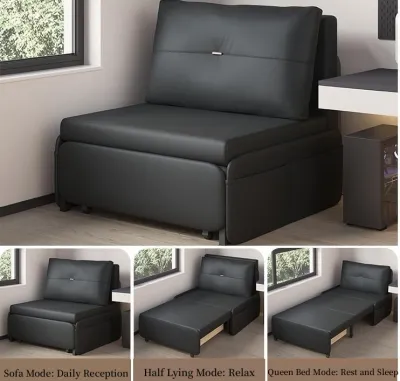
The mechanism of your sofa bed dictates how much floor space it will consume when deployed. Traditional pull-out sofa beds feature a metal or wooden frame that rolls out from beneath the seat cushions. When fully extended, these models require a massive depth of 210 to 230 centimeters from the back wall to the foot of the bed. This means the bed will stretch across almost the entire width of a typical 20 sqm condo living zone, leaving very little room at the foot.
In contrast, click-clack or futon-style fold-down designs operate by lowering the backrest flat to align with the seat. While these models generally have a shallower fully deployed depth (usually around 120 to 140 centimeters), they often require you to pull the entire sofa frame away from the wall before you can lower the backrest. If you choose a fold-down model, look for a “zero-clearance” or “wall-hugger” design that slides forward on its own tracks, saving you from lifting and dragging a heavy piece of furniture every night.
Always measure the “fully deployed” depth from the wall, and add a buffer zone of at least 50 centimeters at the foot of the bed. This buffer ensures you can comfortably get in and out of bed, change the sheets, and walk past the extended frame without having to crawl over the mattress.
Visual Proportion and Layout Strategies for Small Condos
Fitting a queen-size sofa bed physically is only half the battle; you must also ensure it does not visually overwhelm your 20 sqm condo. Large, bulky furniture can make a small room feel dark, heavy, and claustrophobic. By applying smart layout and design strategies, you can keep the space feeling open and airy.
The most effective placement strategy is to anchor the sofa bed against the longest unbroken wall in your living area. Placing the sofa against a solid wall preserves the central floor space, creating a clean, unobstructed sightline from the entryway. Avoid placing the sofa bed diagonally or in the middle of the room, as this breaks up the limited floor area and makes the layout feel disjointed.
When shopping for a sofa bed foldable queen size model, pay close attention to its design details. Opt for models with exposed legs rather than a solid plinth base that sits flat on the floor. Elevating the sofa frame even 10 to 15 centimeters off the ground allows light to pass underneath, creating the illusion of more floor space. Additionally, look for streamlined, narrow armrests (often called track arms) or even armless designs. Bulky, rolled arms can add 20 to 30 centimeters of unnecessary width to the sofa without increasing the actual seating or sleeping surface.
To complement your sofa bed, pair it with highly flexible, multi-functional accent pieces. Instead of a heavy, solid coffee table, choose a set of nesting tables that can be stacked together in a corner when the bed is extended. Lightweight ottomans with built-in storage can serve as footrests, extra seating, and storage for pillows and blankets, and they can be easily rolled or carried out of the way when it is time to deploy the bed.
Practical Checks Before You Buy
Before finalizing your purchase, you must address the unique logistical and structural realities of living in a high-rise condominium in the Philippines. A beautiful sofa bed is of no use if you cannot get it past the building’s front door.
First, carefully measure the entire delivery route from the loading dock to your living room. This includes checking the height, width, and depth of the building’s elevator cabin, as well as the clearance of any tight turns in the stairwells. Do not forget to measure the clear opening width of your unit’s main entrance door frame, which is often narrower than standard residential doors. Many fully assembled queen-size sofa beds cannot fit through standard condo doorways or elevators; verify whether the model you are buying can be delivered in flat-pack sections and assembled directly inside your living room.
Second, check the manufacturer’s official specifications for weight limits, frame stability, and assembly requirements. Because sofa beds contain complex folding mechanisms made of steel or solid wood, they are significantly heavier than standard couches. Ensure the frame is robust enough to handle daily conversions without warping. You must also verify the floor load capacity of your condo, particularly if you are placing the heavy unit on engineered wood or laminate flooring.
Finally, protect your condo’s flooring from scratches and indentations. The heavy metal or wooden legs of a sofa bed can easily damage vinyl tiles or laminate planks under the pressure of daily use. Always attach heavy-duty felt or rubber protective pads to the bottom of all contact points. In the humid tropical climate of the Philippines, moisture can sometimes collect under flat furniture bases, so elevated legs with protective pads also help promote air circulation, preventing mold growth on your floors.
Common Space-Planning Mistakes to Avoid
When arranging a tight 20 sqm space, even a minor miscalculation can lead to major daily frustrations. Being aware of common layout mistakes will help you design a highly functional and comfortable living room.
One frequent mistake is placing the sofa bed in a position that blocks the airflow of your split-type air conditioner or obstructs the sliding balcony doors. In the Philippines, maintaining proper ventilation and cooling is essential for comfort. If your sofa bed blocks the AC unit, it can cause uneven cooling and force the system to work harder, increasing your electricity bills. Blocking a balcony door is not only inconvenient but also a serious safety hazard, as the balcony is often a primary emergency egress route.
Another common oversight is failing to measure the depth of the sofa when it is in its folded, everyday couch position. While you might focus heavily on the extended bed measurements, a folded sofa that is too deep (over 100 cm) can severely encroach on your daily living space. If you place a dining table or a TV console directly opposite a deep sofa in a narrow room, the remaining walkway may become too tight for comfortable movement, even when the bed is not in use.
Lastly, never ignore the wall clearance required by certain folding mechanisms. Many click-clack and reclining sofa beds require a gap of 15 to 30 centimeters between the back of the sofa and the wall to operate. If you push the sofa flush against the wall, you will be forced to physically slide the heavy frame forward every single night before converting it into a bed. To avoid this back-breaking chore, always verify the clearance requirements with the manufacturer or choose a zero-clearance model designed specifically for tight condo spaces.
Community discussion
Share your experience or ask a question. Comments are reviewed before publication.