
Finding the right expanding wooden dining table for a large family in the Philippines means balancing everyday space efficiency with the capacity needed for festive family gatherings. In many Filipino households, the dining room serves as the true heart of the home—a place not only for daily meals but also for hosting extended relatives during Sunday lunches, birthdays, and holiday salu-salo feasts. Choosing a table that comfortably transitions from a compact six-seater for daily use to a spacious ten-seater when guests arrive is an excellent way to maximize your living space.
However, selecting a high-quality expanding wooden dining table requires careful consideration of several practical factors. Beyond aesthetics, you must evaluate the precise dimensions required for comfortable seating, the durability of the extension mechanisms, and how the materials will perform under the country’s demanding tropical climate. This guide provides actionable insights to help you navigate these decisions and choose a table that will serve your family reliably for years to come.
Quick Sizing Guide for 6 to 10 Seats
To ensure your family and guests dine in comfort, you must look beyond the manufacturer’s maximum seating labels. Visual estimates often lead to overestimating a table’s actual capacity, resulting in crowded seating arrangements where guests constantly bump elbows. Calculating the physical space required for each individual is the most reliable way to determine the necessary table dimensions.
Products mentioned in this guide
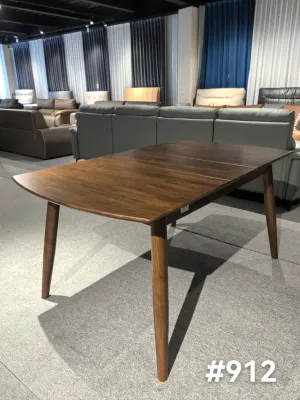
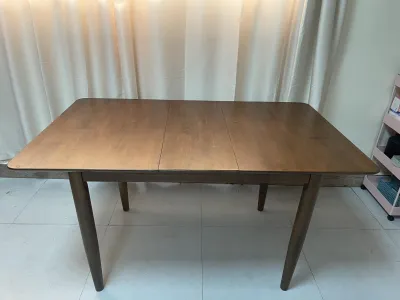
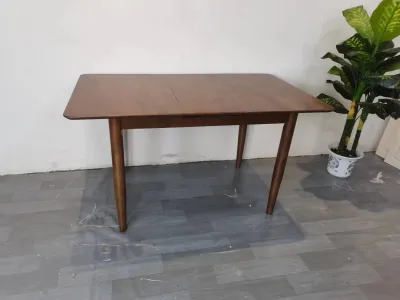
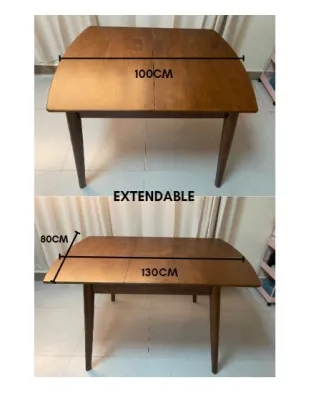
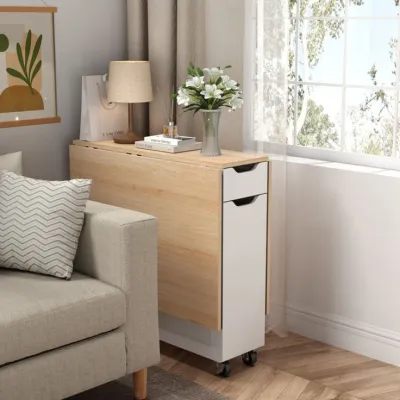
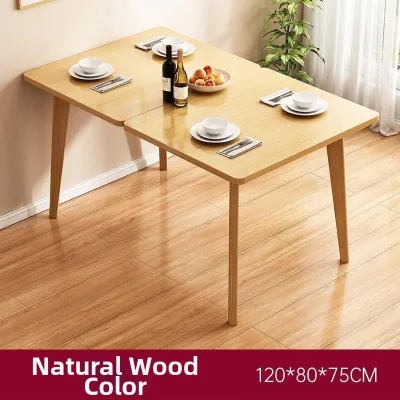
Prices are valid at publication and may change. Please refer to the product page for the latest price.
As a standard rule of thumb, each seated person requires approximately 24 inches (61 cm) of lateral width and 12 to 15 inches (30 to 38 cm) of depth to dine comfortably. This spacing provides adequate room for place settings, utensils, and natural arm movements. When planning for large family meals, you must also account for the center of the table, where serving platters, rice cookers, and shared dishes will be placed. A table width of at least 36 to 40 inches (91 to 102 cm) is highly recommended to accommodate both individual place settings and central serving dishes.
To translate these measurements into actual table lengths, use the following guidelines for both collapsed and expanded states:
- 6 Seats: Requires a minimum rectangular table length of 60 to 72 inches (152 to 183 cm).
- 8 Seats: Requires a minimum rectangular table length of 72 to 96 inches (183 to 244 cm).
- 10 Seats: Requires a fully extended rectangular table length of 96 to 120 inches (244 to 305 cm).
Table shape also plays a critical role in seating capacity and room flow. Rectangular expanding tables offer a structured, traditional look and maximize surface area, but their fixed corners can limit flexible seating arrangements. Oval expanding tables, on the other hand, feature curved ends that make it easier to slide in an extra chair or two when unexpected guests arrive. However, because the corners are rounded off, oval tables provide slightly less surface area for serving dishes at the ends of the table.
Always verify the manufacturer’s specified seating capacity for both the unextended and fully extended configurations. Never assume a table can comfortably seat ten people just because it looks large in a spacious showroom or on an online marketplace listing.
Recommended Extension Mechanisms for Large Families
The extension mechanism of your expanding wooden dining table dictates how easily you can transition the piece between its sizes. If a mechanism is overly complex, heavy, or prone to jamming, you may find yourself leaving the table in its expanded state permanently, defeating the purpose of a space-saving design. Understanding the distinct pros and cons of each mechanism will help you select the most practical option for your household.

Self-Storing Butterfly Leaves
Butterfly leaf mechanisms are highly favored for their convenience and streamlined design. In this setup, the table pulls apart from the center, revealing a hinged leaf folded and stored in a dedicated compartment directly beneath the tabletop. To expand the table, you simply pull the two ends outward, lift and unfold the leaf like butterfly wings, and slide the table ends back together to lock it in place.
Key Benefits:
- No Separate Storage Required: Because the leaf stores inside the table frame, you do not need to find extra closet space or worry about damaging the leaf while storing it elsewhere.
- One-Person Operation: High-quality butterfly mechanisms are often engineered to be operated easily by a single person.
Mechanical Checks to Perform:
- Inspect the sliding tracks beneath the table. In the Philippines' humid climate, wood-on-wood tracks can swell and bind. Look for metal-reinforced sliding tracks that operate smoothly.
- Check for center support legs or heavy-duty steel alignment pins that prevent the table from sagging in the middle when the butterfly leaf is fully deployed.
Removable Center Leaves
Traditional removable center leaves offer a robust and time-tested solution for maximum expansion. With this design, the table frame slides open from the center, and you manually insert one or more separate wooden panels (leaves) into the gap before locking the table sections back together.
Key Benefits:
- Seamless Surface: When fully assembled and locked, tables with removable leaves offer an exceptionally solid, flat, and seamless dining surface, which is ideal for heavy serving dishes and active family meals.
- Greater Expansion Potential: Some tables of this style can accept multiple leaves, allowing you to scale the table from a modest four-seater up to a massive ten- or twelve-seater.
Mechanical Checks to Perform:
- Verify where you will store the loose leaves when they are not in use. They must be kept in a dry, temperature-stable closet to prevent warping.
- Inspect the alignment pins (usually made of brass or heavy-duty polymer) on the edges of the leaves. These pins must align perfectly with the corresponding holes in the main tabletop to ensure a level surface.
- Check for secure table locks or latches on the underside of the tabletop to keep the sections clamped tightly together during use.
Drop-Leaf and Gateleg Designs
Drop-leaf and gateleg tables feature hinged outer sections that hang vertically when collapsed. To expand the table, you lift the hinged sides and secure them by swinging out supporting legs (gatelegs) or sliding wooden brackets out from beneath the main frame.
Key Benefits:
- Extreme Space Efficiency: These tables can be collapsed to a very narrow profile, allowing them to be pushed against a wall to serve as a console table when not in use.
- Flexible Configurations: You can choose to raise only one leaf for a medium-sized setup or both leaves for maximum capacity.
Mechanical Checks to Perform:
- Inspect the hinges connecting the drop-leaves to the main tabletop. Because these hinges bear the weight of the extended sections, they must be heavy-duty and securely screwed into solid wood.
- Verify the stability of the support brackets or gatelegs. Hinged edges can sometimes create slight unevenness or minor wobbling, so ensure the supporting mechanism locks firmly into place to handle heavy serving bowls safely.
Evaluating Wood and Build Quality for Humid Climates
The tropical climate of the Philippines, characterized by high humidity, intense summer heat, and a distinct wet season, poses unique challenges for wooden furniture. Wood is a hygroscopic material, meaning it naturally absorbs and releases moisture from the surrounding air, causing it to expand and contract. To prevent your investment from warping, cracking, or binding, you must carefully evaluate the wood construction and structural engineering.
Solid Wood vs. Veneer Construction
When shopping for an expanding wooden dining table, you will encounter options made of solid wood, wood veneers, or a combination of both. Understanding how these materials behave in humid conditions is essential for making an informed purchase.
Solid wood tables constructed from dense hardwoods like mahogany, teak, or acacia offer exceptional longevity and a beautiful, natural grain. However, solid wood is highly reactive to environmental changes. If the wood was not properly kiln-dried by the manufacturer before assembly, the high humidity in the Philippines can cause the wood fibers to swell, leading to warped tabletops or sticky extension tracks. If you choose solid wood, always ask the retailer about their kiln-drying process and verify the recommended humidity levels for the piece.
High-quality wood veneer construction offers an excellent, climate-stable alternative. These tables feature a thin layer of real hardwood bonded to a highly stable engineered wood core, such as high-density fiberboard (HDF) or multi-layered plywood. Because the engineered core does not expand and contract nearly as much as solid timber, veneered tables are highly resistant to warping and cracking in humid climates.
Regardless of the construction type, always check the product’s care label. Avoid assuming any wood table is inherently waterproof or scratch-resistant. Look for tables finished with high-quality, moisture-resistant polyurethane or specialized protective lacquers, and follow the manufacturer’s instructions regarding cleaning agents and coaster use.
Base Stability and Joinery
An expanding table fully extended to seat ten people carries a significant amount of weight, especially when loaded with heavy serving platters and dinnerware. A weak base or poor joinery will lead to structural sagging, noticeable wobbling, or even tipping hazards.
To ensure maximum stability, look for robust base designs engineered to support long spans. Double-pedestal bases, thick trestle legs, or heavily reinforced aprons (the wooden frame directly beneath the tabletop) are ideal for large tables. Avoid tables that rely on a single, slender center pedestal for extensions beyond 80 inches (203 cm), as they lack the necessary leverage to support the ends of the table when fully expanded.
Before purchasing, inspect the joinery beneath the table. High-quality construction features traditional mortise-and-tenon joints, reinforced corner blocks, and heavy-duty steel brackets. Avoid tables that rely solely on simple wood screws or glue at critical load-bearing joints, as these connections can weaken over time under the stress of regular expansion and contraction.
Space Planning and Clearance Requirements
Before finalizing your purchase, you must measure your dining area using the table’s maximum expanded length and width, rather than its collapsed daily size. A table that fits beautifully in its six-seat configuration can easily overwhelm a room or block major walkways when extended to its full ten-seat capacity.
To maintain a comfortable and functional dining room, adhere to the standard clearance rule: leave a minimum of 36 inches (91 cm) of open space between the edge of the table (when fully extended) and the nearest walls, buffet cabinets, or doorways. This 36-inch clearance provides just enough room for guests to pull out their chairs, sit down, and rise without difficulty. If the dining room serves as a primary pathway to other areas of the home, such as the kitchen or living room, aim for a clearance of 48 inches (122 cm) on those active sides to allow people to walk behind seated guests comfortably.
To visualize how the table will fit in your actual space, map out its footprint on the floor. You can do this easily by using painter’s tape or laying down newspapers to match the exact dimensions of both the collapsed and fully extended configurations. Walk around the mapped area to ensure you can still access nearby doors, cabinets, and walkways without obstruction.
Additionally, consider the placement of your dining room’s overhead lighting. Ideally, your chandelier or pendant light should align with the center of the dining table. If you plan to keep the table in its collapsed state most of the time, align the light fixture with the center of that configuration. If the table will remain expanded for long periods, ensure the lighting setup accommodates the shifted center point to avoid awkward, off-center illumination during family meals.
Pre-Purchase Access and Assembly Checklist
Because large wooden dining tables are heavy and bulky, delivery and installation require careful planning. Completing a few logistical checks before ordering will help you avoid delivery failures and ensure a safe, successful setup.
- Access Verification: Measure the width, height, and diagonal clearance of all entryways, hallways, stairwells, and elevator doors leading to your dining room. Many condominium buildings in urban areas have tight elevator cabins and sharp hallway turns that cannot accommodate a single-piece, non-detachable wooden tabletop. Ensure the table can be delivered in sections or that the legs can be easily unbolted for transport.
- Weight and Floor Protection: Solid wood expanding tables are exceptionally heavy, often weighing between 50 and 80 kilograms. Verify that your flooring can support this concentrated weight without denting. Before assembly, attach heavy-duty felt pads to the bottom of the table legs to protect your hardwood, laminate, or tile floors from scratches when moving or expanding the table.
- Assembly Conditions: Review the assembly requirements provided by the manufacturer. Large expanding tables feature complex track systems that must be aligned with high precision. Assembly typically requires at least two or three people to safely lift, flip, and align the heavy wooden components. If the extension tracks bind, catch, or cause the table to wobble during setup, stop assembly immediately and consult the manufacturer or a professional furniture installer rather than forcing the mechanism.
Frequently Asked Questions (FAQ)
How do I maintain the extension tracks on a wooden table?
To keep your table’s extension mechanism operating smoothly, perform regular visual inspections and gently vacuum the tracks to remove dust, crumbs, and pet hair that can accumulate in the grooves. If the tracks begin to stick, consult the manufacturer’s care instructions before applying any lubricants. Some mechanisms require specific dry-film or wax-based lubricants (such as paraffin wax), while standard oil-based lubricants should be avoided because they attract dust and can seep into and damage the surrounding wood.
Can I leave an expandable wooden table extended all the time?
Yes, you can leave your table permanently extended, provided the room maintains relatively stable humidity levels and the extension leaves are properly supported by the table’s base or center legs. In regions with fluctuating seasonal humidity, keeping the extension leaves inserted can actually be beneficial, as it allows the leaves to acclimate to the environment at the same rate as the main tabletop. This consistent exposure helps prevent uneven wood expansion, warping, or mismatched color fading caused by uneven sunlight exposure over time.

Community discussion
Share your experience or ask a question. Comments are reviewed before publication.