
Filipino households thrive on shared meals, festive gatherings, and Sunday salo-salo where extended family members gather around the table. However, as modern urban homes, townhouses, and condominiums in the Philippines become more compact, finding a dining table that can comfortably seat 6 to 10 people without permanently dominating your floor space is a common challenge. The ideal solution is a smart space saver dining table—an extendable model that remains compact for daily use by 4 to 6 residents but seamlessly expands to host up to 10 guests when the occasion demands. Choosing the right one requires looking beyond aesthetics to evaluate mechanical reliability, physical dimensions, and structural stability under the weight of heavy serving platters.
Selecting the Right Space Saver Dining Table: Key Criteria
A standard 6-seat dining table usually measures around 150 to 160 centimeters in length. To accommodate 10 people comfortably, you need a table that can expand to at least 220 to 240 centimeters. Each diner requires roughly 60 centimeters of horizontal table space to eat comfortably without bumping elbows. When selecting a table, you must assess both its minimum and maximum footprint. The folded size should match your household’s daily occupancy, allowing for easy movement through the dining room during the week. The fully extended size should be reserved strictly for special occasions, preventing your dining area from feeling permanently cramped.
A critical but often overlooked criterion is how easily the extension mechanism operates. The ideal table should allow a single family member to transition the setup from small to large in under two minutes without requiring assistance. If a mechanism is too stiff, heavy, or complex, the table will likely remain in one position permanently, defeating its purpose. Look for designs featuring synchronized gear openings, where pulling one end of the table automatically slides the opposite end open. Smooth, ball-bearing glides are essential for minimizing friction, allowing a single person to glide the tabletop open with minimal physical exertion.
Products mentioned in this guide
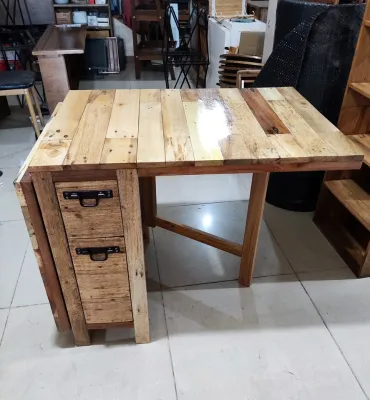
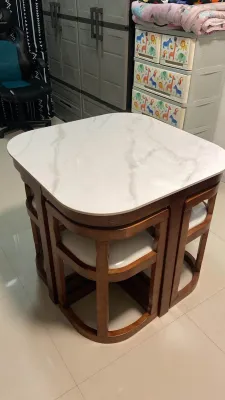
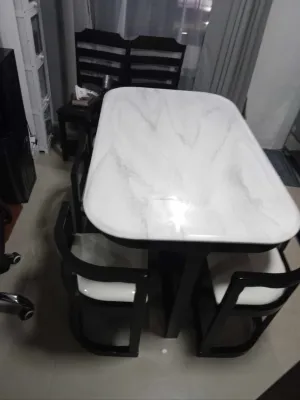
Prices are valid at publication and may change. Please refer to the product page for the latest price.
The design of the table base significantly influences both legroom and chair storage. Traditional tables feature four legs positioned at the outer corners. While highly stable, these corner legs can restrict where guests sit when the table is extended, often forcing diners to straddle a table leg. Alternatively, pedestal bases or trestle designs feature a centralized support structure. This frees up the corners of the table, providing maximum legroom and allowing you to tuck chairs in tightly when the table is in its folded state. However, central pedestals must be exceptionally heavy and well-engineered to prevent the table from tipping when heavy pressure is applied to the extended outer edges.
Top Extendable Mechanisms for Compact Homes
To make an informed purchase, you must understand the primary extension mechanisms available in the furniture market. Each system offers distinct advantages in terms of space efficiency, ease of use, and structural capacity.

Drop-Leaf and Gateleg Designs
Drop-leaf and gateleg tables are among the most versatile space-saving solutions for compact homes and apartments. In these designs, the main tabletop is flanked by one or two hinged side panels (leaves) that hang vertically when not in use. When you need to expand the table, you simply lift the leaves and swing out a supporting leg—the “gateleg”—to hold them in place. This mechanism allows the table to shrink to an incredibly narrow profile, often measuring less than 30 centimeters wide when both leaves are folded down. In this ultra-compact state, the table can be pushed flat against a wall to serve as a console table, a laptop desk, or a breakfast bar for two.
Despite their space-saving brilliance, drop-leaf designs have specific physical limitations. The swinging gatelegs can interfere with guest legroom, restricting where chairs can be placed underneath the table. Additionally, because the leaves are supported by hinges and moving legs, they are inherently less rigid than solid tabletops. When hosting a large family gathering, you must ensure that the gateleg supports are fully extended and locked securely into position before placing heavy serving dishes, such as large bowls of soup or heavy platters of food, onto the extended leaves. Inspect the hinge hardware closely; look for thick steel hinges secured by multiple deep screws to ensure the leaves do not sag over time.
Butterfly Leaf and Self-Storing Extensions
For those who prefer a clean, modern aesthetic without the hassle of storing extra furniture parts, the butterfly leaf mechanism is an excellent choice. This system features a split tabletop that slides open from the center, revealing a folded extension leaf stored horizontally in a hidden compartment underneath. To extend the table, you pull the two halves of the tabletop apart, lift the folded leaf out of its cradle, and unfold it like a butterfly’s wings. The leaf locks into place, and you push the outer halves of the tabletop back together to create a continuous, solid surface.
The primary benefit of a butterfly leaf table is its self-storing design. This is particularly advantageous for high-rise condominiums in Metro Manila or compact subdivision homes where closet space is at a premium. You never have to worry about finding a safe place to store a loose wooden panel. However, because the mechanism relies on intricate folding joints and internal tracks, it requires careful inspection. When shopping, test the smoothness of the internal tracks multiple times. The high humidity levels characteristic of the Philippine climate can cause wooden components to swell slightly; therefore, prioritizing tables with rust-resistant metal tracks and high-quality brass hinges is crucial for preventing the mechanism from jamming. Ensure that the center seam aligns perfectly when the table is closed to prevent food crumbs and dust from getting trapped in the gap.
Removable Center Leaves
The traditional removable center leaf system remains the gold standard for structural strength and maximum seating capacity. In this design, the table slides open from the center, and you manually insert one or more separate wooden panels into the gap. The panels are aligned using metal or wooden locating pins and are held firmly in place by locking latches underneath the tabletop. This system can easily extend a standard 6-seat table to accommodate 10 or even 12 diners, offering a highly stable, flat surface that feels as solid as a non-extendable table.
The trade-off with removable center leaves is storage. Because the extra leaves do not fold or store inside the table frame, you must find a dedicated, safe place to keep them when they are not in use. Storing them in a closet, under a bed, or inside a storage bench is necessary to protect them from scratches and moisture. When evaluating a table with removable leaves, inspect the alignment pins and the underside latches. High-quality tables feature heavy-duty steel alignment pins that slide smoothly into brass-lined holes, preventing the center of the table from sagging when fully extended. Also, check the track glides; steel ball-bearing tracks are highly recommended over wooden slides, as they resist warping and ensure the table opens smoothly even after years of use.
How to Measure Your Dining Space for Maximum Capacity
Before purchasing an extendable dining table, accurate spatial planning is essential to ensure that your new furniture fits comfortably in your home without blocking vital pathways. A table that fits perfectly in a spacious showroom can easily overwhelm a compact dining room once fully extended.
To determine the maximum size table your room can accommodate, start by measuring the length and width of your dining area. As a general rule, you must maintain a minimum walkway clearance of 36 inches (approximately 90 centimeters) between the edge of the table and the nearest wall, cabinet, or doorway. This clearance is necessary to allow guests to pull out their chairs, sit down, and stand up comfortably without hitting the wall. If your dining room is a high-traffic zone leading to the kitchen or living room, increasing this clearance to 48 inches (120 centimeters) on the active side is highly recommended to prevent bottlenecks.
Next, account for the depth of your dining chairs. A typical dining chair requires about 18 to 22 inches (45 to 55 centimeters) of depth when tucked under the table, but it needs at least 30 inches (75 centimeters) of space when pulled out for a guest to sit down. Multiply this by the number of chairs you plan to place along the sides of the table. For a 10-seat configuration, you will typically have four chairs on each long side and one chair at each end. Ensure that the room’s width can accommodate two fully occupied chairs back-to-back if your dining area is positioned between two walls.
Finally, conduct a thorough pre-purchase delivery check. Many homeowners purchase large extendable tables only to discover that the box cannot clear the tight turns in their stairwell or fit inside the building’s elevator. Measure the height and width of your front door, any narrow hallways, stairwell landings, and elevator doors. If you live in a high-rise condominium in Manila, consult the building administration regarding elevator weight and size limits. Choosing a table that is delivered flat-packed and assembled inside your dining room is often the safest option for homes with restricted access.
Durability Checks for Daily Family Use
A dining table for a large family is a major investment that must withstand heavy daily use, accidental spills, and the physical stress of constant extension. Conducting a few simple quality checks before buying will ensure your table lasts for years.
First, inspect the extension tracks underneath the tabletop. Avoid tables that use plastic runners or simple wooden slides, as these materials wear down quickly, warp under humid conditions, and can crack under heavy loads. Instead, prioritize heavy-duty steel or aluminum ball-bearing glides. Metal tracks provide a smooth, consistent sliding action and are strong enough to support the weight of the extended tabletop without bending. Look for tracks that feature integrated locking latches, which secure the tabletop sections together and prevent them from slowly drifting apart during a meal.
Second, test the structural stability of the table when it is fully extended. In a showroom, ask to have the table fully opened. Place your hands on the center seam and apply moderate downward pressure, checking for any noticeable sag, flexing, or separation of the joints. Next, gently shake the table from side to side to check for wobbling. A high-quality 10-seat table should feel solid and grounded, even at its maximum length. If the table sways or creaks during this test, it may lack the necessary structural reinforcement, such as corner bracing or heavy-duty mounting plates, required for long-term durability.
Third, verify the surface materials and finishes. Do not rely solely on the name of the wood or material; instead, check the manufacturer’s care instructions and product specifications for scratch, heat, and moisture resistance. In the tropical climate of the Philippines, humidity can cause solid wood to expand and contract, which can warp the tabletop or cause joints to split. Engineered wood with a high-quality wood veneer or a high-pressure laminate (HPL) finish is often more stable and resistant to warping than solid wood. If you prefer solid wood, ensure it has been kiln-dried and sealed with a moisture-resistant protective topcoat, such as polyurethane, to protect against condensation from cold drinks and heat from hot serving bowls.
Frequently Asked Questions (FAQ)
How much space do I need around a 10-seat extendable table?
To comfortably accommodate a fully extended 10-seat table, you need at least 36 inches (90 cm) of open clearance on all sides. To calculate the minimum room size, add 72 inches (180 cm) to both the extended length and the width of the table. For example, if your fully extended table measures 240 cm in length and 100 cm in width, your dining room should have a minimum clear footprint of 420 cm by 280 cm to allow comfortable movement and seating.
Can one person easily extend a 6-10 seat table?
Yes, tables equipped with modern butterfly leaf or drop-leaf mechanisms are specifically designed for effortless, single-person operation. Many feature synchronized metal glides, allowing you to pull one end of the table while the other side opens automatically. However, traditional tables utilizing heavy solid-wood removable center leaves usually require two people—one on each end—to pull the frame apart and safely align the heavy panels without damaging the alignment pins.
Are extendable tables less stable than fixed dining tables?
High-quality extendable tables that feature robust metal hardware, solid corner bracing, and secure locking latches are just as stable as standard fixed dining tables. To ensure long-term stability, always verify that all locking latches are fully engaged before sitting down. Additionally, avoid placing concentrated heavy weight directly over the extension seams, and perform regular maintenance by tightening any loose bolts or screws on the legs and tracks.

Community discussion
Share your experience or ask a question. Comments are reviewed before publication.