
Finding a dining table that accommodates a large family of 6 to 10 people while offering practical storage requires balancing physical space, material durability, and structural design. In many households, the dining table is the heart of the home—serving not only as the hub for daily meals and festive gatherings but also as a workspace, homework station, and food preparation area. A stainless steel dining table with built-in shelves offers an exceptionally durable, hygienic, and modern solution to these multi-functional demands. The metal surface resists high humidity, while the integrated shelving provides valuable storage for serving platters, rice cookers, and extra tableware. To make the right choice, you must carefully evaluate how the table fits into your dining room, how the shelf design impacts seating comfort, and how to verify the quality of the steel and construction before making a purchase.
Space Planning and Size Requirements for Large Gatherings
To ensure a comfortable dining experience, you must plan for adequate clearance around the table. For a large family of 6 to 10 people, the physical footprint of the table is only part of the equation. Standard furniture planning guidelines suggest leaving at least 90 to 100 centimeters of open space between the edge of the table and the nearest wall, doorway, or adjacent furniture. This clearance allows family members to pull out their chairs comfortably and sit down without bumping into obstacles. If the dining area serves as a primary pathway to other rooms, increasing this clearance to 120 centimeters is highly recommended to allow others to walk behind seated diners without disruption.
The shape of the table plays a critical role in how efficiently it utilizes your available floor space. For seating 6 to 8 people, a rectangular table typically needs to measure at least 180 centimeters in length, while a 10-seater arrangement generally requires a length of 240 centimeters or more. Rectangular tables are highly efficient for long, narrow dining rooms and can be pushed against a wall when not fully occupied. Alternatively, oval tables offer softer corners that can improve traffic flow in tight spaces, though they may slightly reduce the usable surface area for serving dishes. When selecting a table with built-in shelves, ensure the overall length and width do not block doorways or restrict access to nearby storage cabinets.
Products mentioned in this guide
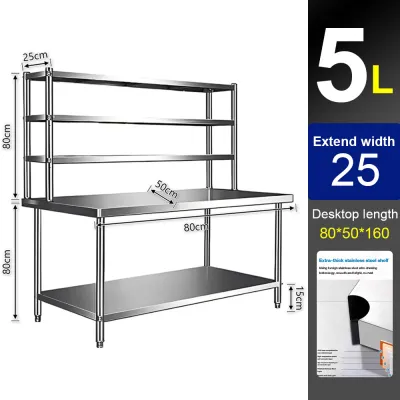
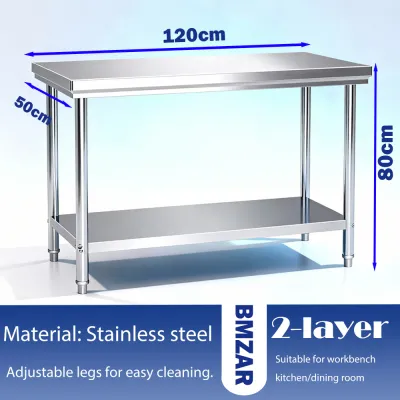
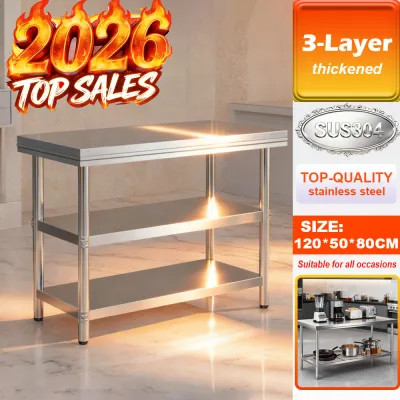
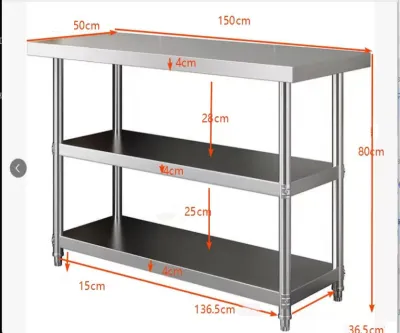
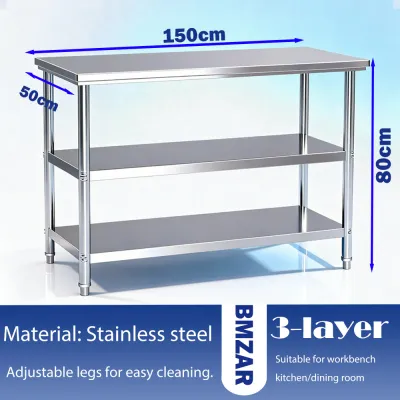
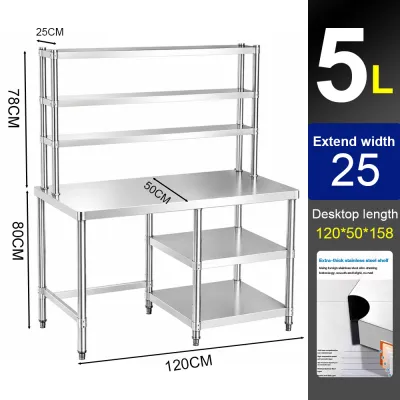
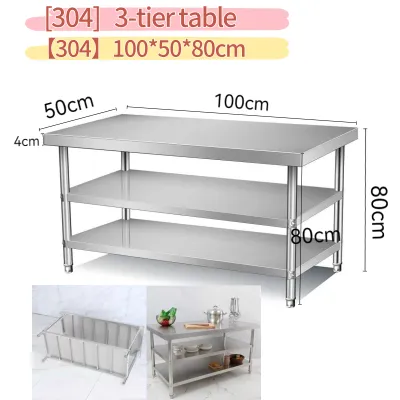
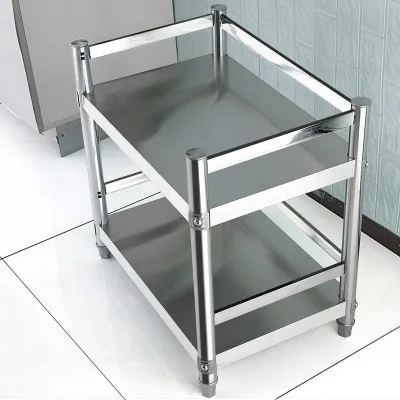
Prices are valid at publication and may change. Please refer to the product page for the latest price.
Built-in lower shelves introduce unique spatial challenges, particularly regarding legroom and chair compatibility. A lower shelf positioned directly beneath the tabletop can restrict the vertical clearance needed for diners to cross their legs or slide their chairs completely under the table. To maintain comfort, look for designs where the shelf is positioned very low to the ground or set back from the table edge. Additionally, you must measure the distance between the table legs to ensure your chosen chairs can slide side-by-side without crowding. Opting for armless dining chairs or slim stools can maximize seating capacity along the sides, while ensuring the seat height aligns comfortably with the table’s apron.
Evaluating Stainless Steel Grades and Shelf Structures
Not all stainless steel is created equal, especially when subjected to high humidity and warm temperatures. When evaluating product listings, look closely at the manufacturer’s specifications for the steel grade. Grade 304 stainless steel is widely considered the standard for residential and commercial food environments due to its high chromium and nickel content, which provides excellent resistance to rust, corrosion, and food acids. Grade 201 is a more budget-friendly alternative that offers good strength but is more susceptible to surface rust over time if exposed to persistent moisture. Always verify the product description or ask the seller directly to confirm the specific grade used for both the tabletop and the supporting frame.

The design of the built-in shelf should match your specific storage needs. Solid stainless steel shelves provide a continuous, flat surface that prevents small items from falling through and makes it easy to wipe away dust or spills. This style is ideal for storing heavy kitchen appliances, stackable storage bins, or delicate serving ware. On the other hand, wire or mesh shelving allows for better air circulation and prevents dust accumulation, making it a practical choice for storing dry goods, linens, or items that benefit from ventilation. Consider what you plan to store on the shelf to determine which structure offers the best balance of utility and ease of cleaning.
The structural integrity of a large dining table depends heavily on how the legs, frame, and shelves are joined together. High-quality stainless steel tables typically feature fully welded joints or heavy-duty bolt-on brackets. Welded construction offers the greatest rigidity and eliminates the risk of fasteners loosening over time, though it makes the table much more difficult to transport and maneuver through narrow doorways. Bolt-on systems provide greater flexibility for delivery and assembly but require periodic inspection to ensure the bolts remain tight. Avoid tables that rely solely on thin metal screws or plastic connectors, as these can fail under the weight of heavy meals and lead to a wobbly, unstable dining surface.
Stability, Weight Capacity, and Safety Checks
A table designed to seat up to 10 people must possess exceptional stability to prevent tipping, especially when family members lean on the edges or place heavy serving platters on one side. A traditional four-leg base design generally offers the most reliable stability for long rectangular tables, as the weight is distributed evenly to the corners of the room. Trestle bases can also provide excellent support while offering more legroom at the ends of the table, but you must verify that the central support beam is robust enough to prevent flexing. Pedestal bases are less common for very large rectangular tables but can work well if the base is sufficiently wide and heavy to anchor the entire structure.
Before purchasing, always check the manufacturer’s specified weight capacities for both the tabletop and the lower shelves. A large family gathering often involves heavy ceramic serving dishes, large pots of food, and multiple beverage pitchers, which can quickly add up to significant weight. The lower shelf must also be rated to handle the specific items you plan to store, such as heavy rice cookers, stand mixers, or stacks of dinner plates. Exceeding these weight limits can cause the stainless steel to bow or warp, permanently damaging the table’s appearance and compromising its structural safety.
Safety is a paramount consideration for any household furniture, particularly in busy dining areas. Inspect the table design for sharp corners or rough edges along the perimeter of the tabletop and the lower shelves. High-quality stainless steel tables feature hemmed or rounded edges to prevent accidental cuts or scrapes. Additionally, look for adjustable leveling feet on the bottom of the table legs; these allow you to compensate for uneven tile or concrete floors, ensuring the table remains perfectly stable. If the table features a folding or extendable mechanism, carefully check for potential pinch points where fingers could get caught during setup or adjustment.
Building Your Shortlist: What to Look for When Shopping
When browsing online marketplaces or visiting local furniture showrooms, using precise search filters can save you significant time. Start by filtering for “stainless steel table with shelves” and narrow the results by seating capacity or length (such as 180cm to 240cm). Look for terms like “commercial grade,” “heavy-duty,” or “dining height” to filter out low-quality utility tables that may be too short or too industrial for a comfortable home dining experience. If you have a specific layout in mind, filter by shape to compare rectangular and oval options that feature integrated storage.
Before finalizing your purchase, carefully read the fine print in the product listing. Pay close attention to the exact assembled dimensions, including the height of the lower shelf from the floor, to ensure your existing chairs will fit. Check the shipping weight and package dimensions, as large stainless steel tables are heavy and may require special delivery arrangements. It is also crucial to review the seller’s return policy for large freight items; because shipping bulky furniture can be costly, understanding who covers the return shipping fees in case of a defect or incorrect size is essential.
Pricing for stainless steel dining tables can vary widely based on material thickness, steel grade, and construction quality. Budget-friendly options, often priced in the lower ₱ range, typically feature thinner gauge steel (such as 201 grade) and require complete self-assembly. Mid-range options often offer a balance of 304 grade steel accents, sturdier frames, and more refined finishes suitable for a home aesthetic. Premium tables, which sit at the higher end of the ₱ spectrum, generally feature thick-gauge 304 stainless steel, fully welded joints, and professional-grade finishes. When comparing prices, remember to factor in delivery fees and assembly charges, as these can add a substantial amount to the total cost of large furniture.
Do not hesitate to contact the seller directly to clarify any details not fully explained in the product description. Ask about the specific assembly requirements, including whether specialized tools are needed or if the package includes clear, step-by-step instructions. Inquire about the warranty coverage, specifically what parts or structural failures are covered and for how long. Finally, ask if replacement hardware, such as leveling feet or assembly bolts, is readily available should you need to replace them in the future.
Daily Maintenance and Care for Stainless Steel Surfaces
Keeping your stainless steel dining table clean and hygienic is relatively straightforward if you follow a consistent routine. For daily cleaning, use a soft microfiber cloth dampened with warm water and a few drops of mild dishwashing liquid. Wipe the surface in the direction of the metal’s grain (the faint lines running across the steel) to prevent scratching and ensure a streak-free finish. After wiping with soapy water, rinse the cloth with clean water and wipe the table again to remove any soap residue, then dry the surface thoroughly with a clean towel to prevent water spots and mineral buildup from hard water.
To preserve the protective chromium oxide layer that prevents stainless steel from rusting, you must avoid using harsh cleaning agents. Never use bleach, chlorine-based cleaners, or highly acidic solutions on your table, as these chemicals can break down the protective barrier and lead to pitting or corrosion. Similarly, avoid abrasive cleaning pads, steel wool, or stiff-bristled brushes, which can leave deep scratches on the smooth surface. If you encounter stubborn food residue or grease, use a specialized stainless steel cleaner or a paste made of baking soda and water, applying it gently with a soft cloth.
While stainless steel is highly heat-resistant, placing extremely hot cookware directly from the stove onto the tabletop can cause localized discoloration or minor warping due to thermal shock. Always use trivets, heat-resistant mats, or coasters to protect the surface from extreme temperatures. Additionally, clean up spills from acidic foods like vinegar, citrus juices, or tomato sauce promptly, as prolonged contact can dull the finish. When placing heavy items on the lower shelf, slide them carefully rather than dragging them to minimize the risk of surface scratches.
Frequently Asked Questions (FAQ)
Can I use a stainless steel dining table outdoors or in semi-open areas?
Whether a stainless steel dining table can be used outdoors or in semi-open spaces like a patio or dirty kitchen depends heavily on its steel grade and construction. If the table is made of high-quality Grade 304 stainless steel, it can generally withstand outdoor conditions, provided it is cleaned regularly to remove environmental debris. However, Grade 201 steel is highly susceptible to rust when exposed to rain, high humidity, and coastal salt air. You must check the manufacturer’s explicit rating to confirm if the table is approved for outdoor use. If the table features non-metal components, such as wooden shelf inserts or plastic leveling feet, these materials may degrade rapidly under direct sunlight and heavy rain. To prolong the table’s lifespan, it is best to place it under a protective canopy or use a heavy-duty, waterproof furniture cover when not in use.
How do extendable mechanisms work with built-in lower shelves?
Extendable stainless steel tables that feature built-in lower shelves require careful engineering to ensure the expansion mechanism does not interfere with the storage structure. Typically, these tables utilize drop-leaf designs or butterfly leaves where the tabletop expands outward while the central frame and lower shelf remain fixed in place. This means that when the table is fully extended to accommodate 10 people, the lower shelf will remain the same size as it was in the compact configuration. Before purchasing, inspect the sliding tracks, locking pins, and hinges to ensure they operate smoothly and lock securely into place. Be aware that when the table is extended, the legs may shift position, which can temporarily alter the legroom around the ends of the table and affect how easily you can access the items stored on the lower shelf.

Community discussion
Share your experience or ask a question. Comments are reviewed before publication.