
Quick Answer: Is the Xpanse T10 the Right Choice for Your Budget?
Finding the right ergonomic chair in the ₱3,000 to ₱15,000 price range requires balancing adjustability, material durability, and physical fit. The Xpanse T10 enters this highly competitive mid-budget segment as a prominent option, but whether it suits your specific home office depends heavily on your daily sitting habits and physical dimensions. In this price bracket, buyers should expect at least basic lumbar support, adjustable seat height, and breathable mesh materials suitable for the warm Philippine climate.
The Xpanse T10 may be a strong candidate if you prioritize a highly adjustable backrest and customizable armrests within a moderate budget. However, before finalizing your purchase, you must verify its exact dimensions, weight capacity, and base materials against your personal requirements. Comparing these specifications with alternative models in the same price tier ensures you do not end up with a chair that is too small for your desk or lacks the necessary structural support.
Core Comparison Dimensions to Evaluate
When shopping for an ergonomic office chair between ₱3,000 and ₱15,000, it is easy to get overwhelmed by marketing buzzwords. To make an objective decision, you must break down your evaluation into distinct, measurable dimensions that directly impact your daily comfort and physical health.
Products mentioned in this guide
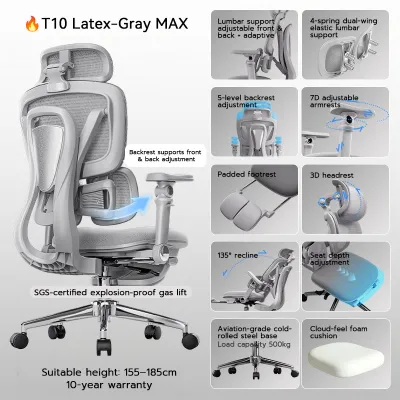
Prices are valid at publication and may change. Please refer to the product page for the latest price.

Your choice should be guided by how many hours you spend at your desk, your specific body measurements, and the environmental conditions of your workspace. By focusing on verifiable specifications rather than aesthetic appeal, you can identify which chair offers the best structural value and ergonomic support for your budget.
Adjustability and Ergonomic Support
The primary goal of any ergonomic chair is to maintain the natural curve of your spine and reduce physical strain during long working hours. In the mid-range segment, the sophistication of these adjustment mechanisms varies significantly between models.
Lumbar Support Mechanisms: When evaluating the Xpanse T10 against its competitors, look closely at how the lumbar support is designed. Some chairs offer fixed lumbar support, while others feature height-adjustable or depth-adjustable bands, or even dynamic spring-loaded systems that adapt to your movements. Check the official product manual to see if the lumbar support can be locked into place or if it relies solely on tension.
Armrest Adjustability: Armrests in this price bracket typically range from 1D (height-adjustable only) to 3D or 4D (adjusting for height, angle, depth, and width). If you type for extended periods, look for armrests that can align flush with your desk height to prevent shoulder strain. Verify whether the Xpanse T10 or its alternatives offer the specific armrest movements required for your typing posture.
Recline and Tilt Lock: A high-quality mid-range chair should allow you to recline comfortably and lock the backrest at multiple angles. Check the specifications for the maximum recline angle and whether the chair features tension control, which lets you adjust how much resistance the backrest offers when you lean back.
Build Quality, Materials, and Durability
The materials used in a chair’s construction determine how well it will withstand daily wear and tear, especially in tropical environments. High humidity in the Philippines can cause low-quality materials to degrade rapidly, making material inspection a crucial step.
Mesh and Foam Quality: Breathability is essential for comfort in warm climates. Compare the mesh tension of the backrest; high-tensile mesh maintains its shape over years of use, whereas cheap mesh can sag, leading to poor back support. For the seat cushion, check if the manufacturer uses high-density molded foam, which resists flattening, or standard cut foam that loses its cushioning properties quickly.
Base and Frame Construction: The base of the chair carries your entire weight and dictates overall stability. Mid-range chairs usually feature either reinforced nylon bases or heavy-duty aluminum alloy bases. While aluminum is generally more durable, high-grade nylon bases can offer excellent structural integrity; check user feedback and manufacturer specifications to confirm the base material.
Gas Lift Certification: The gas lift cylinder is the most critical safety component of any adjustable chair. Always look for official safety certifications such as Class 3 or Class 4 ratings from recognized testing bodies like SGS or BIFMA. Avoid any chair in the ₱3,000 to ₱15,000 range that does not explicitly state its gas lift classification, as uncertified cylinders pose safety risks and are prone to premature failure.
Size, Weight Capacity, and Spatial Fit
An ergonomic chair is only effective if it fits both your body and your physical workspace. Failing to measure your desk clearance and spatial limits can lead to uncomfortable sitting postures or a chair that cannot slide under your desk.
Weight Capacity and Structural Integrity: Always check the maximum weight capacity specified by the manufacturer. A higher weight rating often indicates more robust construction, stronger joints, and a more durable gas lift. Ensure the chair you select provides a comfortable safety margin above your actual weight to prevent excessive wear on the moving parts.
Seat and Backrest Dimensions: Compare the seat width, seat depth, and backrest height of the Xpanse T10 with alternative models. If you are taller or broader than average, a chair with a shallow seat depth or a low backrest will fail to support your thighs and shoulders properly. Look for models that offer seat depth adjustment if you share the chair with other family members.
Desk and Storage Clearance: Measure the height of your desk from the floor to the underside of the tabletop. Ensure the chair’s armrests can be lowered sufficiently to slide under the desk when not in use, saving valuable floor space in smaller rooms. Also, check the overall outer diameter of the wheel base to ensure it fits comfortably within your desk’s legroom area.
Assessing Value and Warranty in the ₱3,000–₱15,000 Segment
A lower initial purchase price can quickly become a bad investment if the chair breaks within a few months and cannot be repaired. Evaluating the warranty terms and after-sales support is a vital part of assessing the true value of the Xpanse T10 and its competitors.
Warranty Coverage Details: Do not just look at the number of years a warranty lasts; read the fine print to see what parts are actually covered. Some manufacturers offer a five-year warranty that only applies to the steel frame, while covering the mesh, foam, and gas lift for only six months or a year. Compare the specific warranty exclusions of the Xpanse T10 with other brands in the ₱3,000 to ₱15,000 range.
Local Service and Replacement Parts: In the Philippines, shipping heavy furniture parts back to an overseas seller for repairs can be incredibly expensive and time-consuming. Check if the brand has official local distributors, service centers, or dedicated customer support channels in the country. Having access to local stock for replacement casters, gas lifts, or armrest pads ensures your chair can be serviced quickly if a component fails.
Return Policies and Assembly Support: Buying a chair online without sitting in it first carries some risk. Review the return policies of the official brand stores and e-commerce platforms to see if they offer trial periods or hassle-free returns for comfort issues. Additionally, check if the chair arrives fully assembled, or if the seller provides clear assembly tools, video guides, or optional home assembly services.
How to Verify Specifications Before Buying
Online marketplaces are often filled with misleading product listings, exaggerated weight capacities, and vague material descriptions. To protect your investment, you must take active steps to verify the specifications of the Xpanse T10 or any alternative chair before making a payment.
Consult Official Documentation: Always search for the official brand website or authorized distributor pages to download the product manual, specification sheet, or assembly guide. These documents contain precise measurements, material compositions, and safety certifications that are far more reliable than the bullet points found on general retail listings.
Cross-Reference Seller Listings: When browsing e-commerce platforms, compare the product descriptions across multiple authorized sellers and the official brand store. If you notice discrepancies in weight limits, base materials, or warranty periods, treat these as warning signs. Reach out directly to the seller’s customer service to ask for clarification and request copies of safety certificates if they are not displayed.
Identify Common Red Flags: Be skeptical of listings that use vague terms like “heavy-duty plastic” instead of specifying reinforced nylon, or those that claim a high weight capacity without listing a certified Class 3 or Class 4 gas lift. Lack of clear warranty details, missing contact information for customer support, and generic product photos without close-ups of the adjustment mechanisms are also major red flags.
Decision Framework: Which Chair Fits Your Setup?
To choose the right ergonomic chair from the ₱3,000 to ₱15,000 range, you must match your personal physical profile and workspace dimensions against the verified specifications of each model.
When to Choose the Xpanse T10: Consider the Xpanse T10 if its verified dimensions match your body type, and its specific adjustment features—such as lumbar depth or armrest range—align with your daily working posture. It is a suitable choice if you can confirm that the local warranty covers key moving parts and that the mesh material is rated for high durability in humid conditions.
When to Choose a Competitor: Opt for an alternative model if you require a higher verified weight capacity, a wider seat cushion, or a specialized base material like polished aluminum that may not be available on the T10. If another brand offers a significantly longer or more comprehensive local warranty on wear-and-tear parts within your budget, that model may provide better long-term peace of mind.
Final Pre-Purchase Checks: Before clicking the buy button, measure your desk height, check your flooring material to ensure the casters will not cause damage, and confirm that you have enough physical clearance in your room. Taking these precautions ensures that whichever chair you choose will integrate seamlessly into your home office setup.
Frequently Asked Questions (FAQ)
Do I need a footrest with the Xpanse T10 or similar mid-range chairs?
To determine if you need a footrest, adjust your chair’s seat height so that your elbows are level with your desk surface while typing. If your feet do not rest flat on the floor in this position, or if you feel pressure on the back of your thighs, you need a footrest. A footrest helps maintain a proper 90-degree angle at your knees and hips, preventing lower back strain and improving circulation.
How can I test the lumbar support before committing to a purchase?
If you cannot test the chair in a physical showroom, review the assembly manual or official video demonstrations to see how the lumbar support adjusts. Look for user reviews from individuals of a similar height and weight to see if they find the support adequate. Additionally, check the seller’s return policy on e-commerce platforms to ensure you can return or exchange the chair if the lumbar support does not fit your spine’s natural curve during the first few days of use.

Community discussion
Share your experience or ask a question. Comments are reviewed before publication.