
Deciding whether the Musso C10 is a worthy investment within the ₱3,000 to ₱15,000 ergonomic chair market requires looking beyond marketing claims and focusing on verifiable specifications. In the Philippines, where daily temperatures and humidity levels place high demands on office furniture, a chair must offer both physical compatibility and structural durability to justify its cost. Rather than relying on universal recommendations, your decision should depend on how closely this model’s actual dimensions, adjustability options, and total landed cost align with your personal workspace requirements.
To determine if this specific model deserves a place at your desk, you must compare its documented features against the standard benchmarks of the mid-tier ergonomic market. This means evaluating the adjustability of the backrest, the breathability of the seating materials, and the hidden logistical expenses of shipping bulky furniture to your specific region. By taking a systematic approach to verifying these details, you can avoid common purchasing pitfalls and ensure your budget is allocated to a chair that truly supports your daily workflow.
Baseline Features to Expect in the ₱3K–₱15K Ergonomic Chair Range
When shopping within the ₱3,000 to ₱15,000 price bracket, you are moving out of the entry-level utility category and into a tier where genuine ergonomic support becomes standard. At this level, you should expect a baseline of adjustability that allows the chair to adapt to different body types rather than forcing you into a rigid posture. Any chair in this range must offer a reliable pneumatic gas lift for smooth seat height adjustments, allowing your feet to rest flat on the floor while keeping your thighs parallel to the ground.
Products mentioned in this guide
Prices are valid at publication and may change. Please refer to the product page for the latest price.
Armrest adjustability is another critical baseline feature in this price tier. While entry-level chairs often feature fixed armrests that can force your shoulders into a shrugged position, mid-tier models should at least offer height-adjustable armrests, often referred to as 1D adjustability. This feature ensures that your elbows can rest at a comfortable 90-degree angle, reducing strain on your neck and upper back during long typing sessions.
Tilt tension control and tilt lock mechanisms are also standard expectations within this budget. A proper ergonomic chair should allow you to adjust the resistance of the backrest when reclining, ensuring that the chair supports your weight without forcing you to push back too hard or causing you to fall backward too quickly. The ability to lock the backrest in an upright position for focused work and a slightly reclined position for rest is essential for maintaining comfort throughout the day.
Lumbar support in this price range typically transitions from a simple, fixed plastic curve to an adjustable mechanism. You should look for either height-adjustable lumbar pads or depth-adjustable support systems that can be positioned directly against the natural curve of your lower spine. A fixed lumbar support that does not align with your torso height can cause discomfort over time, making adjustability a key factor to verify before purchasing.
Material quality is highly relevant, especially in tropical climates. In the Philippines, high humidity and warm temperatures make mesh backrests highly desirable for heat dissipation. Within this budget, you should expect high-tensile mesh that maintains its tension over time without sagging, paired with either a matching mesh seat or a high-density molded foam cushion. Molded foam is superior to cheap cut foam because it retains its shape and support for years, preventing you from bottoming out against the hard seat pan.
Finally, the structural frame and base must meet clear safety and stability standards. A heavy-duty nylon or steel base paired with smooth-rolling casters is standard in this price bracket. You should always verify the manufacturer’s stated weight capacity, ensuring it offers a comfortable margin above your actual weight to guarantee long-term stability and prevent premature wear on the gas cylinder.
Evaluating the Musso C10: Key Specifications to Verify
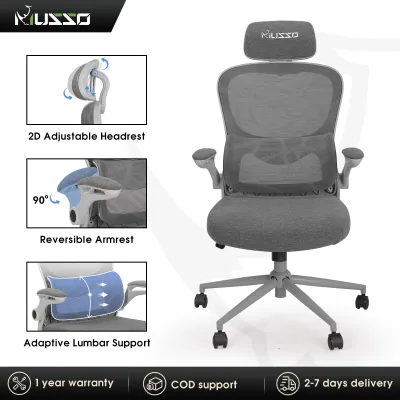
To determine if the Musso C10 is the right fit for your body and workspace, you must cross-reference its official specification sheet against the baseline standards of this price tier. Start by verifying the exact adjustment capabilities of the armrests. Check whether the model features basic height-adjustable armrests or if it offers multi-directional adjustments, such as angle rotation or forward-backward sliding. Multi-directional armrests provide greater flexibility if you frequently switch between typing, writing, or using a controller.

Next, examine the headrest specifications if the variant you are considering includes one. A well-designed headrest should offer both height and angle adjustments to cradle your neck properly when reclining. If the headrest is fixed or has a limited adjustment range, it may press uncomfortably against your shoulders or push your head too far forward, particularly if your height falls outside the average range.
Seat depth and backrest height are critical measurements that dictate overall comfort. You must measure your own body—specifically the distance from your lower back to the back of your knees—and compare it to the chair’s seat depth specifications. A seat pan that is too deep will press against the back of your knees, restricting circulation, while a seat that is too shallow will fail to support your thighs adequately. Similarly, ensure the backrest height is sufficient to support your entire spine, especially if you are taller than average.
The base material and caster design of the Musso C10 require careful inspection. Look for specifications indicating whether the base is constructed from reinforced nylon or a metal alloy like steel or aluminum. While reinforced nylon is highly durable and resistant to corrosion in humid environments, metal bases often provide a heavier counterweight that enhances overall stability when reclining. Additionally, check if the casters are designed for your specific flooring type, such as soft polyurethane casters for hardwood or tile, to prevent scratching.
Do not overlook the density and composition of the seat cushion. If the variant features a foam seat, verify whether it uses high-density molded foam or standard polyurethane foam. Molded foam provides a firmer, more supportive sit that distributes weight evenly, which is crucial for preventing pressure points during extended use. If the specification sheet does not explicitly state the foam type or density, treat it as a point that requires verification from customer support or user reviews.
Factoring in Hidden Costs and Post-Purchase Support
The purchase price of an ergonomic chair on an e-commerce platform is rarely the final cost of getting it to your desk. Because office chairs are bulky and heavy, shipping fees can add a significant premium to your total expenditure, especially in the Philippines. While delivery within Metro Manila might be relatively affordable or occasionally discounted, shipping to provinces in Luzon, Visayas, or Mindanao can dramatically increase the total landed cost, sometimes pushing a mid-tier chair past your ₱15,000 budget ceiling.
Assembly is another practical consideration that requires preparation. Most ergonomic chairs in this price range are shipped flat-packed to reduce shipping volume and protect the components during transit. You should verify whether the package includes all necessary tools, such as Allen keys, and whether the instruction manual is clear and written in a language you understand. If you are not comfortable with self-assembly, or if you lack the physical strength to lift heavy steel bases and seat pans, you may need to factor in the cost of hiring a local assembly service.
Warranty terms serve as a crucial indicator of a manufacturer’s confidence in their product’s durability. Before finalizing your purchase, check the exact duration of the warranty and, more importantly, what components it covers. A comprehensive warranty should cover the gas lift cylinder, the tilt mechanism, and the base for at least one to three years. Be sure to read the fine print regarding how warranty claims are processed in the Philippines; some brands require you to ship the defective part back at your own expense, which can be costly and inconvenient.
Finally, review the seller’s return policy in detail. If the chair arrives with manufacturing defects, missing parts, or shipping damage, you need to know who bears the cost of return shipping. Because returning a bulky box can be incredibly expensive, purchasing from an authorized local distributor or an official store on a major e-commerce platform that offers free return shipping for defective items is highly recommended. This precaution protects your investment from the risks associated with transit damage or factory defects.
Final Decision Checklist: Buy, Pivot, or Wait
To make a confident decision on whether to purchase the Musso C10, you can apply a structured decision framework based on your verified findings. This checklist helps you weigh the physical fit, logistical costs, and budget constraints to determine the best course of action for your home office setup.
You should proceed with the purchase (Buy) if your verification confirms that the Musso C10 meets your specific ergonomic requirements. This means the seat height and depth align with your body measurements, the lumbar support is adjustable to your spine’s curve, and the materials are suitable for your local climate. Furthermore, the total landed cost—including shipping fees to your specific address—must remain comfortably within your ₱3,000 to ₱15,000 budget without compromising on necessary post-purchase support or warranty coverage.
You should look for alternative options (Pivot) if your research reveals that key ergonomic features are missing or incompatible with your body type. For instance, if you are exceptionally tall or short and the seat depth or backrest height cannot be adjusted to fit you, or if the lumbar support is fixed in a position that causes discomfort, reallocating your budget to a different model is the wiser choice. Prioritize chairs that offer the specific adjustments your body needs, even if it means choosing a simpler design with fewer aesthetic features.
You should delay your purchase (Wait) if the total landed cost exceeds your budget ceiling due to high shipping fees or temporary price increases. In this scenario, it is beneficial to wait for major promotional events on e-commerce platforms, which often offer significant discounts on shipping or product prices. Alternatively, you can use this waiting period to save a bit more capital, allowing you to expand your budget ceiling and access higher-tier models that offer better long-term durability and more comprehensive warranty terms.
Frequently Asked Questions (FAQ)
How many hours a day should I use a chair in this budget range?
Chairs in the ₱3,000 to ₱15,000 range are generally designed to support standard eight-hour workdays, provided they feature high-density molded foam or high-tensile mesh. However, regardless of how ergonomic a chair is, continuous sitting for extended periods is not recommended. You should aim to take short movement breaks every 50 to 60 minutes to promote circulation and reduce spinal compression. If your daily routine involves sitting for twelve or more hours, you must pay extra attention to the durability of the seat cushion and the breathability of the materials to prevent discomfort.
Is a headrest necessary for an ergonomic office chair?
A headrest is not strictly necessary for active, upright tasks like typing or writing, as your head should naturally align over your spine without resting against the back of the chair. Headrests are primarily beneficial when you recline to read, watch videos, or take breaks, as they relieve strain on your neck muscles during passive sitting. If you decide to prioritize a headrest within your budget, ensure it is fully adjustable in both height and angle so that it supports the curve of your neck rather than pushing your head uncomfortably forward.

Community discussion
Share your experience or ask a question. Comments are reviewed before publication.