
To comfortably accommodate a shifting guest list of 6 to 10 people, an extendable wooden dining table needs to transition seamlessly from a daily length of approximately 150 to 180 centimeters (about 60 to 70 inches) to an expanded length of 240 to 300 centimeters (about 95 to 118 inches). Finding the right size requires balancing personal dining space, chair dimensions, extension mechanisms, and the physical clearances of your dining room. Investing in a high-quality wooden dining table with chairs that can scale up on demand ensures you can host large family gatherings without sacrificing the daily usability of your home.
Baseline Dimensions: Sizing a Wooden Dining Table with Chairs for 6 to 10 Guests
To determine the exact table size you need, you must first understand the basic ergonomics of a single dining setting. As a standard rule of thumb, each seated individual requires a minimum of 24 inches (61 cm) of table width to dine comfortably. This lateral space allows guests to move their arms, use utensils, and transition between courses without bumping elbows with their neighbors. For a more relaxed dining experience, increasing this allocation to 28 or 30 inches (71 to 76 cm) per person is ideal, especially for longer, multi-course meals.
In addition to width, individual plate depth is a critical factor. Each guest needs roughly 12 to 15 inches (30 to 38 cm) of personal depth for their dinner plate, glassware, and cutlery. When you place two diners opposite each other, their combined depth requirements total 24 to 30 inches (60 to 76 cm). This leaves the center of the table as shared space. To accommodate serving platters, soup tureen bowls, condiments, and decorative centerpieces, a dining table should have a total width of 36 to 42 inches (91 to 107 cm). A table narrower than 36 inches will feel incredibly cramped during family-style meals, as serving dishes will have to compete with personal dinnerware.
Products mentioned in this guide
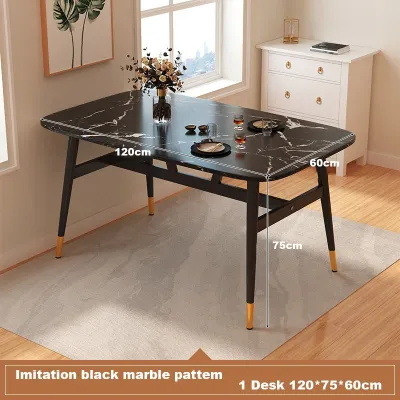
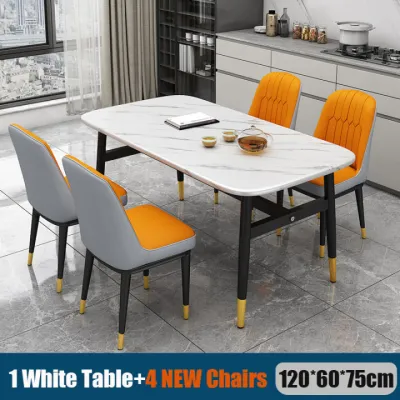
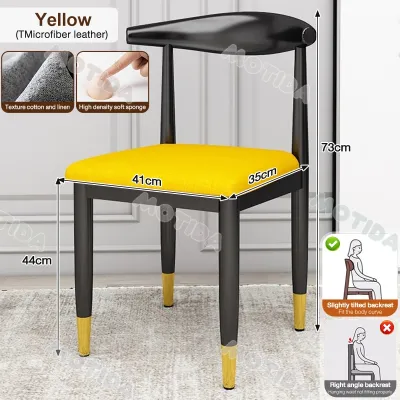
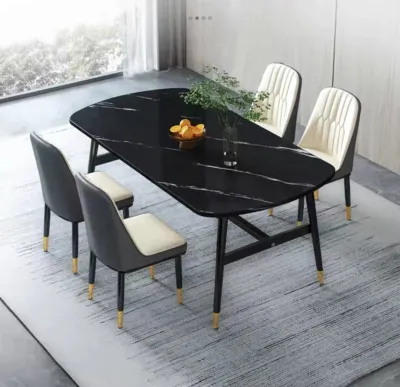
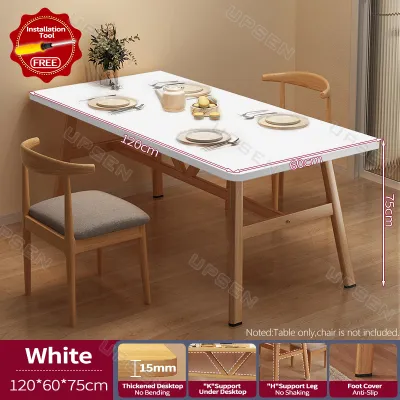
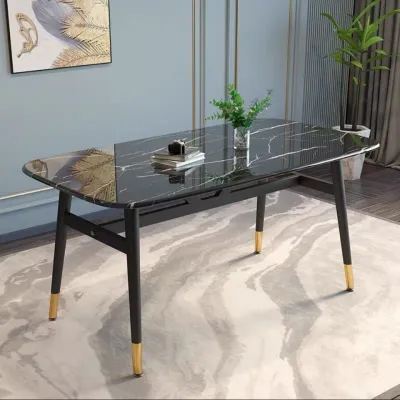
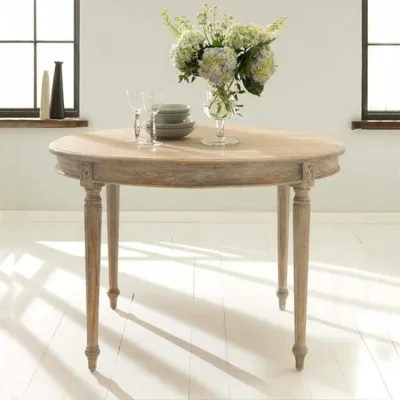
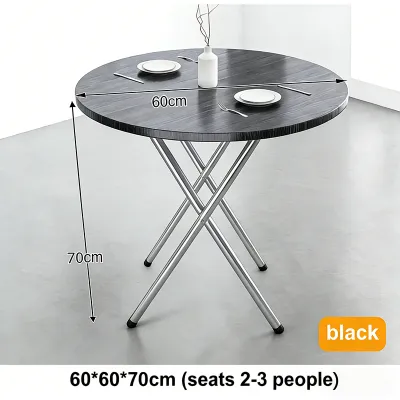
Prices are valid at publication and may change. Please refer to the product page for the latest price.
When planning your seating layout, the overall length of the table must scale according to these per-person requirements:
- Seating 6 People: A rectangular table should measure at least 60 to 72 inches (150 to 183 cm) in length.
- Seating 8 People: The table length should increase to 78 to 90 inches (198 to 229 cm).
- Seating 10 People: You will need a fully extended length of 96 to 120 inches (244 to 305 cm).
How you pair your wooden dining table with chairs heavily influences these baseline measurements. Standard dining side chairs typically range from 18 to 21 inches (46 to 53 cm) in width. However, if your chairs feature wide-set legs, plush upholstery, or integrated armrests, their footprint can easily expand to 24 inches (61 cm) or more. Armchairs, often placed at the heads of the table, require additional clearance because they cannot always slide fully beneath the table apron. When calculating your seating capacity, always measure the widest point of your chosen chairs to ensure they can line up side-by-side between the table legs without overlapping or forcing guests to sit at awkward angles.
How Extension Mechanisms Impact Seating and Legroom
The engineering behind an extendable wooden table dictates how usable the surface and the space beneath it actually are. Different extension mechanisms alter the table’s structural balance, seam placement, and leg positioning, all of which directly affect guest comfort.

The three most common extension designs offer distinct trade-offs:
- Butterfly Leaf: This self-storing mechanism features a hinged leaf folded beneath the tabletop. When the table is pulled apart, the leaf unfolds and locks into place. While highly convenient because you do not have to store the leaf in a closet, the internal hardware can sometimes limit vertical legroom directly under the center seam.
- Removable Center Leaf: This traditional style requires you to physically insert one or two separate wooden panels into the center of the table. Because these leaves are stored elsewhere, they are highly susceptible to environmental changes. In tropical climates like the Philippines, where indoor humidity levels fluctuate dramatically between the dry season and the rainy season, separate leaves can swell or shrink at different rates than the main tabletop. This can lead to misaligned seams or sticking wooden glides when you attempt to assemble the table.
- Drop-Leaf: This design features hinged panels on the ends or sides of the table that hang down when not in use. While excellent for tight spaces, the support brackets beneath the leaves can obstruct knees, and the seating capacity at the ends is often limited by the hanging wood.
Beyond the tabletop itself, the design of the table base plays a massive role in legroom. A traditional four-legged table provides exceptional stability, but the legs sit at the outer corners. When the table is extended, these corner legs remain fixed, meaning guests seated near the ends must navigate the legs to get in and out of their chairs. Conversely, a pedestal or trestle base centralizes the support structure, freeing up the corners and sides for maximum chair flexibility. However, extremely long tables extending to seat 10 people often require double pedestals or additional support columns, which can block feet and restrict where guests can comfortably place their legs.
Finally, always inspect the depth of the table apron—the wooden paneling directly beneath the tabletop that conceals the extension slides. A deep apron provides excellent structural support and hides unsightly metal tracks, but it reduces the clearance between the chair seat and the underside of the table. Taller guests may find their thighs pinched against a deep apron, particularly if your dining chairs have thick, padded seats. Aim for a vertical clearance of at least 12 inches (30 cm) between the top of the chair seat and the bottom of the apron to ensure comfortable seating.
Measuring Your Space: Clearances for Fully Extended Tables
An extendable dining table is a brilliant spatial solution, but it only works if your dining room can accommodate its maximum footprint. To avoid creating a space where guests feel trapped or unable to move, you must apply strict clearance rules before making a purchase.
The golden rule of dining room design is to maintain a minimum of 36 inches (91 cm) of open space between the edge of the dining table and the nearest wall, sideboard, or doorway. This 36-inch boundary allows guests to pull their chairs out, sit down, and stand up without bumping into physical obstacles. However, if you want guests to be able to walk comfortably behind someone who is already seated—such as when serving food or navigating to the restroom—you should aim for a clearance of 42 to 48 inches (107 to 122 cm).
To determine if your dining room can handle a table that extends to seat 10 people, use this straightforward clearance formula:
Required Room Length = Fully Extended Table Length + (2 x Chair Depth) + (2 x Active Walking Clearance)
For example, if you are looking at an extendable wooden table that reaches 270 cm (106 inches) when fully open, and you pair it with chairs that have a depth of 55 cm (22 inches), your calculation would look like this:
- Table Length: 270 cm
- Chair Depth (both ends): 55 cm x 2 = 110 cm
- Walking Clearance (both ends): 90 cm x 2 = 180 cm
- Total Required Room Length: 270 + 110 + 180 = 560 cm (approximately 18.4 feet)
Perform the same calculation for the width of the room using the table’s width (e.g., 100 cm) to ensure you have adequate clearance on all sides of the dining set.
For homeowners in the Philippines, spatial planning must extend beyond the dining room walls to the delivery path. Modern vertical living in Metro Manila, Cebu, and other urban hubs often involves high-rise condominiums, townhouses with narrow spiral stairwells, and compact doorways. A solid wood extendable table is incredibly heavy and often comes in large, pre-assembled sections or single-piece tabletops. Before ordering, measure the height, width, and diagonal clearance of your condominium’s service elevator, the turning radius of your townhouse stairwell landings, and the clear opening of your main entry door. If the packaged table cannot clear these tight architectural bottlenecks, you may face complex delivery failures or expensive manual hauling fees.
Common Sizing Mistakes That Ruin Dining Comfort
Even with careful measurements, several subtle design oversights can turn a theoretically perfect dining setup into an uncomfortable experience. Avoiding these common mistakes will ensure your investment remains functional and inviting.
One of the most frequent errors is ignoring the impact of chair armrests. Many homeowners purchase a wooden dining table with chairs as a matching set, but if they mix and match, they often overlook how armchairs interact with the table’s structure. Armrests add substantial width to a chair’s profile, requiring up to 26 to 28 inches of lateral space per person. Furthermore, if the armrests are too high to slide underneath the table apron, the chairs will remain pushed out into the room when not in use. This permanently eats into your walking clearances and disrupts the visual flow of the dining space.
Another critical mistake is measuring only the collapsed or daily size of the table. It is easy to fall in love with how a compact 6-seater table looks in your dining nook during the week, only to realize that when you insert the extension leaves for a weekend gathering, the table blocks the main corridor to the kitchen or prevents the bathroom door from opening. Always visualize and map out the fully extended footprint in your room using painter’s tape on the floor. This physical representation helps you see exactly how the expanded table will impact daily traffic patterns.
Additionally, never assume that a manufacturer’s “10-person” rating translates to comfortable adult seating. Furniture brands often base their capacity claims on tight configurations using ultra-slim, armless metal chairs and minimal personal space. If your guests are adults who appreciate elbow room, or if you prefer using padded wooden chairs, a table rated for 10 people may only comfortably seat 8. Always rely on actual physical dimensions—specifically aiming for at least 24 inches of table edge per person—rather than the marketing labels on the product tag.
Lastly, don’t forget to account for the swing radius of nearby doors and cabinet drawers. A fully extended table can easily overlap with the swing path of a pantry door, a kitchen swing door, or the doors of a nearby buffet credenza. If a guest is seated in front of these doors, they will have to stand up and move their chair every time someone needs to access the cabinet, creating constant interruptions during your gatherings.
Frequently Asked Questions (FAQ)
Can I fit 10 adults around a table rated for 8 people?
Squeezing 10 adults around an 8-person table is highly discouraged for formal or lengthy meals. An 8-person table typically provides about 192 inches (488 cm) of total perimeter, which translates to a comfortable 24 inches of space per person. Adding two more adults reduces each person’s lateral space to roughly 19 inches (48 cm). At this dimension, guests will constantly bump elbows, struggle to cut their food, and feel claustrophobic. If you must accommodate 10 people on an 8-person table, limit this setup to casual, short-duration gatherings like afternoon tea or a buffet-style layout where guests are not seated for long periods. For sit-down dinners, it is far better to stick to the rated capacity or utilize a separate folding table for younger family members.
Do extended wooden tables need a center support leg?
Yes, many high-quality wooden dining tables that extend beyond 84 to 96 inches (213 to 244 cm) require a center support leg. Wood is a heavy natural material, and when a table is fully extended, the middle section is subjected to significant downward pressure from both the weight of the timber and the weight of serving dishes. Without a center support, the extension slides can sag over time, causing the tabletop to bow and preventing the extension leaves from aligning correctly. When shopping, check if the manufacturer includes a drop-down center leg or a permanent central support. Ensure this support is designed ergonomically so that it does not interfere with the legroom of the guests seated in the middle of the table. In humid tropical environments like the Philippines, maintaining structural alignment is even more critical, as warped wood can permanently damage the extension tracks.

Community discussion
Share your experience or ask a question. Comments are reviewed before publication.