
To choose the right foldable dining table for a 6-to-10-person setup, you must balance your room’s physical dimensions with a highly stable expansion mechanism. The ideal solution accommodates a compact footprint for daily household use while expanding seamlessly to host larger gatherings. Achieving this requires mapping out a strict clearance zone of 36 to 48 inches around the table, selecting standard table lengths of 72 to 120 inches, and opting for a robust slide-out or butterfly leaf mechanism that maintains structural integrity when fully extended.
Assessing Your Space and Seating Needs for 6-10 Guests
In many homes, especially urban townhomes or modern condominiums in Metro Manila where floor area is at a premium, space is highly contested. When a table is fully expanded to its 10-person capacity, it must not block vital pathways or pin guests against walls. To prevent this, interior designers rely on the clearance rule, which dictates leaving 36 to 48 inches (approximately 90 to 120 cm) of open space between the edge of the table and any surrounding walls, cabinets, or doorways.
To find the maximum expanded table size your room can handle, measure the total length and width of the dining area and subtract this clearance zone from all sides. For example, if your dining room measures 12 by 16 feet, subtracting a 3-foot clearance buffer on all sides leaves a maximum allowable table footprint of 6 by 10 feet. If your dining area connects directly to a living space or hallway, ensure the open leaves do not obstruct the natural flow of traffic.
Products mentioned in this guide
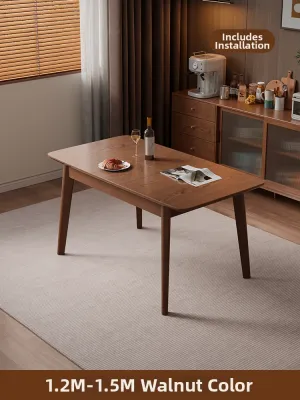
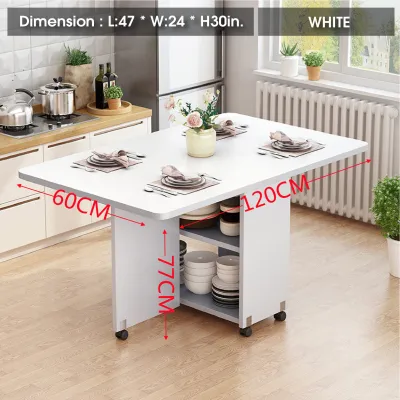
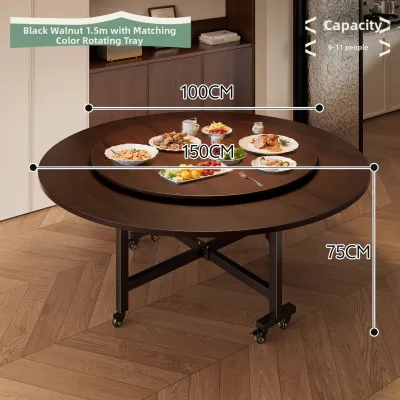
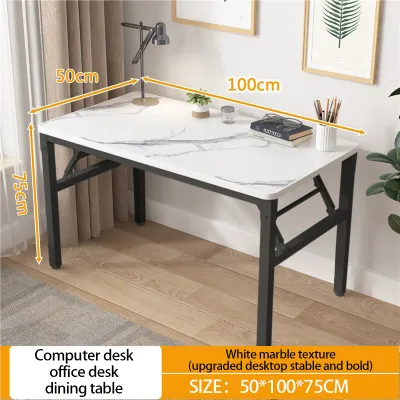
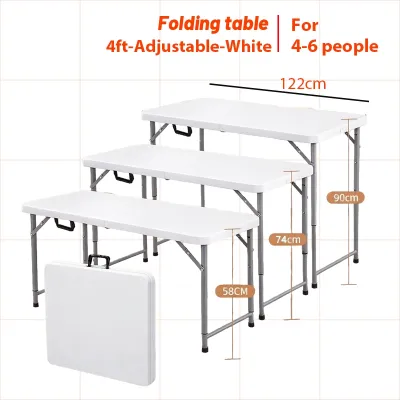
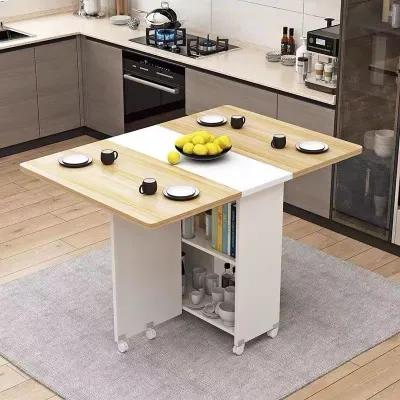
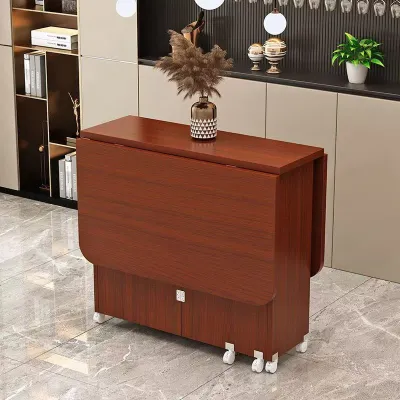
Prices are valid at publication and may change. Please refer to the product page for the latest price.
A common household in the Philippines often consists of 4 to 6 daily members, but weekend family gatherings or holiday salu-salo easily push the guest count to 10 or more. A permanent 10-person table would permanently overwhelm a standard dining room, leaving little room for daily movement. A foldable dining table solves this by remaining compact during the week and transforming only when hosting duties require it.
Matching Table Dimensions to Your Capacity
Every seated guest requires a minimum of 24 inches (60 cm) of horizontal table width to dine comfortably without bumping elbows. This spacing also provides enough room for standard dinnerware, glassware, and serving platters. If you plan to use wider dining chairs with armrests, you may need to increase this allowance to 26 or 28 inches per person.

Equally critical is verifying the folded or closed dimensions of the table. When the table is in its collapsed state, it must fit comfortably within its designated daily spot, allowing easy access to nearby cabinets, doors, and walkways.
Standard Dimensions for 6, 8, and 10 Seats
For a rectangular setup with a standard width of 36 inches (approx. 90 cm), use the following length guidelines:
- 6-Seat Capacity: Requires an expanded length of approximately 72 inches (180 cm). This allows three chairs on each long side, or two on each side and one at each end.
- 8-Seat Capacity: Requires an expanded length of approximately 96 inches (240 cm). This comfortably accommodates three to four chairs along the sides and one at each head of the table.
- 10-Seat Capacity: Requires an expanded length of approximately 120 inches (300 cm). This setup typically places four chairs along each long side and one at each end.
Because individual furniture designs vary, always cross-reference these general benchmarks with the manufacturer’s exact specifications before purchasing. Some modern designs utilize narrower profiles, such as 32 to 34 inches wide, to fit narrow rooms, which can restrict the placement of central serving dishes.
Shape Considerations: Rectangular vs. Round
Rectangular tables are highly efficient for hosting 8 to 10 people. Their straight edges align perfectly with walls or kitchen islands when the table is folded down, saving valuable floor space during the week. In long, narrow dining areas, a rectangular shape mirrors the room’s proportions, creating a balanced aesthetic and clear walkways.
Round tables excel at fostering intimate conversations, as everyone faces the center. However, scaling a round table to seat 8 to 10 people requires a massive diameter—typically 60 to 72 inches (150 to 180 cm). This creates a vast, unusable central space that makes reaching for food difficult, and it demands a large, square room to maintain proper clearance around the entire perimeter. For a flexible 6-to-10-person setup, rectangular or oval expandable tables remain the more practical choice.
Choosing the Right Folding and Extension Mechanism
The mechanism is the mechanical heart of any expandable table. For a table spanning up to 120 inches, the extending hardware must support substantial weight and leverage without sagging in the middle. A poorly designed or flimsy mechanism will stick, warp over time, or fail under the weight of heavy serving platters and tableware.
When selecting a table, check the hardware specifications. High-quality steel or solid wood glides are essential for smooth operation. In humid tropical environments, metal glides should have rust-resistant coatings, while wooden slides must be precision-milled to prevent binding or swelling during the rainy season.
Drop-Leaf and Gate-Leg Designs
Drop-leaf tables feature hinged panels on one or both sides that hang vertically when folded and lift up to be supported by brackets. Gate-leg tables take this further by utilizing hinged legs that swing out like a gate to support the extended leaves.
While these designs are incredibly space-efficient and ideal for transforming a 2-person console into a 4-to-6-person dining surface, they are rarely suitable for a true 10-person setup. The swing-out legs can severely restrict legroom for guests, forcing chairs to clash with the table’s support structure. Furthermore, without heavy-duty structural reinforcement, very long drop-leaf extensions are prone to sagging and lack the stability needed for safe, heavy-duty dining.
Butterfly Leaf and Slide-Out Extensions
Butterfly leaf mechanisms feature a hinged center leaf that folds in half and stores neatly within a hidden compartment beneath the tabletop. To expand the table, you pull the two outer ends apart, retrieve the leaf from its storage bay, unfold it, and lock the sections back together. Slide-out extensions operate similarly but may require you to store the extra leaves separately in a closet or under a bed.
These center-extension designs are the gold standard for 6-to-10-person setups. Because the main structural frame and legs remain anchored or slide outward to support the ends, the weight is distributed evenly across the entire base. This prevents sagging in the center and ensures the table remains rock-solid, even when loaded with heavy serving dishes.
Material and Stability Considerations for Large Expandable Tables
Structural integrity is paramount when a table is extended to its maximum length. Look closely at the base configuration; a table stretching to 10 feet (120 inches) requires a robust trestle base, a wide four-leg stance, or dedicated center support legs that drop down automatically when the table is opened. Without these supports, the center of the table becomes a structural weak point susceptible to tipping if someone leans heavily on the edge.
Material choice directly impacts both stability and long-term durability. Solid hardwoods offer unmatched strength and longevity, but they are heavy and highly sensitive to environmental changes. In regions with high relative humidity, solid wood naturally expands and contracts, which can cause tight-fitting extension joints to stick or warp if not properly sealed. If opting for solid wood, verify that the manufacturer has applied a high-quality, moisture-resistant finish and check their specific care instructions.
Engineered wood (such as high-density fiberboard or marine plywood) topped with a premium wood veneer or high-pressure laminate (HPL) offers an excellent, warp-resistant alternative. These materials remain highly stable under fluctuating humidity levels, making them exceptionally reliable for precision-engineered extension tracks. Regardless of the material, always verify the manufacturer’s rated weight capacity for both the main tabletop and the extended leaves to ensure it can safely handle your dining and hosting needs.
When budgeting, high-quality engineered wood tables with robust steel mechanisms typically range from ₱15,000 to ₱45,000, while premium solid hardwood models with integrated butterfly leaves can exceed ₱60,000.
Common Sizing and Clearance Mistakes to Avoid
One of the most frequent errors when purchasing a large foldable dining table is failing to measure the delivery path. A table that expands to seat 10 people often has a massive main frame or a heavy, non-detachable base. Before ordering, measure the height and width of all entry doorways, tight hallway corners, stairwells, and especially elevator doors if you live in a multi-story condominium.
Another common oversight is ignoring the physical footprint of the dining chairs. While a table might physically fit into your dining room when fully expanded, you must account for the depth of the chairs when occupied. Guests need at least 18 to 24 inches of clearance behind their chairs to pull them out, sit down, and stand up comfortably without hitting walls or adjacent furniture.
Finally, do not assume that all necessary extension leaves are included with the table or that they store self-contained within the frame. Some models require you to purchase the extra leaves separately, or they may lack internal storage, forcing you to find dedicated closet space for large, heavy wooden panels when they are not in use. Always read the product specifications carefully to confirm what is included and where the leaves are stored.
Frequently Asked Questions (FAQ)
Here are answers to some of the most common questions about choosing and using large foldable dining tables.
Can a foldable table comfortably seat 10 people in a small space?
Yes, but only if the room itself has enough temporary clearance to handle the fully expanded footprint. While the table can be folded down to preserve floor space for daily living, you must still have a clear area of at least 10 by 14 feet (approx. 3 by 4.3 meters) during hosting events. This ensures there is sufficient room for the 120-inch fully extended table, ten chairs, and comfortable walking paths around the perimeter.
What is the best mechanism for a table that expands from 6 to 10 seats?
The most stable and practical option is a slide-out or butterfly leaf mechanism supported by a heavy-duty metal track system. These mechanisms maintain a solid central base and distribute weight evenly across the legs. For a 10-person capacity, look for models that feature integrated center support legs or a robust trestle design to prevent any sagging or instability at the center seam.

Community discussion
Share your experience or ask a question. Comments are reviewed before publication.