
Choosing between a foldable and an L-shaped computer table comes down to a fundamental choice between spatial flexibility and permanent, heavy-duty utility. If you work from a compact studio apartment or a shared family room where your workspace must disappear at the end of the day, a foldable table offers excellent space-saving convenience. On the other hand, if your daily tasks require multiple screens, reference documents, and a dedicated corner that remains undisturbed, an L-shaped desk provides the expansive surface and structural stability needed for a highly productive home office.
To make the right investment, you must weigh your room’s physical boundaries against your daily workflow. A desk that is too large will choke your room’s traffic flow, while a desk that is too small or unstable will leave you feeling cramped and disorganized. By examining how each design handles space, weight, and daily wear, you can select a setup that keeps you comfortable and focused throughout long working hours.
Assessing Your Space and Layout Constraints
Before browsing online marketplaces or local furniture showrooms, you must accurately map out the physical footprint of your intended workspace. Foldable computer tables excel in tight, multi-purpose environments because they require minimal permanent floor space. When your workday ends, these tables collapse flat, allowing you to slide them under a bed, tuck them behind a wardrobe, or lean them against a wall to reclaim your living area. This adaptability is particularly valuable in high-density urban housing, such as metropolitan condominiums, where a single room must serve as a bedroom, living room, and office.
Products mentioned in this guide
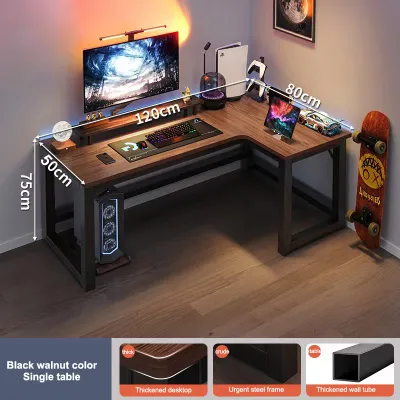
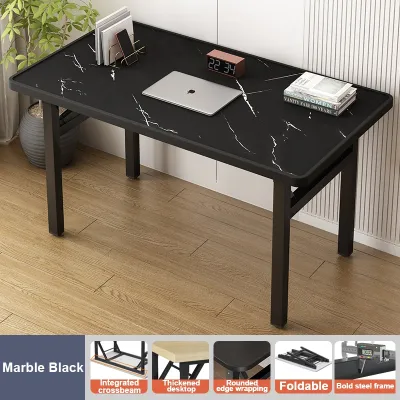
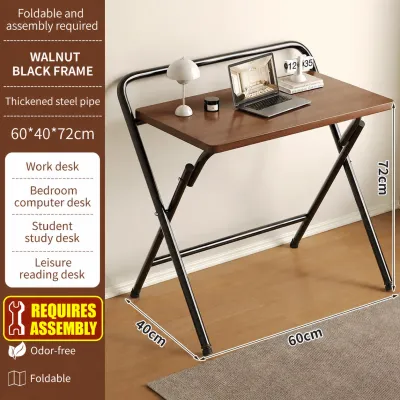
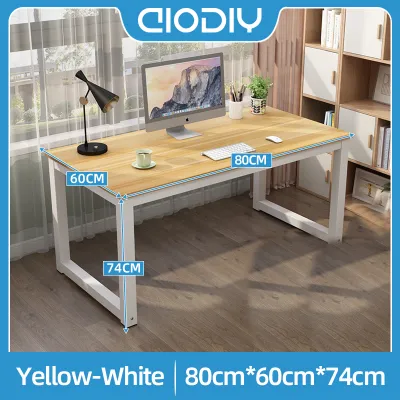
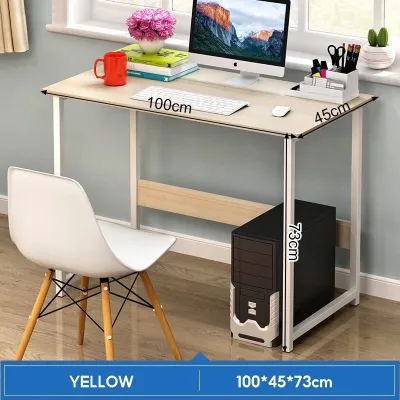
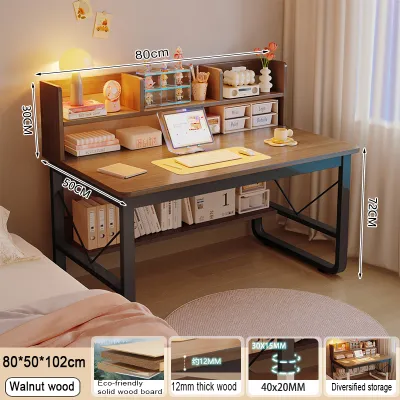
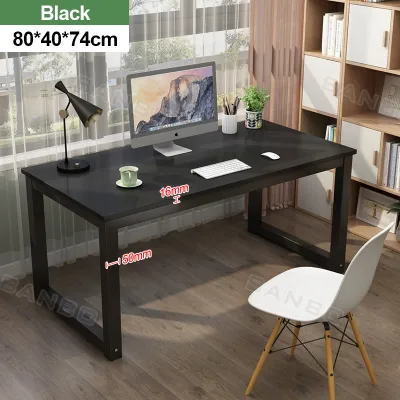
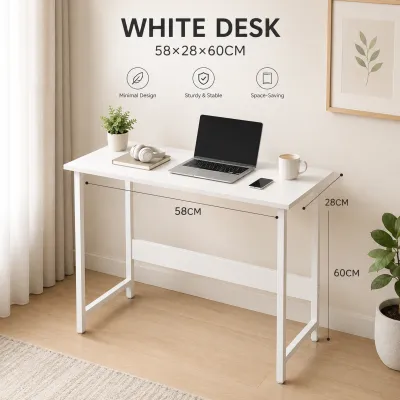
Prices are valid at publication and may change. Please refer to the product page for the latest price.
Conversely, an L-shaped desk is a permanent architectural fixture that demands a dedicated corner or a long, continuous wall. While it occupies a significantly larger footprint, it utilizes corner spaces that often go wasted in standard room layouts. To determine if your room can accommodate this structure, you must measure not just the desk’s physical dimensions, but also the clearance zones around it. Ensure there is at least 75 to 90 centimeters of open space behind the desk to allow your office chair to roll back smoothly without hitting walls, cabinets, or doorways. You must also account for door swings and walking paths to prevent the desk from turning a high-traffic hallway into a bottleneck.
Beyond physical measurements, consider the visual weight of the furniture within your home. In smaller rooms, a large, dark L-shaped desk can dominate the space, making the environment feel cramped, dark, and visually cluttered. A foldable table, with its slender frame and temporary nature, preserves the room’s open, airy feel when stored away. In tropical climates where air circulation is crucial for keeping indoor spaces cool, keeping your floor plan open and uncluttered can significantly improve natural ventilation and overall comfort. However, if you have a spacious, dedicated room for your home office, an L-shaped desk acts as an attractive anchor, clearly defining your professional zone and separating your work life from your personal life.
Evaluating Your Daily Workflow and Equipment Needs
Your daily tasks and the hardware you use should dictate the surface area and load capacity of your computer table. An L-shaped desk is a highly effective option for multitaskers, creative professionals, and remote workers who operate with extensive gear. The dual-surface design allows you to establish distinct work zones. For instance, you can dedicate one side of the “L” to your primary computer, dual monitors, and keyboard, while reserving the other side for writing, reviewing physical documents, or placing secondary devices like tablets and printers. This separation helps organize your mental focus, allowing you to transition between digital and physical tasks without constantly shifting your keyboard or clearing away clutter.

Foldable tables, by design, offer a much more streamlined and restricted surface area. While they are highly efficient for laptop users, writers, and those with minimal hardware, they present clear limitations when subjected to heavy or complex setups. If your work requires a large desktop tower, multiple heavy monitors, external hard drives, and professional audio gear, a foldable table can quickly become overcrowded and unsafe. Spreading heavy equipment across a temporary frame can compromise its balance, leaving little to no room for comfortable arm placement or basic desk accessories.
To avoid purchasing a table that cannot support your daily routine, take a detailed inventory of your essential work tools. Measure the base dimensions of your monitors, laptop stands, and keyboard trays, and calculate their combined weight. If you find that your equipment requires a deep, wide surface to maintain ergonomic viewing distances, a permanent L-shaped desk is almost always the superior choice. However, if your workflow is entirely digital and centered around a single lightweight laptop, a high-quality foldable table will easily accommodate your needs without unnecessary bulk.
Checking Stability, Assembly, and Structural Limits
The structural integrity of your desk directly affects your comfort, focus, and the safety of your expensive electronics. L-shaped desks generally offer a highly stable, rigid structure because they rely on multiple solid legs, wide corner brackets, and heavy-duty wooden or steel frames. Because they are permanent fixtures, they are less prone to wobbling when you type vigorously or lean on the surface. However, this stability comes at the cost of complex assembly. Putting together an L-shaped desk often requires multiple tools, clear instructions, and sometimes a second pair of hands to align the corner joints correctly. In some cases, especially with taller or top-heavy models, you may need to anchor the frame to the wall to prevent tipping.
Foldable tables offer the convenience of zero-assembly or tool-free setup, but they rely heavily on hinges, spring-loaded pins, and folding joints to maintain their shape. Over time, frequent folding and unfolding can wear down these moving parts, potentially leading to minor wobbles or joint play. When shopping for a foldable model, it is critical to inspect the quality of the locking mechanisms. Look for robust steel hinges that lock firmly into place and frames that feature cross-bracing for lateral stability. Always check the manufacturer’s specified weight limits and avoid pushing the table to its maximum capacity, as unevenly distributed weight can cause the frame to buckle.
Regardless of the style you choose, local environmental factors like humidity and floor evenness play a major role in long-term durability. In humid tropical environments, untreated wood can warp, and low-grade metal frames can rust, weakening the joints of both foldable and permanent desks. Ensure the desk you select features a moisture-resistant finish, such as powder-coated steel or melamine-laminated engineered wood. Additionally, uneven tile or concrete floors can cause annoying wobbles. Look for desks equipped with adjustable leveling feet or use protective felt pads to stabilize the frame and protect your flooring from scratches.
Decision Framework: Choosing the Right Computer Table
To finalize your decision, evaluate your living situation and work habits against these clear, condition-based guidelines.
You should choose a foldable computer table if:
- Your home office space is highly restricted, shared, or multi-purpose, requiring you to pack away your workspace at the end of the day.
- You live in a rental property or temporary housing where heavy, bulky furniture is difficult to transport during moves.
- Your daily work setup is minimal, consisting primarily of a laptop, a mouse, and a notepad.
You should choose an L-shaped computer table if:
- You have a dedicated, permanent corner or room for your home office that does not need to serve other household functions.
- Your workflow relies on multiple monitors, heavy desktop towers, or large physical documents that require separate task zones.
- You prioritize maximum stability, high weight capacity, and integrated storage options like built-in shelves or drawers.
Before making your final purchase on any online marketplace, verify the physical conditions of your workspace. Check if your floors are level, as uneven surfaces will amplify any minor instability in a foldable frame. Ensure that your total equipment weight does not exceed the manufacturer’s recommended limits, and confirm whether you will need to purchase separate ergonomic accessories, such as monitor arms or keyboard trays, to achieve a comfortable working posture.
Frequently Asked Questions (FAQ)
Can a foldable computer table support a dual-monitor setup?
While some heavy-duty foldable tables can physically hold two screens, doing so requires extreme caution. You must strictly verify the manufacturer’s stated weight capacity and ensure the tabletop is wide and deep enough to maintain a safe center of gravity. Mounting heavy dual-monitor arms on a foldable desk is generally not recommended, as the clamping force and top-heavy weight can strain the folding hinges and cause the table to wobble or tip over. For optimal safety and stability on a foldable model, it is best to stick to a single lightweight monitor or a laptop paired with a compact secondary portable screen.
Is an L-shaped desk practical for a small apartment?
An L-shaped desk can be highly practical in a small apartment, provided you select a compact model and place it strategically. Because these desks are designed to fit snugly into corners, they can turn an otherwise unused corner of your living room or bedroom into a highly functional workstation. However, because they cannot be folded away, they represent a permanent reduction in your available floor space. Before purchasing, measure your corner dimensions carefully to ensure the desk does not block natural light from windows, obstruct walkways, or interfere with air conditioning units and ventilation. If a standard L-shaped desk feels too overwhelming, look for compact or reversible models that allow you to configure the shorter side to fit your specific layout.

Community discussion
Share your experience or ask a question. Comments are reviewed before publication.