
Choosing the right slim flip shoe cabinet requires balancing the unit’s static depth when closed with its dynamic depth when the drawers are fully tilted open. Because these specialized cabinets are engineered to fit into narrow hallways, compact entryways, and tight condominium corridors, standard furniture measurements do not tell the whole story. To make a successful purchase, you must evaluate your available floor space, calculate operational clearances, and match the internal compartment dimensions to your household’s shoe sizes and styles.
In modern Philippine residences, particularly high-rise condominiums in Metro Manila or compact townhouses, maximizing every square centimeter of entryway space is essential. A slim flip shoe cabinet offers an elegant solution by storing footwear vertically rather than horizontally, keeping walkways clear of clutter. However, selecting a unit without verifying the precise physical boundaries of your space can lead to blocked doorways, unusable drawers, or serious safety hazards.
By systematically measuring your entryway, understanding how the pivoting drawer mechanism alters the cabinet’s footprint, and preparing for secure wall installation, you can select a cabinet that is both highly functional and safe. This guide provides a practical framework to help you navigate these dimensions and choose the ideal cabinet for your home.
Products mentioned in this guide
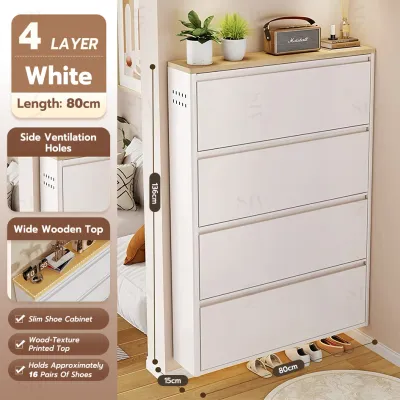
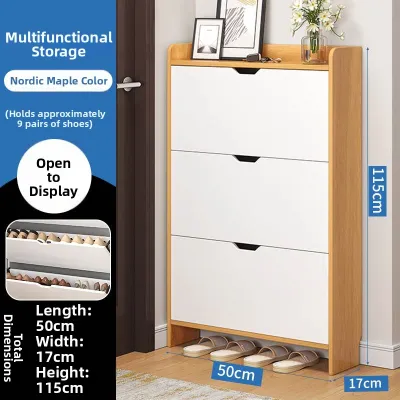
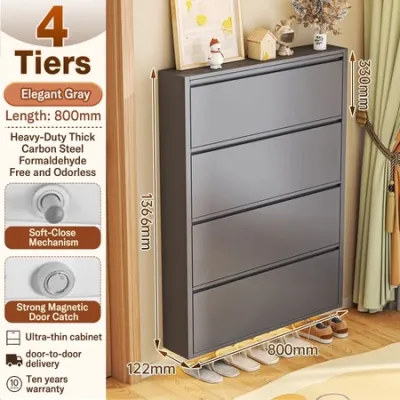
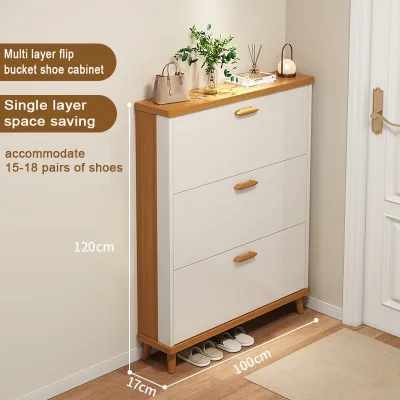
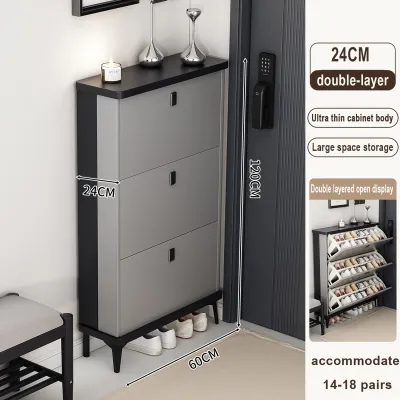
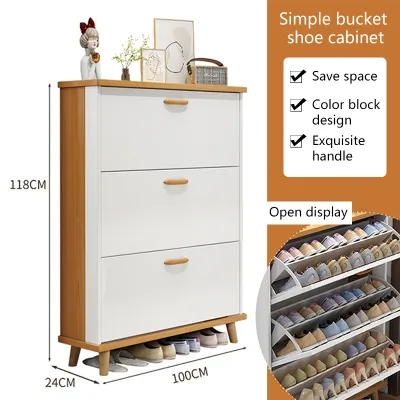
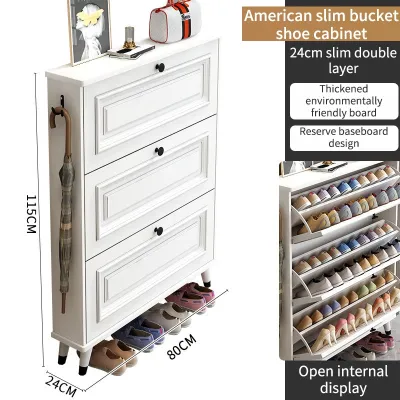
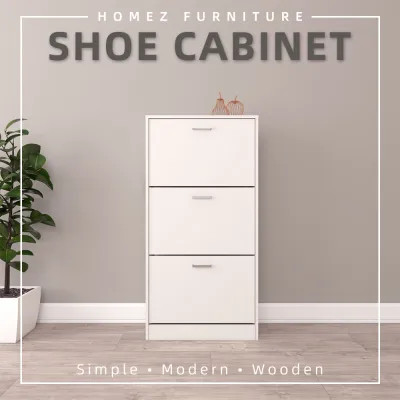
Prices are valid at publication and may change. Please refer to the product page for the latest price.
Understanding Slim Flip Shoe Cabinet Dimensions and Clearance
To select a cabinet that fits your space, you must first distinguish between its static depth and its dynamic depth. Static depth refers to the physical thickness of the cabinet when all drawers are closed and the unit sits flat against the wall. This measurement typically ranges from an ultra-thin 15 centimeters to a slightly deeper 24 centimeters, making these units significantly shallower than traditional open shoe racks or standard cupboards.
Dynamic depth represents the maximum distance the cabinet protrudes into your room when the flip drawers are tilted fully open. Because the drawer pivots downward and outward to expose the footwear, it sweeps through an arc that temporarily increases the cabinet’s footprint. This open depth often requires an additional 25 to 40 centimeters of clearance directly in front of the unit, which must be factored into your spatial planning.
To compensate for their shallow depth, slim shoe cabinets utilize vertical height and horizontal width to deliver adequate storage volume. Manufacturers design these units in two-tier, three-tier, or four-tier configurations, allowing you to scale upward if your wall space permits. A taller unit takes advantage of unused vertical wall space, keeping the floor footprint remarkably small while multiplying the number of shoes you can store.
Before purchasing any model from an online marketplace or furniture retailer, always check the manufacturer’s detailed specification sheet for both the closed and fully open dimensions. Relying on a single depth measurement can result in a cabinet that fits perfectly when closed but blocks your entire hallway the moment you attempt to retrieve your shoes.
How to Measure Your Available Space Accurately
Accurate physical measurements are the foundation of a successful furniture installation. Begin by measuring the absolute floor width and vertical height of the intended wall space using a steel tape measure. If you plan to place the cabinet behind an entryway door or inside a narrow corridor, note any adjacent architectural features such as light switches, electrical outlets, intercom systems, or wall-mounted mailboxes that a tall cabinet might obstruct.

Next, account for the thickness of your baseboards or skirting boards along the floor. Most slim cabinets must sit perfectly flush against the wall to maintain structural stability and allow for secure anchoring. If the cabinet design does not feature a pre-cut baseboard recess at the bottom rear, the skirting board will push the bottom of the cabinet away from the wall, creating an unstable gap at the top and altering the actual depth of the unit.
Walkway clearance is another critical factor that requires careful measurement. In a typical home, a clear hallway width of at least 90 centimeters is recommended for comfortable daily movement. If your corridor is exactly 100 centimeters wide and you install a cabinet with a static depth of 20 centimeters, your remaining walkway is 80 centimeters when closed, which is perfectly manageable. However, if the dynamic depth when open is 50 centimeters, the remaining space shrinks to 50 centimeters, requiring you to stand to the side or squeeze past the open drawer.
Finally, measure the door swing radius of your main entrance door and any adjacent room doors. An inward-swinging entry door must be able to open to its full design angle without colliding with the side or front of the shoe cabinet. If the door strikes the cabinet, it will not only restrict entry but can also cause cosmetic or structural damage to both the door and the furniture over time.
Matching Cabinet Capacity to Your Shoe Collection
The unique pivoting mechanism of a slim flip cabinet imposes strict internal height and depth limits that differ significantly from flat shelves. Inside each flip drawer, shoes are stored at a steep angle, resting on their toes or heels. The total capacity of the cabinet is directly tied to the number of tiers and the width of each drawer, but the types of shoes you own will ultimately dictate how many pairs actually fit.
Standard flip compartments are engineered primarily for low-profile footwear such as flat sandals, slippers, loafers, canvas shoes, and standard low-top sneakers. A typical two-tier cabinet might hold 6 to 12 pairs of these flat styles, while a three-tier model can accommodate 9 to 18 pairs, depending on the horizontal width of the unit. If your household primarily wears lightweight, low-profile shoes, you can expect to reach the maximum advertised capacity.
Bulky footwear presents a significant challenge for ultra-thin cabinets. High-top basketball shoes, thick-soled platform sneakers, high heels, and large men’s shoes (typically European size 44 or US size 11 and above) often have profiles that are too tall or too long for standard compartments. When placed inside, these larger shoes can prevent the drawer from pivoting fully closed, or they may become wedged tightly inside the mechanism, potentially damaging the footwear or the cabinet hardware.
To accommodate slightly bulkier shoes, look for slim cabinets that feature adjustable or removable internal dividers. These dividers are typically horizontal panels inside the drawer that can be slotted into different height positions or removed entirely. While removing a divider allows you to fit taller shoes like ankle boots or high heels, keep in mind that it also reduces the drawer’s storage capacity by half, as you are converting a double-row compartment into a single-row space.
Common Sizing Mistakes to Avoid
One of the most frequent mistakes consumers make is relying solely on generic marketing terms such as “ultra-thin,” “space-saving,” or “slim” without verifying the exact physical specifications. What one manufacturer labels “slim” might be 25 centimeters deep, which could be far too bulky for a tight apartment entryway. Always look for the exact dimensions in centimeters or millimeters in the product description rather than relying on promotional images.
Another common oversight is ignoring the physical protrusion of the drawer handles. Many product listings only state the dimensions of the cabinet’s wooden or metal frame, omitting the extra two to three centimeters added by protruding cabinet pulls or handles. In a very tight hallway, these protruding handles can snag clothing, catch on bags, or bump against your hips as you walk past. Opting for recessed groove handles or push-to-open latch mechanisms can eliminate this issue entirely.
Additionally, buyers often fail to consider the thickness of the cabinet’s back panel. Some inexpensive models use a very thin fiberboard backing that can bow outward when stuffed with shoes, adding unexpected millimeters to the depth and preventing the unit from sitting flush against the wall. Inspecting the construction quality and ensuring the back panel is rigid and recessed into the frame will help maintain the cabinet’s slim profile.
Installation and Stability Considerations
Because slim flip shoe cabinets are exceptionally tall and shallow, they possess a very high center of gravity and a narrow physical base. When you open a heavily loaded drawer, the weight of the footwear shifts forward and downward, creating a powerful leverage effect that can easily pull the entire cabinet forward. This inherent tipping hazard makes proper installation a critical safety priority.
To prevent accidents, the use of an anti-tip wall anchoring kit is mandatory for all slim flip shoe cabinets. These kits typically consist of metal brackets, nylon straps, or heavy-duty screws that secure the top rear frame of the cabinet directly to the wall. A freestanding slim cabinet should never be left unanchored, as the dynamic force of opening a single drawer can cause the unit to topple.
Before mounting the cabinet, you must identify your home’s wall construction material to select the correct anchoring hardware. In the Philippines, interior walls are commonly constructed from solid concrete, hollow concrete blocks (CHB), or plaster-coated masonry, though some modern partitions use drywall or fiber cement boards on metal studs.
- Concrete or Masonry Walls: Require a hammer drill to create pilot holes, followed by the insertion of plastic expansion plugs (commonly known as tox plugs) and heavy-duty masonry screws.
- Drywall or Fiber Cement: Require specialized hollow-wall anchors, such as toggle bolts or self-drilling drywall anchors, to distribute the weight safely across the panel.
Standard wood screws provided in generic hardware packages are rarely sufficient for concrete or drywall mounting. Always consult the manufacturer’s installation instructions, and if you are unsure of your wall’s load-bearing capacity or do not own the necessary tools, seek assistance from a qualified professional installer to ensure the cabinet is permanently and safely secured.
Frequently Asked Questions (FAQ)
Can slim flip shoe cabinets accommodate boots or high heels?
Standard slim flip drawers are designed primarily for flat shoes like sneakers, loafers, and sandals. Ankle boots, high heels, or thick-soled shoes usually require removing the internal drawer dividers to create enough vertical clearance, which will reduce the overall shoe capacity of that drawer. If you have a large collection of tall boots or high heels, you may need to look for a specialized model with deeper compartments or opt for a traditional open-shelf cabinet.
Do I need to anchor a freestanding slim shoe cabinet to the wall?
Yes, anchoring is highly recommended and often required by manufacturers to maintain the product warranty and ensure safety. Because these cabinets are very tall and shallow, they have a high center of gravity and are prone to tipping forward when drawers are opened or fully loaded. The risk of tipping increases significantly in households with children or pets who might climb on, pull, or lean against the drawers.

Community discussion
Share your experience or ask a question. Comments are reviewed before publication.