
Quick Answer: Essential Criteria for Wooden Wardrobes
When purchasing a wooden cabinet for clothes, the most critical factors to evaluate are spatial fit, structural integrity, and internal storage configuration. Before browsing designs, you must verify your actual room dimensions and doorway clearances to ensure the unit can physically enter and fit your space. A successful purchase balances durable wood materials and robust joinery with a layout tailored to your specific wardrobe needs.
Assessing Your Space and Delivery Clearances
Selecting the right wardrobe begins long before looking at wood finishes. You must measure the designated floor space with high precision, taking into account baseboards, skirting boards, and wall trim that can prevent a cabinet from sitting flush against the wall. Additionally, map out the swing zones of adjacent furniture, doors, and windows to ensure that wardrobe doors and drawers can open fully without obstruction. Even a slight floor slope can cause tall wooden cabinets to lean, which misaligns doors and strains hinges, so checking floor levelness is a crucial preliminary step.

Beyond the final resting spot, the delivery pathway is a frequent bottleneck. Measure every door frame, narrow hallway, stairwell turn, and elevator cabin height and width along the route from the delivery truck to your bedroom. Fully assembled wooden cabinets require generous clearance, while flat-pack units require a clear, spacious assembly area within the room itself. If your home has tight corners or low ceilings, a modular or flat-pack system is often a practical choice to avoid delivery damage.
Products mentioned in this guide
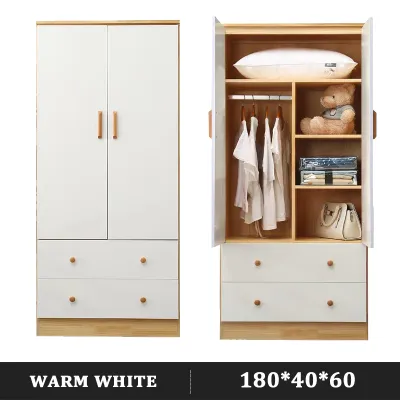
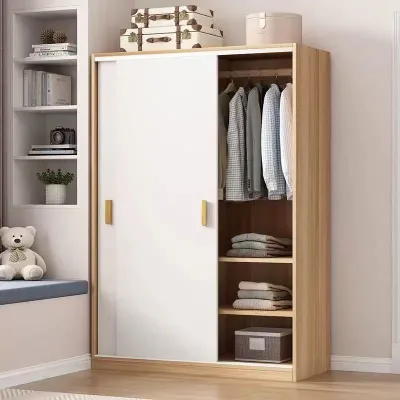
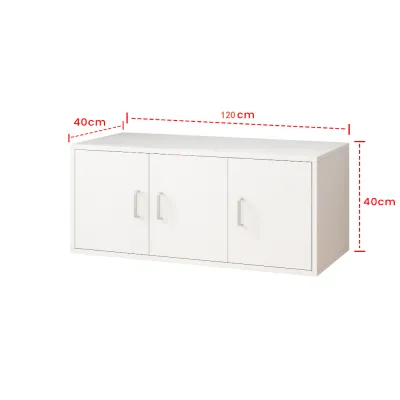
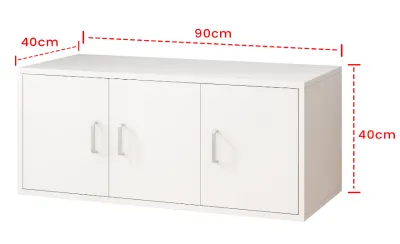
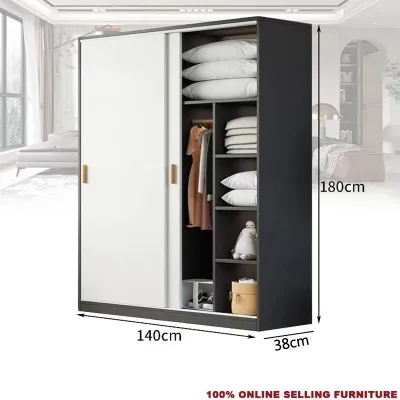
![[On Hand]Nordic Luxury Sliding Door Wardrobe Cabinet Wood Furniture Wardrobe Organizer 180cm Simple Assembly Wardrobe Organizer](https://img.lazcdn.com/g/p/e5d9fb9dfbc188aac006e3415a5274ee.jpg_400x400q80.jpg_.webp)
Prices are valid at publication and may change. Please refer to the product page for the latest price.
Vertical space is equally vital to evaluate. Check your ceiling height against the cabinet’s height, leaving at least a few centimeters of clearance for assembly and ventilation. Be mindful of overhead obstructions such as ceiling fans, light fixtures, air conditioning units, or sloped ceilings that could block the cabinet doors or prevent the unit from standing upright. Furthermore, if you are assembling a flat-pack wardrobe horizontally on the floor, calculate the diagonal clearance required to tilt the unit upright; the diagonal measurement of the wardrobe side panel must be less than your ceiling height to avoid getting stuck mid-raise.
Evaluating Wood Materials and Construction Quality
The longevity of a wooden cabinet depends heavily on its material composition and construction. Solid wood offers natural beauty and high structural strength, but it is sensitive to environmental shifts. Engineered wood, such as Medium-Density Fiberboard (MDF) or particle board, provides a flat, uniform surface and is often more budget-friendly, though it may lack the long-term durability of solid timber. Plywood, constructed from layered wood veneers, offers excellent resistance to warping and holds screws securely, making it a highly reliable choice for structural backing and shelving.
Rather than relying solely on broad material names, inspect the surface treatments and protective finishes applied to the wood. High-quality veneers, laminate overlays, and moisture-resistant sealants are essential for protecting the underlying material from scratches, stains, and ambient humidity. Examine the edge banding on engineered wood panels; it should be smooth, fully adhered, and free of gaps where moisture could penetrate and cause swelling. A poorly sealed edge can quickly absorb atmospheric moisture, leading to bubbling and structural degradation.
The cabinet’s hardware and joinery dictate its daily performance and lifespan. Look for robust joinery methods such as mortise-and-tenon or dowel joints rather than simple glued-and-stapled seams. Test the drawer glides to ensure they operate smoothly; full-extension ball-bearing glides are generally more durable and stable than basic plastic runners. Similarly, inspect the hinges on cabinet doors, prioritizing adjustable, heavy-duty metal hinges that allow you to realign doors if they sag over time. Pay close attention to the thickness of the back panel, as a sturdy back panel prevents the entire cabinet from swaying or racking.
Furthermore, do not overlook the construction of the drawer bottoms and backing boards. In many lower-quality cabinets, these areas are made of thin, unsupported hardboard that can easily bow or collapse under the weight of folded jeans or heavy linens. Check if the drawer bottoms are reinforced with wooden support slats or are constructed from thicker plywood panels that can withstand daily use without sagging.
Configuring the Internal Storage System
An effective wardrobe must match your personal clothing collection and organizational habits. Begin by analyzing your wardrobe to determine the ideal ratio of hanging space to shelving and drawers. If your wardrobe consists primarily of long dresses, trousers, or formal wear, prioritize tall hanging compartments. Conversely, if you fold most of your garments, such as t-shirts, knitwear, and casual shorts, focus on deep shelves and pull-out drawer units.
Standard wardrobe depth is another critical dimension to verify. A cabinet depth of at least 55 to 60 centimeters is recommended to allow standard clothes hangers to hang straight without rubbing against the doors or forcing you to compress your garments. If your room layout only accommodates a shallower cabinet, look for alternative configurations such as sliding doors or pull-out, front-facing hanging rods that maximize storage without requiring deep floor space.
When choosing between door styles, consider how hinged and sliding doors affect your daily routine. Hinged doors require clear floor space in front of the wardrobe to swing open, but they allow you to view your entire clothing collection at once and can even accommodate interior door mirrors or hanging hooks. Sliding doors are excellent for tight spaces because they do not require front clearance, but they always block half of the wardrobe’s interior at any given time, which can affect how you organize and access your daily-use items.
Adjustability is key to a future-proof storage system. Look for wooden cabinets featuring pre-drilled peg holes that allow you to adjust shelf heights as your storage needs evolve. Modular components, such as removable drawer inserts or interchangeable hanging rods, provide the flexibility to reconfigure the interior layout over time without purchasing an entirely new cabinet.
Specialized storage features can significantly enhance daily convenience. Consider units that incorporate dedicated trouser racks, shallow accessory trays for watches and jewelry, or integrated LED lighting that illuminates dark corners. While these features may increase the initial cost, they improve visibility and help maintain order, reducing the time spent searching for specific items.
Verifying Stability, Safety, and Assembly Requirements
Safety and structural integrity should never be compromised, particularly with tall or heavy wooden furniture. Always review the manufacturer’s guidelines regarding wall anchoring and anti-tip hardware. Tall wardrobes, especially those with heavy doors or drawers that shift the center of gravity when opened, must be securely anchored to the wall structure to prevent accidental tipping.
The type of wall in your home dictates the anchoring method required. Concrete or solid brick walls require masonry drill bits and expansion anchors, whereas drywall installations require stud-finders and heavy-duty toggle bolts. Never rely on standard plastic wall plugs for heavy wooden cabinets; instead, verify that the included anchoring kit matches your specific wall material or purchase compatible heavy-duty hardware separately.
Before purchasing, clarify the assembly conditions required for the cabinet. Determine whether the unit arrives fully assembled, partially assembled, or as a flat-pack kit requiring complete DIY construction. Assess the tools needed, the estimated assembly time, and whether the process requires multiple people. If you lack the necessary tools or experience, factor the cost of professional assembly services into your overall budget.
To prevent structural damage and sagging over time, check the manufacturer’s specified weight capacity limits. Hanging rods and wide shelves can bow under excessive weight, which compromises both the appearance and function of the cabinet. Distribute heavier items, such as winter coats or storage boxes, across lower shelves or reinforced compartments to maintain a balanced load.
Building Your Shortlist: A Pre-Purchase Checklist
To finalize your decision, compile a shortlist of potential wooden cabinets and cross-reference them against your physical constraints. Verify that each model’s finished dimensions align perfectly with your measured floor space, ceiling height, and delivery pathways. Eliminate any options that pose a risk of blocking doorways, windows, or light switches.
Next, examine the manufacturer’s warranty terms, return policies, and after-sales support. A reliable warranty should cover structural defects, warping, and hardware failures for a reasonable period. Understand the return process, including who covers the shipping fees for bulky items, in case the cabinet arrives damaged or does not match the description.
Finally, calculate the total cost of ownership rather than looking only at the retail price. Ensure your budget accounts for delivery fees, professional assembly charges, and any additional hardware required for secure wall anchoring. For instance, a cabinet priced at ₱15,000 with free delivery and assembly may offer better overall value than a ₱12,000 unit that incurs high shipping and installation surcharges.
Frequently Asked Questions (FAQ)
How do I prevent a wooden wardrobe from warping in humid climates?
To protect a wooden cabinet from moisture damage, maintain consistent indoor ventilation and use dehumidifiers or moisture-absorbing sachets inside the wardrobe. Avoid placing the cabinet directly against damp exterior walls; leave a gap of at least five centimeters to allow air to circulate freely. Additionally, follow the manufacturer’s care instructions, which may recommend periodic application of specific wood polishes or sealants to maintain a protective barrier against humidity.
Is it better to buy a pre-assembled or flat-pack wooden cabinet?
Pre-assembled wooden cabinets offer superior structural rigidity and immediate usability, as they are constructed in a controlled factory environment with professional joinery. However, they are more difficult to transport through tight spaces and often incur higher shipping fees. Flat-pack cabinets are easier to transport through narrow doorways and stairwells, but they require careful DIY assembly and may have slightly lower structural stability if the joints are not tightened correctly during installation.

Community discussion
Share your experience or ask a question. Comments are reviewed before publication.