
Choosing the right wood lazy susan for a 6-10 person dining table requires balancing the table’s overall dimensions with the physical footprint of individual place settings. For a standard dining table hosting this size of gathering, a turntable diameter between 50 and 70 centimeters typically provides the best balance. This range ensures that guests can easily reach shared dishes while leaving a comfortable 35 to 40 centimeters of clearance around the perimeter for dinner plates, glassware, and cutlery.
Understanding Table Proportions and Place Settings
A typical dinner plate measures 25 to 28 centimeters. Adding cutlery, glassware, and side bowls extends the place setting depth to 35 or 40 centimeters from the table’s edge.
In the Philippines, dining is a communal, family-style affair where large serving platters, rice bowls, and soup tureens sit in the center. This salo-salo style of eating requires a highly functional center zone that preserves individual dining space.
Products mentioned in this guide
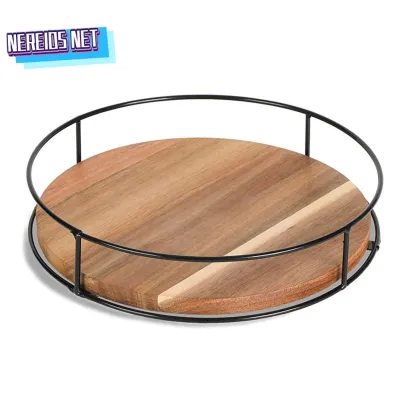

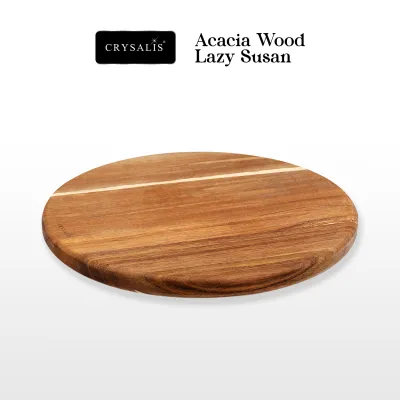

Prices are valid at publication and may change. Please refer to the product page for the latest price.
The reach zone is the distance a seated guest can stretch their arm without standing or leaning awkwardly. A well-proportioned turntable keeps shared dishes within this zone, typically 60 to 75 centimeters from the table edge.
An undersized turntable leaves guests at the ends of a long table struggling to reach food, defeating its purpose. Conversely, an oversized turntable crowds place settings, forcing guests to tuck their glasses and elbows inward.
How to Measure and Calculate the Ideal Diameter
To determine the ideal turntable size for your dining setup, follow a simple three-step measurement process.

First, measure the total width of your dining table. For round tables, measure the diameter; for rectangular or oval tables, measure the shortest side, as this width is the limiting factor.
Second, account for opposite place settings. Multiply the standard place setting depth of 35 centimeters by two (70 centimeters) and subtract this from your table’s total width.
Third, deduct a safety clearance buffer. Leaving an additional 5 to 10 centimeters of open space on each side prevents rotating dishes from knocking over tall water glasses or wine stems.
The formula is straightforward: Maximum Turntable Diameter = Table Width – (2 x Place Setting Depth) – (2 x Clearance Buffer).
For example, on a 120-centimeter-wide rectangular table, subtracting 70 centimeters for opposite place settings leaves 50 centimeters. Deducting 10 centimeters for clearance leaves a maximum lazy susan diameter of 40 centimeters. Always verify your dinnerware dimensions before purchasing.
Sizing for Extendable and Variable-Shaped Tables
Extendable tables present a unique challenge because their seating capacity changes from a daily six-person setup to a festive ten-person arrangement.
When choosing a wood lazy susan, decide whether to size it for daily family meals or fully extended gatherings. Sizing for the unextended state ensures daily visual balance, but the turntable may feel too distant when the table is fully extended.
For rectangular or oval tables, the width remains constant while only the length increases. A single circular turntable that fits the unextended width will still fit the extended width, but guests seated at the far ends of a 2.5-meter extended table will find it out of reach.
To solve this, consider using two smaller, matching wood lazy susans spaced evenly along the centerline. This dual-turntable setup allows guests at both ends to access shared dishes easily. When the table is collapsed back to its six-person size, you can store one turntable away and keep the other as the central feature.
Wood Material and Structural Considerations for Large Sizes
Large wood lazy susans carry significant weight, especially when loaded with heavy ceramic serving bowls, platters, or stone pots.
Before purchasing, check the manufacturer’s specifications for the weight limit and structural rating of the bearing mechanism. A high-quality aluminum or steel ball-bearing swivel is essential for smooth, quiet rotation.
The thickness and weight of the wood top play a crucial role in stability. A top that is too thin may warp, while an excessively heavy top can stress the bearing, causing it to drag or wobble. Look for solid wood constructions with a balanced thickness—typically 1.5 to 2.5 centimeters—that sit securely on a wide, non-slip base.
In tropical climates like the Philippines, high humidity can cause natural wood to expand, contract, or warp. Review the manufacturer’s care instructions regarding moisture and heat resistance. Always use trivets under hot serving dishes to protect the finish from heat marks and moisture rings. Regular wiping with a damp microfiber cloth and occasional conditioning with food-safe mineral oil will maintain the wood’s structural integrity.
Common Sizing and Placement Mistakes
One frequent mistake is ignoring the physical seams, leaves, or center pedestals of the dining table. If your table has a central seam for extension leaves, ensure the lazy susan’s base does not sit unevenly on the seam or interfere with the locking mechanisms.
Another error is choosing a turntable size that blocks access to stationary items. Centerpieces, salt shakers, or decorative candles are often placed outside the rotating zone. If the lazy susan is too large, these items are pushed into active place settings, causing clutter.
Lastly, do not overlook the physical design of the turntable’s edge. Some wood lazy susans feature a raised rim or lip to prevent items from sliding off. While practical, this raised edge can reduce the usable flat surface area. Ensure you calculate clearances based on the outermost diameter of the unit, not just the inner flat surface.
Frequently Asked Questions (FAQ)
Can I use a round lazy susan on a rectangular dining table?
Yes, a round wood lazy susan works exceptionally well on a rectangular dining table, provided you use the table’s narrowest dimension as your primary sizing constraint. This ensures the circular turntable does not encroach on the place settings of guests seated along the long sides. While corner diners will be slightly further away, the rotating action still allows everyone to access dishes comfortably without standing.
How much clearance should I leave between the lazy susan and the place settings?
Aim for a minimum clearance of 5 to 10 centimeters between the outer edge of the lazy susan and the edge of your place settings. This buffer zone prevents rotating platters from clipping wine glasses, water tumblers, or folded napkins. If you frequently serve meals using exceptionally large platters, consider increasing this clearance to 15 centimeters to ensure smooth, worry-free rotation.
Does a wood lazy susan require a specific type of bearing for heavy dishes?
Yes, larger wood turntables require robust, heavy-duty ball-bearing mechanisms—often made of aluminum or galvanized steel—to handle the weight of multiple serving dishes. When shopping, check the product details for a specified load capacity. If you notice signs of bearing strain, such as a grinding noise, sticking, or an uneven tilt, it indicates the turntable is overloaded or the bearings require cleaning or lubrication.

Community discussion
Share your experience or ask a question. Comments are reviewed before publication.