
Choosing the right material for your bookshelf determines whether your shelves will stand straight for decades or slowly bow under the weight of your favorite novels. In the tropical climate of the Philippines, where high seasonal humidity can weaken engineered wood products, making the right choice is even more critical. Plywood, medium-density fiberboard (MDF), and particle board each offer distinct characteristics in terms of strength, moisture resistance, and cost.
Plywood stands out as a highly robust option for heavy-duty book storage, resisting bending and holding up well against moisture. MDF provides an incredibly smooth, uniform surface that is highly suitable for custom painted finishes, though it requires extra support to prevent sagging over long spans. Particle board is the most budget-friendly alternative, making it highly suitable for lightweight, temporary, or ready-to-assemble furniture, provided it is kept away from damp areas.
To select the ideal material for your study or living room, you must balance the weight of your book collection, the local room conditions, and your budget. Understanding how these materials are manufactured and how they behave under load will help you build or buy a bookshelf that lasts.
Products mentioned in this guide
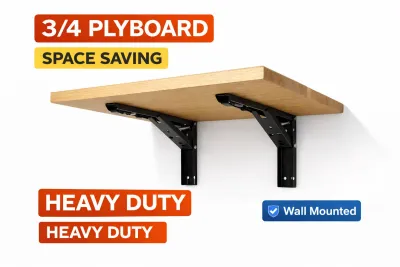

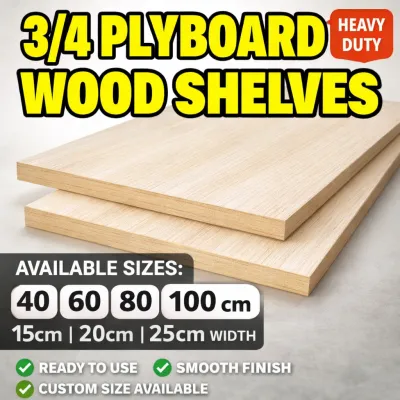

![PARTICLE BOARD/ WOODEN BOARD/ WOOD PLANKS/ WOOD SHELVES PLYBOARD PRE-CUT FOR D.I.Y. [PLAIN WHITE]](https://img.lazcdn.com/g/p/f7c90cb32b6475831dd4a86b7bef55ad.png_400x400q80.png_.webp)
Prices are valid at publication and may change. Please refer to the product page for the latest price.
Understanding the Core Structure and Load-Bearing Capacity
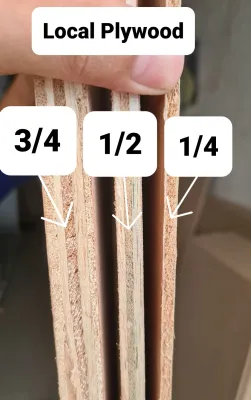
The internal composition of each wood-based material directly dictates how much weight a shelf can support before it begins to sag. Plywood is constructed by gluing together thin layers of wood veneer, known as plies, with the grain of each layer running perpendicular to the next. This cross-grain construction distributes physical stress in multiple directions, giving plywood high structural integrity and natural resistance to bending under heavy, concentrated loads. When you stack heavy textbooks, encyclopedias, or thick hardcovers on a plywood shelf, the material resists the downward force exceptionally well.
MDF, by contrast, is made by breaking down hardwood or softwood residuals into fine wood fibers, combining them with wax and a resin binder, and forming panels under high temperature and pressure. This process results in a dense, uniform sheet with no natural wood grain. While MDF is highly stable and free of knots or voids, its lack of continuous fiber structure means it has a higher tendency to sag over long, unsupported spans when bearing significant weight. If you plan to use MDF for wide shelves, you must design them with shorter spans or add structural reinforcement to prevent a noticeable bow.
Particle board, sometimes called chipboard, is manufactured from even smaller wood particles, such as sawdust, shavings, and tiny wood chips, mixed with an adhesive and pressed into sheets. Because it consists of small, loosely packed particles rather than long fibers or solid veneers, particle board has the lowest structural strength of the three materials. Under heavy loads, the internal bonds can easily yield, making particle board highly susceptible to permanent sagging or cracking if overloaded.
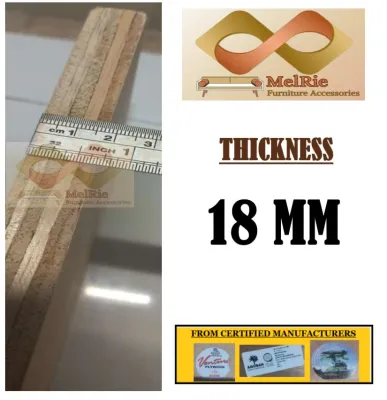
To ensure your bookshelf remains straight and functional, you should apply practical checks during the design or purchasing phase. For standard 18mm (3/4-inch) thick shelves, a plywood shelf can comfortably span up to 90 centimeters without intermediate support under normal book loads. An MDF shelf of the same thickness should generally not exceed 70 to 75 centimeters of unsupported span, while a particle board shelf is ideally kept under 60 centimeters. If your layout requires wider shelves, you must plan for center supports, thicker panels, or heavy-duty brackets to maintain structural integrity.
Evaluating Durability, Finish, and Moisture Resistance
In tropical environments where humidity levels fluctuate throughout the year, moisture resistance is a primary factor in furniture longevity. Plywood handles humidity changes relatively well because its cross-laminated structure limits expansion and contraction. While prolonged exposure to direct water will damage any wood product, high-quality plywood is far less likely to warp, delaminate, or lose its strength in a humid room compared to its engineered counterparts.

MDF and particle board are highly sensitive to moisture and humidity. When exposed to damp air or accidental spills, the fine fibers in MDF and the wood chips in particle board act like a sponge, absorbing moisture and swelling in thickness. Once these materials swell, they lose their structural integrity, and the damage is usually irreversible, resulting in bumpy surfaces and weakened joints. This makes unsealed MDF and particle board risky choices for damp ground floors or rooms without consistent ventilation.
The surface finish of each material also influences both its aesthetic appeal and its resistance to environmental wear. MDF is highly favored by furniture makers for its highly smooth, flat surface, which lacks any grain pattern or texture. This makes it the ideal canvas for a flawless painted finish, as it does not require grain filling and will not show telegraphing lines through the paint. Plywood, on the other hand, retains a natural wood grain on its face veneer, which can be stained, varnished, or painted to showcase a classic, organic wood look.
Particle board almost always relies on factory-applied finishes, such as melamine, laminate, or thin wood veneers, to cover its rough, unsightly core. These synthetic outer layers provide a clean, easy-to-wipe surface, but they are vulnerable to chipping at the corners and edges. To protect both MDF and particle board from moisture ingress and physical wear, high-quality edge banding is essential. Applying a durable PVC or solid wood edge band seals the vulnerable porous edges of these boards, preventing humidity from penetrating the core and extending the lifespan of the bookshelf.
When inspecting pre-assembled bookshelves in a showroom or online marketplace, look closely for early signs of material degradation. Avoid units that show minor edge swelling, surface chipping, or peeling veneer along the seams, as these indicate poor sealing and a high risk of rapid deterioration in a humid home.
Comparing Costs and Long-Term Value
Balancing your immediate budget against the long-term durability of your furniture is key to making a smart investment. Particle board is consistently the most economical option upfront, making it highly popular for student apartments, temporary rentals, or lightweight shelving units. If you need a quick, low-cost storage solution and do not plan to load it with heavy items, a particle board bookshelf offers excellent short-term value. However, because it is easily damaged during moves and has a shorter lifespan, it may need replacement much sooner than other options.
MDF sits in the mid-range of the pricing spectrum, offering a premium, high-end painted appearance without the high cost of solid wood or top-grade plywood. It is an excellent choice for custom-built study rooms where a sleek, modern aesthetic is desired. The trade-off is that MDF is heavy and requires careful handling during assembly and transport to avoid denting or chipping the corners, which can compromise its finished look.
Plywood represents the highest initial financial investment among these three materials. However, it typically delivers the longest lifespan and excellent long-term value. A well-constructed plywood bookshelf can withstand multiple relocations, resist accidental impacts, and support heavy book collections for decades. Furthermore, plywood furniture retains a higher resale or repurposing value, as it can be sanded down, refinished, or modified much more easily than painted MDF or laminated particle board.
When planning your project, it is wise to check local supplier pricing in Philippine Pesos (₱) for raw sheets or pre-made units, while also factoring in hidden costs. For a DIY project, plywood and MDF may require specialized fasteners, wood glue, edge banding, and high-quality primers or paints to achieve a professional finish. If you are hiring a local carpenter, the labor cost for finishing plywood or painting MDF can also vary, so obtaining a complete estimate that includes all finishing materials will help you make an accurate cost comparison.
Decision Framework: Which Material Fits Your Bookshelf Needs?
To finalize your choice, evaluate your specific storage requirements, aesthetic goals, and room conditions against this practical decision framework.
Choose Plywood if:
- You plan to store a large collection of heavy textbooks, encyclopedias, or heavy binders.
- Your design features long, open shelves with minimal vertical supports or brackets.
- The bookshelf will be placed in a room with fluctuating humidity or near open windows.
- You prefer a natural wood grain aesthetic that can be stained or varnished.
Choose MDF if:
- You want a sleek, modern bookshelf with a flawless, solid-color painted finish.
- The items to be stored are moderately light, such as novels, decorative pieces, and photo frames.
- You are willing to design shorter shelf spans or add structural support to prevent sagging.
- You want a premium look at a more moderate price point than high-grade plywood.
Choose Particle Board if:
- You are working with a tight budget and need an immediate, low-cost storage solution.
- The bookshelf will only hold light paperbacks, small toys, or lightweight office supplies.
- You are purchasing ready-to-assemble furniture for a temporary living space or rental.
- The room is well-ventilated, dry, and free from potential water exposure or high humidity.
Verify First if:
- You are purchasing pre-assembled or flat-pack bookshelves from an online marketplace or local furniture store. Always check the manufacturer's specifications for the maximum weight capacity per shelf, the actual thickness of the panels (look for at least 15mm to 18mm), and the material used for the back panel. A sturdy backing board securely attached to the frame is essential for preventing the entire bookshelf from swaying or leaning over time, regardless of the primary material used for the shelves.
Frequently Asked Questions (FAQ)
Can I mix plywood and MDF in the same bookshelf?
Yes, mixing plywood and MDF is a highly effective strategy to balance structural strength, cost, and aesthetic appeal. A common approach is to construct the main load-bearing frame and the horizontal shelves out of sturdy plywood to ensure the unit can support heavy books without sagging. You can then use MDF for non-structural elements, such as decorative back panels, cabinet doors, or ornamental trim, where a highly smooth, painted finish is desired. This hybrid construction allows you to maximize the structural benefits of plywood while taking advantage of the paintability and cost savings of MDF. However, you should avoid using MDF for the horizontal shelves if they will bear heavy loads, even if the outer frame is made of plywood.
How can I prevent MDF or particle board shelves from sagging?
If you already own or prefer to use MDF or particle board shelves, you can significantly reduce sagging by shortening the unsupported span between shelf supports or brackets. Keeping the span under 60 to 70 centimeters helps distribute the weight more safely. Another highly effective method is to glue and screw a solid wood nosing—a strip of solid wood about 2 to 3 centimeters wide—along the front edge of the shelf, which acts as a stiffening rib to resist bending. Alternatively, you can install a metal or wood support rail underneath the center of the shelf. Finally, always check the manufacturer’s maximum load rating, place the heaviest books near the outer edges close to the vertical supports, and use lighter items or decorative pieces in the center of the shelf.

Community discussion
Share your experience or ask a question. Comments are reviewed before publication.