
Selecting a round table dining table for your home is one of the most impactful furniture decisions you can make, particularly when planning for a household that regularly hosts between 6 and 10 people. In the Philippines, where extended family gatherings, festive Sunday lunches, and shared meals are a cornerstone of daily life, the dining room serves as the true heart of the home. A round table naturally fosters a warm, inclusive atmosphere, ensuring that every guest can make eye contact and engage in conversation without feeling excluded at the far end of a long rectangular setup.
However, accommodating a larger group of 6 to 10 diners requires careful mathematical planning and spatial awareness. Unlike rectangular tables, which scale linearly, round tables grow exponentially in surface area as their diameter increases. This means a small miscalculation can lead to a dining room that feels either excessively cramped or visually overwhelmed. To find the perfect balance, you must evaluate the standard diameter ranges, calculate precise edge space, assess room clearances, and understand how the structural design of the table base impacts real-world legroom.
Standard Diameter Ranges for 6, 8, and 10 Seats
When shopping for a round table dining table, industry standard measurements provide an excellent baseline for understanding how diameter translates to seating capacity. These dimensions are calculated to provide a comfortable dining experience under normal conditions, rather than a maximum “squeeze” capacity where guests must sit shoulder-to-shoulder.
Products mentioned in this guide
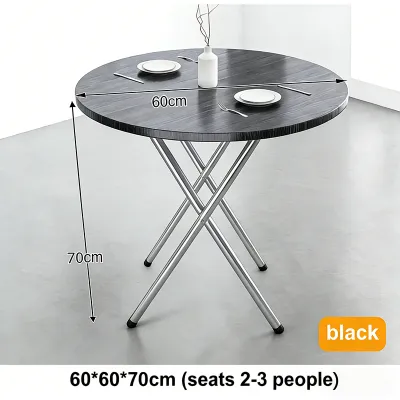
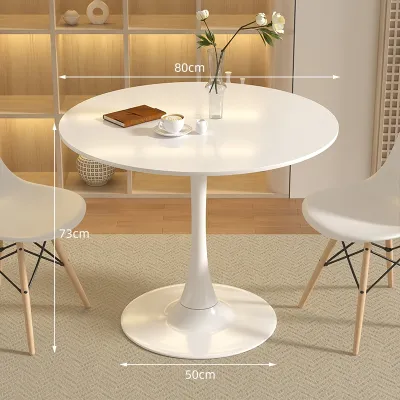
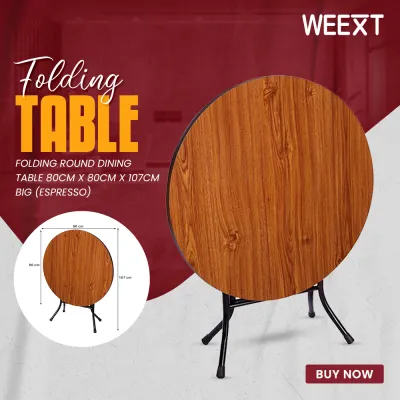
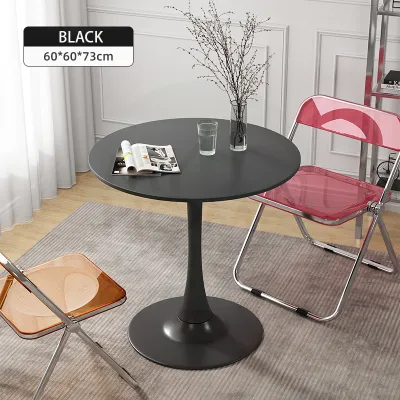
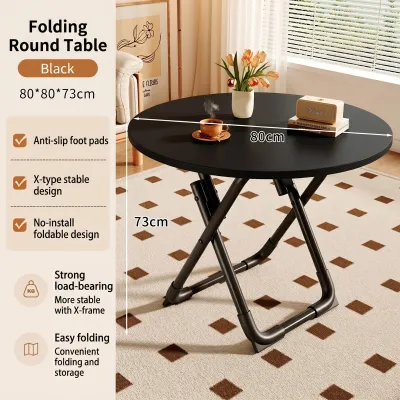
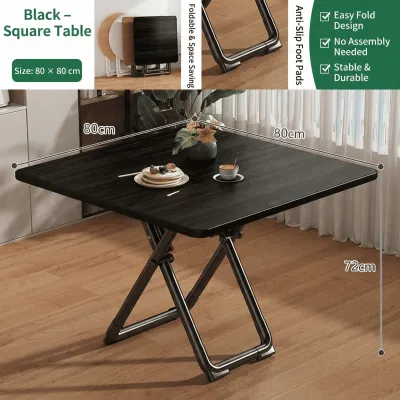
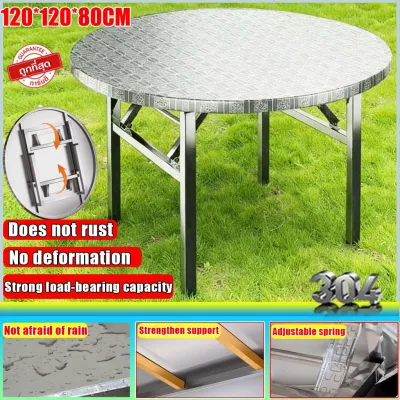
Prices are valid at publication and may change. Please refer to the product page for the latest price.
For a seating capacity of 6 people, the standard recommended diameter range is 54 to 60 inches (approximately 137 to 152 cm). A 54-inch table is highly efficient for smaller dining spaces, offering a cozy yet comfortable setup for daily family meals. Upgrading to a 60-inch table provides a more generous layout, leaving plenty of room for central serving platters and larger tableware.
To comfortably accommodate 8 people, you should look for a table diameter between 60 and 72 inches (approximately 152 to 183 cm). While a 60-inch table can technically fit 8 diners, it requires narrow, armless chairs and leaves very little space for shared dishes in the center. A 66-inch or 72-inch table is far more practical for regular 8-person hosting, ensuring that guests do not bump elbows during the meal.
For a large gathering of 10 people, the required diameter ranges from 72 to 84 inches (approximately 183 to 213 cm). A 72-inch table is the absolute minimum for 10 diners and works best with slim-profile seating. If you regularly host formal dinners or prefer wide, upholstered armchairs, an 84-inch table is necessary to give everyone sufficient personal space.
Keep in mind that these standard ranges are starting points. Design variations, such as the thickness of the tabletop, beveled edge profiles, and the specific shape of the table’s perimeter, can influence how spacious the table feels in practice. Always consult the manufacturer’s specific guidelines to verify the recommended seating capacity for your chosen model.
Calculating Edge Space for Comfortable Dining
To understand why certain diameters work better than others, it is helpful to look at the underlying ergonomics of dining. The key to a comfortable meal is the amount of linear table edge allocated to each individual diner. This is known as the perimeter rule.

As a general standard, a comfortable dining experience requires allocating 24 to 30 inches (approximately 61 to 76 cm) of table edge per person. The lower limit of 24 inches is suitable for casual, everyday meals using compact chairs. The upper limit of 30 inches is ideal for formal dining, where multiple glasses, bread plates, and heavy cutlery sets are used, or when diners are seated in wider chairs.
To calculate the required table diameter for your specific needs, you can use basic geometry. First, multiply your desired number of seats by the edge-space allowance. For example, if you want to seat 8 people with a comfortable 26 inches of edge space per person, you need a total circumference of 208 inches (8 multiplied by 26). To find the required diameter, divide the circumference by pi (approximately 3.14). In this case, 208 divided by 3.14 equals roughly 66.2 inches. This calculation demonstrates why a standard 66-inch table is an exceptional sweet spot for 8 diners.
The style of your dining chairs heavily influences this mathematical equation. If you pair your table with wide, upholstered armchairs, deep-seated cushions, or chairs with outward-flared legs, they will naturally occupy more physical space. In these scenarios, you must design around the upper end of the edge-space allowance, which may require choosing a table diameter that is one size larger than standard recommendations. Conversely, slim, armless wooden, metal, or traditional woven rattan chairs allow you to maximize seating density without sacrificing comfort.
Room Clearance and Delivery Path Measurements
A common pitfall when purchasing a large round table dining table is focusing solely on whether the table fits the guests, while forgetting to check if the table fits the room. Because round tables expand equally in all directions, they require a surprisingly large, square-shaped footprint to maintain a functional traffic flow.
To ensure a comfortable dining environment, you must adhere to the standard 36-inch (approximately 91 cm) minimum clearance rule. This rule dictates that there should be at least 36 inches of open space between the edge of the table and any surrounding walls, buffets, sideboards, or other furniture. This clearance allows diners to pull their chairs out easily, sit down comfortably, and permits others to walk behind seated guests without forcing them to lean forward. If the dining area is located along a primary household pathway, increasing this clearance to 48 inches (approximately 122 cm) is highly recommended.
To determine if a specific table size will work in your room, use this simple formula to calculate the total required footprint:
Total Room Width/Length = Table Diameter + 72 inches (183 cm)
For example, if you are considering a 60-inch (152 cm) table, your dining room must measure at least 132 inches by 132 inches (approximately 11 feet by 11 feet, or 3.35 meters by 3.35 meters) to accommodate the table and chairs comfortably. A massive 72-inch (183 cm) table requires a clear room footprint of at least 144 inches by 144 inches (12 feet by 12 feet, or 3.66 meters by 3.66 meters).
Beyond the room’s dimensions, you must perform a rigorous delivery and installation reality check. Large round tables—particularly those measuring 72 inches or more—are incredibly heavy and cannot be tilted or disassembled as easily as rectangular tables. A solid hardwood or natural stone tabletop is a single, rigid piece of material.
Before placing an order, carefully measure every doorway, hallway, sharp turn, stairwell, and elevator cabin that the table must pass through to reach your dining room. In urban areas of the Philippines, where high-rise condominium living is common, service elevator dimensions and tight hallway corners are frequent obstacles. If your apartment building has a small elevator, a solid 72-inch tabletop may simply not fit, requiring you to opt for an extendable table design or seek alternative delivery methods.
How Table Bases and Pedestals Change a Round Table Dining Table's Seating Capacity
The design of the support structure beneath your tabletop plays a crucial role in determining how many people you can actually seat. A table might have a mathematically perfect diameter on paper, but if the legs or base block your guests’ knees, the seating capacity will be severely compromised.
When selecting a round table dining table, a central pedestal base is highly superior to a traditional four-legged design. Four-legged round tables create rigid “zones” between the legs, forcing diners to align their chairs precisely within those boundaries. Anyone seated directly in front of a leg will be forced to straddle it, which quickly becomes uncomfortable during a long meal. A central pedestal, on the other hand, eliminates these outer obstructions entirely, allowing you to arrange and slide chairs in at any point along the table’s perimeter. This flexibility is essential when trying to squeeze in an extra guest or two for holiday gatherings.
However, you must evaluate the design of the pedestal itself. Bulky, heavily sculpted, or widely flared pedestals can create their own set of problems. If the base of the pedestal flares out too close to the floor, it can block diners’ feet, prevent chairs from being pushed in fully when not in use, or restrict knee clearance. Modern trestle bases or cross-legged geometric designs are visually striking, but they often have wide floor footprints that can interfere with legroom.
Before purchasing, check the manufacturer’s detailed base dimensions and verify the structural stability of the table. Large round tables with a single central pedestal must be engineered correctly to prevent tipping when pressure is applied to the outer edges. Additionally, if you are considering a solid wood table, keep in mind that tropical humidity in the Philippines can cause natural wood to expand and contract. Ensure the table features high-quality joinery and a professional moisture-resistant finish to maintain its structural integrity over time.
Common Sizing and Layout Mistakes to Avoid
To ensure long-term satisfaction with your dining setup, it is important to avoid several common mistakes specific to large-format round tables.
The first major issue is what designers call the “reach” problem. While a round table is fantastic for conversation, any diameter larger than 60 inches (152 cm) creates a massive void in the center of the table. At this scale, it becomes physically difficult for guests to pass food, reach for condiments, or appreciate a central floral arrangement without standing up. If you choose a table in the 66-to-84-inch range, you must plan your dining style accordingly. Utilizing a large Lazy Susan or serving meals family-style with designated servers can help mitigate this reach issue.
Another frequent error is ignoring the visual weight of the table in relation to the room’s shape. A massive 72-inch or 84-inch round table has an immense visual presence. If placed in a distinctly narrow, rectangular dining room, a large round table can disrupt the visual balance of the home, leaving awkward, unusable pockets of space at the ends of the room while constricting traffic flow along the sides. Round tables perform best in square rooms, wide open-concept living spaces, or dedicated dining alcoves.
Finally, avoid falling into the “maximum capacity” trap. Many furniture retailers market their tables using highly optimistic seating estimates, claiming a 60-inch table can “seat up to 10 people.” While you might be able to physically crowd 10 narrow stools around a 60-inch tabletop for a brief meeting, doing so for a full meal is impractical. It leaves less than 19 inches of edge space per person, resulting in overlapping dinner plates, restricted arm movement, and an uncomfortable dining experience. Always prioritize real-world physical comfort over optimistic marketing labels.
Frequently Asked Questions (FAQ)
Can I squeeze 10 people around a 60-inch round table?
While you can physically arrange 10 narrow, armless chairs around a 60-inch (152 cm) round table, doing so is highly discouraged for a standard meal. A 60-inch perimeter divided among 10 people leaves less than 19 inches (approx. 48 cm) of edge space per diner. This setup results in overlapping place settings, bumped elbows, and no room for serving dishes. For a comfortable 10-person dining experience, you should choose a table with a diameter of at least 72 inches (183 cm).
Is a Lazy Susan necessary for large round dining tables?
While a Lazy Susan is not strictly mandatory, it is highly recommended for any round dining table with a diameter of 60 inches (152 cm) or larger. Once a table exceeds this size, the center of the tabletop becomes difficult to reach from a seated position. A rotating Lazy Susan allows guests to easily access shared dishes, condiments, and drinks without needing to stretch across the table or constantly ask others to pass items, making family-style dining much more convenient.

Community discussion
Share your experience or ask a question. Comments are reviewed before publication.