
To comfortably seat 6 to 10 people, a round table typically requires a diameter ranging from 120 centimeters (48 inches) to 180 centimeters (72 inches). The exact size you need depends heavily on your chair design, dining style, and the physical layout of your dining room. Round tables are highly favored for their ability to foster close conversation during family gatherings, but choosing the wrong diameter can quickly lead to crowded elbows or blocked walkways.
To find the right balance between seating capacity and room flow, you must evaluate how much personal space each guest requires, how the table’s base design affects legroom, and how much clearance remains for movement. In tropical climates where natural ventilation and comfortable air circulation are key to a pleasant dining experience, avoiding an overly cramped seating arrangement is especially important. By measuring your space and understanding the math behind table perimeters, you can select a table that accommodates your guests comfortably without overwhelming your home.
Understanding Space Requirements per Person
The first step in determining the right round table diameter is understanding the physical space an individual needs to dine comfortably. As a general rule, each person requires a minimum of 60 centimeters of linear edge space for casual dining, such as a quick breakfast or afternoon snack. For formal, multi-course meals where multiple plates, utensils, and glasses are present, this requirement increases to 70 centimeters or more per person to prevent guests from bumping elbows.
Products mentioned in this guide
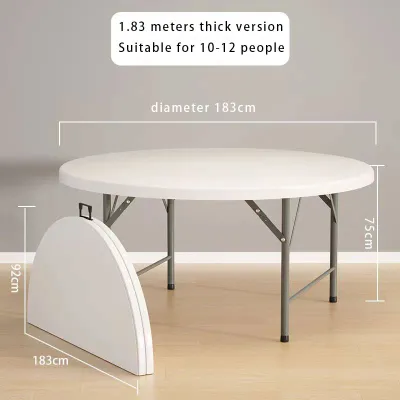
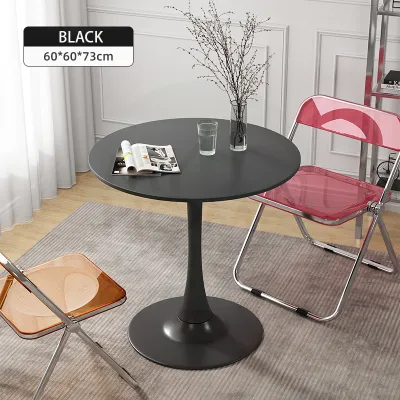
Prices are valid at publication and may change. Please refer to the product page for the latest price.
The style of your dining chairs plays a significant role in this calculation. Standard armless dining chairs with a slim profile typically measure 45 to 50 centimeters in width, allowing them to fit neatly within a standard seating allotment. However, if you prefer wide, upholstered chairs or designs with armrests, each chair can easily measure 60 centimeters or wider. These larger chairs require additional spacing along the table edge to prevent them from clashing when tucked in or when guests are seated.
Beyond the width of the chair seat, you must also consider the vertical space beneath the tabletop. The thickness of the table edge and the depth of the apron—the wooden or metal frame supporting the tabletop—directly impact knee clearance. A thick apron can prevent guests from crossing their legs comfortably and may stop high-armed chairs from being fully tucked under the table when not in use. When shopping, always check the clearance height from the floor to the underside of the apron to ensure comfortable seating.
Calculating the Ideal Table Diameter
To translate individual space requirements into a specific table diameter, you can use a simple mathematical relationship based on the circumference of a circle. The perimeter of a round table is calculated by multiplying its diameter by pi (approximately 3.1416). By multiplying your target number of guests by the desired space per person, you can determine the necessary perimeter and divide it by pi to find the minimum diameter required.

For example, to seat 6 people with a comfortable 63 centimeters of edge space per person, you need a total perimeter of 378 centimeters. Dividing this by 3.1416 results in a minimum diameter of approximately 120 centimeters (48 inches). To seat 8 people comfortably, a diameter of 150 centimeters (60 inches) provides about 59 centimeters of edge space per person, which is suitable for standard chairs. For a gathering of 10 people, a minimum diameter of 180 centimeters (72 inches) is required to give each guest roughly 56 centimeters of space, though a slightly larger table or slim-profile chairs are recommended to avoid a tight fit.
While mathematical formulas provide a solid baseline, you must also evaluate how manufacturer specifications align with your actual usage. Retailers often label round tables with a maximum seating capacity that assumes the use of exceptionally narrow, armless chairs. Additionally, large round tables can suffer from dead space in the center; while a 180-centimeter table offers plenty of perimeter, the center can be difficult to reach. If you plan to use a central lazy Susan or display large serving platters, ensure the table diameter allows for these items without encroaching on individual place settings.
Factoring in Room Dimensions and Clearance
A table that fits your guests is of little use if it does not fit your dining room. To maintain a comfortable and safe environment, you must measure the distance between the table edge and the nearest walls or furniture. A minimum clearance of 90 centimeters is required to allow guests to pull out their chairs and sit down without difficulty. For optimal comfort and to allow others to walk behind seated guests, a clearance of 120 centimeters is highly recommended.
In warm, humid environments, maintaining generous clearance is also essential for air circulation. A cramped dining room with restricted airflow can quickly become uncomfortably warm, especially during midday meals or large family gatherings. If your dining area features adjacent furniture such as a sideboard, buffet table, or display cabinet, measure your clearance from the front edge of those pieces rather than the wall itself to ensure walkways remain completely unobstructed.
Before finalizing your purchase, you must also plan for the delivery and assembly of the table. Large-diameter round tables, particularly those measuring 150 to 180 centimeters, have a massive footprint and cannot be tilted or angled around tight corners as easily as rectangular tables. Measure the width and height of all doorways, narrow hallways, stairwells, and condominium elevators through which the table must pass. If access is tight, look for designs where the tabletop can be detached from the base during transport and assembled directly in your dining room.
Base Design and Extendable Options
The structural design of a round table’s base significantly influences both legroom and actual seating capacity. Traditional tables with four legs at the outer edges restrict where chairs can be placed, as guests cannot sit comfortably where a leg blocks their knees. For round tables, a central pedestal base is highly advantageous because it eliminates outer leg obstructions, allowing you to arrange chairs flexibly and squeeze in an extra guest when necessary.
If you regularly transition between small family meals and larger gatherings, an extendable round table offers excellent versatility. These tables typically feature a split top that slides open to accept one or more leaf inserts, transforming the round table into an oval shape. This design allows you to maintain a compact 120-centimeter diameter for daily use—preserving valuable floor space in your home—while expanding to 180 centimeters or more to comfortably seat up to 10 people during special occasions.
When evaluating extendable options, pay close attention to the stability and leveling mechanisms of the table. Fully extended tables place significant stress on the center joints and sliding tracks. Check that the extension slides operate smoothly and that the table remains stable when fully opened. For very large extended tables, look for designs that include integrated support legs or adjustable leveling feet, which help compensate for uneven flooring surfaces like tile or stone.
Common Sizing Mistakes to Avoid
One of the most frequent errors when buying a round table is relying solely on generic marketing labels. A table advertised as a “6-to-8 seater” may only accommodate that number if you use incredibly narrow, minimalist chairs. Always base your decision on the actual physical diameter of the tabletop and compare it against the width of the chairs you plan to use.
Another common mistake is failing to account for the visual weight of a large round table. A solid wood table with a diameter of 180 centimeters has a powerful visual presence that can easily dominate a small or low-ceilinged room, making the entire space feel cramped and dark. If you need a large seating capacity but want to keep the room feeling light and airy, consider tables with glass tops, slender metal pedestal bases, or lighter wood finishes that do not absorb as much visual space.
Finally, do not forget to account for the space required by high-back or deep-seated chairs. These designs naturally sit further away from the table edge even when tucked in, effectively increasing the overall footprint of your dining set. Always measure your chairs’ full depth and height to ensure they harmonize with both the table’s dimensions and the surrounding room clearance.
Frequently Asked Questions (FAQ)
How do I measure an existing round table to verify its seating capacity?
To measure an existing round table, run a tape measure straight across the widest part of the tabletop, passing directly through the center point from one edge to the opposite edge. If the table features a heavily beveled, sloped, or decorative border, measure only the flat, usable surface where plates and glassware can sit securely. Once you have the diameter, multiply it by 3.1416 to find the total usable perimeter, then divide that number by 60 to 70 centimeters to estimate how many standard chairs will fit comfortably.
What should I do if my room cannot fit a single large round table for 10 people?
If your dining room cannot accommodate a single 180-centimeter round table without blocking essential walkways, consider alternative spatial arrangements. You can use a smaller round table, such as a 120-centimeter model, for core seating and set up a separate console table, buffet sideboard, or kitchen island nearby to serve food buffet-style. This keeps the main dining table clear of large serving platters, allowing guests to dine comfortably with less individual table space. Alternatively, look into an extendable oval table, which provides a narrower profile that fits more easily into rectangular rooms.

Community discussion
Share your experience or ask a question. Comments are reviewed before publication.