
Finding the right plastic rattan table set to seat six to ten people comfortably requires balancing physical table dimensions with the actual layout of your dining space or outdoor lanai. Because large gatherings demand both elbow room and space for serving platters, a standard four-seater setup will not suffice. To accommodate up to ten diners without crowding, you must select a table shape and size that allows at least 60 to 70 centimeters of width per person, while leaving ample clearance behind each chair for easy movement.
In tropical environments, outdoor dining is a popular way to host extended family and friends. However, choosing a set that is too large can make your patio feel cramped, while a set that is too small leads to bumped elbows and restricted movement. Understanding standard sizing guidelines and structural requirements ensures your investment remains comfortable, functional, and durable for years to come.
Standard Table Dimensions for 6 to 10 Seats
To seat six to ten people comfortably, the physical shape of your plastic rattan table plays a critical role in how guests interact and move. For rectangular or oval tables, a length of 180 to 240 centimeters is generally required. A six-seater setup typically functions well with a length of 180 centimeters, whereas a ten-seater configuration demands a minimum length of 240 to 300 centimeters to prevent guests from bumping elbows during meals.
Products mentioned in this guide
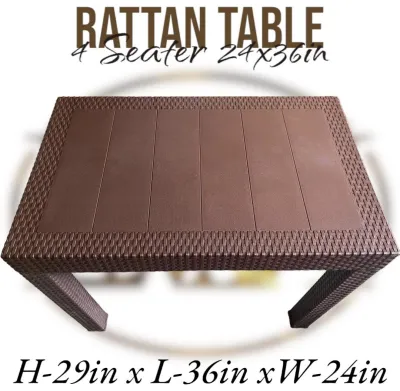







Prices are valid at publication and may change. Please refer to the product page for the latest price.
Width is equally important for accommodating serving dishes, local delicacies, and individual place settings. Aim for a table width of at least 90 to 100 centimeters. Anything narrower makes it difficult to place shared platters in the center without crowding individual plates. If you plan to use large serving bowls or decorative centerpieces, look for tables closer to 110 centimeters in width to provide a comfortable buffer zone.
If you prefer a round table to encourage shared conversations, the diameter requirements increase significantly with guest count. A round table seating six people comfortably requires a diameter of at least 120 to 140 centimeters. To expand this capacity to eight or ten diners, the diameter must scale up to 150 to 180 centimeters, which can make reaching for food in the center challenging without a rotating tray.
Choosing between a fixed-size table and an extendable model depends on how often you host large groups. A fixed 240-centimeter table provides permanent, sturdy seating for up to ten people but occupies a massive footprint daily. An extendable plastic rattan table set offers a practical alternative, allowing you to keep the table compact for daily family meals and expand it only when hosting larger gatherings. This flexibility prevents your dining area from feeling permanently overcrowded.
Space Planning and Clearance Requirements
Selecting the correct table size is only half the battle; you must also ensure the set fits harmoniously within your dining room, patio, or lanai. As a general rule, maintain a clearance zone of at least 90 centimeters between the edge of the table and the nearest wall or piece of furniture. This distance allows diners to pull out their chairs and sit down comfortably without feeling trapped.

For high-traffic pathways or areas near doors, increase this clearance to 120 centimeters. This extra space ensures that family members can walk behind seated guests without forcing them to lean forward. Be sure to account for door swings, nearby storage cabinets, or outdoor pillars that might obstruct the chairs when they are fully extended.
When planning an outdoor setup on a deck or patio, consider the transition zones between indoor and outdoor spaces. A table placed too close to sliding glass doors can restrict access to the kitchen, making hosting more stressful. Ensure there is a clear, unobstructed path from the food preparation area to the table.
Before finalizing your purchase, carefully measure the delivery route to avoid logistical headaches. Large dining tables, even those made of lightweight plastic rattan, often feature wide, non-detachable frames or large single-piece tops. Measure the width and height of your front door, hallway corners, stairwells, and elevator cabins to guarantee the delivery team can safely transport the set into your home.
Evaluating Plastic Rattan Construction for Large Sets
Large dining sets must withstand significant physical stress, especially when fully occupied by up to ten adults. When evaluating a plastic rattan table set, look closely at the underlying frame construction rather than just the outer weave. High-quality sets typically feature powder-coated steel or aluminum inner frames, which provide the necessary rigidity to prevent the table from sagging in the middle.
Because the tropical climate brings high humidity and heavy seasonal rains, verifying the frame’s protective treatment is essential. Ensure the metal frame is treated to resist rust and corrosion, particularly if the set will live on an open patio or near coastal areas. The synthetic rattan itself should be made of high-density polyethylene (HDPE) rather than cheap PVC, as HDPE resists UV degradation and cracking under intense sun exposure.
Always verify the manufacturer’s specified weight limits for both the table and individual chairs. A reliable dining chair should comfortably support daily use, so check the product labels or assembly manuals for explicit load-bearing capacities. Avoid assuming a chair is sturdy just because it looks solid; verified specifications are the only reliable guide.
Inspect the joint reinforcements under the table top and seat frames. Look for double-welded joints or heavy-duty bracing at key stress points. Additionally, ensure the legs are fitted with durable, non-slip foot caps to protect your tiled or wooden floors from scratches and to keep the furniture stable on uneven outdoor surfaces.
Flexible Configurations for Varying Guest Counts
If your household fluctuates between quiet family dinners and large weekend gatherings, flexible furniture configurations offer the best of both worlds. Extendable plastic rattan tables often utilize butterfly extensions or drop-leaf mechanisms. Before buying, check the stability of these mechanisms when fully extended to ensure the center seam does not sag under the weight of heavy serving bowls.
Another practical approach is combining two smaller, matching square tables. This modular setup allows you to push the tables together to form a long banquet layout for ten guests, or separate them into individual dining zones for smaller, intimate gatherings. This is particularly useful for outdoor spaces where you might want to create separate kids’ and adults’ tables.
To keep your dining area uncluttered when hosting fewer guests, plan your seating storage in advance. Opt for plastic rattan chairs that are explicitly designed to stack or fold. This allows you to store the extra four chairs neatly in a utility room, garage, or covered storage box, keeping your daily dining space open and easy to clean.
Frequently Asked Questions (FAQ)
Can plastic rattan chairs support heavier individuals?
Yes, provided you verify the structural specifications before purchasing. Do not rely on visual appearance alone, as synthetic weave can hide weak frames. Check the manufacturer’s product label for explicit weight capacities, and look for chairs constructed with reinforced steel or aluminum frames and thick cross-bracing beneath the seat to ensure reliable support.
How do I clean and maintain a large plastic rattan set?
Routine maintenance requires only mild dish soap, warm water, and a soft-bristle brush to remove dust and food crumbs from the weave crevices. Avoid using harsh chemical solvents, bleach, or abrasive scrubbing pads, which can degrade the synthetic fibers. Periodically inspect the set for any loose weave ends or exposed metal frame areas, tucking loose strands back into place to prevent further unraveling.

Community discussion
Share your experience or ask a question. Comments are reviewed before publication.