
Selecting the right lazy susan for a large dining table seating 6 to 10 people requires balancing smooth rotation, weight capacity, and proper clearance. To ensure everyone can reach the shared dishes comfortably without crowding their personal dining space, the ideal turntable should leave a clear border of 12 to 18 inches around the perimeter of the table. For standard large tables, this typically translates to a lazy susan diameter of 20 to 36 inches, depending on whether your table is round, square, or rectangular. Choosing a model with a sealed ball-bearing mechanism and a slip-resistant, easy-to-clean surface ensures that heavy serving bowls glide effortlessly during busy family meals.
How to Calculate the Ideal Diameter for Your Table
Before shopping for a rotating turntable, you must measure your dining table’s total width or diameter accurately using a physical tape measure. Guessing the dimensions of your table often leads to purchasing a turntable that is either too small to be useful or too large to allow for comfortable dining. Taking a precise measurement across the widest part of the table establishes the baseline for all subsequent calculations.
Once you have the total table width, apply the standard clearance rule by leaving 12 to 18 inches of open space on all sides of the turntable. This perimeter is essential because it accommodates dinner plates, glassware, flatware, and serving utensils without crowding. If the clearance is less than 12 inches, guests will feel cramped, and their personal plates may overlap with the rotating tray. Conversely, if the clearance exceeds 18 inches, diners will have to lean forward excessively to reach the food, defeating the purpose of a rotating server.
Products mentioned in this guide
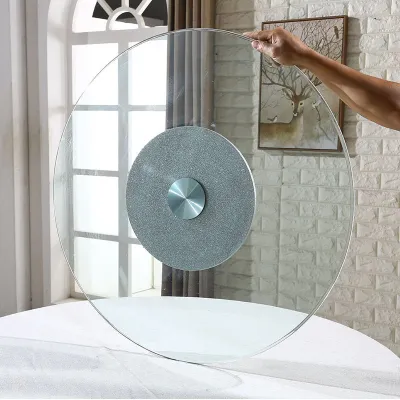
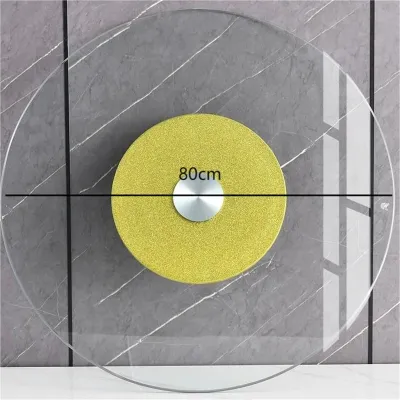
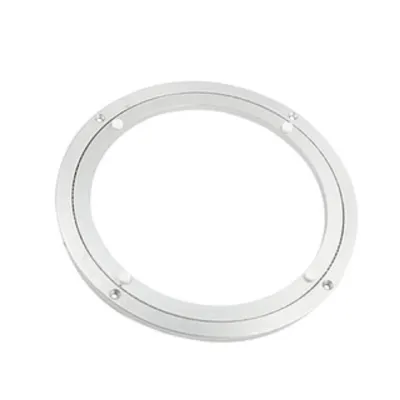
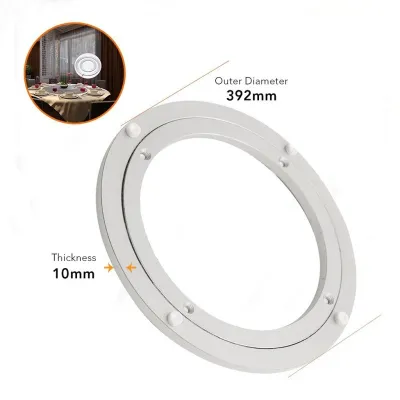
Prices are valid at publication and may change. Please refer to the product page for the latest price.
On a round dining table, the clearance calculation remains uniform all the way around the perimeter. For example, if you have a 60-inch round table and want to maintain a comfortable 15-inch clearance on all sides, you subtract 30 inches (15 inches for each side) from the total diameter. This leaves you with an ideal lazy susan diameter of 30 inches. This symmetrical layout ensures that every guest seated around the table has equal access to the rotating dishes.
Rectangular and oval tables present a different spatial challenge because the distance from the center to the ends is much greater than the distance to the sides. If you size the turntable based on the table’s length, it will spill over the sides and block the place settings of guests sitting along the long edges. Therefore, you must calculate the maximum diameter using the narrowest width of the table. For a rectangular table that is 40 inches wide, subtracting 12 inches of clearance on both sides leaves you with a maximum lazy susan diameter of 16 inches, ensuring the side seats remain fully functional.
Evaluating Weight Capacity and Rotation Mechanisms
The heart of any rotating turntable is its internal rotation mechanism, which must support heavy, shared family-style meals. For large gatherings where heavy ceramic serving bowls, cast-iron pots, and large glass platters are common, basic plastic friction rings or unsealed plastic tracks will quickly bind, squeak, or fail under pressure. Instead, look for heavy-duty aluminum or steel ball-bearing tracks that distribute weight evenly across dozens of tiny metal spheres, allowing the tray to spin smoothly even when fully loaded.

In tropical climates with high relative humidity, exposed metal components are highly susceptible to rust and corrosion over time. Moisture in the air can cause unsealed steel bearings to seize up, leading to rough rotation and annoying grinding noises during dinner. To prevent this, prioritize sealed ball-bearing mechanisms or those made from rust-resistant materials like aluminum or high-grade stainless steel. Checking the product specifications for corrosion-resistant hardware is a crucial step for long-term durability.
Always check the manufacturer’s official weight capacity label rather than assuming a thick, heavy material automatically translates to high load limits. A thick marble or solid wood turntable might look incredibly sturdy, but if it is paired with a cheap, low-capacity bearing, it will struggle under the combined weight of the tray itself and your food. Look for mechanisms rated to hold at least 15 to 30 kilograms to safely accommodate multiple heavy dishes, such as large soup tureens, rice cookers, and loaded serving platters.
The physical footprint of the rotating base is just as important as the bearing quality for maintaining stability. A lazy susan with a narrow base relative to its top tray is highly prone to tipping when a heavy dish is placed on one side while the other side is empty. To ensure stability, the rotating base should cover at least half to two-thirds of the total diameter of the top tray. Additionally, a low-profile design keeps the center of gravity low, further reducing the risk of accidental spills when guests spin the table.
Material and Surface Considerations for Shared Dining
The material of your lazy susan must withstand frequent spills, heat from warm serving dishes, and constant wiping. Solid wood options offer a classic, warm aesthetic that matches traditional dining sets, but they require a high-quality, food-safe polyurethane or lacquer seal. Unsealed wood can easily absorb oils, sauces, and moisture, leading to permanent stains, warping, and mold growth in humid environments.
For a modern, low-maintenance alternative, tempered glass and high-grade acrylic are excellent choices. These materials are completely non-porous, meaning they will not absorb liquids, and they can be wiped clean in seconds with a damp microfiber cloth. Tempered glass also offers excellent heat resistance, allowing you to place hot serving bowls directly onto the surface without worrying about heat rings or cracking, though using trivets is still recommended to protect the finish.
Spills are inevitable during lively family dinners, making a raised edge or lip a highly practical feature. A subtle raised border of a quarter-inch to a half-inch prevents round bowls, condiment bottles, and gravy boats from sliding off the edge of the turntable due to centrifugal force when spun. It also helps contain minor liquid spills, keeping sauces from dripping onto your main dining table.
Finally, consider the underside of the lazy susan base. Constant rotation can cause the base to shift slightly, which can scratch or scuff expensive wooden or glass dining tables over time. Look for models equipped with non-slip silicone pads, felt feet, or a fully padded rubber bottom. These pads not only protect your table’s finish from scratches but also provide the necessary friction to keep the entire unit firmly anchored in the center of the table during use.
Conditional Selection Guide for Large Family Gatherings
To simplify your buying decision, you can map your specific table size to the most appropriate lazy susan dimensions. For a standard 6-person round table, which typically measures around 48 inches in diameter, a 20-inch to 24-inch lazy susan provides the perfect balance of serving space and personal dining clearance. This setup leaves 12 to 14 inches of space around the edge, which is ideal for standard dinner plates and glassware.
If you have an 8-person round table measuring approximately 60 inches in diameter, step up to a 24-inch to 30-inch turntable. This size accommodates a wider variety of shared dishes while maintaining a comfortable 15-inch clearance zone. For very large 10-person tables that span 72 inches, a 30-inch to 36-inch lazy susan is necessary to ensure that food placed in the center is actually within arm’s reach of everyone seated around the perimeter.
The intensity of your gatherings should also dictate the heavy-duty nature of the mechanism. For daily family dinners with three or four modest dishes, a standard-duty aluminum bearing is perfectly adequate. However, if your home is the designated hub for large holiday feasts, fiestas, and Sunday family reunions where the table is packed with heavy cast-iron pots, large clay serving dishes, and multiple beverage pitchers, investing in a commercial-grade, heavy-duty steel bearing is highly recommended to prevent premature wear.
For long, rectangular tables seating 8 to 10 people, a single large circular lazy susan is often impractical because it leaves too much unused space at the far ends while crowding the middle. In these scenarios, consider using two smaller, independent 12-inch to 15-inch rotating trays placed at equal intervals along the center line of the table. This dual-turntable setup allows guests at both ends of the table to access condiments, side dishes, and appetizers easily without disrupting the flow of the meal.
Placement, Stability, and Maintenance Checks
Proper setup is essential for the safe and smooth operation of your rotating server. Always take the time to center the lazy susan precisely on your dining table. An off-center turntable will create uneven clearance zones, making it difficult for guests on one side of the table to place their plates while leaving too much empty space on the other. You can use a simple measuring tape to check that the distance from the edge of the turntable to the edge of the table is identical at four opposite points.
Balanced loading is another key factor in maintaining smooth rotation and extending the lifespan of the internal bearings. Try to distribute heavy serving bowls evenly across the surface of the tray rather than clustering them all on one side. Concentrating too much weight on a single edge puts immense leverage on the central bearing, which can cause the mechanism to warp, tilt, or grind over time, eventually leading to permanent structural damage.
Regular maintenance will keep the rotation mechanism whisper-quiet and free-spinning for years. When cleaning, never submerge the entire lazy susan or its rotating base in water, as this can trap moisture inside the metal bearing track and cause rapid rusting. Instead, wipe the top surface with a damp cloth and mild soap, and use a dry or slightly damp cloth to clean the base. If the rotation begins to feel stiff or noisy, check the manufacturer’s instructions to see if a drop of food-grade silicone lubricant is recommended for the bearing track.
Frequently Asked Questions (FAQ)
Can I use a round rotating lazy susan on a rectangular dining table?
Yes, you can use a round lazy susan on a rectangular table, but you must size it carefully based on the table’s narrowest width rather than its length. This ensures that the rotating tray does not hang over the sides or crowd the place settings of guests sitting along the long edges. Keep in mind that guests seated at the far ends of a long rectangular table will still have a significant reach to access the turntable, so you may need to supplement it with smaller serving bowls or consider using two smaller turntables spaced along the center line.
How do I clean a lazy susan with an internal ball-bearing mechanism?
To clean a lazy susan with an internal ball-bearing mechanism, always avoid submersing the unit in water or running it under a tap, as moisture trapped inside the bearing housing will lead to rust and mechanical failure. Instead, wipe down the top tray and the outer edges of the base with a damp cloth and a mild, non-abrasive dish soap. For the bearing track itself, use a dry microfiber cloth or a soft brush to gently sweep away any dust, crumbs, or debris that may have accumulated, and ensure the entire unit is completely dry before placing it back on your dining table.

Community discussion
Share your experience or ask a question. Comments are reviewed before publication.