
Choosing the right storage system for your footwear is more than a matter of aesthetic preference; it directly impacts how long your shoes last and how easily you can access them during a busy morning. In the Philippines, where high relative humidity and seasonal dust present constant challenges for wardrobe maintenance, selecting the wrong container can lead to mold growth or damaged materials. The choice between traditional stackable (top-opening) shoe boxes and modern drop-front shoe boxes comes down to a balance of accessibility, space efficiency, and physical protection.
There is no single superior option for every closet. Drop-front boxes offer unmatched convenience for daily wear, allowing you to slide a pair out without disturbing the units stacked above. Conversely, traditional stackable boxes with removable top lids provide a tighter seal against dust and pests, making them highly effective for seasonal rotation or long-term storage of formal wear. To make the right decision, you must evaluate your daily habits, the physical dimensions of your closet shelves, and the structural limits of the materials you choose.
Understanding the Core Designs: Top-Opening vs. Drop-Front
To choose the right organizer, you must first understand how these two designs differ in physical construction and mechanical operation. These differences dictate how you will interact with your closet on a daily basis.
Products mentioned in this guide
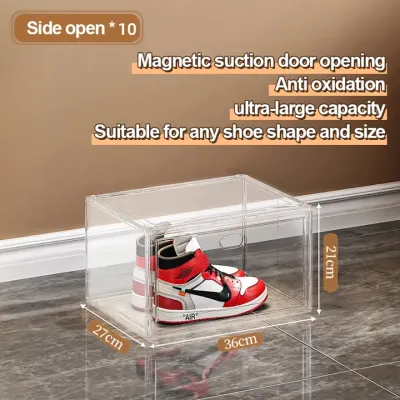
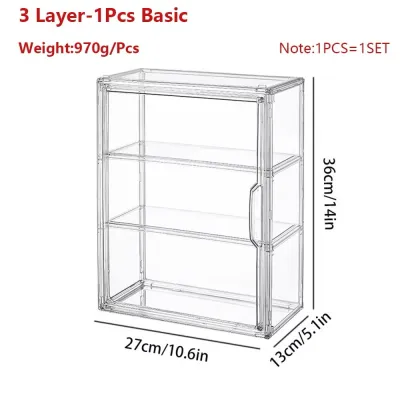
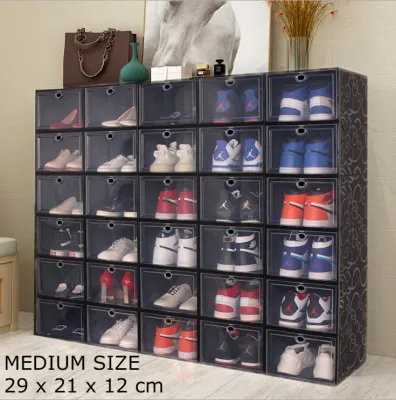
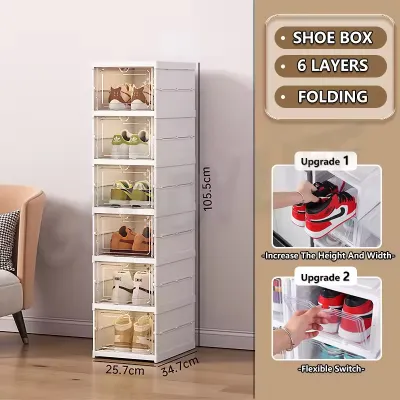
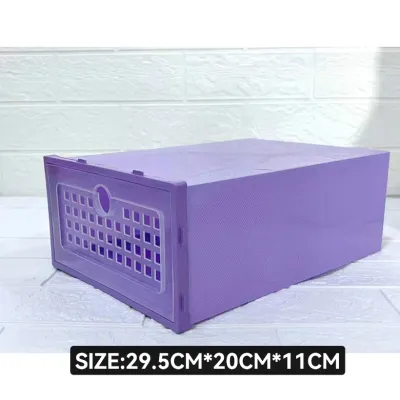
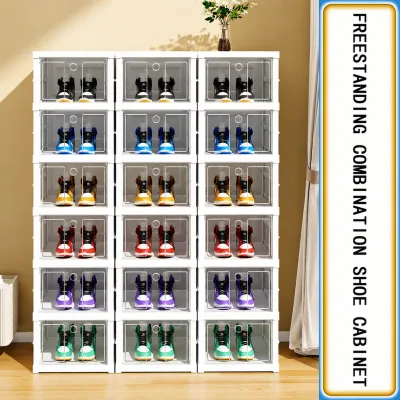
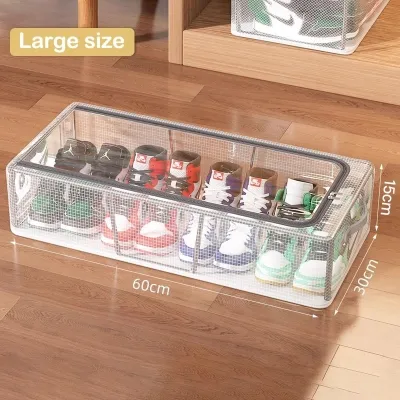
Prices are valid at publication and may change. Please refer to the product page for the latest price.
How Stackable (Top-Opening) Shoe Boxes Work
Traditional stackable shoe boxes rely on a classic two-piece design consisting of a container body and a separate, removable top lid. Some variations feature a hinged lid, but the fundamental access point remains at the top of the box. To secure these units when stacked, manufacturers design interlocking grooves or recessed channels on the lid and the base.
When you place one box on top of another, these channels nest together to prevent lateral shifting. However, because the opening is at the top, retrieving a pair of shoes from any level other than the very top requires you to physically lift and remove all the boxes resting above it. This mechanical limitation makes top-opening boxes highly stable when undisturbed, but labor-intensive to access frequently.
How Drop-Front Shoe Boxes Work
Drop-front shoe boxes are engineered as rigid, five-sided enclosures with a dedicated front door panel. This front door is typically attached via bottom hinges or magnetic latches, allowing it to swing downward or outward while the rest of the box remains completely stationary.
Because the structural frame of each box supports the weight of the units above it, the front opening remains entirely free of load-bearing stress. You can stack these units multiple tiers high and still open any individual door to retrieve or store a pair of shoes. This design prioritizes front-facing accessibility, turning a vertical stack of boxes into a highly functional, modular cabinet system within your closet.
Key Comparison Dimensions for Closet Storage
Evaluating shoe boxes requires looking beyond their appearance. You must analyze how each style performs across the practical realities of closet space, physical stability, and environmental protection.

Accessibility and Daily Use
When it comes to daily convenience, drop-front shoe boxes are the clear winner for active wardrobes. If you are rushing to get ready for work or school, you can open the front door with one hand, slide your shoes out, and close it in seconds. This friction-free interaction makes it much easier to maintain a tidy closet, as there is no temptation to leave shoes on the floor to avoid the hassle of unstacking boxes.
Top-opening stackable boxes, by contrast, introduce significant friction into your daily routine. If you stack them four or five units high, retrieving a pair from the bottom box requires unstacking four separate containers, removing the lid, taking out the shoes, replacing the lid, and rebuilding the stack. For this reason, top-opening boxes are best reserved for shoes you wear only a few times a year, such as formal dress shoes, heavy boots, or seasonal footwear.
Space Efficiency and Stacking Limits
Space efficiency is a critical consideration for built-in Philippine closets, which often feature fixed wooden shelving or compact wire racks.
- Footprint and Wall Thickness: Traditional top-opening boxes are often made of thinner, flexible polypropylene (PP) plastic or cardboard. This allows them to have a slightly narrower footprint and thinner walls, maximizing the horizontal space on deep closet shelves. Drop-front boxes, especially those made of rigid acrylic or heavy-duty injection-molded plastics, require thicker structural frames to support the front-door mechanism, slightly reducing the total number of boxes you can fit side-by-side on a shelf.
- Vertical Clearance: Because drop-front boxes do not require any clearance above them for lid removal, you can stack them all the way up to the underside of the next closet shelf. Top-opening boxes require at least enough vertical clearance at the top of the stack to lift the lid off, meaning you cannot comfortably utilize the absolute top of a shelf compartment without leaving empty space.
Stability and Structural Integrity
Stacking multiple units vertically introduces safety and durability concerns, particularly in active households or regions prone to environmental shifts.
- Interlocking Mechanisms: Top-opening boxes rely on shallow lid grooves for stability. While these work well for low stacks of three to four boxes, taller stacks can become unstable if the plastic of the lower lids begins to bow under weight.
- Rigid Frames: High-quality drop-front boxes utilize rigid, hard-plastic frames that distribute weight straight down through the side panels rather than resting the load on the door. This structural design allows them to be stacked much higher than flexible top-opening models without risk of collapsing or warping.
- Safety Hazards: In homes with young children or pets, tall stacks of lightweight, unanchored boxes pose a tipping hazard. If a child pulls on a lower box, a poorly interlocked stack of top-opening boxes can easily slide apart. Rigid drop-front boxes with secure, interlocking peg-and-hole systems offer better resistance to accidental tipping, though any stack exceeding chest height should be physically secured.
Visibility and Dust Protection
Protecting your footwear investment from dust, pests, and environmental degradation is a primary function of any shoe organizer.
- Visual Identification: Both styles are widely available in transparent or semi-transparent plastics, allowing you to identify your shoes at a glance. However, premium drop-front boxes often feature highly polished, crystal-clear acrylic front doors that offer superior clarity compared to the cloudy, frosted plastic common in budget top-opening boxes.
- Dust and Pest Barriers: Top-opening boxes provide a highly secure, nearly airtight seal when the lid is snapped firmly into place. This makes them exceptionally good at keeping out dust, silverfish, and spiders. Drop-front boxes, because of their moving door hinges and magnetic closures, often have tiny gaps around the door frame. While these gaps are small enough to block major dust, they do not offer the absolute seal of a snapped-on lid.
- The Humidity Factor: In the humid tropical climate of the Philippines, a completely airtight plastic box can sometimes trap moisture, leading to mold and mildew growth on leather or canvas shoes. The minor ventilation gaps in drop-front boxes can actually be an advantage, allowing minimal airflow that helps prevent moisture buildup. If you use fully sealed top-opening boxes, you must ensure your shoes are completely dry before storing them, and consider adding moisture absorbers.
Decision Framework: Which Shoe Box Should You Choose?
To determine which design fits your home, you can use this structured decision framework based on your footwear collection, budget, and closet layout.
Choose Drop-Front Boxes If:
- You are organizing everyday footwear: If you need quick access to sneakers, sandals, school shoes, or office heels multiple times a week.
- You plan to stack boxes vertically: If you want to build a floor-to-ceiling shoe wall or maximize the vertical space under hanging clothes without the hassle of unstacking.
- You prioritize aesthetic display: If you want a clean, uniform look where your shoes are displayed facing forward like a retail boutique.
- Your budget allows for a higher initial investment: Drop-front boxes generally cost more due to their complex multi-part construction and rigid materials.
Choose Stackable (Top-Opening) Boxes If:
- You are storing seasonal or rarely worn shoes: If you are packing away formal dress shoes, heavy travel boots, or collectible shoes that only come out occasionally.
- You have deep, hard-to-reach closet shelves: If you want to slide boxes deep into the back of a shelf where front-access doors would be blocked anyway.
- You need maximum protection from pests and dust: If your closet is prone to dust or insects and you require a firm, snapped-on lid seal.
- You are working with a tighter budget: Simple top-opening plastic boxes are highly economical, allowing you to organize a large collection at a lower cost per unit.
Material and Price Comparison
When shopping in the Philippines, you will generally encounter three price and material tiers. Always check the manufacturer’s care instructions and weight limits before purchasing:
- Budget Tier (₱50 – ₱150 per piece): Typically made of flexible, thin polypropylene (PP) plastic. These are almost always top-opening or very basic, self-assembled drop-fronts with soft plastic walls. They are best for low stacks (up to 3 high) and lightweight shoes.
- Mid-Range Tier (₱180 – ₱350 per piece): Medium-density plastic drop-front boxes with rigid front frames and semi-flexible bodies. These offer a good balance of cost and stability, allowing stacks of 5 to 6 units high.
- Premium Tier (₱400 – ₱800+ per piece): Heavy-duty, injection-molded acrylic or PET plastic drop-front organizers. These feature crystal-clear front doors, magnetic closures, and highly stable interlocking pegs. They can safely stack up to 10 units high on flat, level surfaces.
Practical Tips for Integrating Shoe Boxes Into Your Closet
Once you have chosen the style that fits your needs, proper planning and installation will ensure your closet system remains safe and functional.
Measure Before You Buy
Before purchasing any storage boxes, use a tape measure to record the exact dimensions of your closet shelves. Pay close attention to:
- Depth: Ensure the boxes will not protrude so far that they block sliding closet doors or hanging garments.
- Height Clearance: Measure the vertical distance between shelves to calculate exactly how many boxes can fit in a single stack.
- Shoe Sizes: Check the interior dimensions of the boxes. High-top sneakers, platform heels, and larger men's shoe sizes (typically US size 11 and above) often require "extra-large" or "tall" box variants to fit comfortably without bending the shoes.
Anchor and Secure Your Stacks
Safety should always be a priority when building vertical storage systems.
- Level Surfaces: Always place the heaviest shoes (such as leather boots or thick-soled sneakers) in the bottom boxes of the stack to lower the center of gravity.
- Anti-Slip Solutions: If you are stacking boxes on smooth wooden shelves or polished tile floors, place a thin, non-slip rubber mat under the bottom box to prevent the entire stack from sliding.
- Securing Tall Stacks: For stacks that exceed five feet in height, especially in areas prone to seismic tremors, consider using adhesive anti-tip straps to secure the top boxes to the closet wall.
Tropical Climate Care and Moisture Control
Because the Philippines experiences high humidity throughout the year, storing shoes in enclosed plastic boxes requires active moisture management to prevent mold, dry rot, and material degradation.
- Dry Before Storing: Never place shoes into a box immediately after wearing them. Allow them to air out in a well-ventilated room for at least a few hours to dissipate sweat and environmental moisture.
- Use Silica Gel Packets: Place one or two silica gel packets or small activated charcoal sachets inside each shoe box. These will actively absorb trapped moisture and help eliminate odors.
- Regular Inspections: Every few months, open your stored boxes to inspect your shoes, wipe down any dust, and replace saturated moisture absorbers. This is particularly important for genuine leather shoes, which are highly susceptible to mold in dark, stagnant environments.
Frequently Asked Questions (FAQ)
Can you mix stackable and drop-front shoe boxes in the same closet?
While you can use both styles within the same closet, you should avoid mixing them within the same vertical stack. Because different brands and styles use mismatched interlocking grooves, stacking a top-opening box directly on top of a drop-front box (or vice versa) compromises structural stability and increases the risk of the stack tipping over.
Instead, organize them in separate columns. A practical configuration is to use a column of drop-front boxes on your lower shelves for your daily-use shoes, and place a separate column of top-opening boxes on the highest, hard-to-reach shelves for seasonal or formal footwear.
How high is it safe to stack shoe boxes?
The safe stacking height depends entirely on the material thickness of the boxes, the weight of the shoes inside, and the stability of your floor or shelf.
For budget-friendly, flexible plastic boxes, you should limit your stack to a maximum of 3 to 4 units high to prevent the bottom boxes from buckling. High-quality, rigid acrylic drop-front boxes can typically be stacked safely up to 8 to 10 units high, provided they are placed on a completely flat, level surface and contain lightweight to medium-weight footwear. Always consult the manufacturer’s specified weight limits and stacking recommendations, and keep exceptionally tall stacks secured to prevent accidental tipping.

Community discussion
Share your experience or ask a question. Comments are reviewed before publication.