
To comfortably seat 6 to 10 people, a dining table must balance individual elbow room with the physical limits of your dining area. For a standard rectangular table, you will need a length of at least 180 centimeters (approximately 6 feet) to seat 6 people, which must scale up to 240 centimeters (8 feet) for 8 people, and at least 270 to 300 centimeters (9 to 10 feet) to accommodate 10 guests. If you prefer a round table, a diameter of 150 centimeters can accommodate 6 to 8 diners, while a diameter of 180 centimeters is necessary to seat 10 people without crowding.
In the Philippines, where homes often feature open-plan layouts to maximize airflow and families frequently gather for large Sunday lunches or holiday feasts, choosing the right table size is crucial. A table that is too small leads to cramped meals, while an oversized table can block natural traffic paths and make the room feel congested. Opting for a versatile homemaker dining set with extendable features is often the most practical way to transition between daily family meals and larger social gatherings.
How to Calculate Table Dimensions for 6 to 10 Seats
Calculating the correct table size begins with understanding personal space requirements. Standard ergonomic guidelines suggest that each seated individual requires a minimum of 60 centimeters of lateral width to eat comfortably without bumping elbows with their neighbor. Additionally, each place setting requires a depth of 35 to 40 centimeters to accommodate plates, glassware, and utensils. This leaves a central shared zone of about 20 to 30 centimeters in the middle of the table for serving platters, rice bowls, and decorative centerpieces.
Products mentioned in this guide
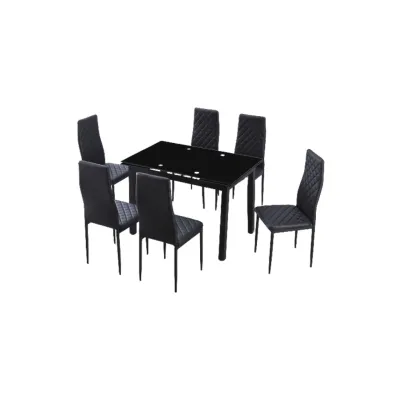
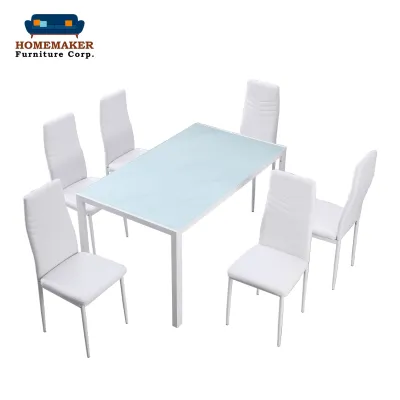
Prices are valid at publication and may change. Please refer to the product page for the latest price.
When calculating the total length for rectangular tables, you must also account for the table legs. If the legs are positioned at the very corners, you can utilize the entire length between them. However, if the legs are inset, they will restrict where chairs can be placed. For a table seating 6 people, a rectangular surface of 180 cm by 90 cm is the standard baseline. To expand this to 8 people, the length should increase to at least 210 cm, and for 10 people, a length of 270 cm to 300 cm is required to ensure everyone has adequate breathing room.
Round and oval tables distribute space differently. A round table naturally encourages conversation because everyone faces the center, but it requires a larger overall footprint as the seating capacity increases. A 150 cm diameter round table comfortably seats 6 to 8 people. To seat 10 people, you will need a 180 cm diameter table. Keep in mind that a round table of this size creates a large empty space in the center, which can make reaching shared dishes difficult without the addition of a rotating lazy Susan.
Extendable or drop-leaf mechanisms offer an excellent compromise for homes that host large groups occasionally but require more floor space daily. These designs allow a table to sit at a modest 150 to 180 cm for daily family use and expand via leaf inserts to 240 or 300 cm when guests arrive. When evaluating these mechanisms, it is important to check how smoothly the tracks operate. In tropical climates with high humidity, wooden slides can swell and bind, so look for high-quality metal gear tracks or moisture-resistant treated wood slides.
Always verify the manufacturer’s actual physical dimensions rather than relying solely on the advertised seat count. Some brands label tables as “10-seaters” based on narrow, armless chairs squeezed tightly together. Checking the exact width and length specifications allows you to compare the table against the actual dimensions of the chairs you plan to use, ensuring a comfortable fit for your household.
Matching Table Shapes to Your Room Layout
Rectangular tables are the most popular choice for large families because they mirror the proportions of most standard dining rooms. They fit exceptionally well in long, narrow spaces and can be pushed against a wall or kitchen island to save space when not fully occupied. This shape is highly efficient for serving style meals, as platters can be lined up down the center of the table within easy reach of all guests.

Round and oval tables are highly effective for improving traffic flow in tight or high-traffic dining areas. Because they lack sharp corners, they make it easier for family members to navigate around the room without bumping into edges. Oval tables, in particular, offer a great middle ground; they provide the elongated seating capacity of a rectangular table while retaining the soft, space-saving corners of a round design. However, a round table large enough for 10 people requires a massive, square-shaped room to avoid blocking walkways.
Extendable designs require careful consideration regarding storage and structural integrity. Removable leaves must be stored in a closet or dry area when not in use, which can be a challenge in smaller homes. Some tables feature self-storing butterfly leaves that fold directly into the table frame, which eliminates storage issues but adds weight to the center of the table. You should also inspect the visual seam where the table splits to ensure it aligns perfectly and does not create an uneven surface when fully extended.
Before finalizing your table shape, assess how it will interact with existing architectural features in your dining room. Low windows, built-in cabinets, columns, and doorways all dictate how people move through the space. A rectangular table might block access to a built-in buffet cabinet, whereas an oval table could provide the necessary clearance to open cabinet doors fully. Ensure that the table shape you choose allows for natural light to circulate and does not obstruct major pathways.
Measuring Your Dining Room for Proper Clearance
To ensure your dining room remains functional, you must measure the clearance around the table rather than just the table itself. As a rule of thumb, leave a minimum of 90 centimeters of open space between the edge of the table and the nearest wall, sideboard, or appliance. This 90-centimeter boundary provides just enough room for a guest to pull out their chair and sit down comfortably. For optimal comfort and ease of movement, a clearance of 120 centimeters is highly recommended.
It is helpful to differentiate between primary walkways and secondary service paths when planning your layout. A primary walkway—such as the path leading from the kitchen to the living room—requires at least 120 centimeters of clearance so two people can pass each other without squeezing. Secondary paths, such as the space behind seated guests against a wall, can function with 90 centimeters of clearance, though servers will need to step carefully when carrying hot dishes.
Overhead obstacles must also be factored into your measurements. In many tropical homes, ceiling fans are essential for keeping the dining area cool and comfortable. You must ensure that the diameter of your ceiling fan does not overlap dangerously with the height of tall guests standing up from the table. Similarly, low-hanging chandeliers or pendant lights should be suspended approximately 75 to 90 centimeters above the tabletop to provide adequate illumination without blocking sightlines or risking accidental contact.
If you plan to place an area rug under your dining set, its dimensions must be calculated carefully. A common mistake is buying a rug that is too small, causing the back legs of the chairs to catch on the edge of the rug when guests pull them out. To prevent this, the rug should extend at least 60 centimeters beyond the table edge on all sides. For a 240 cm rectangular table, this means you will need a rug that is at least 360 cm long to keep all chair legs securely on a flat surface.
Verifying Delivery and Assembly Access Before Buying
One of the most common oversights when purchasing a large dining set is failing to verify that the furniture can actually fit into the home. A solid wood or stone tabletop measuring 240 to 300 centimeters is incredibly heavy and rigid. Before purchasing, measure the width and height of all entry doors, hallway corners, stairwells, and elevator cabins. If you live in a condominium or multi-story home, ensure the delivery crew can navigate tight stairwell landings or low elevator ceilings.
Check whether the tabletop can be detached from the base for transport and assembly. Many high-quality dining tables feature removable legs or bases, which makes maneuvering through tight spaces significantly easier. If the tabletop is a single, solid piece of stone, glass, or heavy timber, verify its weight and ensure you have adequate manpower to carry it safely. Attempting to carry an oversized, heavy tabletop through narrow corridors without proper planning can result in damage to both your walls and your new furniture.
Identify any tight corners or low ceilings along the delivery path that might block the movement of long boxes. A 300-centimeter box cannot bend around a sharp 90-degree hallway turn. If your home has architectural restrictions, an extendable table that arrives in smaller, modular boxes may be a much safer and more practical choice than a single-piece, non-extending large table.
Finally, review the assembly space requirements and the tools needed to put the table together. Large dining tables require a flat, clean, and spacious floor area for assembly, preferably close to their final position to minimize heavy lifting. Check if the manufacturer provides clear assembly instructions and if specialized tools are required, or if professional assembly services are available to ensure the structural joints are secured correctly.
Evaluating Large Dining Sets: A Structural Checklist
When shopping for a complete homemaker dining set or a similar multi-piece bundle, a thorough structural inspection is essential to ensure long-term durability. Large tables are subject to significant weight and leverage, especially when fully extended. Look for robust leg placement, heavy-duty metal brackets, or solid wood cross-bracing underneath the tabletop. A central support leg or a double-pedestal base is often necessary for tables exceeding 240 centimeters to prevent the center of the table from sagging over time.
Surface treatments must be highly durable to withstand daily wear, spills, and humid conditions. For wooden tables, check if the surface has a moisture-resistant polyurethane or lacquer finish that protects against water rings from cold drinks. Smooth, rounded edge profiles are generally safer and more comfortable to lean against than sharp, squared edges. Always review the manufacturer’s care instructions to ensure the cleaning requirements align with your household’s daily routine.
Chair dimensions must be carefully matched to the table’s apron—the wooden panel that connects the tabletop to the legs. Measure the distance from the floor to the bottom of the apron to ensure your dining chairs, especially those with armrests, can slide completely underneath the table when not in use. This saves valuable floor space and prevents the chair arms from constantly bumping into and damaging the table frame.
Lastly, evaluate the weight capacity and warranty terms of the dining set. A table designed to seat 10 people must be able to support the weight of heavy serving dishes, tableware, and the occasional leaning guest. Look for manufacturers that offer clear structural warranties, particularly on the extension mechanisms and joints, to ensure your investment remains a centerpiece of your home for years to come.
Frequently Asked Questions (FAQ)
Can I use a bench instead of chairs to seat more people?
Using a dining bench is an excellent space-saving solution, especially for children or casual gatherings. Benches can be slid completely under the table when not in use, freeing up valuable walkway space in your dining room. However, benches lack back support, which can make long meals uncomfortable for older adults. Additionally, guests sitting in the middle of a bench may find it difficult to stand up or leave the table without disturbing others, so a combination of individual chairs and a single bench is often the most practical setup.
What is the best table base for a 10-seater table?
Trestle and pedestal bases are generally the most practical options for 10-seater tables because they eliminate the traditional four corner legs, allowing you to squeeze in extra chairs without guests having to straddle a table leg. A double-pedestal or sturdy trestle design provides excellent stability for long tabletops while maximizing legroom. Traditional four-legged tables offer superb stability at the corners but restrict seating flexibility, as chairs cannot be comfortably placed where the legs block knee movement.

Community discussion
Share your experience or ask a question. Comments are reviewed before publication.