
Selecting the right lazy susan turn table for a dining table that seats 6 to 10 people requires balancing accessibility with comfortable dining space. To find the ideal size, you must ensure that the turntable is large enough to hold shared dishes within easy reach of every guest, yet small enough to leave ample room for individual place settings, glassware, and cutlery. A turntable that is too large will crowd your guests’ plates and risk knocking over drinks, while one that is too small defeats its purpose by forcing diners to stretch across the table.
For a standard 6-to-10-person dining table, the ideal lazy susan turn table diameter typically ranges from 18 to 30 inches, depending heavily on whether your table is round, rectangular, or oval. The ultimate goal is to maintain a clear border of at least 12 to 15 inches around the entire perimeter of the table for individual dining comfort. By measuring your specific table dimensions and accounting for local dining habits—such as serving large, heavy bowls of soup or family-style platters—you can easily calculate the perfect fit for your dining room.
Understanding Table Dimensions and Place Setting Clearances
Before purchasing a lazy susan turn table, you must take precise measurements of your dining table to understand the physical limits of your space. For round tables, measure the total diameter from one edge to the opposite edge through the center point. For rectangular or oval tables, focus on the narrowest width of the table rather than the length, as this width dictates how much space is available between diners sitting opposite each other.
Products mentioned in this guide
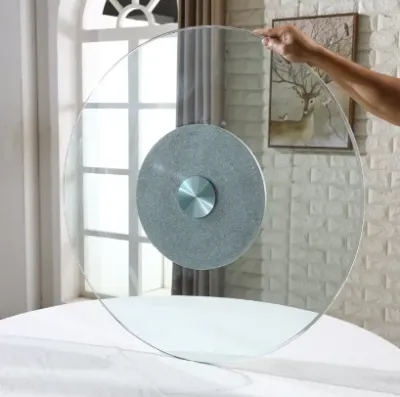
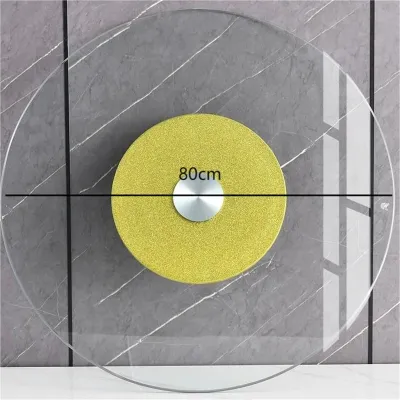
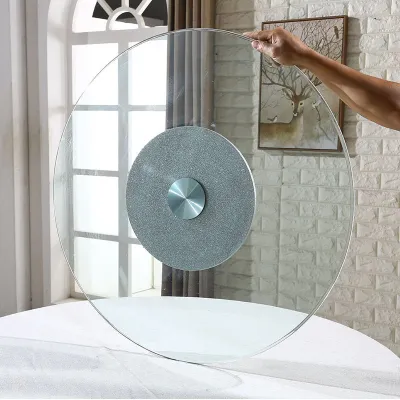
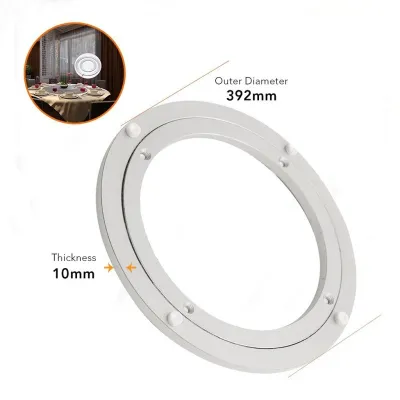
Prices are valid at publication and may change. Please refer to the product page for the latest price.
Next, you need to measure the depth of a fully set place setting to determine how much table surface your guests actually occupy. Lay out your largest dinner plates, along with the forks, spoons, knives, and drinking glasses you typically use during family gatherings. Measure from the edge of the table to the innermost edge of the glassware or plate; this distance usually ranges from 12 to 15 inches.
When measuring your place settings, remember to account for the specific types of dinnerware you use most often. For instance, if you regularly host festive gatherings where charger plates or large soup bowls are standard, your place setting depth will naturally be larger than if you only use standard dinner plates. Be sure to measure using your largest tableware items to guarantee that your clearance calculations remain accurate even during elaborate multi-course meals.
The clearance rule is the most critical factor in keeping your dining experience comfortable and safe. The rotating edge of the turntable must never overlap with this place setting zone. If the turntable sits too close to a guest’s plate, a simple spin could catch the base of a wine glass, bump into cutlery, or make diners feel cramped. Ensuring a generous clearance buffer allows everyone to enjoy their meal without constantly adjusting their plates or worrying about spills.
Sizing Strategies by Table Shape
The geometry of your dining table directly influences how a lazy susan turn table functions and how much center space you can safely utilize. Different shapes distribute the distance between the diners and the center of the table in unique ways, which affects both reachability and visual proportion.

Additionally, the visual balance of your dining room plays a role. A turntable that is technically functional but visually overwhelming can make the entire dining room feel cluttered. Choosing a size that complements the lines of your table helps maintain an inviting, balanced aesthetic.
Round Dining Tables
Round dining tables are highly suited for central turntables because every diner sits at an equal distance from the center point. To find the maximum turntable size for a round table seating 6 to 10 people, subtract the double place setting clearance from the table’s total diameter. For example, if your round table has a diameter of 60 inches and you require 15 inches of clearance on each side, the maximum recommended turntable diameter is 30 inches.
For round tables seating 8 to 10 people, which typically measure around 60 to 72 inches in diameter, a turntable size of 24 to 30 inches is often the sweet spot. This range provides a generous rotating surface for multiple dishes while leaving a comfortable 15-to-21-inch border all around. This border is more than enough for individual plates, drinkware, and even small personal side bowls.
When selecting a size, consider the trade-off between a single massive turntable and leaving static edge space. A larger turntable accommodates more shared dishes, but it reduces the stationary table space where guests can place personal items, salt and pepper shakers, or decorative elements. If you frequently serve dishes that do not need to rotate, leaving a slightly wider stationary border is often the more practical choice.
Rectangular and Oval Dining Tables
Rectangular and oval tables present a different spatial challenge because the distance from the ends of the table to the center is much greater than the distance from the sides. A single circular lazy susan turn table placed in the exact middle of a long rectangular table will be easily reachable for those sitting on the sides, but guests seated at the far ends will still have to stretch or stand up to reach it.
When dealing with rectangular tables, the width is almost always the limiting factor. Most standard rectangular dining tables have a width of 36 to 42 inches. If you subtract 12 to 15 inches of place setting depth from both sides, you are left with a center strip that is only 12 to 18 inches wide. This narrow space means a circular turntable must be selected with extreme care to avoid overlapping the place settings of guests sitting directly opposite each other.
To solve this issue, you can explore alternative configurations rather than simply buying a larger circular model. Using two smaller turntables spaced evenly along the centerline of a long table allows diners at both ends to access shared dishes easily. Alternatively, you can look for specialized elongated or oval-shaped rotating servers that match the linear footprint of your table while strictly verifying that the width clearance remains safe on the narrow sides.
Step-by-Step Calculation for the Ideal Diameter
To avoid guesswork when shopping for a lazy susan turn table, follow this straightforward calculation method tailored to your specific dining furniture.
Step 1: Record the table width or diameter. Use a reliable measuring tape to find the exact width of your rectangular table or the full diameter of your round table in inches. Write this number down as your starting point.
Step 2: Measure the place setting depth. Place your standard dinner plate and glassware on the table as you would during a meal. Measure the distance from the table edge to the back of the plate or glass, then multiply this number by two to account for the diners sitting opposite each other.
Step 3: Subtract the total place setting depth. Deduct the doubled place setting measurement from your total table width or diameter. The resulting number represents the absolute maximum diameter your turntable can be without encroaching on your guests’ personal dining space.
Step 4: Factor in a safety margin. Subtract an additional 2 to 4 inches from your maximum diameter to create a safety buffer. This extra space ensures that tall bottles, handles of serving spoons, or slightly misplaced glasses do not get caught on the rotating edge or knocked over when the turntable is spun.
Material, Weight, and Stability Considerations
A large lazy susan turn table carrying heavy serving bowls must be highly stable and durable to prevent accidents during busy meals. When evaluating different models, check the weight capacity of the internal bearing mechanism. Heavy ceramic platters, cast-iron serving pots, and glass bowls filled with food can quickly add up in weight, so look for turntables with robust, smooth-spinning steel ball bearings that can handle a heavy load without stuttering.
Stability is equally important to prevent the turntable from tipping when weight is distributed unevenly. Look for models featuring a wide base relative to the top platter, as a narrow base can cause the turntable to tilt when a heavy dish is placed near the outer edge. Non-slip silicone feet or rubber grips on the bottom of the base are essential to keep the entire unit firmly anchored to your table surface during rotation.
Additionally, consider how the material handles the local environment and daily wear. In humid tropical climates like the Philippines, wooden or bamboo turntables require careful inspection to ensure they have a high-quality, moisture-resistant sealant. Spills from hot soups, sauces, and condensation from cold pitchers are inevitable, so verify that the surface is easy to wipe clean and that the base protects your dining table from scratches and heat transfer.
The choice of material also impacts how the turntable interacts with your table’s finish. Glass and acrylic turntables offer a modern look and are highly resistant to moisture, but they can be noisy when plates are set down and may show fingerprints easily. Wooden and bamboo options provide a warm, classic aesthetic but require diligent care to prevent water rings. Whichever material you choose, check that the bottom of the base features protective padding, such as felt or silicone pads, to prevent the turntable from scratching your table’s wood or glass surface during use.
Common Sizing and Placement Mistakes to Avoid
One of the most common mistakes is buying a turntable that is too large for the table’s width. While it might seem convenient to have a massive rotating surface that holds every single dish, an oversized turntable will inevitably crowd place settings, leaving guests with no room for their arms, napkins, or drinks, and increasing the risk of spills.
Conversely, choosing a turntable that is too small can make the dining experience frustrating. If the lazy susan turn table is tiny, guests seated at a large 10-person table will still find themselves leaning forward and stretching uncomfortably to reach the items on it, defeating the primary convenience of a rotating server.
Finally, do not ignore the height and overall profile of the turntable. A model that sits too high off the table surface can block the line of sight between guests, hindering cross-table conversation. High-profile turntables also make it harder to lift heavy serving bowls safely and can interfere with low-hanging dining room light fixtures or decorative centerpieces.
Frequently Asked Questions (FAQ)
Can I use a lazy susan on a table with a central pedestal base?
Yes, you can use a lazy susan turn table on a pedestal table, but you must verify the stability of the table itself first. Because a pedestal base concentrates the table’s support in the center, placing a very heavy, fully loaded turntable on top can shift the center of gravity if dishes are not distributed evenly. Ensure your pedestal table is heavy and stable enough to resist tipping, and check that the turntable’s base sits flat over the center point of the pedestal.
How do I clean and maintain a large wooden or bamboo turntable?
To maintain a wooden or bamboo turntable, especially in humid climates, always check the manufacturer’s care instructions first. Wipe the surface with a damp, soft cloth and mild soap after use, and dry it immediately with a clean towel to prevent moisture from soaking into the wood grain. Avoid submerging the turntable in water or placing it in a dishwasher, as this can ruin the internal ball bearings and cause the wood to warp or crack.

Community discussion
Share your experience or ask a question. Comments are reviewed before publication.